Categories
Animals Farm Management Poultry

Start A Successful Egg Business that Makes You Money

Perhaps the only thing better than cracking, cooking and savoring your own farm-fresh eggs is sharing a dozen or two with family and friends—and the occasional cash-paying customer. More of these consumers exist today, and small-flock growers are reaping the rewards, thanks to growing awareness of the health benefits of pasture-raised eggs.

Bud Brown, an 81-year-old chicken farmer in Roseburg, Oregon, regularly fills his pockets with enough “egg money” to pay for feed, supplements and miscellaneous expenses. He sells his free-range eggs at his U-pick farm, at local farmers’ markets and through community-supported agriculture programs. His real customer base, however, formed from word-of-mouth advertising.

“Everybody wants my eggs,” says Brown, decked out in his utilitarian farm garb—a thread-bare T-shirt, perfectly worn denim overalls, a green-and-black frayed-cotton flannel and holey muck boots covered in years of chicken-rearing experience. “Twenty-something years ago, I started out with a dozen layers for my family. As soon as my wife started telling her friends about my eggs, we were in business.”

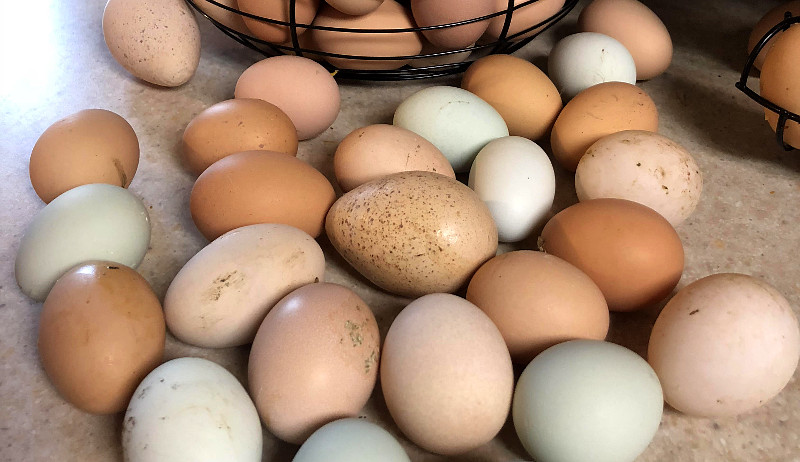
Brown now keeps between 200 and 250 Black Star chickens, a cross between Plymouth Rock and Rhode Island Red chicken breeds, to feed his customers’ supply, along with a few dozen blue-egg-laying Araucana chickens for clients who prefer colored eggs.

“The operation is just enough for my sons and me to handle,” he says.

Pairing the desire to provide nutritious homegrown eggs for loved ones and neighbors with the practical matter of finding a way to pay for chicken feed and expenses makes sense. Depending on where you live, a dozen pasture-raised brown eggs can sell for as little as $2.50 or as much as $4 to $5, occasionally more; a 50-pound bag of organic chicken feed costs more than $30. A flock of six chickens will gobble down the bag in about a month; that’s about 1½ pounds of food per chicken per week. In this instance, selling at the lowest price, a hobby farmer would need to sell 12 dozen eggs to pay for his or her feed, along with a few extra dozen to cover additional costs, such as egg cartons, bedding, water, power, supplements and supplies, which add relatively little to the overall monthly bill.

The good news is that the market for homegrown eggs exists. According to the USDA, an individual consumes an average of 259 eggs per year. More and more egg eaters prefer the all-natural or organic varieties, too.

While your hens continue to churn out two eggs every three days, how can you profit from their natural ability to transform crumble (feed pellets broken up into smaller pieces), greens, bugs and water into healthful sustenance for humans (and other four-legged critters)? Know your market, create a quality product and distribute it successfully to ensure your flock and your stock continue producing “egg money” to pay their own way—and then some.
surplus freezing freeze eggs
Ana Hotaling

Know Your Market, Know the Laws

Hands (or feathers!) down, the most important aspect to consider about the egg business is your market. Do you have buyers lined up before the chicks have feathered out? Do you live in a rural area where fresh eggs are a dime a dozen? Can you sell your wares at a local farmers’ market or through a CSA program? Maybe, like Brown’s wife, your spouse or partner can talk up sales and establish an egg-buying network amongst friends and neighbors. Or perhaps, as Bryan Thomas of Rogers, Ark., discovered, your efforts can take on a life of their own.

“When we moved [to Arkansas] from Arizona, we bought a half-dozen chicks and set up a small coop out by the garden with no intention of selling any eggs,” says Thomas, who invested in a 20-acre ranch after retiring from a career as a plumber. “Before long, my parents wanted a dozen every week, my sister wanted a dozen, their friends wanted some—and our girls couldn’t keep up with demand. So the following spring, we bought another two-dozen chicks, remodeled and expanded the coop, gave the birds an acre to themselves and have been in the egg business ever since.”

As with any successful business venture, you should create some sort of plan that identifies your target market and potential growth areas. It doesn’t need to be that of a billion-dollar corporation, but it should provide some sort of framework for growth, Thomas says.

“Does it mean we can retire on egg money? Not quite,” Thomas adds. “But after people were willing to pay for our eggs, we started to calculate our costs and income and to look at areas where we could sell more eggs to boost our profits. It was a great foundation for what we have now.”

In addition to having a rough business plan in place, you must also be aware of—if not well versed in—the laws regarding egg selling in your municipality, your county, your state and the country. Call your county extension agent or state poultry or agriculture specialist about local and federal laws regarding claims you wish to make about your eggs, conditions you must meet to make those claims and necessary sales permits you may need.

“In some areas, it’s against the law to reuse other companies’ egg cartons,” Brown says. “And most everywhere, you have to go through some big hoops and pay a lot of money to use the ‘organic’ label.”

As for pricing your eggs? You might think your farm-fresh delights are worth $10 a dozen, but nearly all your customers won’t pay quite that much. According to the USDA, as of June 11, 2018, the average price for a dozen extra-large certified organic eggs in cartons runs between $2.61 and $3.60. You probably can lean toward the higher end for your nutrient-dense eggs, depending on where you live and what the market dictates.

“In our area, we can charge $3 a dozen or $4 for an 18-pack,” Thomas says, who sells direct to customers rather than through a second party. “But that’s with free delivery.”

When deciding what to charge for your eggs, consider all of your expenses, including production, marketing and promotion, packaging and delivery costs for the entire year. Feed will likely be your greatest expense, but also budget in one-time or unexpected costs like coop remodels or fencing. Add all of those expenses together. Next, estimate how many eggs each hen will produce: A good average is 180 eggs per year. Multiply 180 by the number of hens you have to get your total number of eggs. Then divide that number by 12 to get your estimated total number of dozens for the year. Finally, take your total expenses and divide that by your number of estimated dozens to get the minimum price you should charge to break even.

If that number is too high, you may want to cut some costs.

“We didn’t make a profit on our eggs for some time,” Thomas recalls. “But after we had all the major expenses behind us, like the coop remodel and additional fencing, the money that came in started adding up quick.”

eggs all year round
Shutterstock

Growing an Egg-cellent Product

Even with a well-researched marketing plan, mastery of the laws and regulations and perfectly priced dozens, you can’t expect to see your egg business take flight without producing a top-quality product. It all starts with choosing expert layer chickens.

With more than 100 chicken breeds described by the American Poultry Association, not to mention those listed by the American Bantam Association and the hundreds of other chicken breeds available in North America, choosing egg-laying hens can be daunting. Sometimes, raising whatever breed is available is a smart way to start.

Suzie Gaston, a hobby farmer who lives just outside Memphis, Tenn., knew she wanted to raise some egg layers; so she went to her local farmers’ co-op and picked up a few chicks, which turned out to be docile and highly productive Plymouth Rocks. Gaston says her success with the chickens led to her new money-making hobby.

“My introduction into the chicken business was pretty painless,” says Gaston, who has since graduated to heirloom breeds, including Orpington chickens and Golden Laced Wyandotte chickens, along with Ancona chickens, Jersey Giant chickens and, of course, Plymouth Rock chickens. “But once you get into it—really get into the hobby—you can go into so many different directions. For layers, though, if you want quantity, go with a Leghorn; if you want pretty eggs, go with an Ameraucana; if you want some dual-purpose laying and meat birds, try the Rhode Island Reds or Barred Plymouth Rocks.”

The APA says that the best layers produce between 250 and 280 eggs per year, though individual chickens may exceed 300. As Gaston mentioned, Leghorns, like other Mediterranean chickens, are among the top producers of white eggs, producing 250 per year on average. A popular brown-egg strain, the APA suggests, is the Hubbard Golden Comet, which is a Red Sex-Link hybrid that lays between 180 and 240 eggs per year.

Gaston says that she does take into account the number of eggs each hen lays but that the end product is most important for her, when considering her income versus the cost ratio.

“In order to give my customers the best possible eggs, I feed the chickens organic feed and give them access to as much greens and grubs that they can eat,” she says. “The chickens are healthier, and the eggs taste better.”

To produce quality eggs, your hens will need a varied diet of commercial chicken feed, high-calcium oyster shells, grit, greens, bugs and the occasional dairy product, such as milk, which will help strengthen the eggs’ shells. These ingredients help to produce nutrient-dense eggs with strong shells, dark yolks and great taste.

Brown also feeds his chickens his garden leftovers, like the bushels of leftover zucchini he has every year.

“I cut feed costs by giving them my garden scraps and letting them free-feed on bugs and greens in the pasture,” he says. “They sure get sick of that zucchini by the end of the summer, though.”

To be productive, your hens will also need a cozy place to call home. Outfit their coop with the necessary nest box filled with egg-catching nesting material, a roost for snoozing, plenty of fresh water, a moderate temperature of between 45 and 80 degrees F, and the right amount of light to trigger egg production.

According to the APA, chickens require at least 14 hours of sunlight to lay—and, when the hours of daylight fall below that magic number in the winter months, your inventory may reduce to near-zero until the spring. A full-spectrum bulb can help keep production numbers strong year-round.

“Up here in Oregon, we don’t get much more than 10 hours of daylight during the winter,” Brown says. “So I hooked up a red heat lamp to keep the hens warm and expose them to more hours of light. It’s worked, so far.”

With the right diet, right environment and right light, you’ll be well on your way to raising happy, healthy chickens that produce tasty, healthy eggs. Then it’s only a matter of getting the goods to your customers.
eggs marketing selling
Shutterstock

Delivering the Eggs

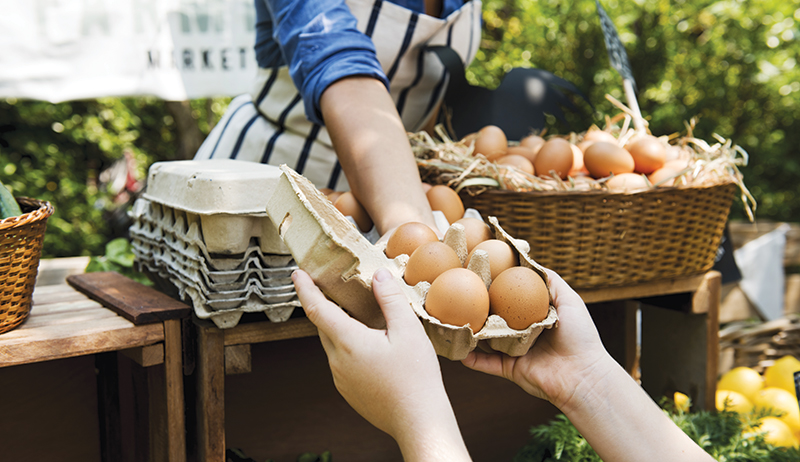
Your egg-business plan is in place, and your hens are busy doing what they do best; so the next thing to consider is packaging, promotion and distribution. Will you set up an honor stand with recycled cartons filled with brown eggs, offer eggs at your local farmer’s market or sell your wares through your local natural-food store? Do you plan to advertise or promote your eggs to the public? If you decide to offer delivery services, how far will your radius extend? You’ll need to weigh the benefits and costs of all these factors—and many more—when you go into the business of egg production.

“I’m not a salesman or a marketing guru,” Brown admits. “But you have to think about how you’re going to get those eggs to your customers—the regulars and the new ones.”

First and foremost, to get top dollar for your eggs, you’ll want to ensure the product is clean and safe. Proper chicken husbandry, which includes keeping the nest boxes fresh and clean, results in eggs that require little washing, Gaston says.

“The eggs come out clean,” she says, adding that washing the eggs could remove their natural bloom, which seals in moisture and seals out harmful bacteria. “So if you gather them regularly throughout the day, you won’t have to wash them. That cuts down on your production and packaging time; the eggs last longer, too.”

Next, consider your packaging. As Brown mentioned, some areas may have laws regarding the use of reused cartons, or you may wish to stamp your name and phone number on the package so customers know who to call when they run out of eggs. Farm-supply stores and online outlets sell unmarked cartons at reasonable prices.

For Brown, plain cartons with his contact information scribed on the lid promote repeat business. “And my customers give me the old cartons, which I can reuse again,” he says. Distributing your eggs will depend on your market. Some options include:

  • setting a “farm-fresh eggs” sign in front of your farm
  • putting an honor stand at the end of your driveway stocked with eggs every morning
  • building a set client list and delivering eggs to them regularly
  • working at a stand at your local farmers’ market
  • participating in CSA programs
  • selling through locally owned grocery stores or markets

Gaston advises budding egg entrepreneurs to remain flexible and bend with the waxing and waning market conditions. In lean times, you may need to consider doing a sales push and advertising in your local penny-saver newspaper or try putting up a sign in your yard. When business is booming, you may need to stop accepting new customers for the time or consider raising your prices.

“It’s a game,” Gaston says. “A fun game, but you have to be savvy, do your research and provide the best product you possibly can. Then customers will come running to you.”

This article originally appeared in the Summer 2010 issue of Chickens.

Categories
Equipment

Little Tools Make a Big Difference

Have you ever noticed how important little things can be? In fact the smaller things get, the more attention they often demand. I was reminded of this the other day when I received my latest mailing from Lee Valley Tools. It was an update on new products they’re introducing.

While all were interesting and some were tempting, one stood out. It was a set of 19 inserts for sockets. Each plastic insert contains a rare earth magnet. Push the insert in place, and no more fighting to get a nut started or having a nut fall away as you remove it, never to be found again.

The inserts are small things in and of themselves and not very expensive. The things they will hold are even smaller and also not very expensive. In fact, I could lose an awful lot of nuts and bolts for the $9.95 the inserts will cost. However, it’s not the actual cost of bits of hardware that comes into play here. It is the frustration that comes with losing that last nut or bolt and knowing you’ll have to put the project on hold until you can go to the hardware store to secure a replacement.

Unfortunately, the shipping fee would be almost as much as the cost of the inserts. I need to check with local hardware stores to see if they can order anything similar. If so, it will be worth the wait. If not, well, I may just have to find a few more tools to add to my order to make the shipping costs worth it.

<< More Shop Talk >>

Categories
News

USDA Surveys Farm Financial Health

Farm
The USDA’s National Agricultural Statistics Service will conduct the 2011 Agricultural Resource Management Survey through April.

At the start of this year, the USDA’s National Agricultural Statistics Service began contacting farmers and ranchers across the nation to conduct the Agricultural Resource Management Survey. This survey will provide the USDA with accurate, real-world data that will help shape the policies, programs and issues that affect them.

“ARMS asks a small but representative sample of farmers about their operation in order to understand the current financial state of U.S. agriculture,” says Herb Vanderberry, director of the NASS North Carolina Field Office. “Participation in ARMS is so important because government and agricultural leaders use the information needed to make sound decisions that impact the future of farmers, their families, their businesses and their communities.”

The survey will be conducted between February and April 2011. In an effort to obtain the most accurate data, NASS will reach out to nearly 35,000 producers nationwide. Producers will be asked to provide data on their operating expenditures, production costs and household characteristics.

“Farm organizations, the U.S. Department of Agriculture, other government agencies, members of Congress, and state and local officials use the collective information from ARMS to answer questions and make important decisions concerning the economic viability of American agriculture, the rural economy and other emerging issues,” Vanderberry explains.

As with all NASS surveys, information provided by respondents is confidential by law. NASS safeguards the confidentiality of all responses, ensuring no individual respondent or operation can be identified.

The economic data gathered in ARMS will be published in the annual “Farm Production Expenditures” report on August 2, 2011. View all NASS reports on the USDA website

Categories
Urban Farming

South L.A. Fights Food Deserts

Fast food

Courtesy Steve Mason/Photodisc/Thinkstock

In order to fight food deserts and make room for healthy food options, South Los Angeles now limits the building of new fast-food restaurants.

There’s no shortage of fast-food restaurants in South City of Angels. On the contrary: The City Council estimates that there are close to 1,000 fast-food restaurants in a 30-square-mile area of South L.A. Thanks to the City Council’s efforts, however, it’s about to get harder to find a double cheeseburger and a side of fries in South Los Angeles. A new ordinance has been passed to prevent any more fast-food chains from firing up their fryers in the district.

“South L.A. is very densely populated, and there isn’t a lot of land left available to be developed,” explains Jan Perry, councilwoman for the ninth council district, who pushed for the restrictions. “We wanted to address the food-desert issues by ensuring the land that’s available is set aside for its highest and best use, and that includes supermarkets, casual dining restaurants and other healthy food options.”

The ordinance is not a full-fledged ban on fast-food restaurants. Existing burger joints, taco stands and donut shops will be unaffected. New fast food restaurants will be impacted instead.

Under the ordinance, which received the unanimous approval of the Planning and Land Management Committee in December 2010, new fast-food restaurants cannot be constructed within a 1/2-mile radius of existing fast-food restaurants and need to meet stringent design guidelines for their building applications to be processed. The guidelines apply to stand-alone restaurants, not those located in mixed-use projects.

According to Perry, the City Council wanted to pass the ordinance to address the imbalance of food options in the neighborhood and pave the way for new grocery stores, farmers’ markets and restaurants serving healthier fare to set up shop in South Los Angeles.

“We wanted to send a strong message that the community in South L.A. is not just actively interested in a broad array of food choices but will support them in word and in deed,” Perry says.

It appears to be working.

Although the ordinance was officially adopted in December, the City Council enacted a temporary moratorium in 2008. Since then, no new fast-food restaurants have opened in the neighborhood. Instead, South L.A. got its first new grocery stores in more than a decade, including Fresh and Easy, a market that sells local, organic produce.

Changes are happening at the area farmers’ markets, too. Through the efforts of Sustainable Economic Enterprises of Los Angeles, a community development organization, the Central Avenue Farmers’ Market became the first market in the region to accept Women, Infants and Children (WIC) checks, increasing access to fresh, local foods for neighborhood residents.

“We have already attracted new sit-down restaurants, full-service grocery stores and healthy food alternatives, and we need to continue to do so in an aggressive manner. Ultimately, this action is about providing choices—something that is currently lacking in our community,” Perry said in a press release.

Perry is also working in partnership with Healthy Eating Active Communities, an organization working to prevent childhood obesity by transforming children’s living environments, to provide makeovers of mini-marts and convenience stores in South Los Angeles. As part of the program, mini-markets are encouraged to change their store layouts to move junk foods, such as chips and chocolate, to the back of the store, opening up space at the front of the store to incorporate fresh food items like fruits, veggies and milk.

“As elected officials, the more we can do to sustain economic development that, as a corollary, helps people make healthier choices, the better,” Perry says.

Categories
Homesteading

How To Turn Your Grill Into A Smoker

Grilling out is one of America’s favorite ways of cooking in the summer, but you can take that same gas or charcoal grill and turn it into a smoker.

If you only think of smoking foods as an old-fashioned alternative to preserving food, used before proper refrigeration was established, think again. Smoking foods is a great way to add unique flavor to meats, fish, vegetables and even cheeses. The recipe ideas are endless, and best of all, it’s easier than you think. By following these simple steps, you’ll be enjoying authentic smoked flavor in all your favorite foods right from your own grill.

Getting Started

Whether you use a gas grill or a charcoal grill, you’ll need to understand the concept of indirect heat is and why you use it to smoke foods. Simply put, indirect heat is like a convection oven, where the heat circulates as it cooks the food. Direct heat is the opposite: The flame (i.e. the heat source) is directly under the food being cooked. Using indirect heat for smoking foods such as briskets, whole hams and ribs, for example, will help these tougher cuts of meat become more tender while retaining the flavor, whereas a direct flame might burn them.

Before setting up your smoker, decide what type of wood chips to use. There are dozens of different flavors to choose from, such as hickory, cherry, apple, alder and mesquite, and each imparts a distinct flavor to your foods as it smokes. Wood chips can be found in the grilling area of your local home-improvement store. For a wider variety, check online suppliers that specialize in making smoking chips. Depending on your taste or what foods you’re smoking, you might prefer one flavor over another. Generally, several handfuls of chips are recommended for most recipes—whatever is necessary to continually produce smoke.

Smoking with a Charcoal Grill

Materials

  • Charcoal grill
  • Wood chips, pre-soaked
  • About 20 charcoal briquettes, depending on your grill size
  • At least two small, disposable aluminum drip pans, approximately 8½ inches by 6 inches, filled halfway with water
  • Grill lid Thermometer
  • Food to be smoked

Preparation

Setting up a charcoal grill as a smoker is simple. Once you gather your supplies, remove the cooking grate and place the aluminum drip pans on one side of the grill’s charcoal grate. These water pans will be under the food as it smokes, keeping the food moist as it cooks slowly and preventing flare-ups.

On the other side of the charcoal grate, arrange your charcoal briquettes and light them. Once they are hot, add several handfuls of the pre-soaked wood chips directly on top of the briquettes to create the smoke. For slower smoking, place the wood chips along the edges of the hot charcoal.

Next, place your cooking grate back on the grill and add your food. Be sure to keep the food over the water pans, which causes the indirect heat, and not over the coals.

Cover the grill, close all bottom vents, and do not open except to rotate food or to add more soaked wood chips and charcoal as needed to regulate the temperature. Monitor the temperature using a grill lid thermometer.  If you have trouble maintaining the proper heat indicated in your recipe, you might need to open a bottom vent slightly.

Smoking with a Gas Grill

If you have a gas grill, it’s just as easy to smoke foods. Plus, because many gas grills have a built-in thermometer, it will be easier to regulate the temperature than with a charcoal grill.

Materials

  • Gas grill with at least three burners (Smoking food is not recommended on less than three burners, as you will lack the proper spacing between wood chips, burners, water pan and food.)
  • Wood chips, pre-soaked
  • 1 disposable aluminum pan, approximately 9 inches by 13 inches, filled half way with water. Pan size will vary depending on the size of your gas grill.
  • At least two or three small disposable aluminum drip pans, approximately 8½ inches by 6 inches
  • Food to be smoked

Preparation

Begin by removing the cooking grate and placing the 9- by 13-inch pan directly on the flavor bars or lava rocks (these should come with your grill) toward the front half of the grill. Next, fill two or three of the smaller drip pans with wood chips, and place them in a row along the far-back flavor bar. Do not place either pan directly on the burners themselves, only on the flavor bars or lava rocks.

Replace the cooking grate, and light only the far-back burner where the wood chips are located in order to produce smoke. Allow the temperature to rise to the ideal heat indicated in your recipe. Then place the food on the cooking grate above the 9- by 13-inch pan of water, which creates the indirect heat source.

Helpful Hints for Smoking

  • Soak the wood chips in water for at least two hours, or overnight, prior to smoking to prevent burning. Depending on the length of time your food will be smoking, you may need to add more soaked chips during cooking.
  • Follow the recipe directions for the correct temperatures. Most often it requires you to keep the indirect heat at less than 300 degrees F because smoking the food slowly, especially meats, makes it more tender.  While this tends to be easier to do with a gas grill that has a built-in temperature gauge, it can be fairly simple with a charcoal grill.  There are several types of external thermometers you can purchase at home improvement stores.
  • Keep the grill cover on as much as possible, and make sure it fits tightly. Taking the cover off during smoking will cause a fluctuation in temperature and loss of smoke.
  • Never attempt to use your outdoor grill as an indoor smoker, and always make sure you have proper ventilation.
  • Different foods may require different preparation before smoking. For example, fattier meat cuts generally smoke better because they are more tender. For other foods, like pork, a recipe may use a brine soak prior to smoking along with a flavorful rub.
  • Dry chips can be used to create a sweeter smoke, but do so with a watchful eye to avoid flare-ups. Avoid using dry chips on gas grills because they can scorch easily and ruin the flavor.
  • Check smoked meats with a thermometer to ensure doneness.
Categories
Equipment

Broken Hydraulic-powered Loader

ATV
Photo by Jim Ruen
We’re knee-deep in snow, and of course, my ATV’s hydraulic-powered loader, which I use to shovel snow, is broken.

Hydraulic power is one of the greatest of on-farm labor savers. The problem with a labor saver is when they don’t work, you hate to go back to doing without. I have a hydraulic-powered loader on my Honda Foreman ATV. It’s great for all kinds of jobs, but it really shines at moving snow. So of course, with a snow fall coming and a stiff north wind promising drifts, the loader stopped working.

Unlike a tractor’s integrated hydraulic system, my loader runs off a 12-volt pump. What I didn’t realize when I bought the loader four years ago was that the pump accounted for roughly 25 percent of the total cost. That became apparent when I started pricing replacements.

Of course, there is a chance that my local mechanic may offer a lower cost solution. It wouldn’t be the first time he saved me money. If he does suggest replacing the unit, I’ll be a slightly more informed buyer, thanks to a recent conversation I had at the Sioux Falls Farm Show.

While visiting with a hydraulic-equipment supplier, I mentioned looking for a larger pump for my loader. He advised me to make sure it had a high temperature override. It seems that 12-volt pumps have a tendency to burn out if heavily used. The override kicks in to protect the pump from overheating. It may be that this is the reason my pump failed. We’ll see shortly.

Meanwhile, I’m reminded of the importance of incidental conversations at trade shows and elsewhere. You never know when you’ll learn something that will save you money or make you money down the road. As Socrates is credited with saying, “The more I learn, the more I learn how little I know.” Like him, I’ll just keep asking.

<< More Shop Talk >>

Categories
Animals

Holey Moley!

Mole tunnels
Photo by Sue Weaver
Can you see the mole tunnels outside my pen?

The soil on our farm is so rocky that it’s hard to garden or even dig a hole, but apparently not for moles—a mole is digging tunnels all over our yard.

Our mole is an eastern mole—Scalopus aquaticus in Latin. Eastern moles habitat ranges from Ontario to the tip of Florida, westward to Texas and southern South Dakota. They’re the most common kind of North American mole.

A lot of people don’t like moles because they push up earth in yards and pastures. Mom says her Irish grandpa used to go bananas trying to trap the ones that made winding tunnels in his Indiana garden. But moles are beneficial, too. Their tunneling aerates soil, and they eat garden pests like cutworms and Japanese beetles.

Uzzi and I have never seen our mole because moles stay down in the earth nearly all of the time. We looked up eastern moles on Google to see what he looks like. Here are some things we learned.

Moles are nearly cylinder-shaped but larger in front than behind. They have short, plushy gray fur and long heads with pink snouts that they use to find their way underground. That’s because moles are blind. They have skin over their eyes that lets in some light, but not enough that they can really see. They don’t have external ears, but they have ear openings under their fur, and their hearing is fairly acute. Their tails are short and thick, and they use them to feel their way when moving backwards through their tunnels. Their front paws are huge—really wide, with a great big claw on each of their toes.

Males are about 6 inches long, including their tails. They’re bigger than females, and males in northern areas are bigger than males from down south. Males also have a larger home range of more than 2½ acres, whereas a female’s range is only about 2/3 acre.

Both sexes dig two kinds of tunnels: the pushed-up dirt ones we see in the yard and deeper ones way down in the earth. They hunt in the shallow tunnels and live in the deeper ones. Eastern moles are mostly solitary, but sometimes their ranges overlap and they may share tunnels when they do.

Moles have fast metabolisms, so they have to eat a lot of food. An average mole weighs 2½ ounces, but it eats 25 percent to 50 percent of its weight in food every day! Moles mostly eat earthworms but they also eat grubs, centipedes and various kinds of larval insects they find in their tunnels underground. Mole saliva contains a toxin that paralyzes earthworms, so moles sometimes store live worms in underground larders. Before eating them, moles pull earthworms between their squeezed paws to force dirt out of the worms’ guts. Yuck!

Humans tend to think moles are cute, so moles feature in lots of books and cartoons. One of Mom’s favorite books, Wind in the Willows, features Mole, who leaves his burrow and meets new friends. A mole named Krtek stars in a series of Czech cartoons. “Hello Kitty” has Moley; Mole is a character in the book and cartoons, The Animals of Farthing Wood; and moles like Monty Mole, Muddy Mole, Mr. Resetti, and Milton appear in video games 

Our mole isn’t a star; he’s just a mole. But we admire him ’cause he’s a tough one to push up tunnels in rocky Ozark soil!

« More Mondays with Martok »

Categories
Urban Farming

Sounds of the Urban Farm

Urban farming community
Photo by Audrey Pavia

My urban farming community boasts a mixture of sounds, from barnyard noises to the hum of city traffic.

My friend Michelle boards her Quarter Horse, Teddy, at a stable about a mile from my house. Michelle lives kind of far away, in a part of L.A. that doesn’t have a lot of places to board horses. So she keeps Teddy near me, where we have plenty of trails to ride, and comes out to see him two or three times a week.

In between her visits, I go to the stable to take Teddy out of his stall. I put him in a big paddock and let him stretch his legs and run around if he wants to.

One night this week, I got to Teddy’s barn at dusk and put him in the paddock. The barn was a ghost town—not a human to be seen. I thought it would be a good time to try to meditate. I sat on a chair next to the paddock, closed my eyes and began to concentrate on my breathing.

As my mind became still, I started to notice an incredible symphony of sounds all around me. I first heard the voices of some sheep bleating a few houses away. Two ducks began to softly quack at the farm next door. I could hear horses munching their hay in the stalls nearby, and a dog barked a couple of blocks away. A mule brayed far in the distance, and a rooster crowed.

Behind all these sounds typical of a rural community was the steady din of car tires on asphalt. The main street in town was only a couple of blocks away, and it was rush hour. Car after car was whooshing by, just to remind me that I wasn’t really out in the country, but on an urban farm. It seemed strange to hear all these barnyard sounds and traffic at the same time, but that is the amazing reality of an urban farming community.

My peaceful meditation was broken by puffs of air on my face. Teddy had decided he’d been out of his stall long enough and wanted to get back to his food. He was standing over me at the fence, blowing on me to get my attention.

I reluctantly opened my eyes and let the sights around me dilute the sounds I had taken in. As I led Teddy back to the barn, I felt a wave of gratitude that I’m able to live in such an amazing place. I have all the benefits of city living—good restaurants, great shopping and lots of employers—along with the companionship of a bevy of barnyard creatures. It’s the absolute best of both worlds.

Read more of City Stock »

Categories
News

Video Demos Cattle Pain Control

Calf
Jupiterimages/BananaStock/Thinkstock
In an online video, the AVMA demonstrates its policy for reducing cattle pain during a dehorning procedure.

The American Veterinary Medical Association released a video promoting its policy on how to reduce pain for cattle during a common surgical procedure—dehorning.

Many breeds of cattle have horns, which are often removed early in life to protect farmers and other animals from injury. The AVMA policy and the informational video offer guidance to help farmers make this procedure as comfortable as possible for cattle.

“America has more than 96 million head of cattle, so—although not widely known—[dehorning] is a common procedure,” explains Dr. Cia Johnson of the AVMA Animal Welfare Division, who appears in the video. “The AVMA Animal Welfare Committee uses the latest scientific research available and practical experience to recommend policy for the association. Research has shown that local anesthesia can be used to reduce the pain experienced by animals during dehorning.”

AVMA recommends that to reduce discomfort for the animal, dehorning be done at the earliest age possible and that consideration be given to the use of local anesthetics, such as lidocaine, and nonsteroidal anti-inflammatory agents for pain control.

The video demonstrates the use of local anesthetic and disbudding (a dehorning technique applied to young calves), and helps educate farmers and the general public about how pain management can improve an animal’s welfare.

For more information, visit the AVMA website.