Categories
Urban Farming

Local Romance

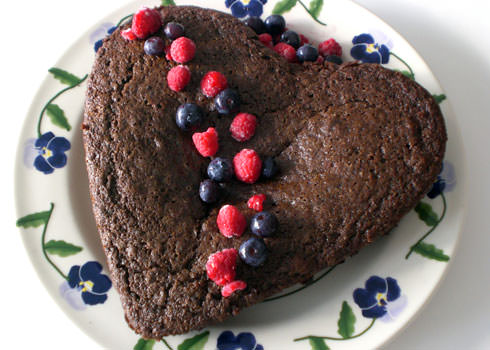
Chocolate heart cake

Photo by Judith Hausman

For Valentine’s Day, I like to incorporate local ingredients, such as local butter and berries, into my sweets. I also try to use ethically produced chocolate.

Keeping Valentine’s Day sweets local is a fun challenge to meet around here. We face blustery cold, sad imported fruit in the supermarket and, of course, the food miles inherent in luscious chocolate. I try to balance this by also using local butter and cream, berries I picked and froze in the—sigh—summer heat, and the jams I made from local fruit, as well as conscientiously farmed and processed chocolate.

Gourmet Glossary

French parts of romantic but local desserts

crème fraiche: a thick, cultured or slightly soured cream crème

chantilly: lightly sweetened whipped cream with a little vanilla added

coulis: a light, strained sauce with no thickener

ganache: an icing or filling of melted chocolate and cream

coeur à la crème: cream cheese, powdered sugar and heavy cream, whipped and then drained

As a treat for my Valentines, I make the simplest of chocolate cakes in a heart-shaped pan and trot a line of raspberries and blueberries across it like a berry parade. A keep-it-simple garnish would be thick Greek yogurt, sweetened with a bit of (local) honey, but a sexier final garnish would be a dollop of crème fraiche or crème chantilly. Invest in one of those heart-shaped molds with drainage holes to make a rich and delicate coeur à la crème. It’s really delicious with fruit. Maybe you can find local cream somewhere. I use Ronnybrook Dairy’s cream, which comes from a little farther up the Hudson Valley in Ancramdale, N.Y.

Want the chocolate part to be fancier, too? Try a chocolate gananche tart, the popular molten chocolate lava cake or your best from-scratch brownies, all great with frozen berries, too. Use a very good chocolate; maybe a dark, 75-percent cacao, single estate, Fair Trade chocolate. Mast Brothers in Brooklyn, N.Y., makes an amazing selection of chocolate bars that reveal all the subtle differences among their sources. The beans for their Grand Cru dark chocolate are farmed and harvested just for Mast Brothers. Or use Taza bean-to-bar chocolate, handmade in Somerville, Mass., from stone-ground, organic, and cooperatively and sustainably farmed cacao. Taza makes discs of Mexican-style spiced chocolate, too, that make amazing hot chocolate.

Beyond ethical chocolate and last summer’s fruit, think about what you can do with local butter. The smell of local butter in baked goods is a fresh reminder of just how wonderful it is. Ronnybrook Dairy’s butter has 84 to 86 percent butterfat content, an average of 5 percent more than the USDA standard. For Valentine’s Day, I may make a simple thumbprint butter cookie, which I’ll fill with my “I-picked” raspberry or strawberry jam. Next level? Make heart-shaped sugar cookies or shortbreads with it. If you have the right heart-shaped cookie cutters, you can make a sandwich cookie. The prettiest version has a window cut into the top heart to show off some bright, garnet-red jam.

The same butter and jam will make an even more impressive jam tart. With patience, you can weave a lattice across the sparkly jam, but open-faced is pretty too, especially in a heart-shaped pan. With ground walnuts or hazelnuts in the pastry, the cookies or the tart will resemble an Austrian-style Linzer tart.

Recipe: Easiest Chocolate Cake

Ingredients

  • 1½ cup white flour
  • 1/3 high-quality unsweetened cocoa
  • 1 tsp. baking soda
  • 1/2 tsp. salt
  • 1 cup sugar
  • 1/2 cup canola oil
  • 1 cup cold water or coffee (vanilla- or hazelnut-flavored is nice)
  • 2 tsp. vanilla
  • 2 T. vinegar

Preparation

Mix the dry ingredients right in an ungreased 8- to 9-inch or heart-shaped baking pan. Beat together the wet ingredients, expect vinegar. Pour the wet ingredients into the pan and mix well with the dry ingredients using a fork. When the batter is smooth, add the vinegar, stirring gently until it’s mixed in. (The baking soda will bubble a little.)

Bake at 375 degrees F for 30 minutes or until a tester comes out clean. Cool 15 minutes on rack before removing from pan.

Frost, glaze or sprinkle with confectioner’s sugar when cool. Serve with berries and crème chantilly.

Categories
Equipment

Farm Show Time

Farm show
Photo by Jim Ruen
Farm shows are a great way for hobby farmers to collect new farm tools and ideas.

We are in the midst of winter farm show season, nationally as well as here in the Midwest. A week and a half ago, I was in Sioux Falls, S.D., for their show. Last week, there was a big show in Des Moines, Iowa. And this week, the two largest shows of the season take place in Louisville, Ky., and Tulare, Calif. Meanwhile, I’ll be attending a show in Toronto.

I’ve been fortunate enough to attend both the National Farm Machinery Show in Louisville and the World Ag Expo in Tulare several times. Both are great farm shows with thousands of exhibitors and tens of thousands of visitors each of three days. If you can’t make either this year, plan ahead for next year. They are well worth the trip.

I’m looking forward to the Toronto show with its 2,000 exhibitors. I know I’ll come home with some nifty tools and lots of ideas. What I love about farm shows is seeing the new equipment and talking to the exhibitors. Often times, the stuff I really like is in the back or off to the side. While the big equipment is front and center, there is plenty for farmers of all sizes. Truth be known, if these companies only wanted to talk to a few thousand mega farmers, a farm show would be a pretty inefficient way to do so.

I guess that’s one reason I keep going back. I’ll never be in the market for that $400,000 tractor, but I can always buy that nifty scrub brush that fits my electric drill, like I did in Sioux Falls. Oh, and wait until you see the guy with the super tape that will bind anything!

See you there.

<< More Shop Talk >>

Categories
Crops & Gardening News

Wild Pollinators Share Pathogens

Wild Pollinators Share PathogensDiseases that affect your Honey bees could also affect 11 other species of wild pollinators, a study finds.Diseases that affect your Honey bees could also affect 11 other species of wild pollinators, a study finds.By Amy GrisakFebruary 8, 2011In a December 2010 Penn State University study involving apiaries in Illinois, New York and Pennsylvania, researchers confirmed pathogens can be transmitted from Honey bees to wild pollinators when both use the same pollen source. newswild pollinators, Honey bees, bumble bees, pathogens, viruses, diseases, pollen, pollination, gardeners

Bumble bee
About half of the U.S. bumble bee species are struggling to survive, but researches cannot pinpoint the exact reason why.

As if the concern of colony collapse disorder, a mysterious condition that devastates Honey bee colonies seemingly overnight, isn’t worrisome enough to those of us who love our bees in the garden, there is evidence wild pollinators are susceptible to many of the same diseases as Honey bees when they share flowers.

In a December 2010 Penn State University study involving apiaries in Illinois, New York and Pennsylvania, researchers confirmed pathogens can be transmitted from Honey bees to wild pollinators when both use the same pollen source. The 11 wild pollinators studied, including the sweat bee and a bumble bee species, contracted all five of the viruses used in the study.

Researchers took samples of the studied species in proximity to hives that were infected with the viruses as well as ones that were not infected. The results demonstrated that the viruses can move from one species to another via pollen. What the study does not conclude is the overall impact and whether it’s prevalent in an uncontrolled situation.

“Unlike Honey bees, wild native bees are not well monitored,” says Eric Mader, assistant pollinator program director at the Xerces Society, an organization dedicated to the conservation of invertebrates.

Bee losses from pesticides or other reasons largely go unnoticed.

Buzz on Bumble Bees
Bumble bees are a particular concern for home gardeners because they’re well adapted to regional conditions. A separate study published in November 2010 from the University of Illinois notes a sharp decline in several North American bumble bee species.

Sydney Cameron, associate professor of entomology at the University of Illinois, headed the study that looked at eight species of North American bumble bees. Of the eight, four are doing very well while the other populations are struggling; however, the reasons for their decreased populations are not black and white.

During the study, researchers noticed the prevalence of the parasite Nosema bombi was higher in declining populations. But the question is whether the Nosema caused the decline or whether the loss of genetic diversity of a particular group made them more susceptible to it.

“It’s too early to know if it’s a general pattern that will affect other species,” Cameron says.

Overall, the study shed light on alarming findings, but Cameron stresses it’s not a reason to panic. From the potential transmission of pathogens between Honey bees and native species to the loss of habitat and use of pesticides, there’s no easy answer.

Bumble bees are critical because they can forage at much cooler temperatures than many other bees. Mader points out that they’re active in early spring when the blueberries and fruit trees are in bloom.

“They might be the only efficient pollinators getting the job done,” he says.

Bumble bees perform a uniquely important function called “buzz pollination.” A bumble bee grabs the flower and vibrates its entire body at the same frequency as the note of middle C on a tuning fork. This greatly improves production for tomatoes, eggplants and peppers.

“It’s essential for releasing that pollen,” Mader says. “That’s a characteristic Honey bees don’t have.”

Take Action
Although the findings from the Penn State study don’t present immediate real-world applications, it’s important to be kind to your native pollinators.

“There are 4,500 [species of] wild bees [in the U.S.],” Cameron notes. “Honey bees are just one, and they’re not even native.”

While home gardeners can’t shield pollinators from infection or commercial chemical applications, they can do their part by creating a pollinator-friendly habitat.

Avoid pesticides by looking for alternatives to insect problems. Mader recommends utilizing crop rotation, resistant crops and floating row covers to act as a barrier between your plants and the bugs that love them.

He also says, “Think about how you can create undisturbed natural areas.” Most bees nest in the ground (even in rodent burrows), while a handful prefer hollow stems of plants. Mader says a certain level of “benign neglect” is beneficial to the pollinators.

Cameron suggests planting a mix of native flowers to provide a nectar source for emerging queens in the early spring and a steady food source for workers throughout the season.

“One of the hardest times [for wild pollinators] is around August because the flowers are fading,” Cameron says. She recommends planting varieties that bloom until frost and maybe beyond. She also strongly encourages home gardeners to talk to their local nurseries about carrying regionally specific wildflowers.

Although reports of disease transmission from Honey bees to wild pollinators and declining populations of some species are alarming, it’s important to remember to focus on what you can do in your own backyard to lessen the pollinators’ plight.


Categories
Crops & Gardening News

Wild Pollinators Share Pathogens

Bumble bee
About half of the U.S. bumble bee species are struggling to survive, but researches cannot pinpoint the exact reason why.

As if the concern of colony collapse disorder, a mysterious condition that devastates Honey bee colonies seemingly overnight, isn’t worrisome enough to those of us who love our bees in the garden, there is evidence wild pollinators are susceptible to many of the same diseases as Honey bees when they share flowers.

In a December 2010 Penn State University study involving apiaries in Illinois, New York and Pennsylvania, researchers confirmed pathogens can be transmitted from Honey bees to wild pollinators when both use the same pollen source. The 11 wild pollinators studied, including the sweat bee and a bumble bee species, contracted all five of the viruses used in the study.

Researchers took samples of the studied species in proximity to hives that were infected with the viruses as well as ones that were not infected. The results demonstrated that the viruses can move from one species to another via pollen. What the study does not conclude is the overall impact and whether it’s prevalent in an uncontrolled situation.

“Unlike Honey bees, wild native bees are not well monitored,” says Eric Mader, assistant pollinator program director at the Xerces Society, an organization dedicated to the conservation of invertebrates. 

Bee losses from pesticides or other reasons largely go unnoticed.

Buzz on Bumble Bees
Bumble bees are a particular concern for home gardeners because they’re well adapted to regional conditions. A separate study published in November 2010 from the University of Illinois notes a sharp decline in several North American bumble bee species.

Sydney Cameron, associate professor of entomology at the University of Illinois, headed the study that looked at eight species of North American bumble bees. Of the eight, four are doing very well while the other populations are struggling; however, the reasons for their decreased populations are not black and white.

During the study, researchers noticed the prevalence of the parasite Nosema bombi was higher in declining populations. But the question is whether the Nosema caused the decline or whether the loss of genetic diversity of a particular group made them more susceptible to it.

“It’s too early to know if it’s a general pattern that will affect other species,” Cameron says.

Overall, the study shed light on alarming findings, but Cameron stresses it’s not a reason to panic. From the potential transmission of pathogens between Honey bees and native species to the loss of habitat and use of pesticides, there’s no easy answer.

Bumble bees are critical because they can forage at much cooler temperatures than many other bees. Mader points out that they’re active in early spring when the blueberries and fruit trees are in bloom.

“They might be the only efficient pollinators getting the job done,” he says.

Bumble bees perform a uniquely important function called “buzz pollination.” A bumble bee grabs the flower and vibrates its entire body at the same frequency as the note of middle C on a tuning fork. This greatly improves production for tomatoes, eggplants and peppers.

“It’s essential for releasing that pollen,” Mader says. “That’s a characteristic Honey bees don’t have.”

Take Action
Although the findings from the Penn State study don’t present immediate real-world applications, it’s important to be kind to your native pollinators.

“There are 4,500 [species of] wild bees [in the U.S.],” Cameron notes. “Honey bees are just one, and they’re not even native.”

While home gardeners can’t shield pollinators from infection or commercial chemical applications, they can do their part by creating a pollinator-friendly habitat.

Avoid pesticides by looking for alternatives to insect problems. Mader recommends utilizing crop rotation, resistant crops and floating row covers to act as a barrier between your plants and the bugs that love them.

He also says, “Think about how you can create undisturbed natural areas.” Most bees nest in the ground (even in rodent burrows), while a handful prefer hollow stems of plants. Mader says a certain level of “benign neglect” is beneficial to the pollinators.

Cameron suggests planting a mix of native flowers to provide a nectar source for emerging queens in the early spring and a steady food source for workers throughout the season. 

“One of the hardest times [for wild pollinators] is around August because the flowers are fading,” Cameron says. She recommends planting varieties that bloom until frost and maybe beyond. She also strongly encourages home gardeners to talk to their local nurseries about carrying regionally specific wildflowers.

Although reports of disease transmission from Honey bees to wild pollinators and declining populations of some species are alarming, it’s important to remember to focus on what you can do in your own backyard to lessen the pollinators’ plight.

Categories
Animals

Collecting Stuff

Bock bier label
Mom started collecting bock bier labels, like this one, because they feature goats.

Remember when Salem got sick and Mom and Dad gave him bock beer to soothe his bellyache? Mom and Dad don’t drink beer, so Uzzi and I decided to Google it for them.

We discovered bock beer is a strong, dark lager that’s been brewed in the German town of Einbeck since the 14th century. Bavarians pronounced “Einbeck” as “ein bock” (a buck goat), so the beer became known as bock beer. And there are goats on most bock beer labels! We told Mom, and now she has a new facet to her farm collectables hobby: collecting bock beer labels featuring goats. 

Uzzi and I don’t understand why humans collect things, but they do. (How much better to eat a tasty label than stick it in a plastic protector in a book!) Because Mom and Dad live in a small area, Mom collects small things. Her favorite collections are antique photos, vintage picture postcards, and old paper advertising items featuring goats, sheep and cattle, but she collects small sheep figurines and plush sheep, too.

Farm photo
Mom also collects antique farm photos because they are small and fit well in her small space.

Maybe you’d like to collect farm-related goodies? It’s easy once you decide what to collect. It can be a broad subject like everything chickens or cows (there are lots of things for you on the market) or something as precise as donkeys carved out of wood. Farm toys and old ceramic crocks are popular collectable items nowadays. People collect everything from Elsie the Borden cow collectables to printed gunny sacks to antique tractor seats—there is something out there just for you!

Once you decide on a theme, you’ll know where to dig for treasures. eBay and antique stores are Mom’s hunting grounds, but farm auctions are additional sources for items like crocks and tractor seats. 

So start a collection—or two or three—by deciding what you’d like to collect. Brainstorm a list of possibilities, and work from there. Factor in space considerations, cost and availability. Be very precise if you like. It’s fun to collect something unusual, like pink pigs or things featuring armadillos; then when you discover an item, it’s a find! Remember, some of the best collections fit in tiny spaces and cost little to amass. Think horses or cattle on postage stamps. There are lots of them at eBay, most cost very little, and you can store them all in a single album.

Then get the word out to friends and family that you’re collecting these things; they may have some that they’ll give you. And when birthdays and Christmas roll around they’ll be glad to know there’s something you really want. Everybody wins!
   

« More Mondays with Martok »

Categories
Urban Farming

Moments to Live For

Anna's hummingbird

Photo by Audrey Pavia

The sight of an Anna’s hummingbird feeding at my agave plant is one of the many joys of living on an urban farm.

The expression “stop and smell the roses” takes on new meaning when you live on an urban farm. There’s nothing like having a little farm in the backyard to cause you to stop and think about how lucky you are to be alive.

I have moments when I feel this way, thanks to my wonderful barnyard of animals. Here are just a few incidents that made me stop what I was doing, forget all my problems, and live completely in the moment:

  • Seeing 3-year-old Rio stop sniffing around the turnout for something to eat to watch two male house sparrows fighting. As the birds chirped and tussled in a nearby tree, Rio watched with wonder, his ears pricked forward, his eyes filled with questions.
  • Watching Nigel sprawl out on the driveway on a sunny morning after eating his breakfast, taking a sun bath. When it gets too hot for him, he slowly does the “sleepy dog walk” back under the patio, cools off and then goes out to sunbathe once again.
  • The color of Mr. Mabel’s bright red comb when he is backlit by the sun. The color is so stunning, I can’t stop looking at it.
  • A view of one of Milagro’s “sculptures,” made when he stacks his feed bucket and a construction cone on top of a stall mat he has rolled up like a burrito.
  • The voice of Mr. Molly crowing as a bright crescent moon and a shimmering Venus come up together over the hill behind my house, just half an hour before the first morning light.
  • The gentle sound of my horses softly chewing their breakfast hay as the sun grows higher in the sky, warming the yard.
  • The soft nighttime hooting of a great horned owl who lives in the trees a few blocks away.
  • The sight of a female Anna’s hummingbird feeding on the flowers of my agave plants, whirring her wings as fast as she can as she flits from one flower cone to another.

When I experience these moments, I can’t help but feel grateful for all I have around me. Sure, I’d like to have a bigger farm and even more critters someday, but for now, it just feels perfect.

Read more of City Stock »

Categories
Animals Breeds Poultry

Shamo Chickens

Photo Credit: Illustration by Diane Jacky

Use: The Shamo is an ornamental chicken breed that produces a good amount of meat; however, the meat has been described as tough and isn’t favorable to every palate. Hens make good mothers, but fare poorly as layers.

History: Ancestors of the Shamo chicken are believed to have reached Japan sometime during the Edo Period (1603 to 1867) by way of Siam. Breeders looked to the strength and endurance of these original breeds when creating the Shamo breed. In 1941, the Japanese government placed the Shamo under protection of law in hopes of avoiding its extinction. It was around this time that the breed arrived in America, possibly as eggs in the pockets of soldiers. The breed quickly gained popularity in the South, particularly as a crossbreed for fighting stock, and are found primarily in the South today. The Shamo was admitted into the American Poultry Association’s Standard of Perfection in 1981.

Conformation: Only second in size to the Malay, the Shamo chicken can reach up to 2½ feet in height. Its face and throat are featherless, and a pea-combed head sits atop a muscular, upright body. Its close feathers often do not cover the entire body. The APA recognizes four color varieties: Black, Dark, Black-breasted Red and Wheaten (female only); all having standard plumage. Wattles are quite small, sometimes missing entirely and, along with the comb and earlobes, are bright red. Its strong, tall shanks are yellow. Standard Shamo cocks weigh 11 pounds and hens weigh 7 pounds; bantam cocks weigh 44 ounces and bantam hens weigh 36 ounces.

Special Considerations/Notes: Although the Shamo chicken breed is known to be quite aggressive toward other fowl, it exhibits a calm friendliness toward people. It’s easy to tame, and it performs well in shows. Chicks will begin fighting almost immediately, so males should be separated from the flock as soon as possible. The Shamo chicken is listed in the Watch category of the American Livestock Breeds Conservancy’s Conservation Priority List.

Categories
Animals Breeds Poultry

Sumatra Chickens

Use: e ornamental Sumatra chicken breed was originally used for fighting. Indonesian Island residents would catch Sumatra cocks during breeding season, use them in combat and release them once their seasonal aggression declined. Today, hens lay an abundant number of white or lightly tinted eggs and are considered excellent winter layers. They are also wonderful mothers and will become broody in late spring.

History: The Sumatra chicken breed originated in the Indonesian Isles of Sumatra, Java and Borneo. It’s the possible result of a cross between feral Kampong chickens and a now extinct variety of wild fowl. J.A.C. Butters of Roxbury, Mass., is responsible for bringing the Sumatra to the United States in April 1847 as a fighting breed. In 1885, Nelson A. Wood of the Smithsonian Institution worked to increase the Sumatra’s productivity and flowing tail feathers, traits we now associate with the modern breed. The Sumatra was admitted into the American Poultry Association’s Standard of Perfection in 1883.

Conformation: Sumatra plumage is black with a greenish sheen, particularly evident in sunlight. Its face, small pea comb and wattles, and earlobes are gypsy-colored (purple to black). Its long, flowing tail sits low and trails horizontally behind the body. Shanks and toes are black with yellow soles. Sumatra cocks can have several clustered spurs on each leg, a trait unique to the breed. Standard Sumatra cocks weigh 5 pounds and hens weigh 4 pounds; bantam cocks weigh 24 ounces and bantam hens weigh 22 ounces.

Special Considerations/Notes: Sumatra chickens are noted as good fliers. They will also jump—even with clipped wings—so large, enclosed pens are a good choice for keeping. Sumatra cocks exhibit aggressive behavior only toward members of their own breed during breeding season. Breeders should place an older rooster among male chicks in order to avoid any battles over rank and should separate the cock once chicks are old and strong enough to overtake it. In general, the Sumatra chicken breed is active, alert, hardy and easy to raise. It’s listed in the Critical category of the American Livestock Breeds Conservancy’s Conservation Priority List.

Categories
Animals Breeds Poultry

White-faced Black Spanish Chickens

Use: The delicate White-faced Black Spanish chicken breed has a unique white face, making it popular as an ornamental. Hens are non-broody and prolific layers of large, pure-white eggs.

History: The heritage of the ancient White-faced Black Spanish chicken breed is unclear, though it is believed to be one of the oldest Mediterranean breeds as well as the first chicken to arrive in the U.S. Before 1816, Spanish chickens were recognized in England as dependable layers. The breed arrived in America by way of Holland and was known as one of the most popular poultry breeds from about 1825 to 1895. Its decline in popularity came as a result of its lack of hardiness and its white face. As hardier breeds began to arrive, farmers lost interest in the high-maintenance Spanish. The White-faced Black Spanish was admitted to the American Poultry Association’s Standard of Perfection in 1874.

Conformation: As its name indicates, the White-faced Black Spanish has lustrous greenish-black plumage and a white face. It has a bright-red, single comb with 5 well-defined points, which stands upright on males and falls to the side on females. Wattles are thin, long and bright-red with white on the upper inside in males. Earlobes are white and extremely long and thin, as if their faces have been melted and extended downwards. Shanks are slate. Standard White-faced Black Spanish cocks weigh 8 pounds and hens weigh 6½ pounds; bantam cocks weigh 30 ounces and bantam hens weigh 26 ounces.

Special Considerations/Notes: The White-faced Black Spanish chicken breed is slow to develop. Its white facial coloring needs one molt (approximately one year) to reach full potential. Due to its prolific egg-laying abilities, the breed is a good option for urban and hobby farmers looking to sell eggs on a small scale. The breed is characterized as noisy and curious, though personality varies from friendly to standoffish. The White-faced Black Spanish chicken is listed in the Critical category of the American Livestock Breeds Conservancy’s Conservation Priority List.

Categories
Animals Breeds Poultry

Dutch Bantam Chickens

Use: Oddly enough, this bantam chicken breed was once favored for its small eggs. Hens will lay small eggs in spring, summer and fall and will become broody in winter. Nowadays, the breed is used mainly for exhibition.

History: The Dutch Bantam likely originated in Holland during the 17th century. The chicken breed was acquired on Bantam Island, in what is now part of Indonesia, by Dutch seamen in search of a source of meat and eggs. The breed’s development in Holland is owed to Dutch peasants’ use of its small eggs. At the time, peasants were expected to give any large eggs laid by their hens to the lord of the manor, but with the Dutch Bantam, they were able to keep all of the eggs laid for themselves. The Dutch Bantam first saw American soil after World War II; however, its popularity did not take off until a second importation in 1969. Today the chicken breed is widely favored by American fanciers. The Dutch Bantam was admitted into the American Poultry Association’s Standard of Perfection in 1992.

Conformation: The APA recognizes the Dutch Bantam in six colors: Black, Blue Cream Light Brown, Blue Light Brown, Cream Light Brown, Light Brown and Silver. The breed has an upright carriage and an attractive, lengthy tail. Shanks are typically slaty blue. Single combs and wattles are bright red, while earlobes are pure white. Standard Dutch Bantam cocks weigh 21 ounces and hens weigh 19 ounces.

Special Considerations/Notes: The Dutch Bantam is a true bantam, meaning it didn’t descend from standard-sized chickens, and it is the smallest bantam chicken breed recognized by the APA. The breed is not especially winter hardy, so farmers should keep chicken coops insulated during winter months. Despite its size, the Dutch Bantam is an impressive flier, so fenced enclosures are something to consider.