Categories
Animals Breeds Poultry

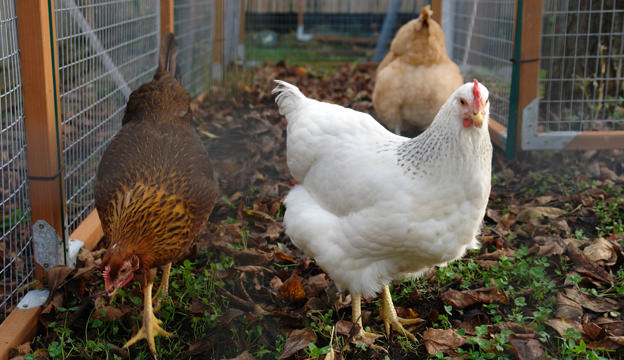
Ancona Chickens

Use: This hardy and vigorous Ancona chicken is a year-round layer of white eggs.

History: This heritage chicken breed’s namesake is Ancona, Italy, where it was bred for centuries before it gained notoriety in England in the late 19th century. Anconas were imported to America in 1888 and 1906 by Francis A. Mortimer of Pottsville, Pa., and H.C. Sheppard of Berea, Ohio, respectively. The chicken breed quickly gained stateside popularity. The American Poultry Association’s Standard of Perfection first recognized the single-comb Ancona in 1898 and the rose-comb Ancona in 1914.

Conformation: The Ancona’s plumage is mottled and it is similar in size and shape to the Leghorn; because of this, the breed was once referred to as the Mottled Leghorn. The shanks are yellow, the wattles are bright red and the earlobes are white. Anconas have two comb varieties. The single comb is bright red with five points standing upright on males; on females, the first point stands while the remaining four fall to one side. The rose comb is bright red and sits directly in front ending in a spike. Standard Ancona cocks weigh 6 pounds and hens weigh 4½ pounds; bantam cocks weigh 26 ounces and bantam hens weigh 22 ounces.

Special Considerations/Notes: The Ancona is a striking chicken breed, but because it’s a quick mover, you’ll likely have to admire it from afar. The breed thrives in a free-range environment and is great at foraging. Laying begins around 5 months and continues year-round. The dark plumage helps hide the Ancona from predators. The Ancona is listed in the Watch category of the American Livestock Breeds Conservancy’s Conservation Priority List.

Categories
Animals Breeds Poultry

Redcap Chickens

Use: The dual-purpose Redcap chicken breed is a former favorite of the farmer’s wife. Hens lay 120 to 180 white (slightly tinted) eggs yearly and it has a long history of being a great provider of meat.

History: The striking Redcap chicken breed was developed in Derbyshire, England. Although it’s one of the country’s oldest chicken breeds, information about it has been recorded only since the early 19th century. The date of its arrival in America is unknown, but it was widely distributed across the country well before 1870. Some speculate that the Red Dorkings shown at some of the earliest American poultry shows were actually Redcaps. The Redcap was admitted into the American Poultry Association’s Standard of Perfection in 1888.

Conformation: One of the most astounding features of the alert and active Redcap chicken breed is its enormous rose comb, which makes it look as though it’s wearing a large, red cap. This feature is more prominent in the male chickens. There is one color variety of Redcap, and plumage ranges with areas from reddish-brown to bluish-black. Wattles and earlobes are bright red, and shanks are dark blue. Standard Redcap cocks weigh 7½ pounds and hens weigh 6 pounds; bantam cocks weigh 30 ounces and hens weigh 26 ounces.

Special Considerations/Notes: Today, the Redcap chicken breed is a fine choice for the hobby farmer as well as the urban farmer. The chickens are able to look after themselves and forage for food in a free-range setting, but they also tolerate confinement well. The Redcap can fly, so urban farmers need to provide high enclosures to contain them. The Redcap chicken is listed in the Critical category of the American Livestock Breeds Conservancy’s Conservation Priority List.

Categories
Animals Breeds Poultry

La Fleche Chickens

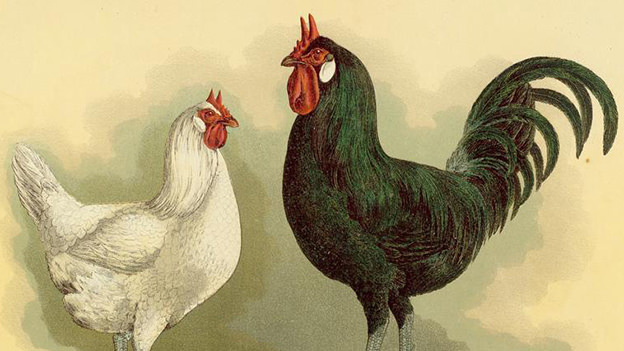
Use: This chicken’s unique v-shaped comb qualifies it as an ornamental breed, though it has great dual-purpose qualities as well. The rarely broody hens lay well and produce large, white eggs into winter months.

History: The La Fleche chicken breed supposedly first appeared during the 5th century in Le Mans, France, according to the American Livestock Breeds Association. It was then taken to Mizeray before finally arriving in its namesake, La Fleche, which translates to “the arrow” in French. The name is also quite fitting for the breed’s arrow-shaped comb. The American Poultry Association’s American Standard of Perfection first recognized the La Fleche in 1874.

Conformation: Close-fitting, black plumage has a slenderizing effect on the somewhat large La Fleche. Its body sits high atop dark-slate shanks. The earlobes are white, and the red wattles are uniform, long and well-rounded on males and smaller on females. The comb, consisting of two round horns located parallel to each other, is bright red. These horns lend to the La Fleche’s nickname, “devil bird.” Standard La Fleche cocks weigh 8 pounds and hens weigh 6½ pounds; bantam cocks weigh 30 ounces and bantam hens weigh 26 ounces.

Special Considerations/Notes: The La Fleche chicken breed is an active forager and prefers to free-range, but it will adapt to confinement if necessary. If given the chance, the La Fleche will roost in trees, so enclosures with tall fences are necessary in keeping this chicken breed contained. The La Fleche can be standoffish and somewhat difficult to tame; however, it more than makes up for this with its reputation as a great layer and producer of juicy, tender meat. The La Fleche is listed in the Watch category of the ALBC’s Conservation Priority List.

Categories
Animals Breeds Poultry

American Game Bantam Chickens

Use: The American Game Bantam chicken is a wonderful exhibition breed for beginning poultry fanciers. Hens are fine layers and make wonderful mothers. Illustration by Diane Jacky

History: Frank Gary of New Jersey is credited with developing the American Game Bantam chicken breed during the 1940s. At the time, fanciers were showing game-bantam chickens, sometimes referred to as “pit bantams,” that were not recognized by any breed associations. Gary set out to fill this void by crossing these pit-bantam chickens with Red Junglefowl in hopes of creating a chicken breed worthy of recognition. The American Game Bantam was accepted into the American Poultry Association’s Standard of Perfection in 2009.

Conformation: The American Game Bantam chicken breed comes in a variety of colors, including Birchen, Black, Black-breasted Red, Blue, Blue-breasted Red, Brassy Back, Brown Red, Golden Duckwing, Red Pyle, Silver Duckwing, Wheaten and White. As of 2011, the APA recognizes 10 of these 12 colors. The breed has a single comb—on hens, it has five upright points. Its wattles and earlobes are thin and smooth, and all are red, though the shade may vary depending on plumage color. Shank color also varies with plumage. American Game Bantam cocks weigh about 30 ounces and hens weigh 27 ounces.

Special Considerations/Notes: The American Game Bantam chicken breed is both hot- and cold-weather hardy and is the most confinement-tolerant of all game breeds. Despite this fact, it’s a good idea to keep males separated.

Categories
Animals Breeds Large Animals Uncategorized

Kangal Dogs

farm-breed-profiles/kangal-dog_190.jpg

Photo Credit: Kangal Dog


Use: The Kangal is a very active dog breed with protective instincts whose talents are most commonly used as a livestock guardian.


History: The Kangal is the national dog breed of Turkey and even makes an appearance on a Turkish postage stamp. The dog breed is found only in the Sivas-Kangal region of eastern Turkey, and even in Turkey, where they are most often found as working flock guards than as pets, purebred Kangals are rare. The first Kangal was imported to the United States in 1985 by David and Judith Nelson, who had studied the dog breed while residing in Turkey. The breed was first recognized by the United Kennel Club in 1998.


Conformation: The Kangal is a large dog breed, standing 30 to 32 inches tall and weighing 110 to 145 pounds. Its body has a black mask and solid body color ranging from dun to dark gray, typically with a pronounced chest blaze and white feet. The dog breed’s short coat is dense and smooth and needs brushed weekly. The Kangal has an average lifespan of 11 to 14 years.


Special Considerations/Notes: The Kangal is a large, powerful dog breed that makes an excellent home guardian, is affectionate with children and is well-suited to obedience work. Because this breed is extremely active, it needs a job on the farm to keep it from becoming destructive. While the breed is generally trustworthy and can be rather gentle when given a task to perform, it has protective instincts, so be wary of its actions if unfamiliar human guests frequent your farm. If you get a Kangal as a puppy, be prepared to spend a lot of energy working with it, as these large young dogs are extremely active.

Categories
Animals Breeds Large Animals

BueLingo Cattle

Use: The BueLingo is a moderately framed, composite beef cattle breed, developed for its quickly maturing beef and its beautiful white stripe along the midsection of the body. While the breed’s appearance attracts attention on pasture, it’s most noted for its tasty, lean beef. Producers aim to process steers or heifers by 18 months of age, for an average carcass weight between 600 and 650 pounds. Carcasses require very little trimming and produce a desirable rib-eye averaging 11.3 to 11.5 square inches.

History: In the late 1970s, a respected cattle rancher by the name of Russ Bueling had the vision of developing a cattle breed that would not only be an asset to the beef industry, but also exhibit aesthetic qualities that would benefit the agricultural landscape. Working with Russ Danielson, of North Dakota State University’s Animal Science Department, and Alfred Ostrum, a cattle rancher from Montana, Bueling started with the Dutch Belted cattle breed and incorporated other bloodlines, including the Lakenvelder, Angus and Chianina, using a strict breeding plan that focused on hardiness, a quick growth rate and a lean carcass. In 1988, the BueLingo Beef Cattle Society was founded with 200 registered animals and today continues to focus on beef quality with consumer’s tastes in mind.

Conformation: The BueLingo boasts a dark-black or deep-red coat with a symmetrical white belt that encircles one-half to three-quarters of the midsection between the girth and hipbone. The tail, feet and legs are a solid color that matches the body’s coat, and the skin, including the muzzle, teats and udder, is either black or a dark pink. Adult BueLingo cows weigh 1,100 to 1,300 pounds and stand 50 to 53 inches at the hips, with a body frame score of 4 to 5½; adult bulls weigh 1,700 to 2,000 pounds and stand 58 to 59 inches at the hips, with a body frame score of 6 to 6½. Individuals can be horned or polled, though polled is preferred.

Special Considerations/Notes: While BueLingo cattle are renowned for their production efficiency, they’re also a gentle breed with excellent mothering abilities. They are very fertile and produce vigorous calves at desirable and consistent calving weights. The breed is also extremely hardy to both warm and cold regions, which has attracted the attention of both hobby and commercial grassfed and organic farmers.

Categories
Animals Breeds Poultry Uncategorized

Catalana Chickens

farm-breed-profiles/catalana-chicken_190.jpg

Photo Credit: Photo by Terry Wild


Use: The Catalana chicken is a dual-purpose breed. Hens are non-broody layers of 150 plus medium to large, white- to light-tinted eggs yearly. Photo by Terry Wild


History: Developed in Catalonia, an autonomous region of Spain with Barcelona as its capital, the Catalana chicken is thought to have been developed over a lengthy period using Castillian chickens and Asian stock, possibly Cochins. It was first introduced at the 1902 World’s Fair in Madrid. Despite being well-received, the breed only garnered a small following in the United States. However, Catalanas saw great commercial success in Latin American countries and are still popular there today. In 1998, an Argentine farmer brought some of his Catalana hatching eggs to a show of 10,000 birds in Columbus, Ohio, where they were purchased by several fanciers. The Catalana chicken breed was admitted into the American Poultry Association’s Standard of Perfection in 1949.


Conformation: Catalana chickens are rich buff colored with black tails. The breed has a large red comb with six points. The comb lies down after the first point in hens and stands upright in roosters. The chicken breed’s earlobes are white, and its shanks and toes are blue slate. Catalana cocks weigh 8 pounds and hens weigh 6 pounds; bantam cocks weigh 32 ounces and bantam hens weigh 28 ounces.


Special Considerations/Notes: The Catalana chicken breed is the only Mediterranean breed raised for both for meat and eggs. Urban farmers, in particular, should keep in mind the Catalana’s tendency to fly and intolerance of confinement when designing coops and enclosures. If given free range, a Catalana chicken will forage eagerly and find high places to roost. The breed is not known for being especially friendly and will avoid contact with humans if possible. It is hardy and very tolerant of hot climates. The Catalana chicken breed is listed in the Watch category of the American Livestock Breeds Conservancy’s Conservation Priority List.

Categories
Animals Breeds Poultry

Cubalaya Chickens

Use: The gorgeous Cubalaya chicken is a popular show breed and has dual-purpose qualities. Hens are broody and will lay a respectable number of small, white eggs yearly.

History: The Cubalaya chicken breed originated in Cuba, resulting from a cross between Oriental fowls brought over from the Philippines and elaborately feathered European game fowls. In addition to being good providers of meat and eggs, Cubalaya chickens were once used as gamefowl. The breed was accepted into the American Poultry Association’s Standard of Perfection in 1939.

Conformation: The Cubalaya has several distinctive attributes, one being a “lobster tail” that trails behind it. This downward-angling tail with ornate feathering resembles the shape of a lobster claw. The lack of spurs on Cubalaya roosters also sets this breed apart from most chickens. The APA recognizes three color varieties in Cubalayas: Black, Black-Breasted and White. Shanks are slate on the black variety and pinkish-white on the two remaining varieties. Its small pea comb, wattles and earlobes are bright red. Standard Cubalaya cocks weigh 6 pounds and hens weigh 4 pounds; bantam cocks weigh 26 ounces and bantam hens weigh 22 ounces.

Special Considerations/Notes: Although the Cubalaya chicken breed is mild-mannered in comparison to other gamefowl, it can be somewhat aggressive toward other chickens. Interestingly enough, it tends to develop close relationships with its keepers. Cubalayas do not tolerate confinement and prefer to noisily forage in hot and humid climates. It may take up to three years for this chicken breed to reach full maturity; however, hens are able to reproduce at 6 months of age. The Cubalaya chicken is listed in the Threatened category of the American Livestock Breeds Conservancy’s Conservation Priority List.

Categories
Animals Breeds Poultry

Delaware Chickens

Use: The historical Delaware chicken is a wonderful provider of eggs and tender meat. Hens lay approximately 150 to 200 medium- to rich-brown eggs yearly. Farmers who want to raise broilers on a small scale should consider keeping this breed.

History: Developed in America by George Ellis in 1940, the Delaware chicken breed is derived from off-colored sports that occurred in the cross breed of a Barred Plymouth Rock rooster and New Hampshire hen. This cross resulted in a unique black barring on the feathers of the mainly white chicken. For nearly 20 years, the Delaware was the meat bird of choice along the entire East coast until the breed was replaced by the Cornish Rock cross in the mid 1950s. It was accepted into the American Poultry Association’s Standard of Perfection in 1952.

Conformation: Delaware chickens are medium-sized and heavy with meaty carcasses. The breed has a moderately large, bright-red single comb with five well-defined points. Its plumage coloring is mainly white to silvery white on the body and breast. Black barring is present on the hackle, tail and wings. Quills and shafts are white, and shanks are yellow. Standard Delaware cocks weigh 8½ pounds and hens weigh 6½ pounds; bantam cocks weigh 34 ounces and bantam hens weigh 30 ounces.

Special Considerations/Notes: Delaware chickens are hardy, quiet, and able to tolerate both confinement and variable weather. Slow Food USA has included the Delaware in its Ark of Taste, a program that promotes the production and consumption of foods in danger of extinction. The breed is listed in the Threatened category of the American Livestock Breeds Conservancy’s Conservation Priority List. It would make a great choice for hobby farmers interested in rare chicken breeds that are a dual-purpose alternative to the Cornish cross.
Categories
Animals Breeds Poultry

Hamburg Chickens

Use: The Hamburg chicken is a dependable layer but shy of people. Hens will lay an abundance of small white eggs year-round. Their dark-colored bones make them undesirable market birds.

History: The origins of the Hamburg chicken breed are somewhat unclear. Some experts agree that they were originally bred in Holland and Hamburg during the 1840s, while others believe that they are a much older breed that started somewhere in the Mediterranean, most likely Turkey. The British and Dutch strongly influenced the Hamburg varieties we see today. The chickens have strong flying abilities and were once thought to be the result of a cross between common chickens and pheasants. Because of this likeness to pheasants, the Hamburg was once called pheasant or pheasant fowl. The breed was accepted into the American Poultry Association’s Standard of Perfection in 1874.

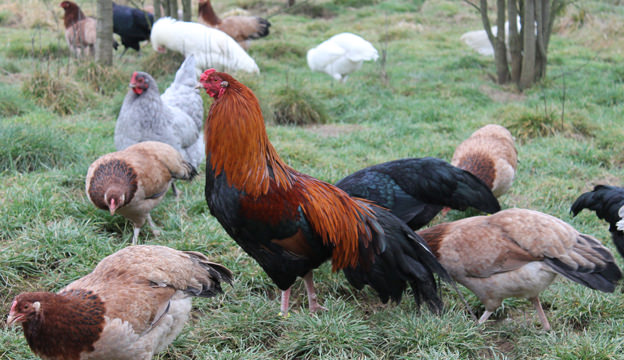
Conformation: The APA recognizes six Hamburg chicken breed varieties: Golden Penciled, Silver Penciled, Golden Spangled, Silver Spangled, Black and White. All varieties have standard plumage. A red rose comb and wattles and white earlobes are characteristic of the breed. Its shanks are grayish-blue, except in the Black variety, in which they are black. Standard Hamburg cocks weigh 5 pounds and hens weigh 4 pounds; bantam cocks weigh 26 ounces and bantam hens weigh 22 ounces.

Special Considerations/Notes: Hamburg chickens are quite flighty so a fence or large enclosure is required for keeping them out of the tall trees where they love to roost. Large coops and free-range environments are best for keeping them, as they do not do well in confined areas. They are not especially friendly and tend to prefer the company of other chickens to that of humans; however, they make up for this in their dependability as layers. The Hamburg chicken is listed in the Watch category of the American Livestock Breeds Conservancy’s Conservation Priority List.