Categories
Animals Breeds Large Animals

Myotonic Goats

Use: The first records of the Myotonic goat breed indicate it was first bred as a meat goat, and it remains so today. Because the Myotonic goat is a more laid-back goat, the meat is said to be very tender. The breed is considered an ideal converter of rough forage to meat—meat-to-bone ratio averages 4:1. The breed is also used as purebreds and for crossing with other goat breeds, like the Boer, because of its reproductive efficiency.

History:

The Myotonic goat gets its rather medical-sounding name from its strange affliction called myotonia congenita, an inheritable muscle condition related to bulky muscling. Although it appears as though the goat “faints” when startled, the painless condition is due to changes in the ion channels in the muscle cell membranes and has nothing to do with the nervous system. However, the strange reaction gave rise to the Myotonic goat’s other names—fainting, nervous, stiff-leg, wooden-leg, and scare.

The breed’s origin remains a mystery; however, the first mention of the Myotonic is in the 1880s when a farm worker brought four goats with myotonia to his new employment in Tennessee. His employer, Dr. H.H. Mayberry, purchased the goats and began breeding them as meat goats. Because the goats were poor climbers and jumpers (and remain so today), they were easy to fence in; this, plus their tasty meat, made the breed very popular in Tennessee. The Tennessee Myotonic is one of the two major strains of the breed (the other is Texas Myotonic). Both strains originated from a single source and have remarkable similarities. Because not all goats with myotonia congenital are purebred, the Myotonic Goat Registry was developed to track and register purebred animals. The registry also respects that foundation herds with wonderful goats are responsible for making the Myotonic goat what it is today, so no single strain or herd is pointed out as being the best or purest.

Conformation: The Myotonic goat can come in various heights and can range in weight from 60 to 175 pounds. This is because breeders haven’t focused on this aspect of the Myotonic, but instead on attributes that set the goat breed apart. The Myotonic goat maintains a stocky, blocky and heavily muscled appearance. It’s facial profile is usually straight or, on a rare occasion, slightly convex, with prominent eyes and a ripple in the ear that starts halfway down the front edge. Horns, if present, are quite large. Various coat types and color variations are allowed, but black and white is most frequently found because this was a favorite color among the earlier breeders. Hair coat is also variable, from short and smooth to long and shaggy, depending on the regional environment where the strain developed.

Special Considerations/Notes: Most goat breeds are very susceptible to parasitic infection but research has shown that the Myotonic goat is somewhat resistant to parasites as compared to other goat breeds. In addition to producing a delicious and tender meat, the Myotonic goat’s sweet personality makes it a wonderful pet. The goat breed is on the American Livestock Breeds Conservancy’s Watch list.

Categories
Animals Breeds Poultry

Old English Game Chickens

Use: The Old English Game chicken breed comes in a variety of colors and is most commonly used in show. Hens lay well for a game breed and make nice mothers. Due to its hardiness, vigor and longevity, it’s been used to develop a number of chicken breeds.

History: The Old English Game, arguably the first chicken breed developed in England, directly evolved from birds used for cockfighting before the hobby was outlawed in 1849. Its ancestors are said to predate the British Isle conquest of Julius Caesar around 55 B.C. The breed’s popularity rose once poultry shows began to replace cockfighting as a form of competition. Of all domestic chicken breeds, the Old English Game has the most similarities in appearance to that of wild jungle fowl and has not seen much physical change over the past 1,000 years. The breed was admitted into the American Poultry Association’s Standard of Perfection in 1928.

Conformation: Two slightly different types of Old English Games evolved from the original fighting stock: the Oxford, with an upright carriage, and the Carlisle, with a horizontal carriage. The breed has 34 known color varieties, eight of which are recognized by the APA. The close, tight feathers emphasize the breed’s small size. It has a single comb with 5 points, and its wattles and earlobes are small and smooth; all are bright red, red or mulberry, depending on the plumage color variety. Shank color varies with plumage. Standard Old English Game cocks weigh 5 pounds and hens weigh 4 pounds; bantam cocks weigh 24 ounces and bantam hens weigh 22 ounces.

Special Considerations/Notes: The Old English Game is a lively, flighty and noisy chicken breed that does not tolerate confinement. Males should be separated early, as chicks will begin to squabble at a young age. The Old English Game chicken breed is listed in the Watch category of the American Livestock Breeds Conservancy’s Conservation Priority List.

Categories
Animals Breeds Poultry

Phoenix Chickens

Use: The Phoenix is typically kept as an ornamental chicken breed. Hens are not reliable as layers, but they will become broody and make good mothers.

History: Hugo du Roi, the first president of the National German Poultry Association, created the Phoenix chicken breed by crossing the delicate Onagadori chicken with Leghorns and hardier game breeds. What resulted was a slightly more self-reliant chicken with an impressive tail length. The 1934 World’s Fair is responsible for bringing the Onagadori chicken breed to America, where it was obtained by poultryman John Kriner, Sr. Kriner then passed the stock onto breeders who were able to use the Onagadoris to maintain the Phoenix breed. It was admitted into the American Poultry Association’s Standard of Perfection in 1965.

Conformation: Although it’s sometimes referred to as an Onagadori, the Phoenix is distinctly different from its ancient Japanese ancestor when it comes to lifespan and tail length. The APA recognizes two color varieties: Silver and Golden. Both have standard plumage and a single, five-point red comb that is medium-sized in males and small in females. The Phoenix’s small body sits atop light- to dark-leaden blue shanks. Wattles are red and earlobes are white. Standard Phoenix cocks weigh 5½ pounds and hens weigh 4 pounds; bantam cocks weigh 26 ounces and bantam hens weigh 24 ounces.

Special Considerations/Notes: The Phoenix chicken breed requires a lot of attention and a patient handler. It’s necessary to house this breed in large dry coops with high perches so that its lengthy tail feathers have room to extend. It benefits from a high-protein diet to compensate for the extra plumage. The breed also does best when it has plenty of room to roam freely. While not known to be particularly friendly, the Phoenix chicken breed is docile, which helps breeders give it the necessary attention. The breed is listed in the Threatened category of the American Livestock Breeds Conservancy’s Conservation Priority List.

Categories
Animals Breeds Poultry

Rosecomb Bantam Chickens

Use: The Rosecomb Bantam is an ornamental chicken breed. Hens are not broody and will lay a small number of tiny white eggs.


History: The Rosecomb Bantam chicken breed is believed to have been developed by English breeders, though its heritage is somewhat unclear. The breed first saw popularity after being kept by King Richard III during his reign in the 15th century. In 1959, it was shown at the first poultry show in Boston, though no one knows when exactly the breed arrived in America. The Rosecomb Bantam is still popular with fanciers today and was admitted into the American Poultry Association’s Standard of Perfection in 1874.


Conformation: The Rosecomb Bantam chicken breed was named for its large, long comb that is accentuated by its petite body. The breed has a strong build, and its large tail is held at an upright angle from the back, creating a handsome appearance. There are approximately 25 color varieties of Rosecomb Bantams, though the APA only recognizes three: Black, White and Blue. All have standard plumage with bright-red combs, face and wattles, and white earlobes. Shanks are black on the Black variety, bluish-slate on the Blue variety and white tinged with pink on the White variety. Rosecomb Bantam cocks weigh 26 ounces and hens weigh 22 ounces.


Special Considerations/Notes: The Rosecomb Bantam, due to its close breeding for a pure rose-shaped comb, may exhibit a genetic flaw that causes poor fertility and hatchability. This can be avoided by setting aside the occasional single-comb sport as breeding stock. Chicks are slow to mature. Keepers of the Rosecomb Bantam are rewarded for their patience and attention with friendly adult birds that are active, hot- and cold-hardy, and great in confined spaces. The Rosecomb Bantam is not a good chicken breed for first-time keepers because it tends to fly and its egg-laying is poor.

Categories
Animals Breeds Poultry

Sebright Bantam Chickens

Use: The historical ornamental Sebright Bantam is studied by molecular biologists in hopes of creating a better understanding of the genome of chickens and how traits are passed on. Hens produce tiny white eggs, but they are non-broody and unreliable as layers.

History: In 1800, Sir John Sebright set out to produce a bantam with laced plumage. Sebright, a member of Parliament and England’s landed gentry, was a writer devoted to working on breeding programs of various animals. Sebright eventually collaborated with Charles Darwin and other influential thinkers on ways to increase knowledge of evolution and animal genetics. The Sebright Bantam chicken breed was admitted into the American Poultry Association’s Standard of Perfection in 1874.

Conformation: Sebright Bantams are hen-feathered. Both color varieties, Golden and Silver, are recognized by the APA. The breed has a short back, a distinct breast, and a tail that is widely spread and held at a slightly upward angle. Its small- to medium-sized rose comb and face are purplish-red in males and gypsy-colored in females. Earlobes are either purplish-red or turquoise. Shanks are slate-blue. Sebright Bantam cocks weigh 22 ounces and hens weigh 20 ounces.

Special Considerations/Notes: The Sebright Bantam is an excellent backyard or show chicken breed. It tolerates confinement well, is quiet and is easy to train. The breed can be somewhat hard to raise due to low fertility and are most likely to breed during the warmer months of April, May and June. Vaccinations for preventing Marek’s disease should be administered as early as possible. The Sebright Bantam chicken breed is listed in the Watch category of the American Livestock Breeds Conservancy’s Conservation Priority List.

Categories
Animals Breeds Poultry

Chantecler Chickens

Use: The Chantecler is a cold-hardy, dual-purpose, heritage chicken breed, especially treasured for its juicy, flavorful meat. Photo courtesy Chantecler Fanciers International

History: Beginning in 1908, Brother Wilfred Chatelain and his fellow monks at the Cisterian Abbey in Oka, Quebec, Canada, developed the white variety of the Chantecler, Canada’s only homegrown chicken breed, releasing it to the public in 1921. Among the chicken breeds he used to create the Chantecler were Dark Cornish, White Leghorn, Rhode Island Red, White Wyandotte and White Plymouth Rock. Later, Dr. J.E. Wilkinson of Alberta, Canada, developed the Partridge Chantecler, which has an attractive color pattern that allows it to blend in with range conditions. The White Chantecler was admitted to the American Poultry Association’s Standard of Perfection in 1921 and the Partridge variety in 1935.

Conformation: The Chantecler chicken breed has a tiny, cushion-shaped comb resistant to frostbite, small earlobes and nearly non-existent wattles, making it an ideal chicken breed for northern flocks. The cushion comb is so small that it resembles a small, round button perched low on the chicken’s head. Standard Chantecler cocks weigh 8½ pounds and hens weigh 6½ pounds. Bantam cocks weigh 34 ounces and hens weigh 30 ounces. Chanteclers mature to fryer size in 16 to 20 weeks. Hens are excellent layers of large, brown eggs, and they lay throughout the coldest winter months.

Special Considerations/Notes: Chanteclers are friendly, gentle chickens that tolerate confinement well. The Chantecler chicken breed is listed as Critical on the American Livestock Breeds Conservancy’s Conservation Priority List.

Categories
Animals Breeds Poultry

Cornish Chickens

Use: The Cornish is a heritage meat chicken.

History: Around 1820, Sir Walter Raleigh Gilbert of Cornwall, England, developed a chicken breed he called the Indian Game using bloodlines from Aseel, Red Old English and Malay chickens. His goal was to breed a fighting chicken with the power of the Aseel and the speed of Old English Games. The cross didn’t work the way Raleigh hoped, but fanciers in Devonshire and Cornwall embraced the chicken breed as an ornamental, due to its unique appearance, and as a first-rate table chicken for its juicy, white breast meat.

The American Poultry Association added Dark Indian Games to their Standard of Perfection in 1893, later admitting White, White-laced Red and Buff to the list of recognized varieties. In 1905, the organization renamed the breed Cornish Indian Game, and in 1910, simply Cornish.

Conformation: The Cornish chicken breed is unique in that the APA lists the same conformation standards for male and female chickens. The breed has short, narrow, close-fitting feathers; a muscular body with an amazingly broad chest; a wide skull; and thick, short shanks with legs set wide apart. Standard Cornish cocks weigh 10½ pounds and hens weigh 8 pounds. Bantam cocks weigh 44 ounces and hens weigh 36 ounces.

Special Considerations/Notes: Cornish chickens are loud and active but friendly. They bear confinement well, though it’s best not to raise them in a mixed flock due to their inability to defend themselves. They are tasty, albeit slow-maturing, meat chickens but only mediocre layers of small, light-brown eggs. They are half of the hybrid Cornish Cross equation (White Cornish bred with White Plymouth Rocks), the most popular commercial meat chicken in North America. Prior to the Cornish Cross’ emergence, they were popular as 2-pound Cornish Game Hens when slaughtered at 5 weeks of age. The breed is listed in the Watch category of the American Livestock Breeds Conservancy’s Conservation Priority List.

Categories
Animals Breeds Poultry

Crevecouer Chickens

Use: The Crevecouer chicken breed is primarily used for exhibition, though it was originally developed for meat. Crevecouer hens are also respectable layers of medium-sized, white eggs.

History: The Crevecouer is an elaborately crested, muffed and bearded chicken breed developed in the town of Crève-Coeur Ange near Normandy, France. Little is known about the origins of the breed, but French poultry historians believe it was developed during or before the 17th century by crossing crested Polish chickens with the old-time, common chickens of Normandy. Crevecouers, in turn, were most likely used in developing the French Houdan and Faverolle chicken breeds. The Crevecouer chicken breed was admitted to the first volume of the American Poultry Association’s Standard of Perfection in 1874.

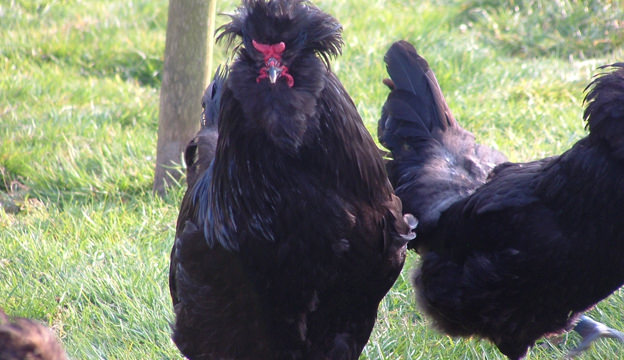
Conformation: Both sexes of the Crevecouer chicken breed have shiny, black plumage with greenish overtones; crests and beards of moderate size; V-shaped combs; compact, well-proportioned bodies with short legs; white skin; and dark blue-gray shanks. Standard Crevecouer cocks weigh about 8 pounds and hens weigh 6½ pounds. Bantam cocks weigh 30 ounces and hens weigh 26 ounces. The breed has small, fine bones and its meat is noted for being fine textured, delicious and very white.

Special Considerations/Notes: Crevecoeurs are active but friendly chickens that do well in confinement. They can also free-range but are poor foragers. The breed is heat tolerant; however, due to their fancy plumage, the chickens are fair-weather fowl, somewhat delicate and require adequate protection when it rains or snows. The Crevecoeur’s name means “broken heart.” It’s listed as Critical on the American Livestock Breeds Conservancy’s Conservation Priority List.

Categories
Animals Breeds Poultry Uncategorized

Java Chickens

farm-breed-profiles/java-chicken_190.jpg

Photo Credit: Photo courtesy American Livestock Breeds Conservancy


Use: The Java is a dual-purpose, heritage chicken breed. Hens are decent layers of large to medium-sized, brown eggs and are broody. Photo courtesy American Livestock Breeds Conservancy


History: Despite its name, the Java is an all-American chicken breed developed using breeding stock of Asian extraction. It was known to exist between 1835 and 1850 but is thought to have been a distinct breed long before that. The Java was especially prized for meat production during the 1800s. The breed was admitted to the American Poultry Association’s Standard of Perfection in 1883. It nearly became extinct by the mid-20th century but is enjoying a revival, largely due to the efforts of Garfield Farm Museum in Illinois, where conservators began breeding Black Javas.


Conformation: Java chicken-breed varieties approved by the APA are Black and Mottled, though White and Auburn Javas have been around since the 1800s and are staging a comeback, too. Javas are rectangular in shape with long, broad backs and full, meaty breasts. Standard Java cocks weigh about 9½ pounds and hens weigh 6½ to 7½ pounds. Bantam cocks weigh 36 ounces and hens weigh 32 ounces.


Special Considerations/Notes: Javas are calm, personable chickens that adapt to confinement or free range. They are cold-hardy except in the far-northern states, where their medium-sized single combs are somewhat prone to frostbite. The breed is listed as Threatened on the American Livestock Breeds Conservancy’s Conservation Priority List. They are also listed on Slow Food USA’s Ark of Taste.

Categories
Animals Breeds Poultry

Jersey Giant Chickens

Use: The Jersey Giant is a dual-purpose, heritage chicken breed, especially noted as an outstanding roasting chicken.

History: John and Thomas Black of Jobstown, N.J., developed this large chicken breed between 1870 and 1890, with the intention of creating a roasting chicken capable of replacing the turkey as America’s favorite roasting bird. To do so, they crossed Black Javas, Black Langshans and Dark Brahmas, selecting for size and meaty carcasses. Around 1895, the Jersey Giant chicken breed was called simply Giant and later was renamed Black Giant in honor of its creators, not its color. Dexter P. Upham, a noted Black Giant breeder from Belmar, N.J., began referring to his flock as Jersey Giants. The name caught on, and in 1921, members of the newly formed American Association of Jersey Black Giant Breeders Club voted to make it official. The Jersey Giant was accepted into the American Poultry Association’s Standard of Perfection in 1922.

Conformation: The Jersey Giant chicken breed has a large frame and broad, deep body. Standard Jersey Giant cocks weigh about 13 pounds and hens weigh 10 pounds. Bantam cocks weigh 38 ounces and hens weigh 34 ounces. The breed has a rather large, single comb and yellow skin. The APA recognizes three color varieties: Black, White and Blue.

Special Considerations/Notes:

Young Jersey Giant chickens grow relatively quickly, but it takes awhile to fill in their massive frames. Most require eight to nine months to reach eating size. Jersey Giant pullets start laying at about 6 months of age, and hens lay an average of 135 to 160 extra-large, light-cream to dark-brown eggs per year. Hens are occasionally broody and they’re protective mothers; however, due to their great weight, they often break the eggs they try to incubate. It’s usually better to incubate their eggs in an incubator. Jersey Giants are great foragers and free-range chickens that also bear confinement well. They are vigorous, hardy, easygoing and gentle.

Although once a popular meat chicken breed, the Jersey Giant was usurped by faster-maturing chicken breeds and is now listed in the Watch category of the American Livestock Breeds Conservancy’s Conservation Priority List. The breed is also recognized by Slow Food USA’s Ark of Taste.