Categories
Animals Breeds Poultry

Russian Orloff Chickens

Use: The Russian Orloff is a dual-purpose, heritage chicken breed, especially prized for its meat.


History: The Russian Orloff chicken breed is said to have originated in Persia (modern-day Iran). It was distributed across Asia in the 1600s and was known in Europe by the end of the 1800s. The breed is named for Alexey Grigoryevich Orlov, an 18th-century Russian count who developed Orlov Trotter and Orlov-Rostopchin horses and is credited with the importation and promotion of the Orloff chicken breed. The Russian Orloffs’ tight plumage, small walnut combs, small earlobes and barely present wattles helped them survive and thrive during Russia’s frigid winters. The breed reached England in 1899 and soon became popular in Germany. The Orloff chicken breed was once represented in the American Poultry Association’s Standard of Perfection but was dropped due to lack of interest in the breed.


Conformation: The Russian Orloff chicken breed is a tall and well-feathered chicken with a fierce, predatory appearance. The breed has yellow skin and comes in an array of color varieties, including Red, White and Spangled (a rich mahogany red accented with flecks of white); the Black variety is now seldom seen. It is a heavy, dual-purpose chicken that is mostly bred for meat due to being an indifferent layer. At 8½ pounds for roosters and 6½ pounds for hens, Russian Orloffs yield a lot of meat. Their heads and necks are thickly feathered, and they have tiny walnut combs, making them an ideal chicken for northern climates. The American Bantam Association also recognizes a bantam variety of the breed.


Special Considerations/Notes: Russian Orloffs are calm and somewhat aloof chickens that do equally well in confinement or in free-range situations. They are extremely cold-hardy and are non-broody. The breed is listed as Critical on the American Livestock Breed Conservancy’s Conservation Priority List.
Categories
Animals Breeds Poultry

Sussex Chickens

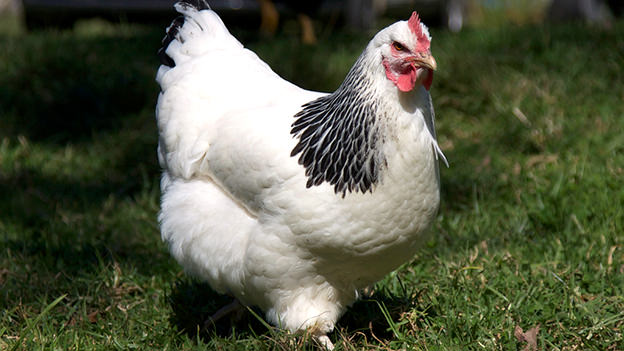
Use: The Sussex is a dual-purpose, heritage chicken breed. Hens are excellent producers of large, cream-colored or light-brown eggs that they lay through the coldest winter months. In addition, they are meaty chickens that fatten easily, and their tender, succulent flesh is second to none.

History: The history of the Sussex chicken breed is unclear. Some poultry historians believe the breed’s ancestors were the same as the Dorking’s and that Sussex history traces to the Roman occupation of Britain. What’s certain is that it was fully developed and present in the English counties of Sussex, Kent and Surrey by the mid-1800s. British cooks once considered Sussex the quintessential table bird. The breed reached America around 1912, and the American Poultry Association’s Standard of Perfection recognized Speckled and Red varieties in 1914. In 1929, a Light variety with a white body and black tail and wing tips was added.

Conformation: The Sussex is a graceful chicken breed with a deep, rectangular body; long, broad back; and tail set at a 45-degree angle from its body. Standard Sussex cocks weigh about 9 pounds and hens weigh 7 pounds. Bantam cocks weigh 36 ounces and hens weigh 32 ounces. In addition to the varieties recognized by the APA, the breed comes in an array of attractive colors, including Coronation (with a white body and lavender-blue tail and wing tips), Buff, White and Silver.

Special Considerations/Notes: The Sussex is an all-around excellent small-farm chicken. They bear confinement well but are also superior foragers and ideal for free-range conditions. They are alert and active but unusually docile, curious and friendly. Hens go broody and are excellent mothers. The Sussex chicken breed is listed as Recovering on the American Livestock Breeds Conservancy’s Conservation Priority List.
Categories
Animals Breeds Poultry Uncategorized

Aseel Chickens

farm-breed-profiles/aseel-chicken_190.jpg

Photo Credit: Photo courtesy Green Valley Stables


Use: Developed for cockfighting, the Aseel chicken breed is now known for its gaminess. Although the chickens are slow to develop, they produce a meaty carcass and lay a few brown eggs per week. Photo courtesy Green Valley Stables


History: The Aseel is an ancient chicken breed from India and Pakistan. Mentioned in the Codes of Manu, an ancient Indian document penned around 1000 B.C., the breed was originally kept for cockfighting. It was exported to England as early as 1846, and the first North American Aseels came from Lucknow, India, to be shown at the 1897 Indiana State Fair. The Aseel chicken breed entered the American Poultry Association’s Standard of Perfection in 1981.


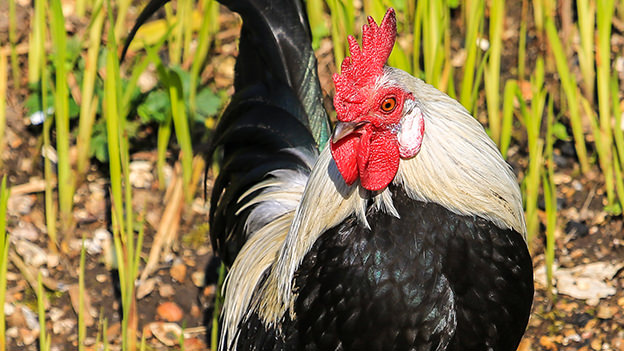
Conformation: Aseels are slow-growing, powerfully built chickens with regal, upright bearings. Color varieties recognized by the APA are Black-breasted Red, Dark, Spangled, White and Wheaton. Aseel roosters weigh 5½ pounds and hens weigh 4 pounds. The breed has short, hard, glossy feathers covering a solid, compact body; pearly white eyes; a broad skull with protruding eyebrows and cheekbones; a short, curved beak; a small pea comb with red earlobes; and a naked dewlap instead of a wattle.


Special Considerations/Notes: Aseel chickens are tame and friendly toward humans but fiercely aggressive toward one another, especially when kept in close confinement. Aseel roosters cannot be penned together or with roosters of other breeds, and hens sometimes fight among themselves. Although Aseels lay very few eggs, they are supremely broody and have wonderful maternal characteristics—they have even been known to fend off snakes that threaten their chicks. Aseels make excellent living incubators for hatching non-broody breeds’ eggs. The breed is listed in the Watch category of the American Livestock Breeds Conservancy’s Conservation Priority List.
Categories
Breeds Poultry

Belgian Bearded d’Uccle Chickens

Use: The Belgian Bearded d’Uccle (pronounced dew-clay) is a bantam chicken breed primarily used for exhibition, though hens are modest layers of small, creamy-white eggs, averaging two to three per week. The breed makes fantastic broody hens that happily hatch any eggs placed under them.

History: Belgian chicken fancier Michel Van Gelder developed the Belgian Bearded d’Uccle chicken breed in the late 1800s. The breed is named for Van Gelder’s home, the small municipality of Uccle, located near Brussels, Belgium. Poultry historians believe Van Gelder crossed another Belgian chicken breed, the rose-combed Antwerp Bearded Bantam, with a single-combed Dutch Sabelpoots Bantam to produce a compact, booted bantam with a small single comb and a beard. The Mille Fleur variety of Belgian Bearded d’Uccle was accepted into the American Poultry Association’s Standard of Perfection in 1914.

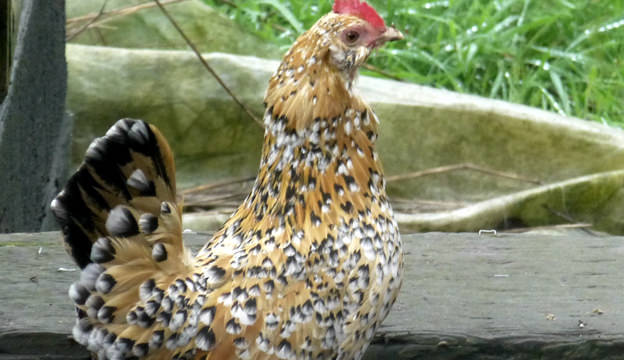
Conformation: The Belgian Bearded d’Uccle is a majestic, bearded, heavily feather-legged bantam chicken breed. It is similar to the Booted Bantam, with the addition of beard and muffs. Roosters weigh 26 ounces and hens weigh 22 ounces. The breed comes in a range of APA-recognized colors, including Mille Fleur, Black, White, Blue, Mottled, Golden Neck and Porcelain. The oldest variety and the one most associated with the breed is Mille Fleur, a name meaning “one-thousand flowers.” Mille Fleur Belgian Bearded d’Uccles are a rich, golden mahogany brown, and every feather is marked with a black spangle and a v-shaped white tip.

Special Considerations/Notes: Belgian Bearded d’Uccle chickens are easygoing, sweet birds that bear confinement well, but they’re also excellent free-range foragers. Because of their fancy feathering, they don’t do well in wet or snowy conditions. They’re strong fliers and require tall fencing when kept in pens.

Categories
Animals Breeds Poultry

Dorking Chickens

Use: The Dorking is an ancient, dual-purpose chicken breed that produces about three to four white eggs per week, even in winter.

History: The Roman agricultural author, Columella, writing during Julius Caesar’s reign, described broad-breasted, squarely built chickens with five toes. Historians believe Columella’s chickens came to Great Britain with the Roman occupation and ultimately became today’s Dorking chicken breed. Named for the market town of Dorking in Surrey, England, the breed was well-distributed in North America before 1840 and was shown at the first American poultry show in 1849. In 1874, the American Poultry Association admitted the White, Silver-Gray and Colored varieties of the Dorking chicken breed to its Standard of Perfection. The Red Dorking was added later. By 1905, the Dorking was the most popular chicken breed in its native England.

Conformation: The Dorking chicken breed comes in an array of colors not recognized by the APA, including Black, Cuckoo and Speckled. The breed has a rectangular, meaty body with broad breasts and tender, delicate flesh. Its legs are comparatively short, with five toes on each foot instead of the usual four. Standard Dorking cocks weigh about 9 pounds and hens weigh 7 pounds. Single-combed bantam cocks weigh 36 ounces and hens weigh 32 ounces, while the rose-combed bantams weigh about 6 to 8 ounces less. Roosters of the single-comb variety have large combs that stand upright; hens’ medium-sized combs fall jauntily to one side. Rose-combed varieties have large rose combs that are square in the front and liberally dotted with spikes and small rounded points.

Special Considerations/Notes: Dorkings are exemplary setters and mothers, often happily brooding other hens’ chicks. They are sweet, gentle chickens that bear confinement well, but they’re also outstanding foragers that don’t wander far when allowed to free-range. As surprisingly strong fliers, they like to roost in trees. The Dorking is an uncommon but accessible chicken breed listed as Threatened on the American Livestock Breeds Conservancy’s Conservation Priority List.

Categories
Animals Breeds Poultry

Minorca Chickens

Use: Minorca chickens are known as wonderful layers of large, chalky-white eggs.

History: Once known as the Red-faced Black Spanish, the Minorca chicken breed was officially imported from Spain to England by Sir Thomas Acland in 1834. However, the breed was found in Devon and Cornwall, England, before that, possibly as early as 1780. J.J. Fultz of Mount Vernon, Ohio, brought the Minorca chicken breed to America in 1884. The American Poultry Association admitted the single-comb Black Minorca and the single-comb White Minorca to the Standard of Perfection in 1888; the rose-comb Black Minorca followed in 1904; the single-comb Buff Minorca in 1913; and the rose-comb White Minorca in 1914.

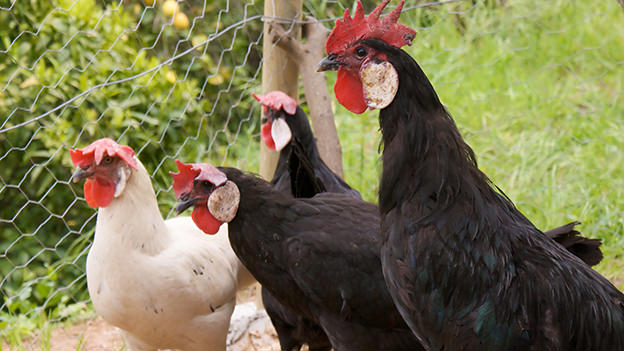
Conformation: Although slender and racy like typical Mediterranean chicken breeds, the Minorca chicken breed is bigger than the others. Minorca roosters weigh 9 pounds and hens weigh 7½ pounds. Single-comb Minorcas have huge, six-point combs and large wattles, both of which have thermoregulatory capabilities and help keep their bearers cool in the summer but predispose them to frostbite in the far North. Rose-comb varieties, however, are winter-hardy where single-comb Minorcas are not because the single comb is more prone to frostbite.

Special Considerations/Notes: Minorca hens are non-broody and respectable layers of large, chalky-white eggs, averaging three to four eggs per week. They are noisy, flighty, early-maturing chickens. They are adept fliers (a common characteristic of Mediterranean breeds), rugged and self-reliant. They prefer to free-range, though they also tolerate confinement reasonably well. The breed is listed in the Watch category of the American Livestock Breeds Conservancy’s Conservation Priority List.
Categories
Animals Breeds Poultry

Nankin Chickens

Use: The Nankin is a bantam chicken breed used primarily as exhibition fowl, though the hens are decent layers of tiny, delectable, creamy-white eggs. The breed is very broody and excels as surrogate hatchers.

History: The Nankin is a naturally tiny chicken breed that originated in Southeast Asia, but it was imported to England prior to the 1500s. It was named for the ancient inland seaport of Nanking (now Nanjing), located on the Yangtze River in east-central China. The breed was widespread throughout Europe by the 18th century, particularly in England, where Nankin hens were used to brood pheasant, quail and partridge eggs. In the mid-1800s, however, the breed started to decline.

Conformation: Nankin cocks weigh a mere 24 ounces and hens weigh 20 ounces. The chicken breed is recognized by the American Bantam Association and comes in shades of Chestnut with black tails and black in its wings. There are two Nankin varieties differentiated by comb type: one has a large, five-pointed comb and the other a medium-sized rose comb ending in a single spike. The comb of each Nankin variety, especially that of the large-combed variety, is prone to frostbite, making the chicken breed unsuitable for far-northern climates.

Special Considerations/Notes: Nankins are calm, ultra-friendly chickens; some say they’re the best of all barnyard pets. They mature quickly and are easy to rear. They thrive in confinement and tend not to wander when allowed to free-range. The petite Nankin is listed as Critical on the American Livestock Breeds Conservancy’s Conservation Priority List.

Categories
Animals Breeds Poultry Uncategorized

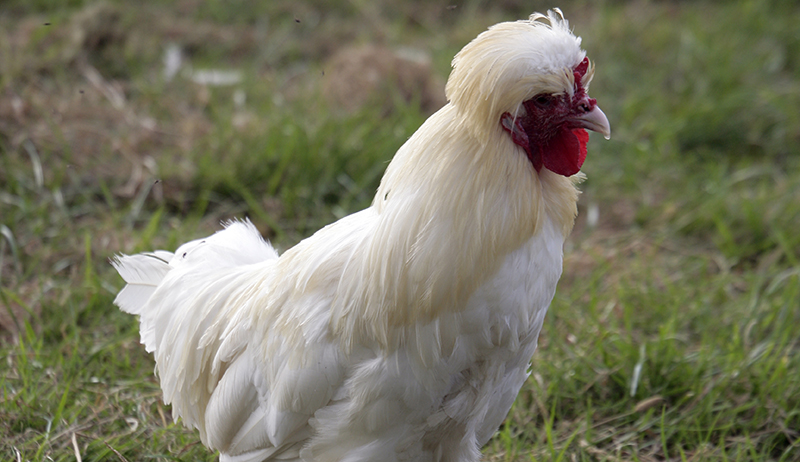
Sultan Chickens

Sultan chickens are primarily used for exhibition. They were once considered fine table chickens, but due to their scarcity, they’re rarely eaten nowadays. 

The breed originated in Turkey, where they’re called “Serai Täook,” meaning sultan’s fowl. They arrived in England from Istanbul in 1854 and came to the United States in 1867. Sultan chickens were recognized in the first volume of the American Poultry Association’s Standard of Perfection, published in 1874.

The Sultan has more distinguishing features than any other chicken. Murray McMurray Hatchery describes this extremely rare breed as having “a full list of distinguishing characteristics including a top crest, muff, beard, vulture hocks, fully-feathered shanks and feet, and a fifth toe. Sultan chickens have a dramatic appearance with their pure white feathering and contrasting bright red V-comb and wattles. Males sport a larger crest and tail, and females have a dainty, rounded crest and shorter tails.”

Sultan chickens come in a single recognized color: White with slate blue shanks and toes, though Blue and Black varieties occur, as well. It comes in standard and bantam sizes. Standard Sultan cocks weigh 6 pounds; hens, 4 pounds. Bantam cocks weigh 26 ounces, and hens weigh 22 ounces.

George O. Brown, poultry expert and co-editor of the early 20th-century classic, The Poultry Book, wrote that his Sultan chickens were the tamest and most contented chickens he ever owned. Modern Sultan owners agree. Sultans are friendly, ultra-calm chickens that bear confinement well. They make gorgeous, ornamental pets as well as eye-catching exhibition chickens. They are nonbroody and lay 50 to 70 large, white eggs per year. 

Sultan chickens are listed as Threatened on The Livestock Conservancy’s Conservation Priority List with fewer than 1,000 breeding birds in the U.S., with seven or fewer primary breeding flocks, and an estimated global population less than 5,000. If you’re looking for a rare and exotic but friendly chicken, this is your bird

Categories
Animals Breeds Poultry

Welsummer Chickens

Use: The standard dual-purpose Welsummer chicken breed is famous for its large, dark, terra-cotta-colored eggs that are often speckled with an even darker hue. (Bantam Welsummer chickens lay lighter brown eggs.) It’s a moderately fast-maturing breed that produces excellent meat.

History: Dutch poultry keepers in and around the village of Welsum in the eastern Netherlands developed the Welsummer chicken breed during the early 1900s by selecting for the production of large, dark-brown eggs. The breed was standardized in the 1920s and exported to England in 1928. It was added to the British Standard in 1930 and the American Poultry Association’s Standard of Perfection in 2001.

Conformation: The Welsummer is a large, upright, active chicken with a broad back, a full breast and a large, full tail. It’s a soft-feathered breed that comes in standard and bantam sizes. Standard Welsummer cocks weigh 7 pounds and hens weigh 6 pounds. Bantam cocks weigh 34 ounces and hens weigh 30 ounces. The breed’s primary color is Red Partridge, but standard-sized fowl come in Silver Duckwing and Gold Duckwing, as well. (The Kellogg’s Corn Flakes rooster is a Red Partridge Welsummer.) The breed has a medium-sized, single comb and yellow skin and shanks. Welsummer bantams carry their tails at a 50-degree angle.

Special Considerations/Notes: Dutch fanciers spell the breed name Welsumer with a single “m”. Welsummers bear confinement well but also make fine free-range chickens. They’re friendly, intelligent and reasonably winter-hardy, though their single combs are somewhat prone to frostbite in the far North. Welsummer hens are broody and good layers, averaging three to four eggs per week.

Categories
Animals Breeds Poultry

Yokohama Chickens

Use: The long-tailed Yokohama chicken breed is used for exhibition.

History: According to the American Livestock Breeds Conservancy, in 1864, the Jardin d’Acclimation (Acclimatization Gardens) in Paris, France, imported fabulously long-tailed Minohiki, or “Saddle Dragger,” fowl from Japan. The French renamed them Race de Yokohama after the port city from which they sailed. In 1869, a man from Dresden, Germany, imported a trio of French Yokohamas. When he and fellow German breeders were unable to acquire unrelated breeding stock from Japan, they developed today’s Yokohama by adding several other breeds to the mix, including long-tailed Phoenix fowl, a similar breed developed in Germany using Japanese stock. Two varieties, White and Red-Shouldered, entered the American Poultry Association’s Standard of Perfection in 1981.

Conformation: The Yokohama is a regal, slim chicken breed with a game-like appearance. It is a small chicken breed that comes in standard and bantam sizes and has incredibly long tails that sweep the ground. Standard Yokohama cocks weigh 4½ pounds and hens weigh 3½ pounds. Bantam cocks weigh 26 ounces and hens weigh 22 ounces.

Special Considerations/Notes: Yokohamas are docile, friendly, unusually quiet chickens that bear confinement well and make outstanding ornamental chickens in urban settings, but they require special housing to accommodate the length of their tails. They are poor layers of small, tinted eggs. The breed is globally endangered and listed as Critical on the American Livestock Breeds Conservancy’s Conservation Priority List.