Categories
Animals Breeds Large Animals Uncategorized

German Shepherd Dogs

farm-breed-profiles/german_shepherd_new.jpg

Photo Credit:


Use: The German Shepherd Dog breed’s versatility has led it to a farm career in herding livestock.


History: The German Shepherd Dog breed was originally found on German farms. Its type was standardized in the 1890s by a German cavalry officer, Capt. Max Von Stephanitz, whose aim was to perfect a superior herding dog of elegant appearance. The breed was first imported to North America early in the 1900s and got its biggest boost in popularity after World War I, largely because of the screen exploits of Rin Tin Tin.


Conformation: The German Shepherd Dog has a double coat; with a dense outer coat and a downy undercoat. The breed has three types of coats: rough-coated, long rough-coated and long-haired. Their colors are usually black-and-tan “saddle.” Black, black and silver, and black and red are also acceptable. Males measure 24 to 26 inches in height at the shoulder, and females measure 22 to 24 inches in height at the shoulder. Both genders’ weights range from 75 to 80 pounds.


Special Considerations/Notes: The German Shepherd dog is intelligent and easy to train. The breed’s life expectancy is about 10 to 12 years. Its coat sheds heavily, so it requires daily to weekly brushing.
Categories
Animals Breeds Poultry

Black Turkeys

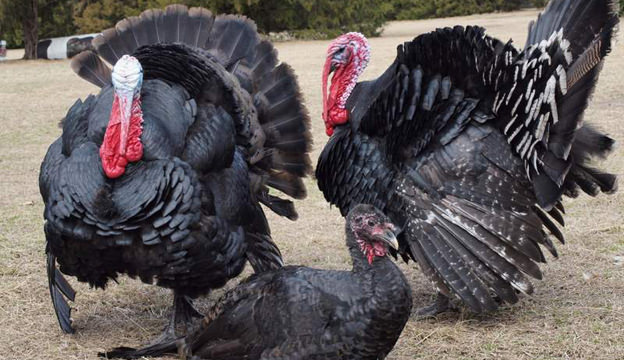
Use: Like most other varieties Black turkeys are primarily used for meat production. Their metallic black feathers are also admired by breeders and fanciers.

History: Black turkeys were developed in Europe from Black turkeys brought back from Mexico by European explorers in the 1500’s. They were selected for meat production for two centuries there until they returned to North America with early settlers. The Black was also used in the development of the Bronze, Narragansett and Slate. They were commercially viable in the early 1900’s but never as popular as the Bronze, Bourbon Reds and White Hollands. They were admitted to the first American Standard of Perfection in 1874.

Conformation: Like other varieties, Black turkeys have the traditional production shape; strong, well-set legs, large rounded breast and broad back. They are solid black with a metallic sheen throughout. Standard weights: Old Tom: 33 lbs., Young Tom: 23 lbs., Old Hen: 18 lbs., Young Hen: 14 lbs.

Special Considerations/Notes: Commonly known as the Black turkey, they are also referred to as “Norfolk Black” and “Black Spanish” in the United States. Some strains of Black turkeys have tended to become smaller than standard weights because of lack of selection for size.

Categories
Animals Breeds Poultry

Bourbon Red Turkeys

Use: Bourbon Red turkeys are used for meat production. They are popular with small farms because of their ability to forage and their light colored pinfeathers make for an attractive carcass.

History: The Bourbon Red has a well documented history of development in Bourbon County, Kentucky from crosses of Bronze, White Holland turkeys and darker reddish-colored Buff turkeys brought from Pennsylvania. They were developed with production in mind and originally competed with Bronze through the 1940’s. Since then until recently, they were primarily kept by hobbyists, but a new surge of interest in heritage turkeys has been a boost for Bourbon Reds in the marketplace. Bourbon Reds were admitted to the American Standard of Perfection in 1909.

Conformation: Bourbon Reds are a large variety. They are known for their deep chestnut colored feathers on their main body contrasted with white tails, primary and secondary wing feathers. Standard weights: Old Tom: 33 lbs., Young Tom: 23 lbs., Old Hen: 18 lbs., Young Hen: 14 lbs.

Special Considerations/Notes: Bourbon Reds are the most popular of the heritage turkey varieties with the largest census of breeding birds in the United States.

Categories
Animals Breeds Poultry

Broad Breasted Bronze Turkeys

Use: Bronze Turkeys are the heavyweight of the Turkey class. They were developed as a meat producing variety though they are no longer favored in commercial production because of their dark pin feathers.

History: The Bronze was developed in the 1700’s in the United States from wild strains of similar coloration crossed with turkeys brought from Europe. This breed was progressively selected for larger breast and legs and became an important commercial turkey until they were replaced with Broad Breasted White turkeys. They were admitted to the American Standard of Perfection in 1874.

Conformation: The American Poultry Association considers all turkeys to be different varieties of the same breed. Bronze turkeys are a dark colored variety with black feathers and a copper-colored bronze band covering much of their body. All turkeys should have a broad body with a large full breast. Legs should be straight and strong, set wide apart. Standard weights: Old Tom: 36 lbs., Young Tom: 25 lbs., Old Hen: 20 lbs., Young Hen: 16 lbs.

Special Considerations/Notes: There is controversy with terminology surrounding Bronze turkeys. Some hatcheries sell ‘Broad Breasted Bronze’ and the APA Standard of Perfection makes reference to Broad Breasted Bronze turkeys as well. It’s generally recognized that Standard Bronze turkeys mate naturally and Broad Breasted Bronze do not.

Categories
Animals Breeds Poultry

Narragansett Turkeys

Use: Narragansett turkeys are a meat variety known for being very prolific, broodiness and possessing a calm disposition.

History: The Narragansett was developed in the Rhode Island bay of the same name in the 1700’s from crosses of native wild turkeys and domestic farm turkeys (most likely Blacks) brought from Europe by settlers. They were most popular in the Northeast though their popularity declined greatly by the 1950’s. This variety has seen recent growth on small farms due to its popularity as a productive heritage turkey. It was admitted into the first American Standard of Perfection in 1874.

Conformation: Narragansett’s have the same productive body type as other varieties, but possess a unique coloration similar to the Bronze. Instead the coppery tinge is replaced by a steely gray in the Narragansett. Standard weights are: Old Tom: 33 lbs., Young Tom: 23 lbs., Old Hen: 18 lbs., Young Hen: 14 lbs.

Special Considerations/Notes: Recent attention to the Narragansett by poultry preservation groups has been very helpful toward increasing the number of breeding birds in the United States.

Categories
Animals Breeds Poultry Uncategorized

Slate Turkeys

farm-breed-profiles/slate-PAllen_190.jpg

Photo Credit: Courtesy P. Allen Smith – Garden Home Retreat


Use: Slate turkeys were originally selected for their coloration. They serve as a meat producing turkey due to their size, but many strains have been selected for exhibition qualities and their productive capabilities are not well documented at this time.


History: Contrary to popular lore, it is now believed that Slate turkeys are not a cross between Black and White varieties but a true genetic mutation of its own. This is a very old variety as Slate turkeys were admitted into the first American Standard of Perfection in 1874.


Conformation: As their name implies, Slate turkeys should have plumage that is slate-colored or ashy blue all over. Some small black dots are permitted on any part of the plumage. Standard weights are: Old Tom: 33 lbs., Young Tom: 23 lbs., Old Hen: 18 lbs., Young Hen: 14 lbs.


Special Considerations/Notes: Slate turkeys do not reproduce in uniform colors; offspring may be black or various shades of blue, slate or lavender.

Categories
Poultry

Ameraucana Chickens

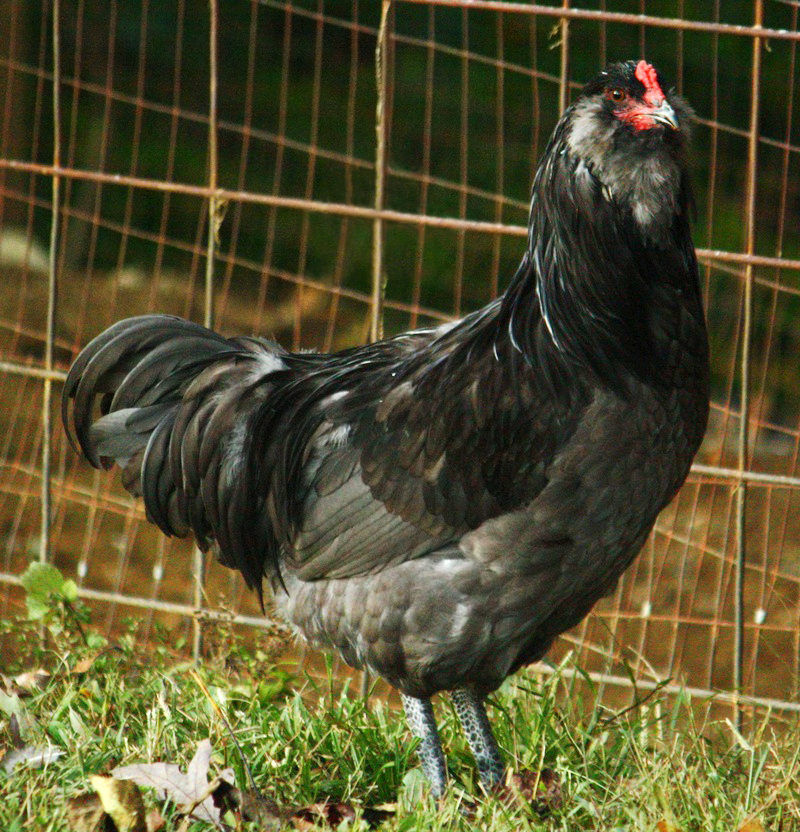
Use: These colorful chickens are actually two distinct breeds, known for production of blue shelled eggs. Unique feathering traits also make these both ornamental breeds.

History: There is often much confusion about these blue egg laying chickens. Araucana chickens were first imported into the United States in the early 1930’s. Little is known about their history prior to that time. They were admitted to the American Standard of Perfection in 1976. Ameraucana chickens were developed in the 1970’s in the United States from Araucanas. They were developed as a practical barnyard fowl that laid pastel shelled eggs, but without some of the limiting genetic factors related to rumplessness and tufts. Ameraucanas were admitted to the American Standard of Perfection in 1984.

Conformation: Araucanas are a medium-sized chicken with a plump and well-fleshed carcass. They have a pea comb, tufts protruding from each side of the neck, no tail and are recognized in Black, Black Red, Golden Duckwing, Silver Duckwing and White varieties. They lay blue shelled eggs. Standard weights: Cock: 5 lbs., Cockerel: 4 lbs., Hen: 4 lbs., Pullet: 3 ½ lbs. Ameraucanas are slightly larger than Araucanas lending the breed to more usefulness as a dual purpose chicken. They also lay blue shelled eggs. Ameraucanas have a pea comb, a beard and muffs and all varieties have slate colored legs. They are recognized in Black, Blue, Blue Wheaten, Brown Red, Buff, Silver, Wheaten and White. Standard weights: Cock: 6 ½ lbs., Cockerel: 5 ½ lbs., Hen: 5 ½ lbs., Pullet: 4 ½ lbs.

Special Considerations/Notes: Many hatcheries over the years have sold ‘Araucanas’, ‘Ameraucanas’ or most recently ‘Easter Eggers’ which is a non-standard mix of chicken that lays blue shelled eggs. The blue egg shell trait is dominant and crossing with other breeds leads to a variety of pastel shell colors including shades of green and pink as well as blue. Pure specimens of either breed have the specific traits listed above; other chickens that lay colored eggs without those specific traits are likely crossbreeds known as Easter Eggers.

Categories
Animals Breeds Poultry

Australorp Chickens

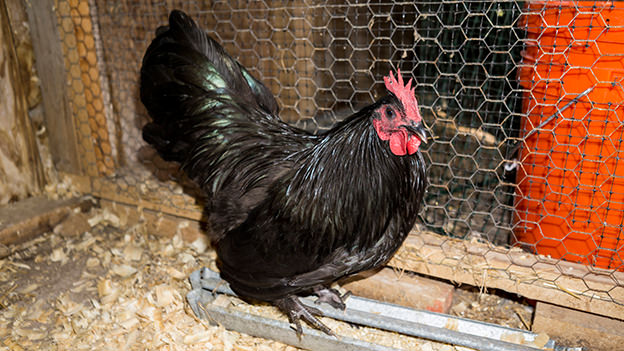
Use: The Australorp is a dual-purpose breed known primarily for extremely prolific production of brown eggs. They were used extensively in the United States in 1930’s and 1940’s for crossbreeding with White Leghorns to produce AustraWhite which was a heavier, high-producing layer. Although they have been surpassed for production by hybrid Leghorns, they are still very useful for economical egg production on small farms.

History: Australorps were developed in Australia from imported Black Orpingtons. They were selected for high egg production and held many records in laying contests around the world. They were admitted into the American Standard of Perfection in 1929 as a member of the English Class.

Conformation: Australorps are a medium-sized breed. Black is the only variety. They are an active breed of moderate proportions with a Single comb. Standard weights: Cock: 8 ½ lbs. Cockerel: 7 ½ lbs. Hen: 6 ½ lbs. Pullet: 5 ½ lbs.

Special Considerations/Notes: Like the other dual-purpose breeds, Australorps forage well and are ideal for small farms.

Categories
Breeds Poultry

Langshan Chickens

Use: The Langshan is the dual purpose breed of the Asiatic Class, being the best layers in that group. They are very good layers of dark brown eggs. Smaller and more active than other breeds in the Asiatic class, they can be used as a table fowl.

History: Langshans originated in China. They were imported into England by Major Croad in 1872 and into America by 1876. One of the three breeds recognized in the Asiatic Class in the American Standard of Perfection. The Black Variety was first admitted in 1883, the White ten years later and the Blue over 100 years later in 1987.

Conformation: The Langshan is the tallest of the non-game breed. Although it is the lightest of the Asiatics, it stands the tallest. Like the other Asiatic breeds Langshans have feathered shanks – though the feathering is not as profuse as Cochins or Brahmas. The Langshan has a distinctive U-shaped profile; the head and tail forming the uprights. Langshans should have a stately appearance set upon firm, balanced legs. They have a large, well-spread tail and great depth of body. They have white skin and a Single Comb. Standard weights: Cock: 9 ½ lbs, Cockerel: 8 lbs., Hen: 7 ½ lbs., Pullet: 6 ½ lbs.

Special Considerations/Notes: Langshans are not typically high on the list for farmyard chickens, but they are prolific layers of dark brown eggs and add a certain majesty to any poultry yard.

Categories
Animals Breeds Poultry

Naked Neck (Turken) Chickens

Use: The Naked Neck (commonly referred to as Turken) is a dual-purpose breed known for the lack of feathering on its neck. This breed is a superb layer of brown eggs and also serves as a table fowl.

History: Naked Necks have a distant and obscure past, but it is generally agreed that the breed originated in Eastern Hungary. They were later reached their closest state of perfection as a breed in Germany. The Naked Neck trait is highly dominant and is passed on the first generation offspring when crossed with a non-naked neck breed. Commonly sold as ‘Turkens’ supposedly a cross between turkeys and chickens, this breed is all chicken. They were imported into the United States in the 1800’s but were not admitted to the American Standard of Perfection until 1965. They are listed in the All Other Standard Breeds Class

Conformation: The Naked Neck trait can be passed on to any breed of chicken, so particular attention to specific color patterns and type is important to distinguish from crossbreeds. Naked Necks are recognized in Red, Buff, Black and White. Barred Necked Necks are also available. They are a moderately-sized and shaped breed with a Single Comb. Naked Necks have less than half the feathers than other breeds of the same size. The bare patches on their skin lack feathers as well as feather follicles and the chicks hatch with the bare patches of skin already present. Standard weights are: Cock: 8 ½ lbs., Cockerel: 7 ½ lbs, Hen: 6 ½ lbs., Pullet: 5 ½ lbs.

Special Considerations/Notes: Naked Necks handle hot and cold weather well and are an interesting and useful addition to any small farm flock.