Categories
Animals Breeds Poultry

New Hampshire Chickens

Use: New Hampshire is a dual purpose breed created primarily for meat production and to a lesser extent egg production. They are rapid feathering and quick growing good layers of brown eggs. New Hampshire breeding figured heavily in some the original broiler breeds in the 1950s.

History: This breed was developed over a period of several years from Rhode Island Reds. Poultry farmers from New Hampshire continuously selected for early maturity, rapid growth, increased size and hardiness. There is no record of any outside blood being introduced. New Hampshires were first admitted to the American Standard of Perfection in 1935. They are listed in the American Class.

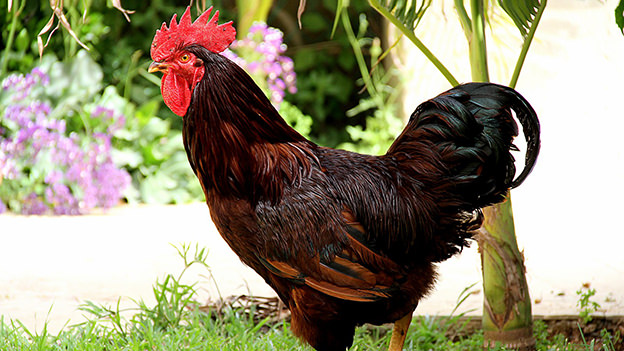
Conformation: Although they were developed from Rhode Island Reds, New Hampshires are much lighter in color and have a body type more closely resembling Australorps than Rhode Islands. There is only one recognized variety although a New Hampshire White was developed in Europe. They have a Single Comb and yellow skin. Standard Weights: Cock: 8 lbs., Cockerel: 7 ½ lbs, Hen: 6 ½ lbs., Pullet: 5 ½ lbs.

Special Considerations/Notes: Although selection in New Hampshires for meat production has fallen off in recent years, there is still great potential for this breed to become useful as an alternative to the conventional broiler or to be used in terminal crosses for small farm broiler production.

Categories
Animals Breeds Poultry

Breed Profiles: Get to Know Orpington Chickens

Use: Orpingtons were originally developed as a heavy meat-producing breed and selected for egg production as well. The lay brown shelled eggs. A dual-purpose breed from England, they are very popular in backyard flocks in America.

History: William Cook of Kent, England developed the Orpington from Black Langshan, Black Minorca, Black Plymouth Rock crosses. Buff and White varieties were developed from other crosses. Cochin blood was also used in some of the earlier crosses as evidenced by the looseness of feathering. Orpingtons were first admitted to the American Standard of Perfection in 1902 in the English Class.

Conformation: Orpingtons are a large heavy-bodied breed with loose feathering and white skin. Plumage is very important in this breed, with large, broad feathers that fit relatively smooth against the body being preferred. They are available in Black, White, Buff and Blue. All varieties have a single comb. Standard weights are: Cock: 10 lbs., Cockerel: 8 ½ lbs., Hen: 8 lbs., Pullet: 7 lbs.

Special Considerations/Notes: Orpingtons have the reputation of being more broody than other dual-purpose breeds though they can be selected for non-broodiness. They also are a docile breed. Buff is the most popular variety.

Categories
Animals Breeds Poultry

Rhode Island Red Chickens/Rhode Island White Chickens

Use: Rhode Island Reds are one of the most popular farmyard chickens for their laying ability and usefulness as a table fowl. They lay a large brown egg. True Rhode Island Reds are a deep mahogany red and forage well on range. They also tolerate semi-confinement although the roosters can become aggressive.

History: Named after the State of Rhode Island, these majestic birds were bred from Red Malay Game, Asiatic native stock and Leghorns in the section around Little Compton near Buzzard’s Bay and Narragansett Bay. The Single-Comb variety was admitted to the American Standard of Perfection in 1904 and the Rose-Comb Variety in 1905.

Conformation: Often described as ‘brick-shaped’ this breed has a distinctive horizontal, oblong body with fairly close feathering. The deep mahogany red offset by black tail feathers with a brilliant green sheen make this breed beautiful in a showroom or in a pasture. They have a medium-sized single or rose comb depending on the variety and both varieties have the same standard weights:Cock: 8 ½ lbs, Cockerel: 7 ½ lbs, Hen: 6 ½ lbs, Pullet: 5 ½ lbs

Special Considerations/Notes: Many hatcheries sell ‘Production Reds’ as Rhode Island Reds, typically these breeds are lighter in color and body weight and do not carry the distinctive brick shape of the Rhode Island Red indicating their impurity or evidence of crossbreeding.

Categories
Animals Breeds Large Animals

Nokota Horses

Use: Nokota horses are being used in a variety of disciplines, including cattle work, trail riding, dressage and hunt seat.

History: The Nokota horse goes back to the wild horse of North Dakota, in the Little Missouri badlands. Wild horses in this region are believed to have the blood of Spanish mustangs and that of Canadian Horses that migrated from the north. In the late 1940s and early 1950s, a band of wild horses was accidentally enclosed within the fenced boundaries of the newly formed Theodore Roosevelt National Park in North Dakota. As wild horses in the northern Plains were captured, the horses enclosed within the park remained the last of their kind. In the 1970s, the National Park Service adopted a policy of removing most of the wild horses from the park, leaving only a very small herd behind for historical reasons. Horses that were removed from the park were auctioned off to local residents. In 1981, a rancher named Leo Kuntz purchased several horses that had been removed form the park. Not long afterwards, the National Park Service released Quarter Horse stallions into the park to breed with the remaining mares in an attempt to make the horses more marketable for auction. In 1986, Leo Kuntz and his brother Frank purchased 54 horses at auction in an attempt to preserve the genetic integrity of the original park horses. The Kuntz brothers purchased more horses that were rounded up in 1991. By 1997, nearly all the horses of the original bloodlines had been removed from the park and purchased by the Kuntz brothers. The Nokota Horse Conservancy was formed in 1998 to help preserve the bloodlines of the original park horses. When the last remaining horse with original bloodlines was removed from the park in 1999, supporters of the Nokota horse Conservancy purchased him at auction. Today, the Nokota Horse Conservancy is working to promote and preserve the breed, and has established a registry.

Conformation: Nokota horses have a square-set, angular frame; a tapering musculature; and a V-shaped front end. Their shoulders are angular and they have prominent withers. The croup is sloped and tail set low. Ears are often slightly hooked at the tips, and many have feathered fetlocks. Nokotas mature slowly, and some have ambling gaits. Nokota horses inherited many of the Spanish coat colors, including roan, frame overo, and dun.

Special Considerations/Notes: Nokotas are a rare breed.

Categories
Animals Breeds Large Animals

Paint Horses

Use: Paint Horses are used for just about every discipline. They are most predominant in western events and as trail mounts.

History: In the 1500s, Spanish conquistadors came to South and Central America, bringing horses with them. Some of these horses had pinto markings. Over time, Spanish horses escaped, and were traded and stolen by Indian tribes. Eventually, pinto horses were found on all the ranches and missions of Southwest. The Pueblo Indians, who had lived here for centuries, learned to ride and became excellent horsemen. Through theft and trading, Indians from other tribes in the U.S. soon acquired horses. Several tribes came to have a special fondness for pintos. As large herds of cattle began to spread through the West, ranchers needed a horse that could help manage the cows. The Quarter Horse breed was developed, mostly as a cow horse. Pinto-marked foals were occasionally born from Quarter Horse breedings, the result of Spanish blood in the breed. Because American Quarter Horse Association did not recognize foals with pinto markings, these patterned horses could not be registered. In the 1960s, admirers of spotted Quarter Horses formed the American Paint Horse Association to preserve and recognize this patterned horse. Today, the Paint is the second most popular breed in the United States, and the fastest growing breed in America.

Conformation: Paints come in two main types of patterns: tobiano and overo. Tobianos have both white and a dark color on their bodies. The dark color can be black, bay, chestnut, buckskin or palomino, and usually covers one or both flanks. All four legs are usually white. The patches in the tobiano pattern tend to be oval or round, and go down over the neck and chest. The face markings on a tobiano are the same as on a solid-colored horse. A tobiano may be mostly dark or white, and the tail is usually white mixed with a dark color. Overos have white and a dark color on their bodies. The white does not cross the back of the horse between its withers and its tail. The white also tends to look scattered or splashed. In most overos, one or sometimes all four legs are dark. Overos have large white head markings, like a bald face, apron face or bonnet face. These horses can be either mostly dark or mostly white, and the tail is usually one color. Because of their close relation, Paints and Quarter Horses have similar conformation. They measure anywhere from 14.2 to 16 hands.

Special Considerations/Notes: Paint Horses with considerable white markings on the face may be prone to sunburn.

Categories
Animals Breeds Large Animals

Percheron Horses

Use: Percherons in America still do heavy draft work on farms, especially those owned by the Amish. They also haul logs in forest work, pull wagons for hayrides and appear in parades. Some people whose who own this breed enjoy showing them at hundreds of draft horse shows throughout the United States and Canada. Percherons can also be ridden, and some have been known to make fine jumpers.

History: The Percheron’s history goes back to Medieval France, when the breed was first developed to carry knights into battle. Much confusion exists about the actual breeds that went into making this horse, but some historians believe the Percheron is closely related to the horse used in the Roman invasion of Brittany. By the time of the Crusades, the Percheron was well established. During peacetime in Europe, the strong body and gentle personality of the Percheron made this horse a good choice for use on farms and in cities. The breed was used to pull the light coaches of French kings, and also called on to haul heavy stagecoaches. In the mid- to late-1800s, Americans needing good work horses for farming and to pull heavy carriages began using the Percheron. In the 1880s, nearly 8,000 draft horses were imported from France to the United States. When farmers in the United States and Europe began using tractors on their farms the early 1900s, draft horse populations began to get smaller. Some farmers still held onto a small number of Percherons out of sentiment, and the breed remained in the United States in small numbers. During the 1980s, the breed’s population began to grow as draft horse breeds came into favor. Today, the breed is managed by the Percheron Horse Association of America. The American Livestock Breed Conservancy has listed the breed as recovering.

Conformation: Percherons are heavily muscled horses as well as powerful. They have a fairly long, level croup with a large, round hip. Good examples of the breed have a large and full prominent eye, a broad and full forehead, and a straight face. Percherons stand anywhere from 15 to 19 hands in height. Most are between 16.2 and 17.3 hands. They weigh in at around 1,500 to 1,800 pounds. They are usually black or grey, although sorrels, bays and roans are not uncommon.

Special Considerations/Notes: Because of their large size, Percherons need stronger enclosures than standard sized horses.

Categories
Animals Breeds Large Animals

Quarter Horses

Use: Quarter Horses are used for a variety of activities, including cow work, western showing, gymkhana, trail riding, dressage and jumping. The breed is still a popular racehorse. Quarter Horses can also be bred to Thoroughbreds to create Appendix Quarter Horses, also registered by the American Quarter Horse Association.

History: The history of the Quarter Horse goes back to the late 1600s, when colonists in New England began breeding horses from Europe to the Chickasaw, a horse of Spanish blood used by Native Americans in the Southeast. By crossing English horses with Chickasaw horses, colonists created a small working horse that was athletic and willing to please. They used this horse for work like hauling logs and plowing during the week, and for racing on the weekends. Races of ¼ mile on dirt roads were popular, and the small crossbred horse eventually became a popular choice for this sport because of its sprinting ability. During the 1700s, the breed became known as the Celebrated American Quarter Running Horse, and was the fastest sprinting horse in America. In the 1800s, Easterners traveling West brought the Celebrated American Quarter Running Horse with them, to ride and to pull wagons. Once established in the West, the horse was used to work the vast herds of Longhorn cattle being bred on the Great Plains. After the industrial revolution, the population of Quarter Horses decreased dramatically. In an effort to preserve the breed, a group of horsemen formed the American Quarter Horse Association in 1940. Today, the American Quarter Horse Association is the largest breed registry in the world. The Quarter Horse is not only the most popular horse breed in the United States, but around the world.

Conformation: Quarter Horses have well-muscled bodies, a broad chest and powerful hindquarters. Because the breed contains Thoroughbred blood, some horses are leaner in type, while others are stockier. Quarter Horses range in size from 14.2 to 16 hands. The American Quarter Horse Association recognizes 13 colors: buckskin, palomino, blue roan, red roan, gray, bay, chestnut, grullo, brown, black, dun, red dun and sorrel.

Special Considerations/Notes: Some purebred Quarter Horses are born with pinto markings, but these horses are not eligible for regular registration with the AQHA. Instead, they can be registered as Paints with the American Paint Horse Association.

Categories
Animals Breeds Large Animals

Rocky Mountain Horses

Use: Rocky Mountain Horses are used often on trail because of their surefootedness and smooth gait. They are also shown in open gaited horse shows, competing with Tennessee Walking Horses, Missouri Fox Trotters and other gaited breeds. Shows just for Rocky Mountain Horses feature classes in trail pleasure, show pleasure, western pleasure, pleasure driving, trail obstacle, pole bending, showmanship, equitation, bareback, costume, lead line and conformation.

History: The Rocky Mountain Horse got its start in the Appalachian Mountains of eastern Kentucky. Breed historians maintain that in 1890, a gaited colt from the Rocky Mountains in the West was brought to live in the mountains of Kentucky. People who lived in the area called the colt “the Rocky Mountain horse.” When this chocolate-colored colt with a flaxen mane and tail matured into a magnificent stallion, he was bred to a number of Appalachian riding mares. The foals that resulted were born with many of the stallion’s characteristics, and are considered to be the first Rocky Mountain Horses. People living in the foothills of the Appalachians used the Rocky Mountain Horse to plow fields, herd cattle, travel over steep and rugged trails, and drove the buggy to church on Sunday. The breed existed in small numbers through the early 1900s well into the century. In 1986, a group of Rocky Mountain Horse breeders in Kentucky formed the Rocky Mountain Horse Association in an effort to help preserve the breed. Today, the goal of the organization is to keep the Rocky Mountain Horse breed pure and of high quality. One way they do this is through an official certification process. Today, the Rocky Mountain Horse is considered a rare breed, and is on the American Livestock Breed Conservancy watch list.

Conformation: These horses stand between 14.2 and 16 hands high, and have a natural, ambling four-beat gait. This gait is either a single-foot gait, which is about the speed of a trot; or a rack, which is faster. These gaits are natural, and Rocky Mountain Horses are born with it. Both gaits are very smooth to ride. Rocky Mountain Horses come in only solid colors. Only minimal white facial markings are desired, and they can’t have any white above the knee or hock. Many Rocky Mountain Horses come in dark chestnut with a flaxen mane and tail.

Special Considerations/Notes: The Kentucky Mountain Saddle Horse, Spotted Mountain Saddle Horse, Mountain Pleasure Horse and Racking Horse are all closely related to the Rocky Mountain Horse.

Categories
Animals Breeds Large Animals

Shire Horses

Use: Shires are still used on farms to plow and pull heavy loads. They are popular at draft horse shows throughout North America, and are used to pull fine coaches. The breed can also be ridden, and is shown at draft horse shows under saddle.

History: The Shire had its beginnings as a European warhorse. The ancestors of today’s Shires carried Roman soldiers into battle and later knights and their heavy armor. In the 16th century, King Henry VIII gave the Shire horse its name, naming it after the shires, or regions, of England. After the breed was no longer used as a warhorse, Shires found a place in England as work horses on farms and pulling heavy carriages over difficult roads. The Shire was also used in British cities, hauling brewer’s wagons through the cobblestone streets. During the 18th century, the Shire became a popular driving horse. These horses were asked to pull coaches, and were bred for pulling carts. The modern Shire type was established about 1790, with further standardization undertaken in the late 1800s. A breed society was formed in England 1878. Crossed with Friesians, Shires became known for a while as Leicestershire Cart Horses and were famous for their high leg action. America discovered the Shire in the late 1880s and began importing many of these horses to work on farms and pull carriages in the cities. As with other draft breeds, their numbers declined with the invention of mechanized farm equipment. By the 1950s, the breed’s numbers had become much lower. It has slowly made a comeback in the United States, and is on the American Livestock Breed Conservancy watch list.

Conformation: Shires are large horses that average 17.2 hands at the withers. Individuals can sometimes reach 19.2 hands, and weigh as much as 2,000 pounds or more. The Shire head has a convex profile, a broad forehead and long ears. The neck is long and well arched, and the legs are short and feathered below the knees and hocks. Shires give an overall impression of substance and power. The breed is most commonly seen in bay, black, brown and gray. Chestnut Shires are sometimes seen, but are rare.

Special Considerations/Notes: The Shire is a large horse that needs sturdier living quarters than standard-sized horses.

Categories
Animals Breeds Large Animals

Standardbred Horses

Use: Standardbreds are bred for harness racing, but go on to a variety of careers after retirement. The breed has been used in parades, dressage, military reenactments, cattle drives, obstacle challenges, police work, pleasure driving, trail riding, jumping, endurance and western events.


History: The Standardbred breed developed in the 1800s from the Thoroughbred, Canadian, Narragansett Pacer and other American breeds. The Thoroughbred origins of the Standardbred trace back to Messenger, a stallion foaled in England in 1780, and later exported to the United States. Man O’War was a descendent of Messenger. Nearly all Standardbred horses registered today go back to a stallion named Hambletonian 10, who was the great-grandson of Messenger. Hambeltonian 10 lived in the 1800s, and was a very successful sire, producing a number of harness horses that easily beat the competition of the day. Standardbreds were initially used only to race at the trot. Pacer races were added in the late 1800s. The breed was given the name “Standardbred” in 1879 because the horses had to complete a one-mile race in a certain, or “standard,” amount of time. Only horses that could do this could be registered. Today, most Standardbred races are still one mile long. An organization called the U.S. Trotting Association was created in 1939 to keep track of the pedigrees of Standardbred horses and promote the sport of harness racing. In 1940, a group of businessmen took the rural sport of harness racing and introduced it to New York City as a pari-mutuel activity. Years later, the night-time racing of trotters and pacers pulling sulkies caught on in metropolitan areas around the country. Today harness racing is well established as a sport.


Conformation: Standardbred horses resemble Thoroughbreds, but have a longer body and are more muscular. Their heads are usually larger than a Thoroughbred’s, and they have powerful thighs. Standardbreds usually stand from 15 to 16 hands, and come in bay, chestnut, brown, gray and black. Trotting Standardbreds are born with the ability to trot at high speeds (as much as 30 mph), and are trained not to break into a gallop. Pacing Standardbreds are born knowing with the ability to pace, and can go as fast as 30 mph.


Special Considerations/Notes: Many adopted Standardbreds used for racing need to be retrained to canter.