Categories
Animals Breeds Large Animals

Suffolk Horses

Use: Suffolk Horses are used primarily for heavy hauling, whether on the farm or at draft horse shows. These horses can also be ridden.

History: Unlike most other draft breeds, the Suffolk Horse (also known as the Suffolk Punch) was developed primarily as a farm horse and not for war. The breed originated in Norfolk and Suffolk Counties of England. Isolated from other counties because of geography, Suffolk farmers developed the breed to accommodate their way of life. The area’s heavy clay soil was difficult to plow and called for a horse that was not only powerful, but also rugged and easily to manage. The breed was used to till and harvest, and individuals were rarely sold. Records on the breed date back to 1880, and show the breed to be pure due to its geographic isolation. The breed was imported into North America in the late 1880s, but decreased in numbers as more farmers switched to mechanized farm equipment. The breed nearly died out. In the 1960s, the few breeders of Suffolk Horses who still existed reformed the American Suffolk Horse Association, an organization that ceased to function in the 1940s during World War II. In the 1970s, more Suffolk Horses were imported to the United States from England to help expand the breed’s gene pool. By the 1980s, the breed’s numbers had increased. Today, the Suffolk Horse is still rare, but is slowly recovering. There are currently between 800 and 1,200 Shires in the United States. Only 150 Suffolks still exist in England. The American Livestock Breed Conservancy considers the breed “critical” on its conservation list.

Conformation: Suffolks are large horses, measuring anywhere from 16.1 to 17 hands, and weighing from 1,400 to 2,100 pounds at maturity. Suffolks have large, straight or convex heads with active ears, and a powerful, arching neck. The shoulders tend to be upright, making them suitable for power. The back is short and strong, and the hind quarters long and smooth. The only color allowed in the breed is chestnut, and can range in shade from light golden to dark liver. Some horses have white markings, usually only a star or snip and white ankles or fetlocks. Suffolk are known for having gentle and easy going temperaments, and a willingness to work.

Special Considerations/Notes: Suffolk Horses are large and need sturdy housing.

Categories
Animals Breeds Large Animals

Tennessee Walking Horses

Use: The breed is used for many different types of riding. Showing takes place in two different categories: Performance and Pleasure. Performance Tennessee Walking Horses wear built-up shoes and perform very dramatic versions of their famous gaits in the show ring. Tennessee Walkers in the Pleasure division are shown in western and English tack, and are considered “light shod” because they don’t wear the built-up shoes of the horses in the Performance division. Tennessee Walking Horses also compete with other breeds in open shows. They can do gymkhana, jumping and reining. They even do dressage in special classes for gaited breeds where the trot is not required. Tennessee Walking Horses also make good trail horses. Some riders use Tennessee Walkers for competitive distance riding, such as competitive trail riding and endurance.

History: The Tennessee Walking Horse is an old American breed that was developed in the 1700s. The Narragansett and Canadian Pacer, the Standardbred, the Thoroughbred, the Morgan, and the American Saddlebred breeds all contributed to the development of the Tennessee Walking Horse. The creation of the Tennessee Walking Horse was prompted by farmers looking for a comfortable horse to ride long distances. These horsemen used common breeds to come up with a hardy horse that was willing to work and easy to ride. This new breed, at first known as the Plantation Horse, was widely used by plantation owners to survey their land holdings. Eventually, the horse came to be known as the Tennessee Walker because it originated in the Volunteer State, and had a smooth, ambling gait. The breed became famous throughout the South for this special gait, which was easy to ride for long periods of time. In 1935, the Tennessee Walking Horse Breeders and Exhibitors Association was formed in Lewisburg, Tenn., to record the pedigrees of the Tennessee Walking Horse. Today, more than 430,000 TWHBEA registered Tennessee Walking Horses can be found throughout the world.

Conformation: The breed has a large height range, from 14.3 to 17 hands. Tennessee Walking Horses also come in a variety of colors, including black, bay, chestnut, brown, buckskin, grey, palomino, cremello and perlino. Tennessee Walking Horses also come in pinto and roan.

Categories
Animals Breeds Large Animals

Thoroughbred Horses

Use: Thoroughbred Horses are bred primarily for racing. They are also popular mounts for jumping, eventing and dressage. Retired racehorses are often used for these disciplines after their careers are over, while some Thoroughbreds are bred specifically for these events. Thoroughbreds are often crossed with other breeds, especially warmbloods, to create sport horses.


History: The Thoroughbred was developed in England in the 1700s strictly for the purpose of racing. Three stallions are credited with being the foundation of the breed: the Darley Arabian, the Godolphin Arabian and the Byerly Turk. Named after the men who owned them, these stallions were born in the Middle East and brought to England for breeding at the turn of the 17th century. They were bred with the strong native horse of England. The horse that resulted from this crossing could carry a rider’s weight with speed over long distances. This quality proved popular with the British aristocracy and the newfound sport of horse racing. Selective breeding began to create the fastest horse on earth. Breeding records were not carefully kept until 1791 when James Weatherby researched and published the first volume of the General Stud Book. The book featured the pedigree of 387 mares that could be traced back to the original foundation stallions. Racing was also popular in America at this time, and Thoroughbreds had already been established in the United States at the time of the colonies. The first volume of the American Stud Book was published in 1873. The breed also played a part in the development of certain American breeds, including the Standardbred and Quarter Horse. The Jockey Club was founded in 1894 to be the principle governing body dedicated to the registry of Thoroughbred horses. Today, the Jockey Club maintains the pedigrees of all Thoroughbreds in the United States. The club’s database contains more than 1.8 million horses on a master pedigree file, including names that trace back to the late 1800’s. Approximately 37,000 Thoroughbreds are registered annually with The Jockey Club.


Conformation: The typical Thoroughbred has a straight head, high withers, and long, fine legs. Standing anywhere from 15 to 17 hands high, Thoroughbreds have a lean, lanky appearance. The colors most often seen in this breed are bay, chestnut, black, brown, and gray.


Special Considerations/Notes: Thoroughbreds are the fastest horses in the world, and can reach speeds of 40 miles per hour on the racetrack.

Categories
Animals Breeds Poultry

African Geese


Use: The African goose is one of the heavyweight breeds. They were developed as a meat breed. Commercial meat geese are raised primarily for meat and feathers.

History: The African has been known by various names throughout its history. The African’s origin is not well documented. Africans arrived to the United States in the mid-1800’s on trader ships. Some experts believe it was developed from the Swan goose of Southeast Asia. Brown African geese were admitted in the first American Standard of Perfection in 1874.

Conformation: This large breed is recognized in two varieties, Brown and White although breeders are working on Buff. Africans are massive in appearance with a pronounced knob on their forehead, protruding from their skull at the upper mandible. They also have a well-developed dewlap that hangs below the jaw in both sexes. The Brown African is a beautiful mix of shades of gray and brown with a dark brown stripe running down the back of their neck. The females have the same coloration and shape of the males although they are typically smaller in size. White Africans are completely white in color with blue eyes and orange knob, bill, shanks and feet. The White variety was not admitted into the Standard until 1987. Africans may not have well developed knobs until they near maturity. Standard weights: Old Gander: 22 lbs., Young Gander: 18 lbs., Old Goose: 18 lbs., Young Goose: 15 lbs.

Special Considerations/Notes: Africans are very hardy and are considered the most docile breed of geese by many. Their knob can be subject to frostbite in extreme cold.

Categories
Animals Breeds Poultry

Goose Breed Profiles: Get to Know Chinese Geese

Use: Chinese geese are the layers of the goose world. They are very prolific, laying from 40 to 100 eggs with proper management. They are in the Light class so are not particularly useful as a market fowl, but will dress nicely with less grease than other breeds. Very ornamental and noisy, they have been used as guardians. They are also active foragers and have been used as weeder geese in strawberry, tobacco and other crops.

History: Like the African, the Chinese is thought to descend from the Asian Swan goose. They were brought to the United States early on as both varieties were well established in Colonial times and admitted into the first Standard in 1874.

Conformation: Chinese geese are available from many sources but geese that meet the American Standard of Perfection description and weights are difficult to find. Chinese geese are small with a long arched slender neck meeting the body at a 45-degree angle. Their body should be short, compact with a prominent breast. Chinese geese have no keels, lobes or dewlaps. They should have a very large, round, prominent knob – the larger the better. White China geese are all white with light-blue eyes and orange bill, feet and shanks. Brown Chinese are colored similarly to the African, with shades of brown and gray and a brown stripe running down the center of the back of their neck. Bills should be black or dark slate with shanks and feet being orange. Standard weights: Old Gander: 12 lbs., Young Gander: 8 lbs., Old Goose: 10 lbs., Young Goose: 8 lbs.

Special Considerations/Notes: Pure Chinese geese are very small, with a graceful appearance. The long arched neck and compact body are very important breed characters. Some sources sell Chinese that are heavier, with shorter necks and larger bodies. Pay particular attention to the Standard description when selecting Chinese geese for breeding purposes.

Categories
Animals Breeds Poultry

Embden Geese

Use: Embden is a heavy goose breed used for meat and feather production. They are the primary breed used in commercial goose production in America.

History: Believed to be developed around the Ems River in Germany, the Embden is one of the oldest breeds of geese. Embdens were first imported into the United States from Germany in 1820. They became popular for commercial goose production and were selected for growth and carcass development.

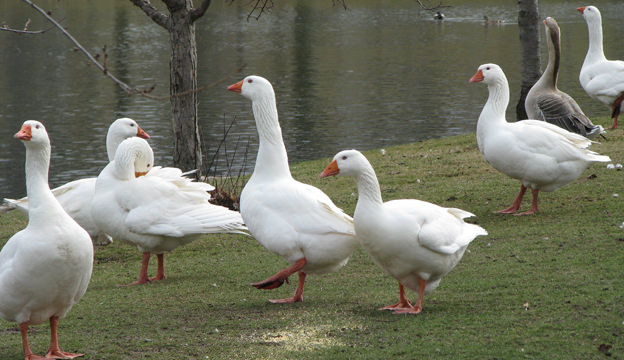
Conformation: The Embden is the tallest breed of goose. They are massive in appearance with all white plumage and orange bill, feet and legs. They should have a rounded breast and paunch with balanced dual lobes hanging between their legs. Eyes are bright blue.

Special Considerations/Notes: Very popular and useful as barnyard goose, the Embden is the most common domestic goose breed.

Categories
Animals Breeds Poultry

Pilgrim Geese

Use: The Pilgrim is in the Medium Class of geese. Though not as large as geese from the Heavy Class, they still produce an excellent roasting carcass and are good mothers. Pilgrims have the distinction of being a sex-linked breed, meaning their sex can be determined by sight using the color of the down or feathers. This is an important economic quality.


History: Contrary to legend, Pilgrim geese were not brought to the United States by early settlers. Oscar Grow, noted waterfowl expert from the early 1900’s developed this breed from one or more of the auto-sexing European breeds such as the West of England goose or the French Normandy goose. Their name was supposedly assigned by Mrs. Grow to commemorate her family’s personal pilgrimage to Missouri during the Great Depression. They were admitted to the American Poultry Association Standard of Perfection in 1939.


Conformation: Pilgrim geese are medium in size; they have no knobs nor a dewlap. They are similar in shape to an Embden, but smaller. The males should be nearly all white with bluish gray eyes and traces of gray in the plumage-typically on the back near the tail and in the wings. The female is a combination of varying shades of gray with white around the bill and eyes, the white patches increasing with age. Color of eyes in females should be hazel brown. Bill, shanks and feet of both sexes should be orange. Newly hatched male goslings are yellowish or silver with light colored bills. Newly hatched females are greenish-gray with darker bills. Standard weights: Old Gander: 14 lbs., Young Gander: 12 lbs., Old Goose: 13 lbs., Young Goose: 10 lbs.


Special Considerations/Notes: Be aware of the distinct coloration of the Pilgrim. Crossbred geese can be passed off as Pilgrims, but will not pass the auto-sexing characteristic of the breed to their offspring.

Categories
Animals Breeds Poultry

Toulouse Geese

Use: Toulouse is a heavy breed of goose used for meat production and exhibition.


History: Toulouse is a very old French breed, developed as a farmyard bird in Southern France and selected for foie gras production in certain regions. They were admitted into the first American Standard of Perfection in 1874. Gray geese commonly sold by hatcheries are called Toulouse but often do not have the massive appearance or dewlap of Standard-bred Toulouse geese.


Conformation: Massive, deep-bodied geese with a large pendulous dewlap are characteristic of this breed. They lack the knob of the African and are recognized in Gray and Buff varieties. Known for large square, broad bodies, they have a deep keel which nearly touches the ground. They should carry themselves nearly horizontal. Like the other heavy breeds of geese they are typically docile.


Special Considerations/Notes: The American Livestock Breeds Conservancy has divided Toulouse into three sub-groups’ Production, Standard Dewlap and Exhibition. The Production type includes smaller gray geese commonly sold by hatcheries. They typically lack the dewlap and massiveness of traditional Toulouse. They are good layers and actively forage. The Standard Dewlap and Exhibition types are the massive birds described above with the Exhibition type having more exaggerated features.

Categories
Animals Breeds Waterfowl

Call Ducks

Use: Calls are mainly kept as lovely little pets and exhibition birds. The females lay up to 75 white or green-tinted eggs each year, and they will actually sit on the eggs and mother their ducklings, unlike many larger duck breeds.

History: The aptly-named Call duck was developed as a living decoy to lure unsuspecting wild ducks into funnel traps and within range of hunters’ guns with its shrill, far-carrying vocalizations. In fact, Calls are still known as Decoy ducks in their native Holland. By the 1850s, Calls had arrived in Britain, and in 1874 they made it into the first Standard of Perfection published by the American Poultry Association. After suffering a decline during the first half of the 20th century, these personable ducks have rebounded to become popular ornamental and show birds.

Conformation: Weighing around 1 ½ pounds, the toyish-looking Call has a plump body, stubby bill, short legs, and rounded head. This breed displays a delightful variety of colors and patterns, including White, Snowy, Pastel, Buff, Gray (a Mallard-like coloration), Chocolate, and Black and White Magpie. Sociable and friendly, Call ducks tend to be fairly hardy once they reach adulthood.

Special Considerations/Notes: Like other bantam waterfowl, Calls require less food and space then the big ducks do – a plus for raisers with limited room. However, if you have close neighbors (or prefer peace and quiet yourself), keep in mind that these ducks can produce a lot of noise for such petite creatures; indeed, they rank as one of the most vocal of duck breeds! They also fly well.

Categories
Animals Breeds Waterfowl

Muscovy Ducks

Use: Muscovies love foraging on pasture, where they convert slugs, snails, mosquitoes, weeds, tender grass, berries and other edibles into tasty, lean meat and eggs. Muscovy females only lay around 50 to 100 eggs a year, but they make devoted broody birds that will gladly set their own eggs, as well as those belonging to other waterfowl, and vigorously defend their young from perceived enemies. These birds can make friendly, fascinating pets, too.

History: While all other farmyard ducks developed from the wild Mallard, the domestic Muscovy arose from a perching, hole-nesting tropical duck species, the wild Muscovy. Domesticated by the indigenous peoples of South America, this large breed served as an efficient, pest-eating source of meat and fresh eggs for centuries, and still does today. Some sources speculate the breed’s Russian name came from a shipping company (called the Muscovite Company) that may have ferried these ducks from the New World to Britain during the 1500s.

Conformation: Muscovies are monsters of the duck world, with drakes tipping the scales at around 15 pounds and females weighing about 8 pounds. Some unkind people call these ducks ugly; more enlightened Muscovy enthusiasts describe their appearance as unusual: vivid red skin adorned with fleshy “caruncles” surrounds the drake’s eyes and bill, while the female’s face has a less warty appearance. Muscovies flaunt a number of different color varieties, including White, Chocolate, Blue and Black.

Special Considerations/Notes: Thanks to their tropical roots, Muscovies tolerate hot weather well (always provide them with water), but they do need shelter during freezing weather. Unlike domestic ducks derived from Mallards, these quackless fowl utter quiet squeaks and hisses, making them a good breed choice if noise is a concern. Use caution when handling these hefty ducks: Muscovies possess powerful wings, clawed feet, and strong, hooked bills – and the feisty disposition to wield them.