Categories
Animals Breeds Waterfowl

Rouen Ducks

Use: North American Rouens come in two types: the standard, raised mainly for exhibition, and the production type, usually kept as an all-purpose farm fowl. Both of these heavyweights make decorative additions to the farm, as well as good meat ducks. The females lay around 35 to 125 whitish eggs a year; some might even be inclined to set, although standard birds may crush their eggs in the process.

History: The Rouen duck derives its name from the French city of Rouen, the historical capital of Normandy. Originating in France, the breed crossed over to England around 1800, where British breeders developed it into a big roasting duck of superior quality. The American Poultry Association included the Rouen in its first American Standard of Perfection in 1874. Once popular as a farm fowl, the breed is now listed by the American Livestock Breeds Conservancy as globally endangered, with fewer than 5,000 breeding birds in the United States.

Conformation: Weighing in at a hefty 10 pounds or so, the Rouen resembles a huge Mallard. The standard Rouen is massive and deep-keeled with a rounded back, while the production type has a sleeker – though still chunky – profile. Drakes sport the striking Mallard coloration of iridescent green head, dark chestnut breast, yellow bill, and orange legs and feet, while the subtle females have a penciled plumage of earthy browns. Rouens are mellow, slow-waddling ducks unlikely to fly the coop because of their large size.

Special Considerations/Notes: Due to its deep keel and heavy weight, the standard Rouen drake will need a pool of water to facilitate breeding. Although these fowl don’t grow as fast as Pekins, raisers can help prevent lameness and other health problems by taking care not to feed growing birds a diet too high in protein if they plan to keep them for show, breeding, or as pets (see Pekin profile).
Categories
Animals Breeds Waterfowl

Runner Ducks

Use: The Runner ranks as one of the best egg producers in the duck world, pumping out up to 300 white eggs per year (however, don’t ask them to set!). Active and quick, these ducks excel at foraging on pasture, devouring pesky slugs and snails, weeds, tender grass and other food items. They also make entertaining pets and cool exhibition birds. Due to their powerful flocking instincts, Runners can stand-in for sheep so herding dogs can practice their moves.

History: Runner ducks, also known as Indian Runners, originated centuries ago in Asia, where they provided farmers with an abundance of fresh eggs. In parts of Asia, farmers traditionally herded these speedy ducks to and from the rice paddies, allowing them to spend the day dining on pests and weeds, fertilizing the crop as they went. After their introduction to Britain during the 1830s, Runners became the rage because of their unusual look and impressive egg output. Although still a favorite today, the American Livestock Breeds Conservancy lists Runners in their “Watch” category, with less than 5,000 breeding birds in the United States.

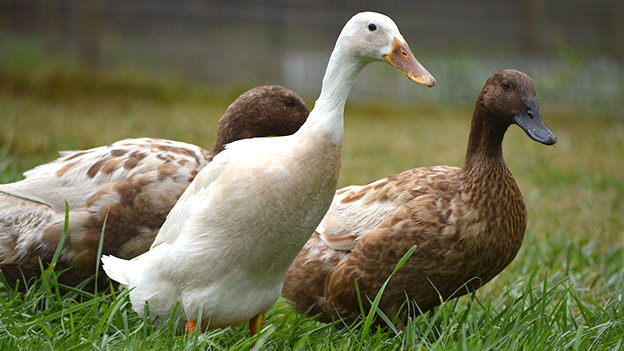
Conformation: The comical-looking Runner has a skinny body, long neck, and amazingly upright stance that make it resemble a long-necked penguin. The slim head has a slightly convex bill and high-set eyes. Classified as lightweights, these ducks weigh around 4 pounds and live up to their name as runners. They flaunt a fantastic variety of colors and patterns, including Black, White, Buff, Chocolate and Gray.

Special Considerations/Notes: If you’re looking for a mellow, slow duck, a Runner would not be your best choice: these ducks have loads of energy. Be sure to pick – and breed for – Runners with strong legs.

Categories
Animals Breeds Large Animals

Poitou Donkeys

Use: Poitou Donkeys are mainly used as draft animals. Some breeders in the United States have trained their donkeys for harness. They don’t make good riding donkeys, because of their slow movement. Jacks are usually kept exclusively for breeding.

History: Some historians believe that the Le Baudet de Poitou, as it’s known in France, existed as far back as during the Roman occupation in 54 BC. Owning this prestigious donkey was a considered a status symbol among the nobility of the Middle Ages. The Poitou Donkey was typically used for breeding, and often was crossed with the Mulassière horse to produce the Poitou Mule. The region, at its peak, produced 30,000 mules per year of very high quality and bred for France and the rest of Europe. These prized mules regarded as the finest working animal in the world. Poitou Donkeys were not gifted riding animals and were used purely for bloodstock. Their coat, called a cadanette, was highly prized by breeders. Genuine efforts were taken to ensure that the donkeys were not crossed with other donkeys or sold out of the region. As a result, the breed was kept pure for hundreds of years. The United States has a number of animals that are pure bred but not inscribed in the Studbook. FABBA (The Franco-American Baudet Breeders Association) was formed in 1999. They are linked with the ADMS (the American Donkey and Mule Society) as the official breeders liaison between the French Studbook and the American and Canadian breeders of Poitou Donkeys. In 1977, just 44 registered purebred donkeys were left in the world. Fewer than 400 currently exist worldwide. The Studbook of France, as stipulated by French law, must be properly inscribed for a donkey to be called a Baudet du Poitous or Poitou. All other donkeys, regardless of purity of breeding, may not use the name if they do not have official French papers.

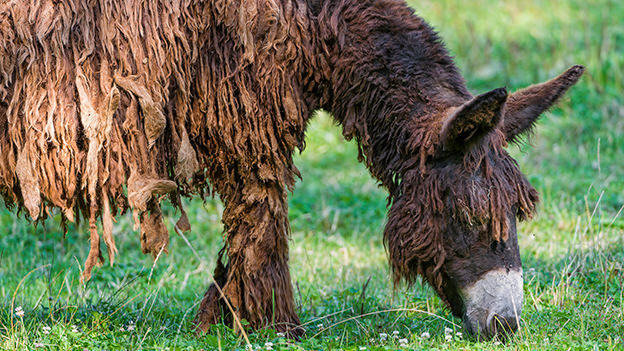
Conformation: The Poitou is notable for its long, soft shaggy coat, which is a rich dark brown or black. The coat hangs in long cords, and bears no cross or stripe. The underbelly is gray and the nose and eye rings are white. The Poitou typically stands from 1.31 to 14.3 hands high. It has a large head and ears proportionate to its body. The donkey’s withers are low, and the back is flat and long. The haunches are round with a flat croup.

Special Considerations/Notes: Today the Poitou Donkey is one of the most endangered breeds in the world.

Categories
Animals Breeds Large Animals

Miniature Donkeys

Use: Miniature Donkeys are mostly kept as pets and companions for other equines. They can be taught to drive and pull a small cart. Small children can also ride them, and they can be trained to carry a small pack. Some horse breeders use them to help foals learn how to lead.

History: Miniature Donkeys were developed in the Mediterranean, just north of Africa in ancient times. The modern version of these donkeys originated on the islands of Sardinia and Sicily. Their small size made them suitable for turning grinding stones for grain inside simple houses. Eighteenth century wood block pictures show these small donkeys, attached to grain mills and walking in endless circles wearing blindfolds. They were also used to carry water from village wells, and to haul shepherd’s supplies into the mountains. Since 1929, Miniature Donkey pedigrees have been recorded in the United States. This date coincidences with the first importation of Miniature Donkeys in the United States. More Miniature Donkeys were brought to the U.S. in the late 1950s and 1960s. An official registry for Miniature Donkeys was started in 1958. Now almost extinct in Sardinia and Sicily, Miniature Donkeys have become a popular pet in the United States, and are catching on in England. The American Miniature Donkey Society and the National Miniature Donkey Association register these equines. Currently, the Miniature Donkey Registry lists 52,000 registered Miniature Donkeys.

Conformation: Miniature Donkeys range in size from 25 inches (the smallest on record) to 36 inches at the withers. They weight from 200 to 350 pounds at maturity. Like all donkeys, they have long ears, a coarse and upright mane, no forelock and a tail covered with short hair and a tassel at the end. Miniature Donkeys come in a number of colors, including gray-dun (or slate gray), red (sorrel), black, brown and spotted. They usually have light tan markings around the muzzle and eyes. Some have dark points. Miniature Donkeys are known for their gentle and affectionate natures.

Special Considerations/Notes: Miniature Donkeys are herd animals and do best when kept with other donkeys or livestock.

Categories
Animals Breeds Large Animals

Mules

Use: Mules are used for a variety of purposes, including draft work, show and trail riding. Mules have been trained for just about every discipline that horses work in, including gymkhana, dressage and eventing. The Bishop Mule Days Celebration, which takes place every Memorial Day weekend in Bishop, Calif., showcases the many talents of mules.

History: Mules are the infertile result of the crossing of a male donkey and a female horse. (Less numerous, hinnies are the result of a male horse and a female donkey, but are also classified as mules.) Mules have been around since ancient times, and were the preferred animal for transportation among the Greeks and Romans. Mules were first bred in the United States in the 1700s, and were used widely through the 1800s for heavy work. They were popular beasts of burden in the West, and played a significant role in the building of the railroads, establishing town and in mining. Among the most famous mules in U.S. history are the members of the 20-Mule Team, which worked 1883 to 1889 hauling the mineral borax through Death Valley for the Pacific Coast Borax Company. A museum in Boron, Calif., honors the work of these mules. Another famous American mule was a jack named Frances, who starred in a number of films in the 1950s. Frances, who spoke only to his army soldier pal, was known as the Talking Mule. Thousands of people have ridden the famous mules of the Grand Canyon, which are the only equines allowed to take tourists into the great gorge from the South Rim. Mules are still popular for both draft work and riding today. They are considered more surefooted than horses, and are hardier.

Conformation: Mules are a combination of a horse and donkey in appearance. Mules have smaller ears than donkeys, but much longer ears than a horse. The head, hip and legs are similar to a donkey. Mules usually have a sparse forelock, coarse mane and a horse-like tail. Mules can be anywhere in size from less than 36 inches at the withers for miniature mules to 17-hands for draft mules. Mules come in all horse colors and patterns, although they usually have light-colored points.

Special Considerations/Notes: In rare instances, mules have been able to reproduce. One molly in a million is fertile. Male mules should always be castrated.

Categories
Animals Breeds Large Animals

American Cream and White Horses


Use: American Cream and Whites are used in many different disciplines, including Western, hunt seat, dressage and trail. Photo courtesy American White American Creme Horse Registry

History: The history of the American White and Cream horses begins in 1908, with the birth of a white colt that would eventually come to be known as Old King. Possessing a pure white coat, pink skin and brown eyes, the young horse captured the attention of brothers Caleb R. and Hudson B. Thompson of West Point, Nebraska, who purchased the stallion in 1917 with the intent of creating a special breed of white horse. The Thompson brothers bred several dark-colored Morgan and mixed Morgan mares to Old King. Half of the foals born to these mares were pure white, just like their sire. Years later, when Hudson left the partnership, Caleb and his new wife Ruth continued breeding these horses and dubbed their new breed “the American Albino Horse.” Creating something called the White Horse Troupe, the Thompsons began traveling around the United States and Canada with a group of white horses. Trained to perform a variety of circus-types acts, the horses wowed spectators with their eye-catching color and incredible talent for unusual feats, including Roman riding, hurdle jumping with a standing rider, jumping over cars and even high school dressage. The Thompsons also gained notoriety for their white breed by sharing the stage with celebrities like Gene Autry and Minnie Pearl. One particular white horse gained fame by being purchased by a prince from India. Another became well known by being ridden by Admiral Haley in a World War II Victory Parade in New York City. And one horse went on to become an animal actor, starring in the film “Thunderhead.” A few years earlier, the Thompsons had started the American Albino Horse Club to serve as a registry for Old King’s progeny. In time, the registry was opened to all true white horses with pink skin and brown, black, hazel or blue eyes, regardless of breed or bloodlines. In the 1980s, horses with light cream coloring and pink skin, known as American Creams, were added to the registry. Over the years, the registry has changed names and moved from Nebraska to Oregon and back to Nebraska again. Today, the official registry for white and cream horses is the American White & American Cream Horse Registry, and is open to horses of all types and parentage, including draft breeds and ponies, as long as they meet the registry’s color requirements.

Conformation: Horses registered as American Whites and American Creams exhibit a variety of types, since the coloration is seen in a few different breeds, including the Tennessee Walking Horse, Thoroughbred, Missouri Fox Trotter and Arabian. American Whites and Cremes with Tennessee Walking Horse and Missouri Fox Trotter breeding exhibit a four-beat gait.

Special Considerations/Notes: The pink skin of American White and Cream Horses is prone to sunburn, especially on the nose. This area should be protected with sunscreen or a fly mask that blocks UV rays.

Categories
Animals Breeds Large Animals

American Morgan Horses

Use: Morgans are used in just about every discipline, including western show, saddle seat events, hunters, jumpers, dressage, eventing, driving and competitive trail riding. They also appear often in parades and drill teams, and are found in many police horse stables.

History: The Morgan horse breed originated in Vermont during the late 1700s with a stallion named Figure. Only 14 hands tall, the small bay horse, believed to have been of Dutch, Thoroughbred and Arabian breeding, became famous for his ability to pull heavy loads and win races. As the horse’s notoriety spread, mare owners brought their horses to him for breeding. Figure, who became known as Justin Morgan, after the man who owned him–was adept at passing along his characteristics to his foals. The resulting horses became known as Morgans. Morgans played a part in early U.S. history, serving as mounts during the Civil War. A number of cavalry regiments were mounted exclusively on Morgans, who were chosen because of their steady dispositions, hardy constitutions and endurance. At the time of westward expansion, Morgans found their way into cavalry units and soon were bred as remounts by the U.S. government. Morgans were also bred in the West to work cattle, and contributed to the development of the Quarter Horse breed. In 1907, the U.S. government responded to the drastic reduction in the numbers of horses being born since the introduction of the automobile. Congress acted to help preserve the Morgan, considered the ultimate cavalry horse. A government breeding program actively began when a Morgan breeder named Joseph Battell donated a 400-acre farm near Weybridge, Vermont, to the U.S. government. The farm was to be used as headquarters for the government’s Morgan breeding program. Eventually, hundreds of Morgan horses were produced at the farm, which is now part of the University of Vermont. In 1909, the Morgan Horse Club was formed in at the Vermont State Fair. In 1971, the organization changed its name to the Morgan Horse Association. Today, the association registers Morgan horses around the world.

Conformation: Morgans stand between 14.1 and 15.2 hands in height and come in just about any solid horse color, including black, bay, chestnut, grey, buckskin, dun, perlino, cremello, and palomino. Pintos are also seen in the breed. The Morgan’s body is compact yet powerful, with a short back and a long croup. The neck springs from a steeply angled shoulder, is slightly arched and crested, thick at the base and blended with the withers. The ideal Morgan has picture-perfect balance, with a high-set tail.

Categories
Animals Breeds Large Animals

American Saddlebred Horses

Use: Saddlebreds are used for exhibition in gaited horse shows. They also compete in open shows in western events, hunt seat, jumping and dressage. Saddlebreds also make good trail horses.

History: The Saddlebred breed began with the development of the Narragansett Pacer, created in the Narragansett region of Rhode Island. British colonists in the New World used Galloway and Hobbie horses from the British Isles to develop this pacing horse, which possessed a smooth riding gait. By the early 1700s, Thoroughbreds were being crossed with Pacers to get a bigger, more versatile horse. Called the American Horse, it inherited an ambling gait from the Narragansett Pacer. Because the American Horse was such an excellent riding mount, colonists used it during the American Revolution and into the early part of the next century. A new breed descended from the American Horse called the Kentucky Saddler, which also had Morgan, Canadian Pacer and Hackney blood. By the mid-1800s, the Kentucky Saddler had come to be called the Saddlebred, and was one of the most popular breeds in the East. When the Civil War began in 1861, these horses carried soldiers and generals into the fighting. Both General Ulysses S. Grant and General Robert E. Lee owned Saddlebreds. The breed’s involvement in the war was of great importance, both during and after the conflict. Historians believe the Saddlebred was valuable in helping the South recover from the war. In the 1890s, a group of breeders organized to “collect, record and preserve” the pedigrees of the American Saddlebred. In 1891, the National Saddlebred Horse Breeders Association was formed in the South, later to be called the American Saddlebred Horse Association. In the days before the Industrial Revolution, the Saddlebred Horse served several purposes. He was a saddle horse mostly, used to comfortably carry his rider from place to place. He could also work as an elegant carriage horse, pulling rigs with style, grace and speed. With the advent of the automobile in the early 1900s, the Saddlebred became mostly a show horse, a job he still excels at today.

Conformation: The Saddlebred has an elegant and refined appearance. Standing anywhere from 15 to 17 hands in height, these horses have large, wide-set eyes and gracefully shaped ears set close together. The neck is long with a fine, arched and well-flexed at the poll. The breed has well-defined and prominent withers, while the shoulders are deep and sloping. A strong level back also characterizes the breed. Saddlebreds come in palomino, chestnut, bay, black, gray, brown, and even spotted (pinto). Saddlebreds are born with three gaits and some go on to be trained to have five. In addition to the walk, trot and canter, five-gaited Saddlebreds also know how to slow gait and to rack.

Categories
Animals Breeds Large Animals

Appaloosa Horses

Use: Appaloosas are known for their versatility, and are used for cow work, Western showing, dressage, cross-country jumping, gymkhana and trail.

History: The colorfully marked Appaloosa horse is best known for his association with the Nez Perce tribe of the Pacific Northwest of the United States. The only tribe to selectively breed horses, the Nez Perce valued the Appaloosa for his willingness, ruggedness and spotted coat. The Nez Perce came to know the Appaloosa horse as a result of the importation of horses by the Spanish conquerors. Among the equines brought to the New World were horses with spotted patterns. Horses with these kinds of markings had been seen in Europe and Asia for centuries, and were treasured for their unique appearance. When the Nez Perce saw these spotted Spanish horses, they were drawn to their wild color. The Nez Perce were great horseman, and had been breeding their own horses for many years when the government opted to obtain land for settlers by moving tribes around the West onto reservations. In 1877, the majority of the tribe was captured and placed on a reservation. In order to make sure the Nez Perce would never be able to escape again, the soldiers were ordered to shoot the tribe’s horses. Many Appaloosas were killed, although a few managed to escape into the hills. These horses, along with Appaloosas that had come into the possession of ranchers near the Nez Perce’s homeland, would eventually become the foundation for a new Appaloosa breed. In 1938, the Appaloosa Horse Club (ApHC) was formed to protect and preserve the Appaloosa horse. The organization searched the country for Appaloosas, and registered a number of horses as foundation sires and dams. The breed steadily grew in popularity, and by the 1970s, was among America’s favorite stock breeds.

Conformation: The conformation type of the Appaloosa horse varies, depending on the individual horse’s breeding. Appaloosas range anywhere from 14.2 to 16 hands in height, and usually have a stock horse appearance. Appaloosas with Thoroughbred breeding are often leaner in type than those of heavy Quarter Horse breeding. The Appaloosa comes in a variety of color patterns, including snow-capped blanket, leopard, blanket with spots, varnish roan and snowflake.

Special Considerations/Notes: The pink skin of some Appaloosa horses is prone to sunburn, especially on the face. This area should be protected with sunscreen or a fly mask that blocks UV rays. Some Appaloosas are also prone to eye problems, including night blindness.

Categories
Animals Breeds Large Animals

Arabian Horses

Use: Arabian horses are used in many different disciplines, including dressage, western showing and trail. They are best known for their dominance in the sport of endurance.

History: While many experts believe that the ancestors of today’s Arabian were domesticated in the deserts of the Middle East centuries ago, no one is completely certain of where the Arabian horse originally came from. His beginnings are mysterious, which seems fitting considering the romance behind the rest of the breed’s history. The first documented breeders of the Arabian horse were the tribesmen of Arabia known as the Bedouins. To these nomadic people who managed to survive in the harsh desert, the Arabian horse was valued above all else. They relied on the horse for transportation and to carry them into battle. To the Bedouins, the Arabian horse was more than just a servant. They viewed their horses as friends, inviting them to sleep in the family tent on cold nights and escape the hot sun there during the day. As a result of this closeness, Arabian horses developed a strong affinity for humans, which lingers to this day. When the Islamic prophet Muhammad ultimately embraced the Arabian horse in the 6th century A.D., the breed became forever etched in human history. Muhammad declared the Arabian a sacred participant in the Holy Wars, and encouraged his followers to meticulously care for their mounts. When Muhammad’s forces invaded Africa, Spain and France, they brought the Arabian horse with them. When Europeans discovered the breed, they recognized its strengths. They crossed Arabians with their heavier horses, incorporating Arabian blood into other breeds in an effort to improve them. The Crusaders also perpetuated the Arabian horse’s influence in Europe by importing them in large numbers and taking the horse around the globe as they spread Christianity worldwide. The influence of the Arabian eventually became such that nearly every modern breed today traces back to this early desert horse. Thoroughbreds, Morgans, Andalusians, Quarter Horses, Paso Finos–these and many other breeds owe their very existence to the Arabian.

Conformation: The Arabian is characterized by a distinctive head with a dished, or concave, face. The head is small and delicate and features large, widely set eyes; small curved ears; and a wide forehead. The Arabian’s back is shorter than that of most other breeds, and his croup is nearly flat. His neck is set on steeply sloping shoulders, giving him a high head carriage. Arabian horses are most commonly seen in grey, bay, chestnut and black, and have long, flowing manes and tails. They usually stand between 14.2 and 15.3 hands.

Special Considerations/Notes: A number of the Arabian horse’s present-day characteristics were bred for by the Islamic people during the time of Muhammad. A feature dubbed the jibbah, which is the bulge between the horse’s eyes, is still present in today’s Arabians. The breed’s greatly arched neck and high crest, called the mitbah, was considered a sign of courage.