Categories
Animals Breeds Large Animals

Belgian Horses

Use: Belgian horses are most often used for draft purposes. Some are still used on traditional farms to work the fields, while others are shown in harness at draft horse shows. Some Belgians are ridden.

History: The Belgian horse breed began in the Middle Ages. Draft horses were used to carry soldiers into battle. When their warring days ended, these heavily muscled horses went on to become the farm horses of Europe. The Belgian Provinces became known for their excellent horses at the time of the Roman Emperor Augustus. The same sturdy animals that were admired by Julius Caesar went on to create the magnificent work horses in later years. In the late 1800s, the Belgian people began to selectively breed their farm horses, creating the Flemish, Brabant and Ardennes breeds. It is from these breeds that the horse known in America as the Belgian was created. In 1887, a group of horsemen formed the American Association of Importers and Breeders of Belgian Draft Horses, and the Belgian breed club, which would later be known as the Belgian Draft Horse Corporation of America. Motivated by a fondness for the sorrel color sometimes seen in the Brabant horse, breeders began to focus on appearance as well as working ability. An American type of Belgian horse began to evolve, and could be seen working in fields from Wisconsin to Ohio alongside the horses that had been imported from European shores. The breed suffered a steep decline during World War II and was nearly lost. It wasn’t until the 1950s that the breed experienced a resurgence. Today, the Belgian is the most popular draft horse in the United States.

Conformation: The American Belgian is a classic heavy horse with a large head and a huge neck, and a powerful, round body. While the American Belgian is a direct descendant of the European draft horse, there are substantial differences in the two. The American horse is most often seen in a sorrel coloration with a flaxen mane and tail, and a white stripe. The European Brabant on the other hand, is usually red roan with a black mane and tail. There is a distinct difference in conformation between the two breeds as well. The American Belgian is more finely built and somewhat taller at 18 hands. The European horse is heavier and stockier.

Special Considerations/Notes: Because of their large size, Belgian horses require more feed and sturdier living quarters than light breeds.
Categories
Animals Breeds Large Animals

Chincoteague Pony

Use: Chincoteague Ponies are used as children’s hunters, and in western and English pleasure classes. Dressage, driving, drill team and ride-and-tie events have recently seen Chincoteague Pony participants.

History: For centuries, Assateague and Chincoteague Islands, located in the Atlantic Ocean just on the other side of the Chesapeake Bay, have been home to herds of feral ponies. The descendents of horses of Spanish origin, these ponies survived on the salt marsh cordgrass, thorny greenbrier stems and seaweed plentiful on the islands. By the 18th century, farmers who inhabited Chincoteague Island had begun capturing select ponies from these herds and domesticating them for use on their land. The ponies proved to be rugged and willing to work, and their popularity grew among islanders. In the early 1900s, Chincoteague and Assateague Islands became popular with tourists. In response, the Chincoteague Volunteer Fire Department was created in 1924, and became an important feature in the island community. In order to help secure funds for much needed equipment, the Chincoteague Volunteer Fire Department began holding annual pony pennings, and sold the captured ponies to raise funds. The welfare of the wild ponies became the responsibility of the fire department. The fire department began monitoring the ponies in their habitat, and in the late 1930s, became concerned that the limited gene pool might start to affect the health of the herd. In an effort to infuse new blood, the fire department introduced 20 BLM mustangs to the islands in 1939 to interbreed with the ponies. Later on, Arabians were also introduced to the island. In 1943, Assateague Island was purchased by the federal government and divided into Assateague National Seashore Park and Chincoteague National Wildlife Refuge. The Chincoteague Volunteer Fire Department continued its job of caring for the ponies, and continued its annual pony penning procedure. When Marguerite Henry authored Misty of Chincoteague a few years later, the islands of Assateague and Chincoteague became tourist attractions for horse lovers who came every summer to watch the annual pony penning and to obtain a Chincoteague Pony of their own. To this day, the annual pony penning and festival is this area’s biggest attraction.

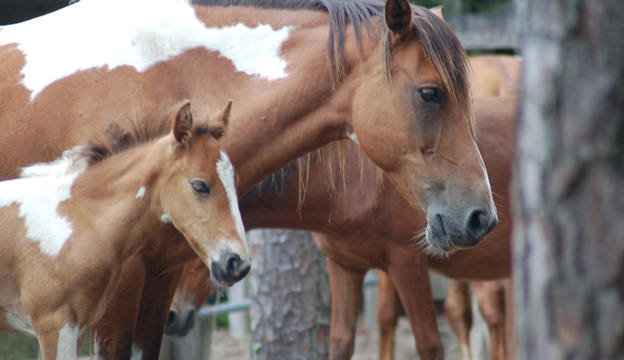
Conformation: Because Chincoteague Ponies are bred through the process of natural selection while in their feral state, the breed’s characteristics are less uniform than what is traditionally seen in other breeds. For this reason, Chincoteague Ponies come in a variety of conformation types. Welsh, Arabian and mustang traits are most common. Nearly all Chincoteague Ponies have an expressive head with a broad forehead, and large, soft eyes. Profiles are either slightly dished or straight, and muzzles are usually tapered. The back is short and the croup rounded. Ponies range in size from 12.2 hands to 14.2 hands, although some individuals are either larger or smaller than this. They also come in just about any color, although pinto markings are most common.

Special Considerations/Notes: Chincoteague Ponies are willing to learn and eager to please. They are also known for being highly intelligent.

Categories
Animals Breeds Large Animals

Cleveland Bay Horses

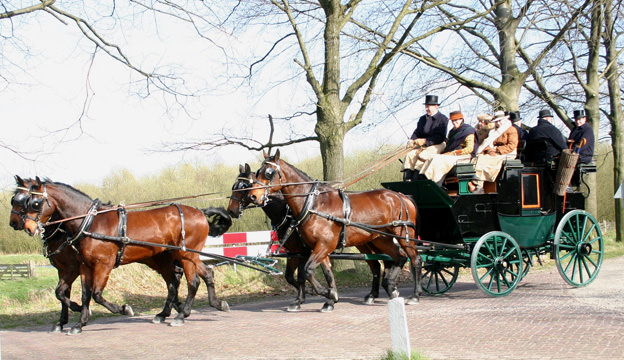
Use: Cleveland Bays are known for being excellent carriage and driving horses, and are often driven in teams of two, four or six. The breed has competed at FEI level in driving. They are also used for eventing and hunt seat. The breed is often crossed with the Thoroughbreds to create a lighter sport horse suitable for jumping, eventing and dressage

History: The Cleveland Bay originated in the Cleveland area of northeast England. The breed’s ancestors worked as pack horses in the monastic houses of north eastern England, carrying goods between abbeys and monasteries. These pack horses were known as Chapman hoses and were bred in the Yorkshire Dales. When barb horses were introduced to England, they bred with Chapman horses to create a light harness horse similar to today’s Cleveland Bay. By the late 1800s, this horse was being used in other areas of England besides the northeast. The need for faster carriage horses lead horsemen to cross the Cleveland Bay with Thoroughbreds. The resulting breed, the Yorkshire Coach Horse, was tall and elegant. It became a popular horse with the wealthy in Europe and was soon exported all over the world. The breed came to America in the late 1800s, and curried favor with the famous showman Buffalo Bill Cody. He drove a team of four Cleveland Bay stallions in his Wild West Show. The breed declined with the invention of motorized vehicles and considerable crossbreeding, and today is considered rare.

Conformation: Cleveland Bays are known for their intelligence and willing disposition. They are medium-weight horses, and are heavier in build than most warmbloods. They are hardy, long-lived horses that measure anywhere from 16 to 16.2 hands. Their bodies are wide and deep and the back strong with muscular loins. The shoulder is sloping, deep and muscular, and the hindquarters are level and powerful. The head is carried on a long, lean neck. These horses only come in bay. The only white marking allowed is a small star on the forehead.

Special Considerations/Notes: Cleveland Bays are very rare, with only 200 alive in the United States, and 500 alive worldwide. The American Livestock Breed Conservancy ranks the Cleveland Bay as “critical” on its endangered breeds list.

Categories
Animals Breeds Large Animals

Clydesdale Horses

Use: The Clydesdale is most known for its abilities as a draft horse, and the breed is used in driving shows and exhibitions. Clydesdales can be ridden as well, and are being seen on trails around the country.

History: Descending from the warhorses of the Middle Ages, the Clydesdale’s more modern ancestors worked in the fields of Scottish farmers. In the 18th century, the Clydesdale took on its modern appearance. A system present at the time in Scottish agriculture, which dictated the hiring of particular stallions to service mares within each district, helped to create a breed of horse that was consistent in type. Slowly, the breed developed a distinctive look, and eventually became known as the Clydesdale, a name taken from the area of Scotland we know now as Lanarkshire. The breed’s official debut under the name of Clydesdale was in 1826, at the Glasgow Exhibition. Because of the Clydesdale’s great strength and tractability, the breed was used as a workhorse on Scottish farms, and to haul coal. Today, the Clydesdale is virtually the only draft horse seen in Scotland. In 1877, the Clydesdale Horse Society was founded in Great Britain. In 1879, Americans in the Midwest who were using the breed to work their farms and to haul heavy loads joined together to form the American Clydesdale Association. The name was later changed to the Clydesdale Breeders of the United States, and now includes Clydesdale aficionados from both the United States and Canada. While not as popular as the Belgian and Percheron, the Clydesdale was in some demand during the late 1800s in America. It was not until the arrival of mechanized machinery that the Clydesdale’s popularity–along with that of the other draft breeds–began to slip. Powerful workhorses were replaced on farms by motorized tractors, which did not have the same maintenance requirements as the big horse, and could do a lot more work in less time. As the need for Clydesdales lessened, the breed’s numbers began to shrink. A handful of breeders dedicated to the breed hung on desperately, and continued to keep the Clydesdale alive as a show and exhibition horse.

Conformation: Clydesdales measure anywhere from 16.2 hands to 18 hands, and can weigh from 1,600 pounds to 2,200. Color and markings also vary within the breed. Most Clydesdale are bay with a white blaze and white stockings, but some also come in black, brown and chestnut. Roans are seen in all of these colorations. While the preferred markings are four white socks to the knees and hocks, and a well-defined blaze or bald face, horses with one or more dark legs are often seen. White patches on the belly–called “splashes” in the breed–are also common, although somewhat controversial; some Clydesdale breeders don’t like the splashes, while others believe they should not be considered a flaw. Clydesdale breeders look for horses with “action,” which they describe as high-stepping movement with a distinct lifting of the feet. Each foot must be raised well off the ground, leaving someone standing directly behind the horse able to clearly see each and every shoe as it flashes into the air. The Clydesdale is known for having a gentle and tractable disposition.

Special Considerations/Notes: The most famous Clydesdales in the world are the Budweiser Clydesdales. For the past 75 years, Anheuser-Busch has been exhibiting these horses, which are bred specifically to represent the Budweiser name.

Categories
Animals Breeds Large Animals Uncategorized

Colonial Spanish Horses

farm-breed-profiles/SpanishMustang-pav_190.jpg

Photo Credit: Audrey Pavia


Use: Colonial Spanish horses are used in a variety of disciplines, including cow work, eventing and endurance. Photo by Audrey Pavia.


History: Spanish Conquistadors brought horses to New World, and by the 1500s, horses were established in the Southwest among the native populations. They gradually spread north, east and westward to the Southeast, the Plains and the Pacific Northwest. The horses that became the mounts of Native Americans were uniquely of Spanish origin and type. In the 1800s, as tribes were gradually defeated by the U.S. cavalry, their horses were destroyed. Thousands of Spanish Mustangs were shot by the U.S. cavalry under government orders. The few Spanish Mustangs that were not killed were bred to Thoroughbred stallions by the cavalry in the hopes of creating a rugged horse with greater size. Despite the widespread destruction and crossbreeding of Spanish Mustangs, some pure, isolated pockets of these horses remained into the 20th century. These rare animals lived in feral groups, mostly in the West. The rangeland where they lived was remote enough that they remained fairly pure in breeding. In 1957, a Wyoming horseman named Bob Brislawn started the Spanish Mustang Registry in an attempt to save what was left of the original Spanish Mustang. In 1925, he had begun trying to preserve these horses by starting his own breeding program. After establishing the Spanish Mustang Registry, Brislawn continued his quest to save the breed by purchasing a number of these horses from an Apache mustanger in Utah, Monte Holbrook, who rounded them up from the wild with the help of his son, daughter and wife. These 20 horses would become the foundation stock of the Spanish Mustang registry. Today, several different organizations exist to represent different strains of the Colonial Spanish Horse. The American Livestock Breed Conservancy, which has placed the Spanish Mustang on its “critical” breeds list, recognizes several strains of Colonial Spanish Horse—horses that descend from the original Spanish horses, but are of different breeding. The ALBC strains that are found in horses registered with the Spanish Mustang Registry represent horses that were gathered from different parts of the country. They include the Choctaw, Cerbat and New Mexico. Other strains in the breed include Bookcliff, Cherokee, Yates and McKinley. Outside the definition of Spanish Mustangs but considered Colonial Spanish Horses by the ALBC are the Cracker Horse, Pryor Mustang, Sulphur and Marsh Tacky.


Conformation: Conformation differs among the different strains of Colonial Spanish Horse, but generally speaking, these horses measure anywhere from 13 to 15 hands. These horses often have a straight to concave forehead and a nose, which is straight or slightly convex. The muzzle is fine and small, with crescent-shaped nostrils. They come in all horse colors and patterns, including dun, grulla, pinto and Appaloosa.


Special Considerations/Notes: Only 3,000 Colonial Spanish Horses exist in the United States. Includes horses registered by the Spanish Mustang Registry, Southwest Spanish Mustang Association, Spanish Barb Breeders Association, Horse of the Americas, American Indian Horse Registry, and strain registries.

Categories
Animals Breeds Large Animals Uncategorized

Hackney Horse Horses

farm-breed-profiles/HackneyLangrish_190.jpg

Photo Credit: Bob Langrish


Use: The Hackney Pony is mainly used for showing, and competes in driving, riding and showmanship classes. Some are also used under saddle in dressage. Hackneys ponies are shown in four divisions depending on their size and type. The Hackney Horse can be shown single, pair, four in hand, obstacle, or under saddle. Hackney Horses are also ridden in eventing, hunter/jumper, dressage, English pleasure and competitive trail. Photo by Bob Langrish.


History: The Hackney originated in Norfolk, England, where horses called Norfolk Trotters had been bred for elegant style and speed. Breeders began mating Norfolk mares to Thoroughbreds in the mid-1700s to create the beginnings of the Hackney. Over the next 50 years, the Hackney was developed as a special breed. Vast improvements in British roadways in the mid-1800’s contributed to the development of the Hackney, which was a swift trotting horse. Better roads meant that lighter horses could travel them, and could move with considerable speed. The breed was well-established by 1883, when the Hackney Stud Book Society was founded in England. The Hackney Horse was a popular driving horse in England and the United States in the late 1880s. The first Hackney pony imported to America was brought to Philadelphia in 1878. In 1891, the American Hackney Horse Society was founded. The breed still exists today primarily for show.


Conformation: Hackneys come in black, brown, bay and chestnut, with or without a facial strip and white stockings. The breed’s small head features a delicate muzzle and ears, and the neck is long and blends into a broad chest and powerful shoulders. Hackneys come in difference sizes and types. The Cob Tail pony is 14.2 hands and under at the withers. They are shown with the appearance of a shortened tail and with a braided mane. Long Tail ponies measure 12.2 hands or under at the withers, and are shown with a long mane and an undocked tail. The Roadster pony measures below 13 hands and shows at three separate trotting speeds: the jog, the road gait, and at speed. The Pleasure Pony is 14.2 hands or under, and is well mannered and a pleasure to drive. The Hackney Horse stands over 14.2 hands. The Hackney breed is known for its distinct movement, high leg action and trainability.


Special Considerations/Notes: Some Hackney ponies have docked tails.

Categories
Animals Breeds Large Animals

Irish Draught Horses

Use: The Irish Draught is considered a warmblood breed, and is used for jumping, hunters, dressage, eventing, driving, foxhunting and halter. The breed is also commonly crossed with Thoroughbreds to create the Irish Draught Sport Horse in the United States and the Irish Sport Horse in Europe. Irish Sport Horses are among the top competitors in the Grand Prix jumping world and also in eventing.

History: The origins of the Irish Draught are thought to stem from the chariot horses of the Roman Empire, Anglo-Norman warhorses and horses of Spanish breeding, which all mingled over the centuries in Europe. From 1850 to 1950, Irish farmers developed the Irish Draught, a versatile horse that could work in the fields, foxhunt and pull a carriage. In the mid-1900s, the Irish Draught became a popular cross with Thoroughbreds to create the Irish Sport Horse. The breed nearly became extinct because of considerable outcrossing. In addition, Irish breeders stopped registering their horses during periods of poverty and famine. Breed enthusiasts and the Irish Horse Board spent considerable time to start a new stud book. While putting this document together, they discovered that many Irish Draught horses were being sent to slaughter, leaving very few of these to carry on the breed. The Irish Draught Horse Society was founded in 1976 to help save the breed, which is still represented by only has 2,000 individual horses worldwide.

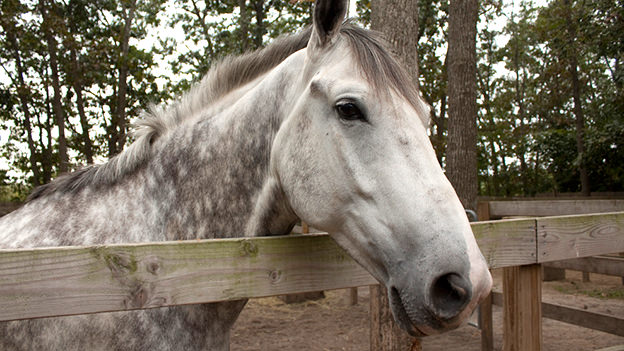
Conformation: The Irish Draught Horse is a powerful horse with considerable substance. It is has a deep girth, and a strong back and hindquarters. The withers are well-defined, and the croup is long and sloping. The head features a wide forehead and long ears. Some horses have a slight Roman nose. Stallions stand from approximately 15.3 to 16.3 hands, while mares usually measure 15.1 to 16.1. The breed comes in all solid colors, including gray. White that reaches above the hocks or knees is not acceptable. The Irish Draught’s movement is smooth and free.

Special Considerations/Notes: The Irish Draught is a rare breed in need of conservation. The European Food and Agriculture Organisation (FAO) of the United Nations classifies the Irish Draught horse as an endangered breed due to the declining population size. The American Livestock Breed Conservancy lists the Irish Draught as a breed under study.

Categories
Animals Breeds Large Animals

Miniature Horses

Use: Miniature Horses are used for driving small carts. They are also shown in halter classes, and used for riding by very small children. Many Miniature Horses are simply pets or serve as companions for other animals.

History: The origins of the Miniature Horse lie in Europe. In the 1600s, horses were bred down in size to be pets for the wealthy. Some of these small horses ended up working in Dutch and English coalmines in the 1700s, pulling carts underground. These small mining horses were brought to the U.S. in the 1900s and put to work pulling coal wagons in the Appalachian Mountains. Eventually, Shetland Ponies were bred to these “pit ponies” to create the Miniature Horse we see today. A different type of Miniature Horse called a Falabella was created in Argentina. In a harsh part of the country called the Argentine Pampas, the tiny Falabella was bred to survive in the desert. Measuring no more than 40 inches at the withers, the Falabella looked like a regular-sized horse, in miniature. In 1970, 25 Falabellas were imported to the U.S. and a breeding program started in Pennsylvania. In the U.S., the Miniature Horse became a recognized breed in 1971 by the American Miniature Horse Registry. Since then, another breed registry, the American Miniature Horse Association, also came into being, in 1978. For the Falabella, the Falabella Miniature Horse Association was created in 1973.

Conformation: The American Miniature Horse Association and the American Miniature Horse Registry have different criteria regarding size. The American Miniature Horse Registry has two divisions. In Division A, Minis can be up to 34 inches in height, while in Division B, they can range anywhere from 34 to 38 inches. In the American Miniature Horse Association, Minis must measure 34 inches or less to be registered. Falabella horses registered with the Falabella Miniature Horse Association are 30 to 32.5 inches at the withers. Some are even as small as 23 inches. Although the Falabella has its own registry, it can also be registered and shown with the American Miniature Horse Association and the American Miniature Horse Registry. Miniature Horses with all three registries come in every color seen in full-sized horses, including Appaloosa and pinto patterns. Some also have curly coats.

Special Considerations/Notes: Miniature Horses easily contract laminitis if given food that is too rich or if they are allowed to become overweight.

Categories
Animals Breeds Large Animals Uncategorized

Missouri Fox Trotter Horses

farm-breed-profiles/MOFoxTrottr-pav_190.jpg

Photo Credit: Audrey Pavia


Use: Missouri Fox Trotters are shown in jumping, western classes, parades, gymkhana and competitive trail riding. They are also common as family and pleasure horses, and are known being gentle and good for beginners. Photo by Audrey Pavia.


History: The origins of the Missouri Fox Trotter are in the Missouri Ozarks, where pioneers from Kentucky, Illinois, Tennessee, Virginia and Arkansas settled after Missouri was given statehood in 1821. The horses they brought with them interbred over the decades, resulting in a surefooted horse with considerable stamina able to negotiate the rugged Ozark Mountain terrain. They used these horses to plow, work cattle, haul logs and for general transportation. In time, the breed was given the name Missouri Fox Trotter because of its smooth, four-beat gait. In 1948, an association formed to maintain the breed’s studbook. The association took the name of Missouri Fox Trotting Horse Breed Association in 1958, and was reincorporated as a stock company. In 1973, the organization changed to a membership association. The studbook remained open until 1983. Today, Missouri Fox Trotters can be found in all 50 states and Canada. Nearly 50,000 of these horses are currently registered.


Conformation: The Missouri Fox Trotting Horse usually stands between 14 and 16 hands in height, and averages a weight of between 900 to 1200 pounds. The breed has a graceful neck; a neat, clean, symmetrically shaped head of medium length; pointed ears that are well shaped; eyes that are large, wide set and bright; and a tapered muzzle with large nostrils. The back should be reasonably short and strong. Shoulders should be sloped at a 45 to 50 degree angle, and moderately muscled. Missouri Fox Trotters can be found in palomino, cremello, perlino, chestnut, black, brown, bay, buckskin, gray, roan and pinto. Missouri Fox Trotters are born with the ability to perform the fox trot and the flat foot walk, in addition to the canter. The fox trot is a collected gait that features a walking step in the front and a trotting step behind. The flat foot walk is a four-beat gait that differs from the fox trot in that it features a steady, equal, four-beat cadence produced by the hooves.


Special Considerations/Notes: The Missouri Fox Trotter is the official state horse of the Show Me State.

Categories
Animals Breeds Large Animals

Mountain Pleasure Horses

Use: Mountain Pleasure Horses are used primarily as family horses, rather than for show, although the breed association does sponsor a breed show each year. Mountain Pleasure Horses make excellent trail mounts because of their sturdy constitution and calm dispositions.

History: The Mountain Pleasure Horse developed in the limestone plateau west of the Appalachian Mountains. Horse that were rugged and sure-footed were in high demand, so breeders crossed English and European horses from the East Coast to with tough Spanish horses, many of whom were gaited. The resulting horse, now known as the Mountain Pleasure Horse, has changed very little in the past 100 years. Characteristics of a primitive Appalachian gaited horse are still evident in the breed. In 1989, the Mountain Pleasure Horse Association was formed to conserve and promote the breed. The association currently has about 3,000 horses registered. The group aims to maintain the heritage of the breed, with emphasis on its kind disposition and comfortable, natural gait. The Mountain Pleasure is closely related to the Rocky Mountain horse and many horses are included in registries of both breeds. In 1994, Kentucky governor Brereton Jones issued an official proclamation about the Mountain Pleasure Horse, indicating the breed has been carefully and closely breed for more than 160 years in Kentucky. The proclamation also stated that blood typing by the University of Kentucky has shown the Mountain Pleasure Horse to be the parent stock of the Rocky Mountain Horse, the Tennessee Walking Horse and the American Saddlebred.

Conformation: Mountain Pleasure horses vary in type. Some have Spanish features, while others resemble more modern breeds. All types should have a deep, wide chest; long, sloping shoulders; and a gracefully arched neck that is medium in length and set at an angle to allow natural carriage with a break at the poll. All types have a smooth, four-beat gait instead of a trot. Foals are born with this gait, and no special training is needed for the gait to be present. Mountain Pleasure Horses stand 14.2 to 15.2 hands high and come in many solid colors, including gray and roan. Horses with pinto markings are not desirable for breeding. The breed is renowned for its calm and willing temperament.

Special Considerations/Notes: The Mountain Pleasure Horse is considered a rare breed and appears on the American Livestock Breed Conservancy watch list.