Categories
Animals Breeds Large Animals

Mustang Horses

Use: Sometime called Bureau of Land Management Mustangs or BLM Mustangs, these horses have been used in every discipline, including hunt seat, jumping, western, trail, gymkhana, driving and cow work. They excel in endurance, and exceptionally rugged. They often make reliable and confident mounts.

History: The first wild horses in North America were descendants of the horses brought to this continent by the Spaniards. Escapees from ranches, these horses were once the mounts of European conquerors and went on to become the first wild horse herds in the United States. These first wild horses, descended from pure Spanish blood, came to be known as Spanish Mustangs. In some parts of the United States, descendants from these same wild horses can still be found in isolated pockets of the West. In most cases, however, today’s wild horses are descendants of ranch horses that escaped into the wild over the last several decades. They can be found throughout the United States, although most live in Nevada, California and Utah. In the 1960s, wranglers rounded mustangs up by the thousands and sold them to be slaughtered for pet food. In the 1971, pubic outcry convinced Congress to pass the Wild Horse Protection Act, which made it illegal to capture and sell wild horses for slaughter. Since that time, wild horses have enjoyed protection on the government lands where they live, in states such as California, Nevada, Wyoming and Montana. Controversy still rages over whether wild horse herds should be allowed to live undisturbed or be rounded up periodically and put up for adoption. Currently, thousands of wild horses are rounded up by Bureau of Land Management (BLM) agents each year, using trucks, helicopters and riders on horseback. After capture, the horses are sent to adoption centers around the country, where those interested in providing a home for a wild horse can bid on their horse of choice.

Conformation: Mustangs come in many different types. Conformation varies depending on the originating herd. Most are between 14 and 15 hands, and many show characteristics similar to the Spanish Mustang. Mustangs come in every solid color and pattern known in horses. They typically have hard hooves and a strong constitution.

Special Considerations/Notes: Mustangs require considerable training after adoption from a BLM facility. Most have never been handled by humans.

Categories
Animals Breeds Large Animals

Brahman Cattle

Use: Large or small, zebus are the quintessential cattle for hot, steamy climates where non-humped Bos taurus breeds fail to thrive. Not only used as beef and household dairy producers in tropic and semi-tropic parts of the world, zebu bulls are used to sire hardy, heat-resistant calves from cows of other breeds. Consider the Brahmin bull in our own Southern states. He’s been used to create breeds as diverse as the Brahmousin (Brahmin and Limousin), Beefmaster (a combination of Hereford, Shorthorn and Brahman genetics), Braford (Brahmin and Hereford), Brangus (Brahmin and Angus), and Santa Gertrudis (a unique blend of Brahmin, Hereford, and Shorthorn genetics blended at the vast King Ranch in Texas).

History: The ancient aurochs, a tall, massively built bovine that once ranged from Asia to Europe and south to the Middle East, was tamed in several locations, one of them being the Indus Valley of Pakistan. These humped cattle became Bos indicus, better known to the modern world as zebus. Two types of zebus call North America home: the Brahman and the Miniature Zebu. Brahmin (sometimes referred to as Brahma) cattle were developed in our Southern states in the early 1900’s using the genetics of four different Indian breeds, some by way of Brazil where zebu cattle are treasured for their heat tolerance, hardiness, and disease resistance. Miniature Zebus are a separate breed and not miniaturized versions of their larger Brahmin cousins. They are descended from Indian Nadudana zebu cattle imported by zoos during the early years of the twentieth century.

Conformation: Zebus of all breeds (and there are an estimated 75 breeds world-wide) have a number of characteristics in common. All have distinct humps over their shoulders and necks that are larger in zebu bulls and steers than the humps on zebu cows. Both sexes have pendulous dewlaps hanging from their necks to provide more skin surface for cooling. Zebus have more sweat glands than non-zebu cattle so they also dissipate heat through sweating. Their unusually mobile, oily skin helps repel bothersome bugs. All have dark skin pigmentation, so skin cancer rarely poses a problem. Zebus are also resistant to tropical diseases like rinderpest in Africa and to parasites that quickly fell European cattle breeds. They’re known for being docile, friendly, intelligent animals when handled with kindness. Most Brahmins are gray, ranging from porcelain to nearly black, but come in other colors, particularly red. Cows weigh in the neighborhood of 1000 to 1400 pounds, while bulls tip the scale at 1600 to 2000 pounds. They’re noted for their long, pendulous ears and attractive, up-curved horns that often tilt back at the tips. Miniature Zebus come in an array of colors including cream, gray, black, red, and spotted. Mature cows weigh only 300 to 500 pounds; bulls, 400 to 600 pounds. They are measured at the withers behind the hump and cannot exceed 42 inches tall at three years of age. Unlike Brahmins, Miniature Zebus have shorter, less pendulous ears. They are registered by two organizations, the American Miniature Zebu Association and the International Miniature Zebu Association. There are fewer than 1000 Miniature Zebu in North America.

Special Considerations/Notes: While most people associate zebus with Southern climes, in fact Brahmins and Miniature Zebus are hardy, adaptable animals that given protection from weather extremes, fare well in Northern states too. Both breeds thrive on low-quality forage. They are exceptionally long-lived and due to their calves’ low birth weight, calving problems are rare indeed.

Categories
Animals Breeds Large Animals

British White Cattle

farm-breed-profiles/BritishWhiteOK_190.jpg

Photo Credit: Courtesy Oklahoma State University


Use: British Whites are medium-size beef cattle about the height and size of Herefords or Angus. Both sexes are docile, fertile, and extra-friendly; even heifers calve with ease. They’re long-lived, productive (owners say these cows produce more pounds of calf per acre than any other breed in existence), and they thrive on middling pasture. Another bonus: they tend to stay put; they don’t challenge poor fences the way some other breeds do.


History: A great deal of confusion surrounds the origin of British White cattle. However, thanks to recent blood protein studies we know one thing is certain: they are not descended from Britain’s horned White Park cattle (known as Ancient White Park cattle in North America) as their advocates once believed. Most bovine historians think British White cattle trace their roots to eight- or ninth-century Scandinavia and that Viking traders may have carried them to the British Isles. What’s certain is that the British White herdbook was established in England in 1918, where the breed is now flourishing as never before. However, on the brink of World War II, British fanciers feared for their cattle’s survival. As a hedge against disaster, they shipped five cows and a bull to a prison farm in Pennsylvania. These animals, plus British Whites imported during the 1700’s, and several more bulls imported from England during the twentieth century, form the foundation of today’s American White Park and British White herds. In 1975, a registry formed, calling itself the White Park Cattle Association of America (it’s now called the American British White Park Association). The original name created considerable confusion since the breed is descended from British Whites instead of White Park cattle, so when a second group formed in 1987, organizers called it the British White Cattle Association of America.


Conformation: British White cattle are white with black points (noses, eyes, ears, teats, and lower front legs) and some cattle have scattered spots of black along their sides. Occasionally a red-pointed or line-backed calf is born and this has occurred throughout the breed’s history. Most are polled (naturally hornless) although three- to five-percent are horned (the American British White Park Association registers horned cattle, the British White Cattle Association of America does not), and rudimentary horns called scurs sometimes occur.


Special Considerations/Notes: British White Cattle are ideal for the farmer who wants to produce a lot of tasty beef (particularly organic or grass-fed beef) but who doesn’t care to deal with flighty cattle.

Categories
Animals Breeds Large Animals

Chianina Cattle

Use: Chianinas are not only outstanding beef producers by and of themselves, they are wide employed as sires to produce composite breeds like the Chiangus and Red Chiangus (a blending of Chianina and Angus genetics), Chiford (Chianina and Hereford), and Chimaine (Chianina and Maine-Anjou), all of which are also registered with the American Chianina Association.

History: The Chianina (kee-a-NEE-na) is an ancient breed that originated in the Chianina Valley in central Italy at least 2000 years ago. Developed as massive, hard-working draft animals, from the beginning Chianinas were tall, muscular cattle. Roman authors Virgil and Columella sang their praises and they modeled for ancient Roman artists whose work survives to modern times. Chianinas remained largely unchanged through the passage of time. When United States servicemen stationed in Italy during World War II ‘discovered’ Chianinas, they were the largest cattle in the world, with mature oxen frequently standing six feet tall at the withers and weighing 3500 pounds. American soldiers that hailed from cattle country instantly realized the breed’s potential but at the time, United States Department of Agriculture regulations prohibited importation of hoof stock from Italy. Eventually a private quarantine station was established in Italy for the collection, processing, and shipment of European bull semen to North America and in 1971 Chianina genetics finally crossed the sea to America in the form of cooled semen collected from an Italian bull named Diaceto I. American beef producers instantly fell in love with the massive Chianina and in 1972 the American Chianina Association was formed. And then in 1973, Italian Chianinas were allowed into this country by way of Canada. Particularly huge Chianinas from the plains of Arezzo and Siena supplied most of the foundation stock and semen used to establish the breed in North America.

Conformation: Chianina colors range from porcelain white to pearly gray; bulls are frequently a shade of darker gray on their forequarters. Both sexes have dark-pigmented skin overlain by short, close-lying, glossy hair, making lighter colors appear to be silvery white. Calves are fawn-colored at birth but lighten to their true color by three to five months of age. The Chianina’s tail switch is black, as is his nose, tongue, palate, and the skin around his eyes. Chianinas have sturdy but relatively lightweight skeletal structures that, coupled with their long, smooth musculature, account for an outstanding meat yield of roughly 65 percent of live weight. Their legs are longer than those of most other cattle breeds and their hooves unusually strong. Chianina faces are long and straight, topped by short, graceful horns that curve forward. Newborn Chianina calves’ horns are black but their horns turn lighter beginning at the base as the calves mature.

Special Considerations/Notes: Chianinas are famous for their heat tolerance yet they do well in cooler climates too. Their gestation runs a few days longer than British breeds. Due to their calves’ small heads, calving problems are rare. They and their crossbred offspring are widely used throughout New England as competition weight-pulling oxen but due to their immense size and lively dispositions, they are oxen best trained and handled by experienced drovers.

Categories
Animals Breeds Large Animals

Devon Cattle

Use: Devons are hardy, efficient beef cattle noted for producing well-marbled, succulent and flavorful beef on a forage diet, making them a perfect choice for organic and grass-fed beef production. Devon steers dress out at 50-60 percent live weight.

History: There are three breeds of Devon (DEV-un) cattle: beef Devons (they’re called North Devons in their British homeland), South Devons (known as the “orange elephants”, they’re the largest of all British breeds), and Milking Devons. Devons are the modern beef version of the ancient Milking Devon, while South Devons are unrelated to the other two. Small, red cattle roamed the hills of southwest Britain beginning in ancient times; the Romans wrote about them as early as 55 B.C. Developed as triple-purpose draft, milk, and meat cattle, they were frequently carried by settlers to foreign lands; this was due to their own merits but also because the seaports of Devon and Cornwall were the last ports of call for sailing ships departing for Britain’s colonies abroad. In 1623 the British ship Charity brought “red cattle”, one bull and three heifers, to Edward Winslow, agent for Plymouth Colony, making Devons the first British cattle to set hoof on American soil. Cattle became an important source of wealth in the colony; the average cow sold for £28 in 1638. So valuable were they that in 1627 Edward Winslow “sold unto Capt. Myles Standish his sixth share in the red cow”, indicating that one cow was often shared by several families. There was a great need for draft oxen throughout the colonies and Devon oxen perfectly filled the bill. They were strong, calm, willing, and they worked at a good, honest pace, traits that endear them to oxen teamsters even today. Cows gave rich, high-butterfat milk perfect for crafting cheese and butter. Spent oxen and milk cows were eaten and excess young stock was raised for beef. Devons remained triple-purpose cattle until 1952, when the American Devon Cattle Association decided to take the breed in a new direction. By selecting primarily for beef qualities they felt they could breed Devons that were longer, taller, and trimmer, while accelerating their rate of maturity. One group, however, wanted to keep the ancient breed exactly as it was; in this manner the Milking Devon breed was formed.

Conformation: Devons are invariably red. A deep, blood red color described as ruby red is the preferred hue (this is why fanciers call Devons the Red Rubies). Their muzzles are flesh-colored and they have slightly lighter colored patches of hair around their eyes. The tail switch is creamy white and their skin, yellow-orange. Beef Devons come in both horned and polled varieties. Modern beef Devons are intermediate- to large-size size cattle. Cows weigh 950-1300 pounds; bulls fall into the 1700-2200 pound range.

Special Considerations/Notes: Devons adapt to every climate extreme with ease; cows are milky, maternal, and calving problems are all but nil; and Devons are extremely fertile. If you’re looking for a hardy, good-natured, long-lived breed for forage-based beef production, you simply can’t go wrong with red Devons.

Categories
Animals Breeds Large Animals

Dexter Cattle

Use: The Dexter is primarily a beef breed; calves grow fast, maturing in 12 to 18 months as finished beef. Dexter cows also give more milk for their body weight than any other breed. There’s a growing interest in these small, gentle cattle since they require less feed than other breeds, yet thrive in a variety of climates.

History: These naturally small cattle originated in southern Ireland in the 1800s, grazing in rough country adjacent to small farms.

Conformation: Dexters come in three solid colors: black (predominant), dun and red, according to the American Dexter Cattle Association. There are two body types, defined as long- and short-legged. The “long-leg” is a small regular-cow proportional animal; the “short-leg” is a slightly smaller, heavier-set version.

Special Considerations/Notes: Dexters make wonderful farm companions. Not only is the breed efficient, but size and temperament make Dexters nice to have around. Dexters are known for their ease of calving. Calves weigh about 45 pounds at birth, and by seven months when they are weaned, weigh between 350 and 500 pounds. Both sexes will continue to grow until five or six years of age. The “long-leg” type live to over 20 years and continue to calve up to 16 to 18 years, on average.

Categories
Animals Breeds Large Animals

Dutch Belted Cattle

Use: Highly-prized for their milking and fattening ability, the Dutch Belted Cattle were used as a dairy breed in the United States until 1940. They are gaining in popularity for grass-based beef and dairy programs because of easy calving, high meat yield and good disposition.

History: Now rare, this breed originated on mountain farms in Switzerland and Austria.

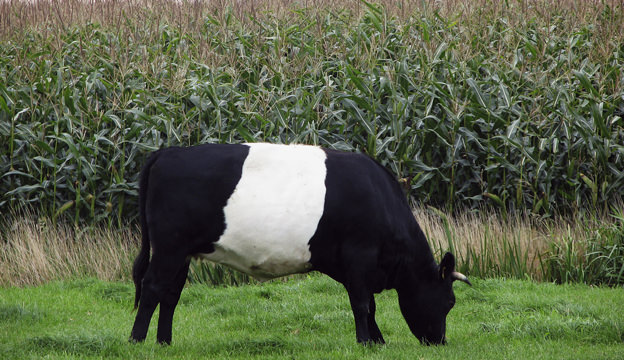
Conformation: The medium-sized Dutch Belted is an efficient animals. Cows weigh 900 to 1500 pounds and bulls weigh 1350 to 2000 pounds. The breed is distinguished by the wide, white belt around its middle; the cattle are black or occasionally red.

Special Considerations/Notes: The breed tends to have a long life, reducing replacement costs. Heifers breed early and produce a calf every year; calves average 70 pounds, which is a less stressful size for the mother. Still, Dutch Belted are listed as “critical” on the ALBC Conservation Priority List.

Categories
Animals Breeds Large Animals

Florida Cracker Cattle

Use: Florida Crackers and Pineywoods are triple-purpose cattle ideal for small-farm beef production, milking, and draft purposes (they make outstanding small oxen), especially in the Southeastern tier of states. Beef produced by these breeds is lean, flavorful, and their smaller carcasses make ideal freezer beef for today’s smaller families. Thanks to their tasty beef, both Pineywoods and Florida Cracker cattle are listed on Slow Foods USA’s Ark of Taste. And, since some strains emphasize dairy qualities; cows from these families make excellent hobby farm family dairy cows.

History: If you’re looking for a hardy, all-American breed custom-tailored for the South, seek no further: Florida Crackers and Pineywoods are the breeds you need. The primary difference between Pineywoods and Florida Cracker cattle is their place of origin. Both descend from criollo (Spanish stock born in the New World) cattle. One breed, the Pineywood, evolved in the longleaf pine forests of Louisiana, Mississippi, Alabama and Georgia, while the Florida Cracker is a product of the Sunshine State. Both breeds share a common history. When Spain set out to claim the New World, she sent cattle with her conquistadors and colonists, to the tune of about 300 head. These animals proliferated. In many cases cattle escaped or were abandoned to the wild so that in time a vast feral population roamed New Spain. They became the Longhorns of Texas, the Corriente of Mexico, and the Pineywoods and Florida Crackers of the Southeastern states. Eventually, breeders ‘improved’ native cattle by crossing them with heat-hardy, humped zebu bulls like the American Brahmin, until purebreds almost ceased to exist. However, a handful of dedicated families in both regions maintained herds of pure, native stock and in the 1990’s the Pineywoods Cattle Registry and Breeders Association and the Florida Cracker Cattle Association were formed to preserve them. Both breeds are listed under the Critical heading of the American Livestock Breeders Conservancy’s watch list and additional conservators are needed.

Conformation: Florida Crackers and Pineywoods come in a wide palette of spotted and solid colors including blacks, reds, yellows, and blues in speckles, linebacks and roans. Some lines lean toward beefiness, others more toward dairy type. Most Pineywoods and Florida Crackers are fairly rangy with light- to moderately-heavy muscling and bone, and they weigh in the 600 to 1000 pound range. “Guinea” or dwarf cattle with shorter heads and legs occur in both breeds. Both horned and polled bloodlines exist but the majority of Pineywoods and Florida Cracker cattle are horned, with horn types varying from short, curved, Holstein-like horns to large, upswept, somewhat Longhorn-type varieties. They have short, shiny summer hair coats but grow longer hair in the winter months.

Special Considerations/Notes: Florida Cracker and Pineywoods cattle are self-sufficient animals that thrive on rough pasture and brush with minimal human intervention. They are remarkably easy keepers. Both breeds are long-lived and prolific. Pineywoods and Florida Cracker cows have strong maternal instincts and produce plenty of milk for their calves.

Categories
Animals Breeds Large Animals

Galloway Cattle

Use: Galloways are an ideal breed for forage-based beef production. Efficient grazers and browsers, they readily consume and fully utilize brush and coarse grasses that most breeds spurn. Galloway beef is flavorful. The breed is noted for producing well-marbled carcasses with large ribeyes and very little internal fat. When Galloways shed their winter coats, their soft undercoat can be combed, blended with other fibers, and spun into yarn. And, due to their protective nature, a few Galloways in a pasture are as effective as donkeys or llamas for guarding sheep and goats from wandering dogs.

History: Galloway cattle originated in the Scottish Lowlands in the six shires that made up the Province of Galloway. As early as 1570, Scottish philosopher Hector Boece wrote of Galloway cattle, saying, “In this region ar mony fair ky [cows] and oxin…[their] flesh is right delicious and tender.” Flemish cartographer Abraham Ortelius seconded that notion in 1573 when he wrote, “In Carrick [then part of Galloway) are oxen of a large size, whose flesh is tender, sweet and juicy.” Records indicate that most early Galloways were black but red, browns, and brindles, with or without white markings were also fairly common. Most were then as now naturally polled (hornless). The first Galloway arrived in Canada in 1853. In 1872, the Ontario Galloway Herd Book was chartered and in 1882, Canadian and American fanciers united to form the North American Galloway Association. A few years later, American breeders formed the American Galloway Breeders Association and the Canadian group reorganized as the North American Galloway Breeders Association. The latter registers black, dun, and white Galloways in separate sections of the Canadian Galloway Herd Book, the oldest continuously maintained Galloway herd book in the world. A separate American registry for Galloways of the belted variety (the United States Belted Galloway Society) was founded in 1951, although the American Galloway Breeders Association also registers Fullblood, Belted, and White Galloways in separate herd books.

Conformation: According to American Galloway Breeders Association registration rules, Galloway cattle come in three patterns: solid, white park, and belted. Solids are black, red, or dun (in shades ranging from silver to brown). A moderate amount of white on the underside is permissible. White Galloways must be of distinct “white park” coloration: white with black, red or dun pigmented on the nose, ears, hooves and around the eyes. Some pigmentation on the legs, udder, and poll and a moderate amount of freckling throughout the body is permissible. Belted Galloways may be black, red, or dun, and must have a complete white belt encircling their midsections. What all three color phases have in common are depth, thickness, length of body, and intermediate size, with cows weighing 1000 to 1300 pounds; bulls, 1800 to 2000 pounds. A hallmark of the breed is its handsome winter coat consisting of a layer of soft, insulative undercoat topped by a covering of coarse, wavy outer hair perfect for shedding wind and rain.

Special Considerations/Notes: Galloways are friendly, docile cattle; even bulls are noted for their calm demeanor. Cows are milky, maternal, and long-lived, with a well-deserved reputation for getting in calf every year. And, though Galloways are a quintessential hardy, Northern breed, they adapt well to Southern climates too. Galloways are listed on the American Livestock Breeds Conservancy’s conservation priority list under the Watch category (“Fewer than 2500 annual registrations in the United States and a global population of less than 10,000”) and Belted Galloways as a Recovering breed.

Categories
Animals Breeds Large Animals

Guernsey Cattle

Use: Guernseys are the quintessential family milk cow. They also work well in commercial dairy settings. According to registry research, 100 percent Guernsey milk contains 12 percent more protein, 30 percent more cream, 33 percent more vitamin D, 25 percent more vitamin A, and 15 percent more calcium than the milk produced on the average commercial dairy farm. Due to its high beta-carotene content, Guernsey milk is a rich, creamy yellow. Pure Guernsey milk was once widely marketed under the American Guernsey Association’s Golden Guernsey trademark; it was particularly popular during the 1950’s. Golden Guernsey milk is still produced in the United States, only on a far more limited scale.

History: Guernsey cattle share a rich and colorful history with the Jersey and Alderney breeds, all of which evolved on islands located in the English Channel between England and France. Collectively they’re known as the Channel Island breeds; although the Alderney cattle are now extinct (the last few Alderneys were eaten by German Army soldiers during World War II). The story of the golden Guernsey begins around 1000 A.D. when Robert I, Duke of Normandy, sent a group of monks to the Isle of Guernsey to educate the natives and protect the land. They brought cattle with them: fine Norman and Froment du Leon from Brittany. With this seed stock, over time, they developed the Guernsey, which was considered a separate breed as early as 1700. In 1789, new imports were forbidden to protect the integrity of the pure island breed, a prohibition that still stands today. Early imports to the United States were misnamed Alderneys. On January 11, 1817, Richard Morris of Pennsylvania wrote: “I have upon my farm on the Delaware a cow of the Alderney breed…She has been fed in the usual way with potatoes, and during the last week the milk from her was kept separate, and yielded eight pounds of butter. The cow is a small animal, and is supported with less food than our ordinary stock. P.S. The cow is three years old.” Additional Guernseys soon followed and in 1877 admirers chartered the American Guernsey Cattle Club. Many of the cattle recorded in the club’s first herdbook were the inbred descendants of a single bull and cow imported from the Isle of Guernsey in 1830. Hundreds of additional Guernseys came to North America beginning around 1865 and continuing through the early twentieth century. The Guernsey was once America’s sweetheart dairy breed. Americans considered Guernseys such a hardy, productive breed that three Guernsey cows named Deerfoot, Emmadine and Klondike accompanied the Byrd expedition to Antarctica to provide milk for its intrepid adventurers.

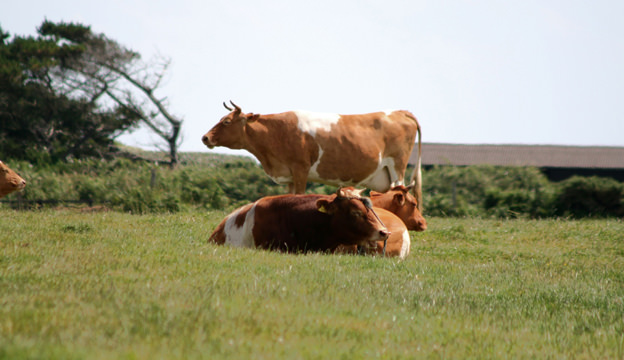
Conformation: Guernseys are neat, intermediate-sized dairy cattle; the average cow weighs 1,100 pounds and bulls tip the scale around 1,700 pounds. Unless they’ve been de-horned (and nowadays most are) Guernseys have small, light-colored, dark-tipped horns. They come in one color: brown (ranging from fawn to golden red), nicely accented by white spots or white trim. Guernseys have yellowish-orange skin.

Special Considerations/Notes: Guernsey cows are noted for their docility and ease of hand milking, particularly in a family cow setting. In his book Oxen; a Teamster’s Guide, Drew Conway rates Guernsey steers best bets for novice drovers’ first teams due to their gentleness, intelligence, and ease of handling. Guernseys adapt to most climates and are especially noted for their heat tolerance. They are highly efficient grazers that require 20 to 30 percent less feed than larger cattle, while producing more milk per unit of body weight than any other breed, making them ideal for grass-based and organic milk production. Cows are noted for ease of calving and they produce well into their late teens.