Categories
Animals Breeds Large Animals

Highland Cattle

Use: Fanciers claim Highland beef is the best in the world: lean but well marbled, juicy and flavorful, it commands a premium price as niche-marketed beef. Because Highlands thrive on rough forage (they’re browsers as well as grazers, a trait not seen in less-primitive breeds) and they’re outstandingly hardy and long-lived, they’re arguably the ideal beef cattle for grass-based and organic beef producers in Canada and the Northern states. Their woolly mammoth hides and sturdy bones are another stellar feature. Pelts are readily saleable as lap robes and rugs; long-horned skulls fetch a pretty price as wall décor; and soft, cushy winter undercoat is a spinners delight–and it’s combed out, rather than shorn! Folks who ride and drive cattle (and there are more and more of us every day) treasure Highlands for their eye-grabbing looks, solid physiques, and calm dispositions.

History: Highland cattle (also known as Scottish Highland) have been a colorful part of Scotland’s history since at least 600 A.D. Today’s Highlands descend from two groups of cattle: the small black or bridled Kyloes raised on islands off the west coast of Scotland and slightly larger, mainly red or yellow cattle native to the Scottish mainland. Written records go back to the 1700’s. The first Highland Cattle Society was chartered in Scotland as early as 1884. A first batch of Highlands arrived in the United States in 1893 and more followed during the 1920’s. They are currently the darlings of many a North American hobby farm where they provide tasty beef, fluffy undercoat fiber for spinning, and eye-candy for owners and passers-by.

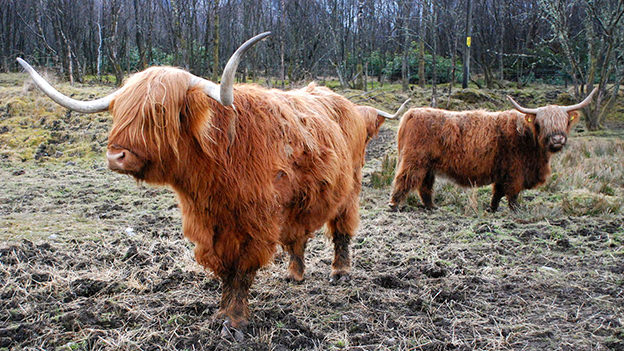
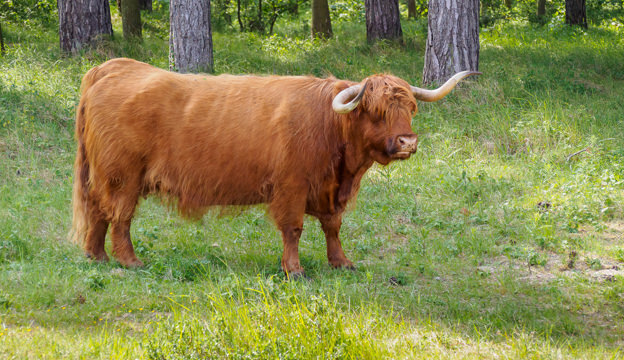
Conformation: Highland cattle (also known as Scottish Highland) are short-legged, wide, deep, and very solidly built. Most Highland cows weigh 1,000 to 1,300 pounds; bulls and steers can weigh 2,000 pounds or more. They have short, broad faces ending in wide muzzles, with a thick shock of hair called a dossan that reaches from their horns to a point just short of their noses. They also have strong, sturdy legs; large hooves; and long, dramatic horns. Highlands come in an array of solid colors ranging from white to black with reds, yellows, duns, silver duns, and brindles in between. Their most striking feature is their shaggy hair, a trait that makes them appear prehistoric at first glance. Highlands are double-coated. Their long, coarse outer coat can grow up to 14 inches in length; this in turn tops a soft, highly insulative undercoat designed to Highlands them toasty warm at temperatures far below zero, even without shelters to shield them from blowing snow and ice.

Special Considerations/Notes: Highlands are wonderful cattle. Treated kindly they are docile, friendly, easy to contain and handle, and they are intelligent to a fault. They are also exceptionally long-lived and highly fertile. Cows often calve well into their late teens. Calves are small at birth, making calving problems rare indeed. While ideal for Northern climates, Highlands also adapt well to the Mid-Western states and the Mid-South. In Southern climates, summer access to a pond for leisurely, midday soaking is strongly advised.

Categories
Animals Breeds Large Animals

Holstein Cattle

Use: Holsteins are one of the largest dairy breeds; they’re large not only in size but in milk production. The average Holstein in a commercial dairy produces 24,000 pounds of milk per year with 2.5 to 3 percent butterfat—that’s about 10 gallons of milk per day. Of the over 9 million cows regularly milked in the United States, about 90 percent are Holsteins.

History: Holsteins, to most Americans, are the quintessential dairy cow. From advertising to country kitsch decorating, these large, black-and-white cows symbolize country life. The breed, which originated in the Netherlands and was first imported to the United States in the mid-19th century, is also recognized in a rare red-and-white variety.

Conformation: Holsteins are the largest of the dairy breeds, with a mature cow weighing around 1,500 pounds and standing almost six feet tall at her withers.

Special Considerations/Notes: Holstein heifers can be bred at 13 months of age, when they weigh about 800 pounds–but it’s desireable that Holstein females calve for the first time between 23 and 26 months of age. Holstein gestation is approximately nine months.While some cows may live considerably longer, the average productive life of a Holstein is 3 to 4 years. The breed’s current popularity is derived from the cow’s production capability and the fact that she stands up reasonably well to the confinement system used in large-scale, industrial dairies.

Categories
Animals Breeds Large Animals

Jersey Cattle

Use: Very popular with homesteaders, Jerseys account for about 7 percent of all cows in the United States. This smaller sized dairy breed is respected for producing a fairly high quantity of milk relative to their size (about 16,000 pounds per year) that is particularly rich in butterfat (4.9 percent) and protein. Though their total production is lower than that of Holsteins, their net return (or dollars of profit per cow per year) is higher thanks to their lower feed requirements and their ability to stay productive for many years.

History: Like the Guernseys, they come from an island, the Isle of Jersey, located in the English Channel between England and France. They were imported to the United States in the early 19th century.

Conformation: Jersey cows are relatively small; most mature cows weigh about 900 pounds and stand around four feet tall at the withers.

Special Considerations/Notes: When a Jersey heifer matures earlier, she can be bred at a younger age and smaller size–and can enter the milking herd sooner; they’re quicker to generate income for a dairy producer. Jerseys are renown for their ease of calving. Overall, Jerseys are sweet animals, but in spite of their doe-like eyes and small size, they can also be playful and rambunctious, sometimes to the point of being a nuisance.

Categories
Animals Breeds Large Animals

Milking Devon Cattle

Use: Milking Devons are perfect all-around small-farm cattle. Cows give decent quantities of delicious, four percent butterfat milk (comparable in quantity and flavor to Jersey milk) ideally suited for crafting butter and cheese. Milking Devon steers are reasonably fast maturing and fatten easily, making them ideal for grass-fed and organic beef production. Milking Devons’ well-marbled beef is noted for its tenderness, juiciness, and flavor; most carcasses dress out at about 60 percent of live weight. And, Milking Devons are still a number one choice with oxen teamsters who prefer a lively, fast-walking yoke of working oxen.

History: There are three breeds of Devon (DEV-an) cattle: Milking Devons, beef Devons (called North Devons in their British homeland), and South Devons (known as the “orange elephants”, they’re the largest of all British breeds). Beef Devons are the modern version of the ancient Milking Devon, while South Devons are unrelated to the other two. Small, red cattle roamed the hills of southwest Britain beginning in ancient times; the Romans wrote about them as early as 55 B.C. Developed as triple-purpose draft, milk, and meat cattle, they were frequently carried by settlers to foreign lands; this was due to their own merits but also because the seaports of Devon and Cornwall were the last ports of call for sailing ships departing for Britain’s colonies abroad. In 1623 the British ship Charity brought “red cattle”, one bull and three heifers, to Edward Winslow, agent for Plymouth Colony, making Devons the first British cattle to set hoof on American soil. Cattle became an important source of wealth in the colony; the average cow sold for £28 in 1638. So valuable were they that in 1627 Edward Winslow “sold unto Capt. Myles Standish his sixth share in the red cow”, indicating that one cow was often shared by several families. Devons remained triple-purpose cattle until 1952, when the American Devon Cattle Association decided to take the breed in a new direction. By selecting primarily for beef qualities they felt they could breed Devons that were longer, taller, and trimmer while accelerating their rate of maturity. One group, however, wanted to keep the ancient breed exactly as it was; in this manner the separate Milking Devon breed was formed.

Conformation: All Milking Devons are red. A deep, blood color described as ruby red is preferred (this is why fanciers call Devons the “Red Rubies”). Their muzzles are flesh-colored and they have slightly lighter colored patches of hair around their eyes; white on the tail switch, udder, or scrotum is allowed. The skin of Milking Devons is yellow-orange. Unless de-horned, Milking Devons have graceful, mid-length, waxy-colored horns with dark tips. Milking Devons are fine-boned, agile cattle–lithe and lovely, with neat, compact bodies and strong legs. They are thin-skinned. They have sleek summer coats that grow thicker and show a tendency toward curliness in the wintertime. Milking Devons are intermediate-sized cattle (larger than a Jersey but smaller than a Holstein); mature cows weigh 1000-1200 pounds, while bulls tip the scale at 1400-1700 pounds.

Special Considerations/Notes: Milking Devons thrive on rough forage that other livestock spurn. They are intelligent, easygoing, and with kind handling they develop wonderful personalities. Cows are outstanding mothers and calve well into their late teens. And, this highly adaptable breed is both heat and cold tolerant. According to the American Milking Devon Association there are only about 600 of these unique, triple-purpose cattle in the world. The Milking Devon exists only in North America; it’s been lost in its British homeland. Milking Devons are listed in the Critical category of the American Livestock Breeds Conservancy’s conservation watch list, making Milking Devons an ideal breed for potential hobby farm conservators seeking a unique, all-American breed for their small farms.

Categories
Animals Breeds Large Animals

Pineywoods Cattle

Use: Pineywoods and Florida Crackers are triple-purpose cattle ideal for small-farm beef production, milking, and draft purposes (they make outstanding small oxen), especially in the Southeastern tier of states. Beef produced by these breeds is lean, flavorful, and their smaller carcasses make ideal freezer beef for today’s smaller families. Thanks to their tasty beef, both Pineywoods and Florida Cracker cattle are listed on Slow Foods USA’s Ark of Taste. And, since some strains emphasize dairy qualities; cows from these families make excellent hobby farm family dairy cows.

History: If you’re looking for a hardy, all-American breed custom-tailored for the South, seek no further: Pineywoods and Florida Crackers are the breeds you need. The primary difference between Pineywoods and Florida Cracker cattle is their place of origin. Both descend from criollo (Spanish stock born in the New World) cattle. One breed, the Pineywood, evolved in the longleaf pine forests of Louisiana, Mississippi, Alabama and Georgia, while the Florida Cracker is a product of the Sunshine State. Both breeds share a common history. When Spain set out to claim the New World, she sent cattle with her conquistadors and colonists, to the tune of about 300 head. These animals proliferated. In many cases cattle escaped or were abandoned to the wild so that in time a vast feral population roamed New Spain. They became the Longhorns of Texas, the Corriente of Mexico, and the Pineywoods and Florida Crackers of the Southeastern states. Eventually, breeders ‘improved’ native cattle by crossing them with heat-hardy, humped zebu bulls like the American Brahmin, until purebreds almost ceased to exist. However, a handful of dedicated families in both regions maintained herds of pure, native stock and in the 1990’s the Pineywoods Cattle Registry and Breeders Association and the Florida Cracker Cattle Association were formed to preserve them. Both breeds are listed under the Critical heading of the American Livestock Breeders Conservancy’s watch list and additional conservators are needed.

Conformation: Pineywoods and Florida Crackers come in a wide palette of spotted and solid colors including blacks, reds, yellows, and blues in speckles, linebacks and roans. Some lines lean toward beefiness, others more toward dairy type. Most Pineywoods and Florida Crackers are fairly rangy with light- to moderately-heavy muscling and bone, and they weigh in the 600 to 1000 pound range. “Guinea” or dwarf cattle with shorter heads and legs occur in both breeds. Both horned and polled bloodlines exist but the majority of Pineywoods and Florida Cracker cattle are horned, with horn types varying from short, curved, Holstein-like horns to large, upswept, somewhat Longhorn-type varieties. They have short, shiny summer hair coats but grow longer hair in the winter months.

Special Considerations/Notes: Pineywoods and Florida Cracker cattle are self-sufficient animals that thrive on rough pasture and brush with minimal human intervention. They are remarkably easy keepers. Both breeds are long-lived and prolific. Pineywoods and Florida Cracker cows have strong maternal instincts and produce plenty of milk for their calves.

Categories
Animals Breeds Large Animals

Santa Gertrudis Cattle

Use: Santa Gertrudis are beef cattle designed to thrive in hot, arid climates around the globe.


History: The name of the Santa Gertrudis breed of red beef cattle is from “Rincon de Santa Gertrudis”, the title of the original 15,500-acre land grant purchased by Captain Richard King from the heirs of Juan Mendiola of Camargo for the grand sum of $300. Thus in 1858, the King Ranch was born. As the years passed, additional land was added until at its extent, the ranch encompassed 1.2 million acres, making it one of the largest ranches in recorded history. The first cattle that roamed the vast Kingdom were native Longhorns. They were fully adapted to the harsh South Texas climate but they yielded a poor carcass. So, in the early years the ranch brought in British breeds like the Hereford and Beef Shorthorn to improve their stock but it wasn’t until 1918, when high-percentage zebu bulls came to the vast ranch to be bred to its Shorthorn cows, that real improvements occurred. In 1920, a red calf was born. Part Brahmin (zebu) and part Shorthorn, he was the best calf born at the ranch to date. During his 12 years on earth, he sired more than 150 bulls and became the foundation of the Santa Gertrudis breed. In 1940 the United States Department of Agriculture recognized 3/8 Brahmin and 5/8 Shorthorn Santa Gertrudis as a distinctive beef breed. The Santa Gertrudis Breeders International was formed in 195. Since then, 11,500 Santa Gertrudis have been registered in the United States alone.


Conformation: Santa Gertrudis are cherry-red with red-pigmented skin. They have deep, muscular, strong-boned bodies and large, semi-pendulous ears. Cows weigh in the neighborhood of 1,400 to 1,600 pounds and the average bull, 2,000 pounds or better. Some have short horns and some are naturally polled.


Special Considerations/Notes: Santa Gertrudis are exceptionally good foragers developed to thrive on the thin native grasses of the South Texas brush country. Cows breed young and produce well into their teens. They are very fertile and have exceptional mothering instincts. Calves are small at birth (so calving problems are rare) but due to their mothers’ heavy milk production gain up to three pounds of weight per day. Santa Gertrudis are noted for their even temperaments, hardiness, and disease resistance. Thanks to their zebu heritage, they have more sweat glands than most breeds of cattle, thus they dissipate heat in hot climates. They are, however, extremely adaptable, with herds kept as far to the south as Argentina and as far north as Upper Canada.

Categories
Breeds

Scottish Highland Cattle

Use: Fanciers claim Scottish Highland (also known as Highland) beef is the best in the world: lean but well marbled, juicy and flavorful, it commands a premium price as niche-marketed beef. Because Highlands thrive on rough forage (they’re browsers as well as grazers, a trait not seen in less-primitive breeds) and they’re outstandingly hardy and long-lived, they’re arguably the ideal beef cattle for grass-based and organic beef producers in Canada and the Northern states. Their woolly mammoth hides and sturdy bones are another stellar feature. Pelts are readily saleable as lap robes and rugs; long-horned skulls fetch a pretty price as wall décor; and soft, cushy winter undercoat is a spinners delight–and it’s combed out, rather than shorn! Folks who ride and drive cattle (and there are more and more of us every day) treasure Highlands for their eye-grabbing looks, solid physiques, and calm dispositions.

History: Scottish Highland cattle (also known as Highland Cattle) have been a colorful part of Scotland’s history since at least 600 A.D. Today’s Highlands descend from two groups of cattle: the small black or bridled Kyloes raised on islands off the west coast of Scotland and slightly larger, mainly red or yellow cattle native to the Scottish mainland. Written records go back to the 1700’s. The first Highland Cattle Society was chartered in Scotland as early as 1884. A first batch of Highlands arrived in the United States in 1893 and more followed during the 1920’s. They are currently the darlings of many a North American hobby farm where they provide tasty beef, fluffy undercoat fiber for spinning, and eye-candy for owners and passers-by.

Conformation: Scottish Highland cattle (also known as Highland Cattle) are short-legged, wide, deep, and very solidly built. Most Highland cows weigh 1,000 to 1,300 pounds; bulls and steers can weigh 2,000 pounds or more. They have short, broad faces ending in wide muzzles, with a thick shock of hair called a dossan that reaches from their horns to a point just short of their noses. They also have strong, sturdy legs; large hooves; and long, dramatic horns. Highlands come in an array of solid colors ranging from white to black with reds, yellows, duns, silver duns, and brindles in between. Their most striking feature is their shaggy hair, a trait that makes them appear prehistoric at first glance. Highlands are double-coated. Their long, coarse outer coat can grow up to 14 inches in length; this in turn tops a soft, highly insulative undercoat designed to Highlands them toasty warm at temperatures far below zero, even without shelters to shield them from blowing snow and ice.

Special Considerations/Notes: Highlands are wonderful cattle. Treated kindly they are docile, friendly, easy to contain and handle, and they are intelligent to a fault. They are also exceptionally long-lived and highly fertile. Cows often calve well into their late teens. Calves are small at birth, making calving problems rare indeed. While ideal for Northern climates, Highlands also adapt well to the Mid-Western states and the Mid-South. In Southern climates, summer access to a pond for leisurely, midday soaking is strongly advised.

Categories
Animals Breeds Large Animals

Texas Longhorn Cattle

Use: Many breed enthusiasts keep Texas Longhorns as pets, curiosities, and links with the past; a growing faction of admirers ride Longhorn steers in parades, shows, and on trail rides; and Longhorns produce tender, tasty beef that is lower in fat, cholesterol, and calories than the meat of most other breeds.

History: When Christopher Columbus embarked on his second voyage in 1493, he carried in his hold the first cattle to set foot on American soil. Many followed. These intrepid Spanish cattle, likely mixed with cattle moving west with American settlers from the East, were the ancestors of today’s Texas Longhorns. Early Spanish cattle invariably escaped and naturalized throughout the area comprising our American Southwest. Tough, ingenious, and fecund, they multiplied by the millions. Enterprising cattlemen captured them, domesticated some, and drove countless numbers along cattle trails to slaughter. Their heyday, however, ended in the early twentieth century when British breeds like the Hereford, Angus, and Shorthorn became the cattle du jour. Texas Longhorns all but disappeared; then in 1927, the United States government placed remnant Longhorn herds on wildlife refuges in Oklahoma and Nebraska; the state of Texas followed by installing herds in Texas state parks. Conservators and history buffs started breeding Longhorn cattle and in 1962, the Texas Longhorn Breeders Association was formed.

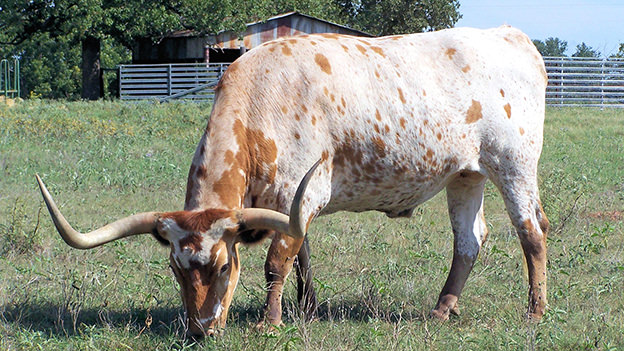
Conformation: No one ever described Longhorns’ colors better than J. Frank Dobie, writing in The Longhorns (Little, Brown & Company; 1941): “The colors were more varied than those of the rainbow. There were brindles; blues – mulberry blue, ring-streaked blue, speckled blue, grullas – so named because they had the hue of the sandhill crane, also called mouse-colored or slate duns, washed-out and Jersey creams — all hues of ‘yellow’ browns with bay points; blacks, solid and splotched with white, brown and red; whites both clearly bright and dirty speckled; many sabinas, red and white peppered; reds of all shades except the dark richness characteristic of the Hereford, pale reds being very common; paints of many combinations. The line along the back was common, as in the mustang breed. Coarse brown hairs around the ears were characteristic. The shadings and combination of colors were so various that no two were alike.” Amazing color, plus impressive horns (on trophy steers, sometimes as long as 120 inches from tip to tip) and rangy good looks help Longhorns stand out in any crowd!

Special Considerations/Notes: Longhorns are incredibly hardy animals; these are cattle that know how to take care of themselves. They’re extremely fertile and long-lived cattle; cows calve annually (and easily) well into their teens. They adapt to all climates, they’re parasite-resistant and they thrive on marginal pasture, making them ideal for grass-fed and low-input management situations.

Categories
Animals Breeds Large Animals

Welsh Black Cattle

Use: Due to their capability to thrive on marginal pasture, Welsh Blacks are an outstanding breed for grass-fed and organic beef production. Indeed, Welsh Black beef is uncommonly tasty. In 2002, 12 top London chefs participated in a blind taste test of fillet steak from the world’s most famous beef breeds including Angus, Simmenthal, Charolais, Limousin and Salers. The Welsh Beef steaks emerged the winner, hands down.


History: The Welsh Black is a particularly ancient breed descended from hardy hill cattle that already roamed Wales’ mountains prior to the birth of Christ. Originally there were two strains: a stocky, beef type from North Wales and the taller, rangier, more dairy-like cattle of South Wales. The first Welsh Black herd book was published in 1882 and the formation of a breed society followed in 1883. For a time, separate North Wales and South Wales societies existed. However, the combined Welsh Black Cattle Society was formed in 1904 and during the ensuing years, breeders intermingled the two types to produce an intermediate-sized, rugged, beef breed Welsh Black admirers call “black gold from the Welsh hills.” The first Welsh Blacks came to the United States in 1963. There are Welsh Black associations in the United States, Canada, Australia and around the globe.


Conformation: Most Welsh Blacks are rusty- to jet-black, although a red gene exists in this breed and once a red individual pops up, it breeds true. Registered Welsh Black cattle are, however, allowed a splash of white on the underline behind the navel. Until recent times additional colors including belted, white park, line-backed, and blue existed and a British organization called the Ancient Cattle of Wales Society (www.ghc-acw.org/english.htm) is working to resurrect them. Historically the breed was horned but now both polled and horned bloodlines can be found. The horns of adult cattle are ivory-colored with black tips, and medium in length. Welsh Blacks are strongly built, medium- to large-size animals with bulls averaging 2000 pounds and cows, 1200-1300 pounds. They are deep and long, with plenty of bone. Welsh Blacks have thick, soft, fairly long hair. It can be wavy, but tightly curled hair is objectionable.


Special Considerations/Notes: Welsh Black cattle are above all, hardy, efficient grazers with the ability to utilize rough pasture and upland grasses. Due to the breed’s dual-purpose background, brood cows produce plentiful supplies of milk for their young. Black Welsh calves, while born small for ease of calving, grow quickly. The breed is noted for its docility.

Categories
Animals Breeds Large Animals

Yaks

Use: Yaks are marvelous hobby farm livestock. They yield respectable amounts of high-butterfat milk; lean, succulent meat (it’s said to make world’s best jerky); beautiful pelts to be used as rugs or lap robes; and cashmere-quality, 14-16 micron undercoat that can be combed out, rather than shorn. Yaks make admirable pack animals and are reasonably easily taught to carry riders on their backs—jobs they were bred to do in their native land. A well-conditioned adult yak can pack up to 225 pounds for long distances at speeds of two and one-half to three miles per hour.

History: Some time between 2500 and 3000 B.C., yaks (Bos grunniens, meaning “grunting ox”) were domesticated on the Qinghai-Tibetan Plateau—one million square miles of vast alpine meadow and steppe land surrounded by towering mountains, a region sometimes referred to as the roof of the world. Their ancestor was the now-endangered wild yak (Bos mutus; “silent ox”), a fierce, hairy bovine standing as much as 72 inches high at the shoulder and sometimes weighing more than 2400 pounds; about 10,000 wild yaks still roam the Qinghai-Tibetan Plateau and its surrounding highlands, at altitudes of up to 13,000 feet. Domestic yaks quickly spread throughout adjacent territories from Mongolia to Nepal and beyond, though they’re most closely associated with the people of Tibet. For thousands of years nomadic herders in the high mountainous region of Central Asia depended on yaks for draft power, meat, milk, hair, and pelts; they also burned dried yak dung for fuel. Some do yet today. The export of yaks to parts of Europe and North America began in 1783 when Samuel Turner shipped two bulls from Tibet to England; more followed during the mid-nineteenth century. These were sent primarily to zoos and to research facilities in attempts to breed hardy hybrid livestock ideal for cold climate grazing. Yaks were shipped to Canada, first in 1909 and again in 1921, where they were crossed with domestic cattle and with bison. In a similar study undertaken between 1919 and 1930 at the Fairbanks Experiment Station in Alaska, yaks were crossed with domestic cattle. Both projects were ultimately unsuccessful.

Conformation: Yak cows are smaller than yak bulls or steers, standing about 54 inches tall (measured to the highest point on their humped backs) and weighing 500-800. Bulls can weigh as much as 1500 pounds. Yaks are compactly built. They have thick bodies with humped shoulders; short legs; graceful, upswept handlebar horns; and dense, woolly coats with luxurious forelocks, horse-like tails, and a skirt of long hair that nearly sweeps the ground. American yaks come in five recognized colors: black (all black with a gray nose), imperial (all black with a black nose), royal (black and white pied), golden (gold-colored), and trim (black with white markings on the head, feet, and tail). They also come in two coat types: regular and extra-woolly, with longer, thicker coats. Yaks are intelligent, inquisitive, and when handled from calfhood, friendly and easy to work with.

Special Considerations/Notes: Yaks are browsers and grazers; they thrive on brush and marginal pasture; stocking rate is roughly three yaks to one domestic beef cow. They’re slow maturing (yaks reach full growth at six or seven years of age) but are very long-lived, with a life expectancy of 25 years. Cows are attentive mothers. Due to their comparatively low birth weight (25-35 pounds), yak calves rarely need to be pulled. Domestic cattle, bison, and yaks are all members of genus Bos and they have the same number of chromosomes (60) so the three species are inter-fertile. First generation yak crossbred males are sterile but most females are fertile and can be crossed back to yaks, bison, or cattle. Cattle-yak hybrids are called yakows in North America. Due to hybrid vigor, yak-cattle crosses usually grow larger and stronger than either parent. Yaks crossed with bison produce yakalo. The International Yak Association allows for grading up to purebred status (animals of 15/16 yak background are considered purebred yaks). Yaks are domestic livestock instead of exotics, so no special permits are required to raise them. Any fencing and handling cattle that holds domestic cattle will work for yaks. Yaks are ideally suited for rearing in the Northern tier of states. Although they also thrive in mid-America, they don’t fare as well in our southernmost states, particularly the hot and humid American Southeast.