Categories
Animals Breeds Large Animals

Zebu Cattle

Use: Large or small, zebus are the quintessential cattle for hot, steamy climates where non-humped Bos taurus breeds fail to thrive. Not only used as beef and household dairy producers in tropic and semi-tropic parts of the world, zebu bulls are used to sire hardy, heat-resistant calves from cows of other breeds. Consider the Brahmin bull in our own Southern states. He’s been used to create breeds as diverse as the Brahmousin (Brahmin and Limousin), Beefmaster (a combination of Hereford, Shorthorn and Brahman genetics), Braford (Brahmin and Hereford), Brangus (Brahmin and Angus), and Santa Gertrudis (a unique blend of Brahmin, Hereford, and Shorthorn genetics blended at the vast King Ranch in Texas).

History: The ancient aurochs, a tall, massively built bovine that once ranged from Asia to Europe and south to the Middle East, was tamed in several locations, one of them being the Indus Valley of Pakistan. These humped cattle became Bos indicus, better known to the modern world as zebus. Two types of zebus call North America home: the Brahman and the Miniature Zebu. Brahmin (sometimes referred to as Brahma) cattle were developed in our Southern states in the early 1900’s using the genetics of four different Indian breeds, some by way of Brazil where zebu cattle are treasured for their heat tolerance, hardiness, and disease resistance. Miniature Zebus are a separate breed and not miniaturized versions of their larger Brahmin cousins. They are descended from Indian Nadudana zebu cattle imported by zoos during the early years of the twentieth century.

Conformation: Zebus of all breeds (and there are an estimated 75 breeds world-wide) have a number of characteristics in common. All have distinct humps over their shoulders and necks that are larger in zebu bulls and steers than the humps on zebu cows. Both sexes have pendulous dewlaps hanging from their necks to provide more skin surface for cooling. Zebus have more sweat glands than non-zebu cattle so they also dissipate heat through sweating. Their unusually mobile, oily skin helps repel bothersome bugs. All have dark skin pigmentation, so skin cancer rarely poses a problem. Zebus are also resistant to tropical diseases like rinderpest in Africa and to parasites that quickly fell European cattle breeds. They’re known for being docile, friendly, intelligent animals when handled with kindness. Most Brahmins are gray, ranging from porcelain to nearly black, but come in other colors, particularly red. Cows weigh in the neighborhood of 1000 to 1400 pounds, while bulls tip the scale at 1600 to 2000 pounds. They’re noted for their long, pendulous ears and attractive, up-curved horns that often tilt back at the tips. Miniature Zebus come in an array of colors including cream, gray, black, red, and spotted. Mature cows weigh only 300 to 500 pounds; bulls, 400 to 600 pounds. They are measured at the withers behind the hump and cannot exceed 42 inches tall at three years of age. Unlike Brahmins, Miniature Zebus have shorter, less pendulous ears. They are registered by two organizations, the American Miniature Zebu Association and the International Miniature Zebu Association. There are fewer than 1000 Miniature Zebu in North America.

Special Considerations/Notes: While most people associate zebus with Southern climes, in fact Brahmins and Miniature Zebus are hardy, adaptable animals that given protection from weather extremes, fare well in Northern states too. Both breeds thrive on low-quality forage. They are exceptionally long-lived and due to their calves’ low birth weight, calving problems are rare indeed.

Categories
Animals Breeds Large Animals

Tunis Sheep

Use: Tunis sheep excel as extremely feed-efficient, productive meat animals capable of thriving on poorer pastures and in hot, dry conditions. According to the National Tunis Sheep Registry website, Tunis lambs require less feed than larger sheep breeds to reach the same market weight within similar time frames. For their size, they yield a high percentage of delicately-flavored meat. Even the mutton (meat of sheep older than one year) is said to be tasty. They also grow a lustrous fleece with a staple length of four to six inches that weighs approximately six to nine pounds.

History: One of the oldest sheep breeds developed in the United States, the modern-day Tunis resulted from crossings of “fat-tailed” sheep imported from Tunisia, a North African country bordering the Mediterranean, with various European breeds. The first importation occurred in 1799, a gift of ten sheep from the ruler of Tunisia to the U.S.; these animals passed into the care of Pennsylvanian Judge Richard Peters. In following years, the breed gained popularity in a number of eastern and southeastern states, garnering fans that included the likes of Thomas Jefferson and George Washington. The Civil War, however, resulted in the demise of most Tunis sheep in the upper South. Today, the American Livestock Breeds Conservancy lists the Tunis in the watch category, its global population estimated to be less than 10,000 animals, although interest in this unique breed seems to be increasing again.

Conformation: You can easily distinguish a Tunis from other sheep breeds by its coppery-red, usually wool-free face and legs, lovely accents for the ivory to cream wool on its body. The Tunis has a well-muscled, deep-chested body with a wide back and a broad, fat tail that’s normally docked. A hornless breed, they possess slender faces and long, pendulous ears. Rams of this medium-sized breed weigh from 175 to 225 pounds and ewes run about 125 to 175 pounds. Raisers praise the long-lived Tunis for its grace, calm temperament, and hardiness.

Special Considerations/Notes: Tunis sheep have an extended breeding season and the motherly ewes experience a high rate of twinning and produce plenty of milk. The lively lambs arrive with red or tan wool that gradually changes to creamy white except for the face and legs. These sheep, thanks to their roots in Tunisia, can tolerate hot weather well, whether humid or arid; of course, ample water should always be provided.

Categories
Animals Breeds Large Animals

Llamas

Use: Llamas are widely used as guardian animals; fleece producers (llama fiber averages 20 to 30 microns in diameter, compared to alpaca fiber’s 15 to 30 microns); show, pack, and cart animals; as animal-assisted therapy workers, and as pets.

History: The ancestor of today’s llamas evolved on the central plains of North America about 40 million years ago. Some migrated north across the Bering Straits to further evolve as Old World camels, others journeyed south to become South American camelids: guanacos and vicuñas. These two species were domesticated in the high plains of Peru well before 3000 B.C., becoming llamas and alpacas, respectively. The ancient tribes of the region, most notably the Incas, kept llamas as pack animals. Llamas also produced fiber for weaving rugs and twisting strong ropes, they provided tasty meat, and they were widely employed as sacrifices in ancient burials and religious rites. After the Spanish conquest, more than 300,000 llamas were used to pack ore down from the famed Potosí mines alone. In the late 1800’s, North American European zoos began adding llamas to their collections. One of the more significant importations occurred in the early 1900s when William Randolph Hearst imported 12 llamas to populate his San Simeon estate. Eventually, llamas became more commonplace, leading to an active market both here and abroad. The United States llama herd now numbers in excess of 100,000 animals.

Conformation: Llamas come in all sizes from standard-size llamas in the 250 to 400 pound range to miniature llamas standing 38 inches or less at the shoulder. Four coat types prevail: llamas with short, shedding fiber (also called classic or ccara llamas); medium-length fiber (sometimes called curaca llamas); long, non-shedding fiber (variously called tapada and lanuda llamas), and non-shedding suri llamas with fiber that hangs in locks like that of longwool sheep. Llamas come in a palate of beautiful colors ranging from white to blacks and everything in between in solids and pieds and appaloosa-spotted animals.

Special Considerations/Notes: It’s a common misconception that llamas readily spit; while they do spit at one another and in perceived self-defense, socialized llamas rarely spit at their human caretakers. They’re intelligent, intensely interested in the world around them, and somewhat aloof (many seasoned owners compare them to cats). Baby llamas (called crias) should never be separated from their dams and bottle-raised as pets (visit llama trainer John’s Mellon’s website at www.mallonmethod.com/llearning4.html to learn precisely why).

Categories
Animals Breeds Large Animals

Huacaya Alpacas

Use: Farmers normally raise Huacaya (pronounced wah-KI-ya) alpacas for their fiber, which is short, dense, crimpy and gives a woolly appearance. Like the Suri alpaca, the Huacaya alpaca is prized for its thick, soft fleece–it’s been known for centuries as “The Fiber of The Gods.” Alpaca fiber offers quality, versatility and rarity; in the fashion world it’s considered to be one of the most exclusive fibers, competing with wool, cashmere and mohair. Alpaca fiber can be used as sheer in the finest silks, to as thick and chunky as tweeds and wool. It dyes easily, makes the warmest batting, the softest felt, spins like a dream, and can be mixed with other fibers to combine textures and beauty. People also raise alpacas for companionship and to enjoy a rural lifestyle.

History: Alpacas are originally from South American where the Incas bred them for thousands of years. In the early to mid-1980s, several alpacas were imported to the United States from Bolivia, Chile and Peru. Alpacas are modified ruminants, part of the camelid family, which includes llamas and camels. While their smaller size and quizzical faces do in fact give them a high cuteness factor, whether or not they are huggable is debatable. At the end of the day, these are livestock. The occasional alpaca may enjoy a hug, but for the most part, they’re happy to mingle among their own.

Conformation: Huacaya, as well as Suri alpacas are a small and relatively easy livestock to maintain. They stand about 36 inches tall, weigh between 150-200 pounds. The alpacas need basic shelter and protection from heat and foul weather; being livestock, they require certain vaccinations and anti-parasitic medicines. They don’t have horns, hooves or claws, incisors, or upper teeth; they eat grass and chew cud. Alpacas don’t have hooves-they have two toes, with hard toenails on the top of their feet and a soft pad on the bottom of their feet, much like a dog’s foot. Therefore, you don’t experience compaction of the soil to same degree that you would with other types of livestock.

Special Considerations/Notes: Additionally, their toenails need to be trimmed every couple of months and the fleeces sheared off once a year.

Categories
Animals Breeds Large Animals

Suri Alpacas

Use: Farmers normally raise Suri alpacas for their fiber, which is silky and resembles pencil-like locks. Like the Huacaya alpaca, the Suri alpaca is prized for its their thick, soft fleece–it’s been known for centuries as “The Fiber of The Gods.” Alpaca fiber offers quality, versatility and rarity; in the fashion world it’s considered to be one of the most exclusive fibers, competing only with wool, cashmere and mohair. Alpaca fiber can be used as sheer in the finest silks, to as thick and chunky as tweeds and wool. It dyes easily, makes the warmest batting, the softest felt, spins like a dream, and can be mixed with other fibers to combine textures and beauty. People also raise alpacas for companionship and to enjoy a rural lifestyle.


History: Alpacas are originally from South American where the Incas bred them for thousands of years. In the early to mid-1980s, several alpacas were imported to the United States from Bolivia, Chile and Peru. Alpacas are modified ruminants, part of the camelid family, which includes llamas and camels. While their smaller size and quizzical faces do in fact give them a high cuteness factor, whether or not they are huggable is debatable. At the end of the day, these are livestock. The occasional alpaca may enjoy a hug, but for the most part, they’re happy to mingle among their own.


Conformation: Suri, like the Huacaya alpacas are a small and relatively easy livestock to maintain. They stand about 36 inches tall, weigh between 150-200 pounds. The alpacas need basic shelter and protection from heat and foul weather; being livestock, they require certain vaccinations and anti-parasitic medicines. They don’t have horns, hooves or claws, incisors, or upper teeth; they eat grass and chew cud. Alpacas don’t have hooves-they have two toes, with hard toenails on the top of their feet and a soft pad on the bottom of their feet, much like a dog’s foot. Therefore, you don’t experience compaction of the soil to same degree that you would with other types of livestock.


Special Considerations/Notes: Additionally, their toenails need to be trimmed every couple of months and the fleeces sheared off once a year.

Categories
Animals Breeds Large Animals

Gloucestershire Old Spots Pigs

Use: Gloucestershire Old Spots is a multipurpose breed that reaches market weight at about 7 months old and reaches full size (400-600 pounds) by age 2. They produce top-quality meat for chops, roasts, hams and sausages; organic pork production also has renewed interest in the breed. In their homeland of Gloucestershire, England, they’ve been known as orchard pigs, commonly used to clean up fruit orchards, nut tree stands and crop residue.

History: Gloucestershire Old Spots, or GOS, found in their nameplace in England, where they were commonly used to clean up orchards and other crops. They’re considered critically endangered in the United States and the United Kingdom; only 80 Old Spots are estimated to be in the United States. Expect to be placed on a waiting list for available pigs.

Conformation: A large, white pig with irregular black spots, the GOS has large, lopped ears that cover the entire face to the snout. Spots are clearly defined and black, not blue. Legs should be strong and straight, stand erect on their feet, not down on the pasterns (their back toes) and the tail should be high on the rump.

Special Considerations/Notes: As pink-skinned pigs, Old Spots should be provided with shade to prevent sunburns. They’re known as a gentle and sweet-tempered breed, able to be raised in a variety of climates and will thrive outdoors year-round. While first-time mothers tend toward smaller litters, mature sows have litters of six to eight piglets.

Categories
Animals Breeds Large Animals

Guinea Hogs

Use: With a docile disposition, they make an excellent homestead pig. Historically, Guinea Hogs foraged for their own food, eating rodents and other small animals, grass, roots and nuts, and cleaning out garden beds. They produce hams, bacon and lard.

History: Guinea hogs have had a plethora of names: Yard Pigs, Snake Eaters, Acorn Eaters or Pineywoods Guineas. Most believe they came from West Africa and the Canary Islands to America in conjunction with the slave trade. Guinea hogs are critically rare and can be found only in very small groups in a few states in the Southeast. It’s said that fewer than 200 now exist in the United States.

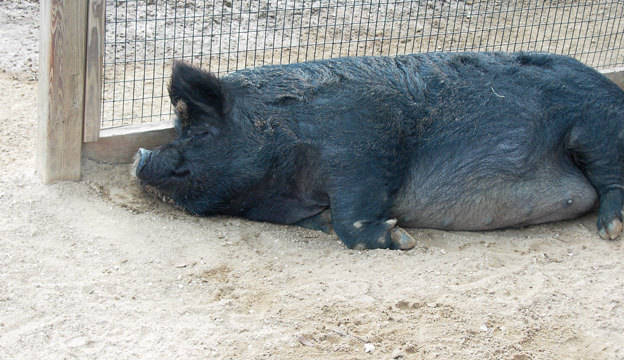
Conformation: They are a small hog, weighing between 85 and 250 pounds. They’re solid black with large pricked ears and a straight or very slightly dished snout. They’re hair rather than bristly and are flat backed, larger in the shoulder than in the ham. Described as a true miniature pig, Guineas are proportionate in stature, unlike the potbellied pig, which is a dwarf.

Special Considerations/Notes: Guinea Hogs are adaptable and suited to sustainable or low-input systems. They forage and graze well, gaining weight nicely on grass and weeds. They’re also good mothers, averaging eight piglets per litter.

Categories
Animals Breeds Large Animals

Hampshire Pigs

Use: Hampshire hogs yield a lean, well-muscled carcass with low backfat and contribute these qualities, along with speedy growth, to their cross-bred young. Some say when the famous Smithfield Ham was established, their products were made using only Hampshire hogs.

History: “Old English” hogs wandering the New Forest of Hampshire in England are thought to have been the forerunners of the Hampshire breed. The pigs arrived in the United States during the early 1800s; farmers in Kentucky worked with the breed and formed the first registry in 1893. Around that time, the Hampshire went by a number of different names, including “Thin Rind,” which described their thinner-than-normal skin. Now officially called the Hampshire, this hog may be the oldest swine breed in existence today—at least in the United States.

Conformation: Another departure from most folk’s stereotypical view of pigs, the black-coated Hampshire sports a thick, flashy white belt around its shoulder area that includes both front legs. This vigorous breed possesses perky, upright ears, a slightly dished face, and sound legs and feet.

Special Considerations/Notes: Sows have a reputation as good mothers with long breeding lives. Said to be an easy-care pig for beginners and an efficient feeder and forager, it’s no wonder that the Hampshire follows the Duroc as the third most-recorded swine breed in the United States.

Categories
Animals Breeds Large Animals

Hereford Hogs

Use: Herefords are a lean, meat hog that mature early, needing five to six months to reach market weight (250 pounds). Hams from Herefords are gaining popularity in specialty markets. Popular for 4-H and FFA projects for showing, Herefords now have their own division at most state shows.

History: Herefords were created from a cross of Duroc-Jersey and Poland China hogs by John C. Schulte of Norway, Iowa, around 1920. Modern representatives of the breed can be traced to this foundation.

Conformation: Hereford enthusiasts claim they raise the “world’s most attractive hog.” Herefords are a red hog, ranging from blonde to mahogany, with white feet, faces and occasionally bellies. They have drooping ears, a wide, slightly dished face and a curly tail. Their color and hardiness are well-suited to outdoor production, but shade should be provided to protect against sunburn. Herefords are even from shoulder to ham with a slight arch to the back.

Special Considerations/Notes: Herefords can be raised on pasture or in semi-confined conditions. Farrowing can be managed easily on pasture or in barns. They grow well on a variety of feeds and do not put on large amounts of fat. They love to root and can be quite useful for tilling. Hereford boars are known for their aggressive breeding habits and are very prolific. Many Herefords are being bred with commercial-breed sows to improve fertility and numbers. Hereford sows are average mothers with decent milk production. They typically wean all the piglets they gave birth to. Litter size averages eight to nine piglets. Full-sized Herefords range from 600 to 800 pounds at two years of age. The Hereford Hog is blessed with a large breeding population and an active registry (National Hereford Hog Record Association) with close to 10,000 hogs. Breeding stock is readily available from reputable breeders across the country.

Categories
Animals Breeds Large Animals

KuneKune Pigs

Use: The KuneKune pig is a producer of sweet, succulent meat. It is an intelligent and charming breed that makes an excellent addition to any pig lover’s menagerie.

History: The KuneKune (also spelled Kune Kune or Kune-Kune) is pronounced cooney cooney and means “plump” in Maori. This diminutive pig breed came to America from New Zealand in 1995 through a breeder in Kansas named Katie Rigby. Because pigs aren’t native to the lands down under, it’s anybody’s guess how they got there. Some speculate the breed originated in Spain while others say it’s of Chinese origin. However they got there, the Maori, New Zealand’s aboriginal people, adopted them and they thrived, but by the 1970s, their numbers were dwindling and it seemed the breed could become extinct. In 1984, a pair of wildlife park owners gathered a remnant population of 18 pigs and the New Zealand herdbook formed soon thereafter. The American KuneKune Breeders’ Assocation was established in 2006.

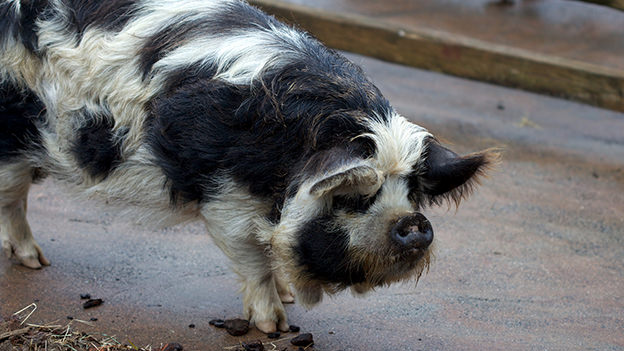
Conformation: The KuneKune pig breed is larger than the Vietnamese Pot-Bellied pig but smaller than commercial swine. It stands about 24 to 30 inches tall and weighs anywhere between 80 and 250 pounds. There’s a good deal of genetic diversity in the breed, but the typical KuneKune is stocky and solid with short, thick legs and a short, upturned snout. Its large ears stand or flop. The hair can be short or bristly. KuneKune pig breed colors include black, tortoiseshell, ginger and blue, with or without spots. A distinctive feature of the breed is piri piri (wattles; sometimes called tassels) on its lower jaws; some KuneKune pigs have them, others don’t.

Special Considerations/Notes: The KuneKune is a heritage pig breed with winsome looks, a sweet temperament and amazing intelligence that make it the crème de la crème of small pigs. It’s a hardy pig breed, so a stable with a thick bed of straw or a sty or arc in a field make adequate housing. KuneKunes are grazers, so they don’t tend root the way other pig breeds do. They make interesting organic lawnmowers and weed-trimmers in orchards, as they typically don’t harm trees and shrubs, and are a good option for farmers wanting to market grass-finished pork. The breed is slow-growing and late-maturing, so farmers who choose to raise them for their meat butcher them at 10 to 12 months of age.