Categories
Animals Breeds Large Animals

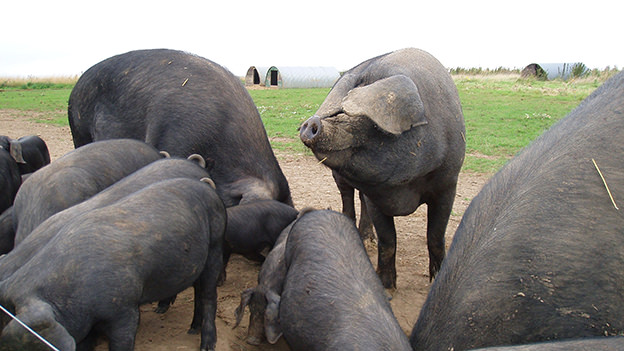
Large Black Pigs

Use: Large Blacks have light shoulders, large hams and good sides for bacon. The meat is finely textured, well-marbled and medium-pink in color. They’re easily managed, hardy and thrifty, meaning they can maintain weight well. The sows have good maternal instincts and are prolific mothers. Some sows can reproduce up to as long as 9 years.

History: Also known as the Cornwall, Devon or Lop-eared Black, the Large Black originated in Cornwall and Devon areas of England in the late 1800s. Today, very small numbers of Large Blacks can be found in Great Britain, Australia, Ireland, Canada and the United States. They were initially selected as a bacon type, resulting in its long and deep body.

Conformation: The Large Black is a full-sized pig with intensely black pigment in the hair and skin. They have long, straight faces and snouts. The large, drooping or lopped ears nearly cover the entire face down to the snout, covering their eyes completely and often obstructing their vision. The dark pigmented skin protects the hogs from sunburn.

Special Considerations/Notes: Large Blacks can be managed easily on pasture and with a variety of feeds. They’re recognized as hardy and thrifty (meaning it can maintain weight well); they were originally raised in rough conditions, left to clean up fields, brush, crop residue and hardwood forests. Large black sows have good maternal instincts and are prolific mothers, averaging 10 to 13 piglets per litter—and are know for their longevity.

Categories
Animals Breeds Large Animals

Mulefoot Hogs

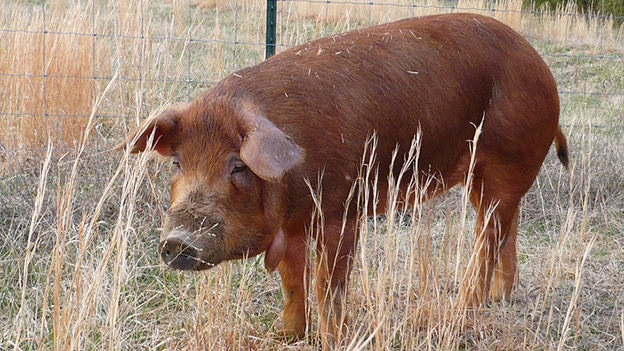
Use: Mulefoot hogs produce succulent, flavorful meat that’s red in color and highly marbled. It offers premium hams and lard. Photo by Arie McFarlan/Maveric Heritage Ranch.

History: The Mulefoot Hog is a distinct breed officially recognized since 1908 and recorded since the American Civil War. It’s origins are unknown but they resemble a variety of landrace British and Spanish breeds.

Conformation: Mulefoot hogs are a medium-sized, black hog with medium-sized forward ears; a soft, hairy coat; and hoof-like feet. The Mulefoot’s single toe that resembles a hoot of an equine is not a mutation, but a distinct breed characteristic that passes from one generation to the next. They have a solid, heavy bone structure and a long, straight, primitive-looking tail. Tusks are evident by eight months of age.

Special Considerations/Notes: Mulefoot hogs tolerate both heat and cold very well and can be raised in nearly any climate. They’re excellent forages and grazers, as well as highly efficient users of farm surplus and crop residues. They prefer shade in the summer and deep bedding in the winter, but will thrive outdoors if given the proper shelter. Litters average six piglets, but may yield as many as 12. Interest in the Mulefoot has grown, with approximately 250 purebred, registered animals; breeding stock is available occasionally.

Categories
Animals Breeds Large Animals

Ossabaw Island Hogs

Use: Prolific Ossabaw Island hogs offer tasty meat with a firm, not tough, texture. Fat is marbled throughout, with a rind over the ham and the shoulders. They’re larger in the shoulder area, giving more meat on roasts and chops. They’re suitable for home pork and lard production and for niche marketing.

History: The hogs of Ossabaw Island are descendants of hogs left by the Spaniards nearly 400 years ago on an island off the coast of Georgia. They’ve remained a distinct and isolated population, closely resembling their Spanish ancestors. Ossabaws adapted to the food cycle and salt water of the island, becoming smaller in size. Being food-to-weight efficient, Ossabaws are able to put on large amounts of fat during times of ample feed to sustain them during lean times.

Conformation: Ossabaw Island hogs are primarily black with white splotches and a brown tinge. They have pricked ears, long snouts and heavy coats with thick hackles similar to the Razorback. Ossabaw Island hogs average about 100 to 250 pounds fully grown.

Special Considerations/Notes: Ossabaw Island hogs should be raised outdoors to avoid overfeeding and obesity. Penned Ossabaws should be fed a diet high in fiber with oats, hay and garden scraps; corn is not recommended because it contains too much energy. They’re excellent nest builders and mothers, averaging eight piglets per litter. Boars will be able to breed at 4 months old.

Categories
Animals Breeds Large Animals

Red Wattle Hogs

Use: Red Wattles produce a fine, lean meat, initially prized by the French for its excellent flavor. They tend to grow muscle first and put on fat after reaching 300 pounds; butcher weight of 280 to 300 pounds can be achieved in about seven months. Raising them in environment-friendly systems, where they are used to turn compost of root up marginal grounds, is popular.

History: The Red Wattle is believed to have originated in New Caledonia, a French Island near Australia and cam to America via New Orleans with French immigrants. They’re also know at the Red Waddle, Woods Hog or Tassled Hog. Many factors have contributed to the near-extinction of the Red Wattle, including discrimination against its very lean carcass during years when lard was a primary fat source.

Conformation: The Red Wattle’s red coloring, which often includes black markings, helps prevent sunburn. The head is lean with a straight snout and ears that are erect. The most identifying feature is the wattle that hangs from the lower jaw at the neckline. Each wattle is thumb-sized in diameter, hangs one to five inches in length and contains cartilage. Expect well-fed Red Wattles to reach 500-700 pounds in 1 1/2 years and full size of 1,000 to 1,200 pounds by age 3.

Special Considerations/Notes: Red Wattles are raised from Canada to Texas under a variety of production methods, including sustainable farming methods (multi-species management, intensive grazing and deep-bedded systems. Most breeders supplement pasture-based systems with grains, corn and other farm surplus. Small numbers of these rare pigs are available from dedicated breeders.

Categories
Animals Breeds Large Animals

Vietnamese Potbelly Pigs

Use: Also known simply as pot belly pigs, Vietnamese Potbelly pigs are a dwarf swine breed, originally bred to be zoo animals. They are now most commonly used as domestic pets.

History: Potbelly pigs were developed in Vietnam and brought later to Canada, where the first breeders originally intended to offer them as zoo animals. Not long after they got their start, it was thought the small-sized pigs would make good pets, an idea which soon became widely popular. In 1986, when the first potbellies were sold into the United States, their market price ran well into the thousands of dollars. As the prices of the pigs became more affordable, they became more accessible alternative pets to cats, dogs and other typical household pets.


Conformation: Full-grown potbellied pigs weigh an average of 70 to 150 pounds with some reaching 200 pounds or more (typical domestic swine can weigh as much as 600 to 1500 pounds). Potbellied pigs average 3 feet in length and 15 inches in height. They’ll reach full growth by about age 5. Colors range from solid black to solid white, with a variety of spots in between.


Special Considerations/Notes: Most people who purchase these pigs want them as pets, but these pigs do not necessarily stay small. Potbellied pigs tend not to enjoy being picked up or held. (Unlike cats and dogs, pigs are prey not predators, so being lifted up or restrained causes them extreme alarm.) If keeping the animals as pets, owners will want to spay or neuter the potbelly pig. Unspayed females will display strong mood swings and intact males produce a pungent odor and other undesirable traits. A neutered male is called a “barrow,” an intact male is a “boar,” a female that has never had babies is called a “gilt” and a female that has given birth is a “sow.”

Categories
Animals Breeds Large Animals

American Water Buffalo

Use: Water buffalo are to Asia as bison were to the American plains Indians. For millennia, water buffalo provided draft power, milk, meat, hides, horn, and fuel in parts of Asia where no other sources existed. They are still an integral part of South Asian life. Riverine water buffalo also contribute up to 15 percent of the world’s milk supply. Buffalo milk is high in milk solids and averages eight percent butterfat, making it an ideal medium for making soft cheeses, butter, and yogurt. Most of the ghee (clarified butter) sold in India is made from buffalo milk, as is much of the gourmet mozzarella cheese crafted in Italian dairies (the United States imports 90,000 pounds of mozzarella di bufala every year). Lean, tasty, water buffalo meat contains less than one-fourth the amount of fat and half of the cholesterol of beef. Cooked, it closely resembles (and tastes like) lightly marbled beef. Ranchers in Trinidad developed a beef-type water buffalo called the buffalypso that is now available in the United States. And, due to their intelligence and placid natures, water buffalo are easily trained to ride or as working oxen.

History: Water buffalo (Bubalus bubalus) were domesticated in the Indus Valley of India and Pakistan at least 5000 years ago. Their ancestor, the critically endangered Asian Wild Water Buffalo (Bubalus arnee), still survives in limited numbers in India, Nepal, Bhutan, and Thailand. Early on the domesticated water buffalo separated into two types: swamp buffalo (the working water buffalo associated with China and Southeast Asia) and river or riverine buffalo (further developed in India and Pakistan for milk production). Water buffalo arrived in North Africa and the Near East as early as 600 A.D. They came to Europe with Crusaders returning from the Middle East. They were introduced to Australia in the early 18th century, where escapees quickly naturalized and where large feral populations still exist. The University of Florida, in an attempt to develop an organic approach to aquatic weed control, imported five buffalo in 1975. Their success led to an article in the December 1976 issue of Smithsonian magazine that in turn inspired Lake Charles, Louisiana businessman, A.P. Leonard, to import 103 riverine buffalo from Trinidad and 78 swamp buffalo from Guam. Experimental herds were ultimately established at the University of Florida and at Berry College in Georgia. The American Water Buffalo Association was formed in 1986 and there are now an estimated 4000 water buffalo in the United States.

Conformation: Swamp buffalo are the living tractors of China and Southeast Asia. Most are brownish-gray with lighter-colored legs and a pair of light-colored chevron markings on their chests. They are massively built with strong bodies and short legs ending in large hooves that enable them to navigate Asia’s flooded padi rice fields with ease. Their horns are triangular in cross-section and sweep back from their forehead in a wide crescent that can easily measure five or more feet from tip to tip. Riverine buffalo are combination draft and dairy animals. They can be brown but are usually black; white markings on the tail switch, legs, or forehead are common. They are taller, more angular, and have longer legs than swamp buffalo. Their horns sweep back, then up and in, frequently terminating in spiral curls. While swamp buffalo have 48 chromosomes and riverine buffalo 50 chromosomes, their genetic material is very similar and the two types are inter-fertile. Many North American water buffalo are mixtures of the two, as are the meaty buffalypso of Trinidad. They cannot, however, hybridize with genus Bos species such as domestic cattle, yaks, or bison, all of which have 60 chromosomes, nor are they closely related to bison (erroneously called American buffalo) or the Cape buffalo of Africa. Depending on type and breed, adult buffalo average 46-60 inches tall (measured at the withers) and weigh between 800 and 2000 pounds. They have one-tenth the number of sweat glands of domestic cattle and correspondingly sparse hair coat. They’re born with all the hair follicles they’ll ever have, so calves have relatively lush coats while adults have very little hair.

Special Considerations/Notes: Water buffalo are not exotics and thus not regulated as such. Fences that hold domestic cattle work for water buffalo. They thrive on marginal pasture with rough browse and consume a fraction of the feed required to raise cattle. Calving problems are virtually nil; cows display strong mothering instincts. They’re intelligent, long-lived, and cows frequently calve into their 20’s. With few exceptions, water buffalo are uncommonly easygoing and they thrive on attention. It’s easy to train buffalo to ride. Swamp buffalo are perfectly adapted to our Southeastern states. With winter protection, riverine buffalo can thrive anywhere in the United States. In hot, humid climates they prefer to wallow in water to cool down but hosing them with cool water twice a day is usually sufficient.

Categories
Animals Breeds Large Animals

Angus Cattle

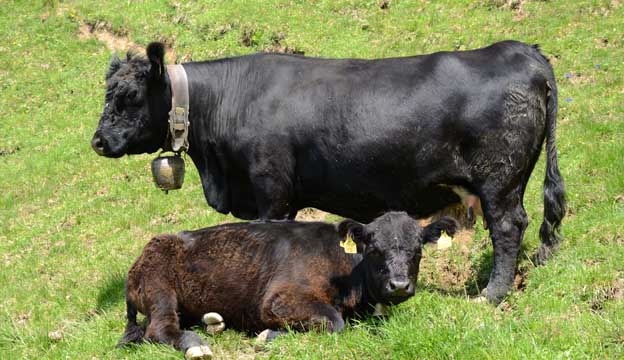
Use: Angus cattle are known for their ability to produce well-marbled, high-quality beef. Photo by Russell Graves

History: Angus bulls were first transported from Scotland to Kansas around 1870. Red Angus numbers was rejuvenated in America during the 1950s, after it was discriminated against by the Aberdeen Angus Breeders’ Association. The registry preferred the Black Angus to the Red and barred the color from the registry. The Red Angus Association was later developed to protect and promote the purebred Red Angus.

Conformation: Angus and Aberdeen Angus are both black and red and genetically polled (no horns). They were produced by crossing the cattle of two Scottish counties, Aberdeenshire and Angus.

Special Considerations/Notes: They are noted for their fast weight gain, marbled meat (flecks of fat, making it juicy and tender) and outstanding maternal qualities (aggressive, protective mothers that produce lots of milk for their calves).

Categories
Animals Breeds Large Animals

Ankole-Watusi Cattle

Use: The Ankole-Watusi are used in the United States for roping–and meat production because of their low fat and low cholesterol content. The milk is about 10 percent fat. Some dairy farmers have used crossbred Ankole-Watusi cows in their herds to boost the butter-fat levels.

History: Forerunners of the breed were raised by Egyptian farmers in the Nile Valley 6,000 years ago. They eventually spread to Ethiopia and southern Africa where they were crossed with humped Zebu cattle from India to produce the Sanga, which became the base of many African breeds including the Ankoli-Watusi.

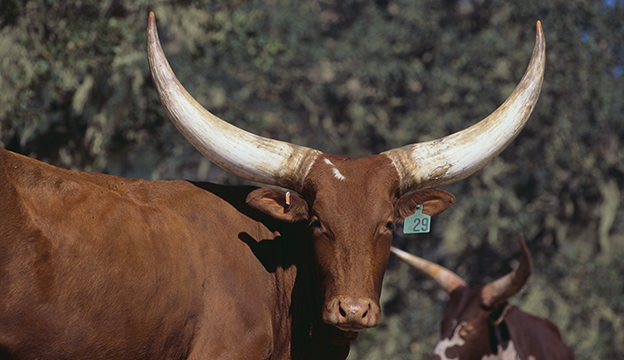
Conformation: These medium-sized cattle have long, large-diameter horns. Cattle may be solid or spotted in color, according to the Ankole-Watusi International Registry. The Ankole-Watusi is medium in size, with cows weighing 900-1200 pounds and bulls weighing 1000-1600 pounds. Newborn calves weigh 30-50 pounds.

Special Considerations/Notes: Ankole-Watusi tolerate temperature and weather extremes well, says the breed’s international registry. The large horns act as radiators; blood circulating through the horn area is cooled and then returned to the main body. This allows excess body heat to be dispersed. At night, the herd-members sleep together, with the calves in the center of the group for protection. The horns of the adults serve as formidable weapons against any intruders.

Categories
Animals Breeds Large Animals

Ayrshire Cattle

Use: A medium-sized breed, the Ayrshire weighs about 1,200 at maturity and produces about 17,000 pounds of milk with 3.9 percent butterfat.

History: The breed originated in Scotland and was imported to the United States in 1822. According to the U.S. Ayrshire Breeders’ Association, farmers in New England needed a dairy cow that would graze the pastures of their rough, rocky farms and tolerate the cold, often inhospitable winters. In many ways, the environment in New England was very similar to the Ayrshire’s native Scotland, and she thrived in her new home.

Conformation: Ayrshires are lovely cows with mottled, reddish-brown patches set against a white background. On some bulls, the mahogany color is so dark that it appears almost black in contrast to the white. For many years, the Ayrshire horns were a hallmark of the breed. These horns often reached a foot or more in length. Unfortunately, the horns were not very practical, and today almost all Ayrshires are dehorned as calves.

Special Considerations/Notes: Farmers practicing dairy grazing—or making milk primarily off of pasture have shown a renewed interest in the breed. Ayrshires excel in udder conformation and are not subject to excessive foot and leg problems.

Categories
Animals Breeds Large Animals

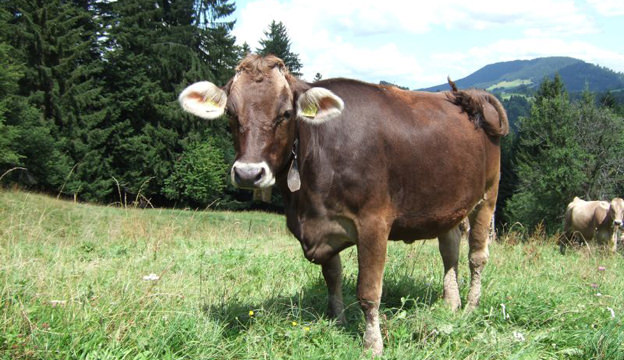
Brown Swiss Cattle

Use: The Brown Swiss is a dairy breed that can produce over 21,000 pounds of milk per year with 4 percent butterfat. According to Brown Swiss Association, the milk of the Brown Swiss cow is coveted by cheese makers. The volume of milk plus the protein produced by Brown Swiss makes the best milk for the fluid and cheese markets. Brown Swiss breeders benefit from the best fat-to-protein ratio of any of the dairy breeds for production of most cheeses. For this reason, Brown Swiss producers regularly receive more for 100 pounds of their milk than milk producers of other breeds.

History: Brown Swiss cattle originated in the Alps of Switzerland and were first imported to the United States in 1869.

Conformation: Their color is always brown—ranging from light grayish-brown to very dark mahogany—and their size is medium to large.

Special Considerations/Notes: They are fairly good grazers and are extraordinarily hardy—tolerating both very cold and very hot climates well. The breed is also known for its longevity, good feet, solid legs and well-developed udders.