Categories
Animals Breeds Large Animals

Belted Galloway Cattle

Use: Belted Galloways have similar uses to the Galloway. They’re efficient grazers and browsers, making them ideal for forage-based beef production. Their beef is flavorful and noted for well-marbled carcasses with large ribeyes and very little internal fat. And, due to their protective nature, a few Galloways in a pasture are as effective as donkeys or llamas for guarding sheep and goats from wandering dogs. Photo by Rhoda Peacher.

History: Galloway cattle originated in the Scottish Lowlands in the six shires that made up the Province of Galloway. Records indicate that most early Galloways were black but red, browns, and brindles, with or without white markings were also fairly common. A separate American registry for Galloways of the belted variety (the United States Belted Galloway Society) was founded in 1951, although the American Galloway Breeders Association also registers Fullblood, Belted, and White Galloways in separate herd books. Belted Galloways are thought to have risen from crossing black Galloways with Dutch Belted cattle.

Conformation: According to the U.S. Belted Galloway Society, Belted Galloway can be black, red or dun in color. A complete belt should encircle the midsection of the body, between the front and rear legs. Skin should be moderately thick. Hair coat should have two layers, a short undercoat covered by a long shaggy coat that protects the animal. Cattle should be moderate in size. The head should be broad with the poll low and flat.

Special Considerations/Notes: Galloways are friendly, docile cattle; even bulls are noted for their calm demeanor. Cows are milky, maternal, and long-lived, with a well-deserved reputation for getting in calf every year. And, though Galloways are a quintessential hardy, Northern breed, they adapt well to Southern climates too. Belted Galloways are listed on the American Livestock Breeds Conservancy’s conservation priority list under the Recovering category.

Categories
Animals Breeds Large Animals Uncategorized

Delaine Merino Sheep

farm-breed-profiles/delaine-merino_190.jpg

Photo Credit: Photo courtesy Amy Schroeder


Use: The Merino is justifiably famous for its wool.  Hand spinners adore the Merino’s exceptionally fine fleece, which spins up into a soft yarn that, when turned into garments, offers lightweight warmth without the itchy, scratchy feel of coarser wools.  Quality Merino wool often fetches top dollar. Photo courtesy Amy Schroeder


History: The Merino has its roots in Spain, where from the 14th to the 19th centuries this breed with its fine, luxurious fleece dominated the European wool trade. For many years, the Spanish government maintained a monopoly on the breed, refusing to allow its export. Finally, in 1786 the King of Spain relinquished a small flock to his cousin Louis XVI’s estate at Rambouillet in France (the Rambouillet breed emerged from this stock). After the Spanish empire fell apart, the breed spread to other countries, including Australia, Britain, and the U.S. Arriving soon after Australia’s settlement, the Merino proved to be as a versatile and resilient breed capable of succeeding in this vast continent’s varied climates and terrain. Today, the Australian Merino—the most common breed in that country—consists of four strains: the Saxon Merino, South Australian Merino, Spanish Merino, and the Peppin Merino.


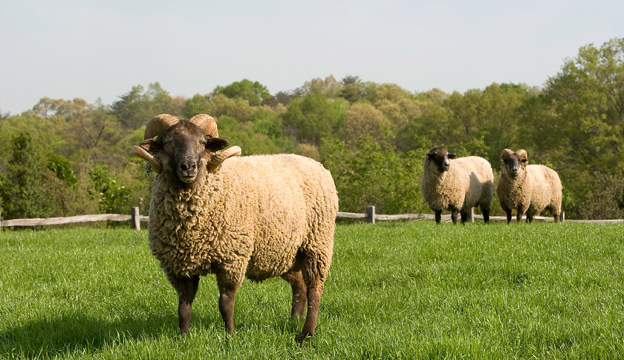
Conformation: The Oklahoma State University Breeds of Livestock website divides Merinos in the United States into types A, B, and C. The smaller, wrinkly-hided type A Merino developed in Vermont, while the larger type B Merino hailed from Ohio, where breeders selected for a heavier fleece and mutton body type. The adaptable, smooth-bodied Type C, or Delaine, Merino is the most common type in the United States today. Medium-sized Delaine Merino ewes generally weigh between 125 and 180 pounds, while rams weigh in at around 175 to 235 pounds. Merino rams often sport magnificent curling horns. Each year, the Merino grows a dense, finely-fibered fleece with a staple length of  2.5 to 4 inches long. The wool color ranges from white to cream to straw-colored.


Special Considerations/Notes: Merinos have a highly developed flocking instinct, which makes them good range animals and easy for shepherds and their dogs to herd around. The motherly ewes produce twins about half the time and can breed out of season, allowing shepherds to be more selective about when lambing occurs. These sheep are said to have longer productive lives than other sheep breeds, living and producing wool and lambs for ten years or more.

Categories
Animals Breeds Large Animals

Dorset Sheep

Use: Dorsets are dual-purpose wool and meat sheep. Dorset fleece is white, strong, and free of dark fiber. Averaging a five to nine pound clip with a two to four inch staple, it measures in the 26 to 32 micron range. Because they’re attentive, extremely milky dams, Dorset ewes produce fast-growing, meaty lambs; twins are the norm.

History: The British Dorset’s origin is uncertain but it’s believed to be descended from a long-tailed, primitive breed, the Portland, whose tan-faced, horned ancestors ranged throughout southwest England prior to the Roman Conquest. Says M.L. Ryder, writing in The History of Sheep Breeds in Britain (1964), “The unimproved Portland breed, now almost extinct, is probably a good example of what the South-West Horned type was like before it evolved into such breeds as the Wiltshire Horn and Dorset Horn. It is of interest that the long breeding season for which the Dorset Horn is now famed was noted by Edward Lisle as early as 1757, in the Wiltshire breed. The only other breed that is so fertile is the Merino, and this has led some to suggest Merino blood in the modern Dorset.” The British Dorset Horn Sheep Breeders Association was founded in 1891 but Horned Dorsets came to America long before that. The Hudson’s Bay Trading Company brought them to Oregon prior to 1860 and the first to reach our East Coast arrived in 1885. Using Horned Dorset breeding stock, North Carolina State College in Raleigh, North Carolina, pioneered polled (hornless) Dorsets in the early 1950’s, creating a second and now more popular Dorset breed.

Conformation: Dorsets, both horned and polled varieties, have white faces with pink skin. They are solidly build, at least as long as they are tall, with broad backs and medium-length legs. Horned Dorset ewes have small, sturdy horns that curve forward and downward close to the jaw; Horned Dorset rams have magnificent, spiral-curved horns. Dorset ewes weigh 150 to 225 pounds and stand 34 inches tall or less; mature rams tip the scale at 225 to 350 pounds and shouldn’t exceed 37 inches tall at the shoulder.

Special Considerations/Notes: The Dorset’s most remarkable trait is its ability to breed out of season, a quality not seen in most wooled breeds; properly managed Dorset ewes produce three lamb crops in just two years. In addition, Dorsets adapt extremely well to both grass-based and feedlot situations. Polled Dorsets are the most popular white-faced breed in North America, while the much less-common Dorset Horn remains in the Watch category (“Fewer than 2,500 annual registrations in the United States and estimated global population less than 10,000”) of the American Rare Breeds Conservancy’s Conservation Priority Watchlist.

Categories
Animals Breeds Large Animals

Finnsheep Sheep

Use: The Finnsheep produces about 5 to 6 pounds of soft, lustrous wool with a moderate crimp, a long staple of 3 to 9 inches, and spinning count in the 50s. Ideal for outer garments, the breed’s wool has found favor with handspinners and knitters. Although these sheep are of moderate size, they also furnish a lean, tasty meat. This bountiful breed has been widely used in crossbreeding programs to produce more prolific sheep.

History: The Finnsheep evolved from the wild Mouflon, a tough mountain sheep inhabiting the islands of Sardinia and Corsica. Known as the Finnish Landrace in its native Finland, this breed counts as its close relatives the other short-tailed sheep of Scandinavian origins, such as the Icelandic and Shetland. The University of Manitoba brought the first Finnsheep to North America in 1966.

Conformation: Most Finnsheep in the United States have white fleeces, but they can also sport black, black and white spotted, and – rarely – brown, fawn, and gray wool. These polled sheep have wool coats that extend to their knees or hocks, straight backs, and slender, wool-free heads. They wag woolly, naturally- short tails only 4 to 6 inches long: no docking required! Rams average 170 to 240 pounds, and ewes weigh around 130 to 180 pounds. Finnsheep enthusiasts praise this breed for its friendly disposition, foraging prowess, and ability to adapt to various climates and rough terrain.

Special Considerations/Notes: Along with the Romanov, the Finnsheep ranks as one of the most prolific sheep. The super-ewes mature early and frequently give birth to litters of lambs, often triplets or quadruplets. Fortunately, birthing problems are uncommon due to the lambs’ small size and the ewes make fine, heavy-milking moms. With more than two or three lambs, however, mother ewe will need help with the feedings.

Categories
Animals Breeds Large Animals

Gotland Sheep

Use: The Gotland Peltsheep (pälsfår) or modern Gotland has been developed in Sweden since the 1920’s through controlled breeding and intensive selection, producing a true multipurpose long wool sheep, yielding good flavored close-grained meat, furskins and soft silky lustrous fleece. Gotland sheep may also be found in Sweden, Britain, Denmark, New Zealand and Australia

History: The breed was first established on the Swedish island of Gotland by the Vikings with Karakul and Romanov sheep brought back from expeditions deep into Russia and crossed with the native landrace sheep. The Vikings were great seafarers as well as sheep farmers and took these animals on their extensive voyages to provide meat and skins along the route. Hence the spread of these Northern short-tailed sheep and the development into related breeds such as Goth sheep, Icelandic, Finnsheep, Shetland, North Ronaldsay and Manx. Primitive horned Gotland sheep still exist on the island of Gotland today.

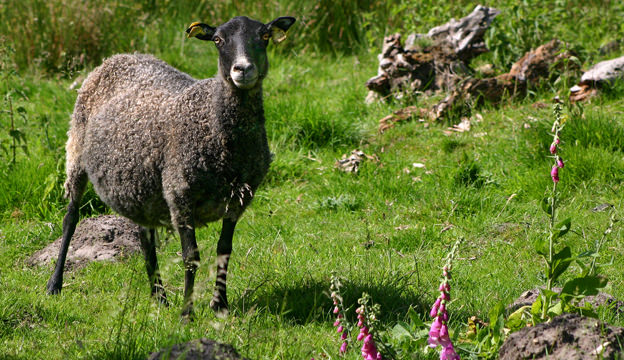
Conformation: With a calm, friendly disposition, Gotlands are fine-boned and of medium size. The sheep has a hornless black head sometimes with white markings and free from wool. The eyes are bold and they have alert medium sized ears. They have small neat muzzles with even jaws and teeth set squarely on the pad. With slender necks and shoulders set smoothly into a level back with generous length, they have good depth and reasonable breadth of body. Their black legs are slender, well spaced and upright. Dense, long, lustrous grey fleece, occasionally black, or white. Clearly defined even curl and staple, soft to the touch. They have a short, hair-tipped tail. Fleece is fine, long, lustrous and dense with clearly defined curl and staple, soft to the touch. It is typically 29 to 34 microns in diameter at 18 months of age, as measured midside at the last rib. Lambs wool is typically in the low to mid 20’s micron range.

Categories
Animals Breeds Large Animals

Hampshire Sheep

Use: Hampshires are commonly used as terminal sires for commercial flocks because they pass along valuable production traits like efficient feed conversion and rapid growth. This breed yields a lean, heavy carcass and also gives around 8 pounds of dense, fine wool with a spinning count in the 54s to 60s and a staple length of 2 to 3½ inches.

History: Hampshire County located on the south coast of England, an area with a kinder climate than many parts of Britain. This large breed arose from sheep native to the district and bordering areas, possibly the Old Hampshire, Berkshire Knot, Southdown, and Willshire Horn. A Cotswold ram owned by John Twynam also seems to have also played a role in the development of what is still called the Hampshire Down in Britain. The first Hampshires came to the United States in 1840; however, these sheep apparently met an untimely end during the Civil War. Fortunately, more sheep arrived in 1879.

Conformation: With their large size, strong muscling and deep, blocky bodies, Hampshires look like the oxen of the sheep world. The hefty mature rams can tip the scales at more than 275 pounds, while the ewes weigh 200 pounds or more. This polled breed fits the stereotype most humans have of sheep: white wooled with a wool cap over an “open” dark face and moderately long, slightly drooped ears. Their legs are also dark, with some wool present below the knees.

Special Considerations/Notes: Hampshires have a long breeding season, and the ewes experience a large percentage of multiple births. Though these big, active sheep may look a bit intimidating, raisers describe them as quiet and laid-back, a plus for farmers and exhibitors.

Categories
Animals Breeds Large Animals

Hog Island Sheep

Use: Hog Island sheep furnish between 3 to 5 pounds of medium, short-stapled wool a year; it’s said to spin easily and take dye well. However, most raisers keep these sheep in order to preserve this endangered heritage breed. The American Livestock Breeds Conservancy lists their status as critical, estimating a global population of less than 2,000.

History: The first settlers of Hog Island had to have been hardy souls to eke out a living on this remote, exposed barrier island off Virginia’s eastern shore. And that applies to the island’s sheep community, too. Descended from British stock and established during the 1700s, these sheep essentially fended for themselves, eventually evolving into a unique breed, compact and rugged. When an epidemic of hurricanes forced the human inhabitants to leave, many of the Hog Island sheep remained behind as truly feral animals – one of the few populations of feral sheep in the U.S. They survived in this marshy environment until the Nature Conservancy bought the island in 1974 and sent them to live in more civilized surroundings, including historical monuments and museums like George Washington’s birthplace, Mount Vernon Estate and George Mason’s Gunston Hall.

Conformation: Thanks to their island environment, the Hog Island breed developed into a hardy, variable, compact sheep weighing between 90 and 150 pounds. Most flaunt white wool, which naturally sheds in the spring, although many raisers choose to shear for a neater look and to obtain more wool. They also come in black, and new lambs often arrive with spotted fleeces that generally fade with maturity. Their faces and legs may be black, or have varying amounts of speckles and spots in white, brown or black. Rams usually bear horns or small scurs, while the ewes can be either horned or polled.

Special Considerations/Notes: Hog Island sheep make lovely, low-maintenance additions to the hobby farm. These thrifty sheep have a powerful flocking instinct and the motherly ewes often produce twins.

Categories
Animals Breeds Large Animals

Icelandic Sheep

Use: The medium-sized Icelandic makes a wonderful triple-purpose addition to the farm. The versatile, double-coated fleeces grown by this breed charm hand spinners with a wide and lovely range of natural colors.  Their double coat consists of a soft, lustrous, inner “Thel” and a longer, coarser, wavy outer “Tog.”  Fast-growing Icelandics make fine, lean meat animals; in Iceland, they’re bred almost solely for this purpose.  The skins transform into gorgeous rugs and clothing, too.  Once used extensively in dairy production, the breed again seems to be catching on as a producer of milk and cheese.

History: The Icelandic, a breed that has remained virtually unchanged for over 1,000 years, may be the oldest and most genetically pure sheep breed in the world.  Modern Icelandics descend from sheep ferried by Vikings to Iceland during the 9th and 10th  Centuries.  Attempts to “improve” the breed by outcrossing generally resulted in increased vulnerability to disease, and so raisers on this island nation decided to keep their selective breeding attempts confined within the breed.  A small flock of these sheep finally entered Canada in 1985, and during the 1990s the breed found its way down to the U.S.

Conformation: As part of the North European short-tailed sheep group, Icelandics have a naturally short tail that requires no docking (in fact, docking disqualifies animals from registration in North America). These sheep have a stocky, short-legged build, with rams weighing in at about 180-220 pounds and ewes running around 130-160 pounds. They can be horned or polled. Those lush fleeces come in white and shades of gray, black, and brown, and they can also exhibit many different patterns. The water-resistant outer coat can reach 15 inches in length. Icelandics have alert, active, somewhat nervous personalities and a poor flocking instinct.

Special Considerations/Notes: Icelandic ewes mature early into prolific, long-lived, seasonal breeders. They have few difficulties lambing, usually producing vigorous twins (and often triplets), and like many primitive breeds, they possess good mothering skills. These tough, feed-efficient sheep excel on pasture and rocky, hilly terrain, plus they tend to be resistant to disease.

Categories
Animals Breeds Large Animals

Karakul Sheep

Use: Karakul wool is an ideal medium for weaving fine rugs and saddle blankets as well as for felting. While not meat sheep per se, Karakul flesh is lean, fine-textured, and tasty.

History: Karakul fat-tailed sheep are one of the world’s most ancient breeds. Archaeological evidence suggests they were raised for their skins in the Middle East as early as 1400 B.C. Karakul felt has been fashioned into dwellings called yurts since 400 B.C. and Persian carpets since at least 500 B.C. The breed’s name is derived from Qara Qul, meaning “black lake” in several Turkic languages, probably after an ancient village of the same name in the former emirate of Bokhara located in what’s now Uzbekistan. Karakul sheep were (and are) kept throughout the region for milk, meat, tallow, and wool, but especially for the pelts of their fetal and newborn lambs. Due to a dominant black gene in this breed, most lambs are born with coal black coats. To ‘harvest’ broadtail (karakulcha) moiré-patterned pelts, pregnant ewes are slaughtered and their fetal lambs skinned; Persian lamb pelts with flattened curls are taken from newborns less than three days old (for a discussion of Karakul sheep and pelt production, download “Karakul Sheep and Lamb Slaughter for the Fur Trade.” Karakuls were imported to the United States between 1908 and 1929 in an effort to produce domestic Persian lamb; however, American pelt-producers infused the blood of other breeds to the extent that the pelts they produced lacked value and the experiment was subsequently abandoned. While the Middle Eastern Karakul is quite plentiful (there are an estimated four million in Uzbekistan alone), the American Karakul is listed on the American Livestock Breeds Conservancy’s Conservation Priority List as a Threatened breed (“Fewer than 1,000 annual registrations in the United States and estimated global population less than 5,000”). Additional conservators are needed.

Conformation: The Karakul is a fat-tail sheep that deposits fat in the upper part of its tail as a hedge against starvation, always a possibility in the harsh climate in which it evolved. Its long-stapled (six to 12 inch), low-grease fleece ranges from silky soft to coarse textured; some Karakuls are double coated, others aren’t. Newborn lambs are usually coal back but most Karakuls change, as they age, to hues as diverse as silvery blue, gray, golden tan and reddish brown, white, and pied. Karakuls are tall, narrow sheep with long bodies; ewes range from 100 to 150 pounds, while rams run 175 to 225 pounds. Rams can be polled or horned; ewes are generally hornless. Some Karakul sheep even have wattles!

Special Considerations/Notes: Karakul sheep are long-lived, extremely hardy, and given dry cover, they adapt well to extremes of heat and cold. They’re foot rot- and worm-resistant. Karakul ewes generally produce a single lamb but they’re attentive and fiercely protective mothers, resulting in a high lamb survival rate. A bonus: Karakuls breed out of season so it’s possible for ewes to lamb three times in just two years.

Categories
Animals Breeds Large Animals

Katahdin Sheep

Use: Katahdins make hardy, low-maintenance meat animals and produce excellent lamb crops throughout their long productive lives. The lambs yield a lean, mild-tasting carcass that holds appeal for specialty markets. These adaptable sheep are also useful in land management and cross-breeding programs.

History: Although this breed’s name sounds quite exotic, the Katahdin hair sheep actually originated on a farm in north central Maine run by Michael and Barbara Piel.  An amateur geneticist and avid livestock raiser, Michael Piel had initially looked into utilizing sheep to graze power lines and for other forms of land management. However, his focus later shifted to the development of a meat sheep that wouldn’t require shearing. In 1957, Piel imported some wool-less sheep known as “African Hair Sheep” from St. Croix in the Virgin Islands.  Over the years he crossed these animals with a variety of other breeds, including Tunis, Hampshire, Suffolk, and Cheviot.  Finally, in the early 1970s, Piel picked about 120 of his finest ewes and named them after the highest mountain in Maine, Mount Katahdin.  The breeder’s association and registry for these sheep, Katahdin Hair Sheep International (KSHI), formed in 1985.  Today, the American Livestock Breeds Association lists the Katahdin as recovering, meaning it has an estimated global population exceeding 10,000 but still needs monitoring.

Conformation: Katahdin sheep possess a coarse outer hair coat that can vary in length and texture, and a fine, woolly undercoat. Their coat thickens during periods of cold weather and naturally sheds as temperatures warm and days lengthen. These sheep can sport any color or color combination. The breed has an alert look with wide-set eyes and horizontal ear carriage, and their tail length can be variable (preferably undocked).  Defects include weak shoulders/back, weak pasterns or splayed hoofs, and cryptorchidism/monorchidism in rams. Katahdins are a medium-sized breed, with mature ewes weighing approximately 125 to 180 pounds, while the rams weigh around 180 to 250 pounds. They have a docile nature and the ewes exhibit good mothering skills and milking ability, producing lively lambs.

Special Considerations/Notes: According to the KSHI, studies in Arkansas have indicated this breed has a significantly higher degree of parasite resistance than the other wooled breeds studied. Thanks to the absence of thick fleece, Katahdin also showed increased heat tolerance, making them ideal candidates for the warm, humid, parasite-prone South. Unlike the wool breeds, hair sheep require no yearly shearing – a boon to busy shepherds who don’t plan to market or use the wool from their flocks.