Categories
Animals Breeds Large Animals

Savannah Goats

Use: Savannahs are premier meat goats; they produce delicious, mild-tasting chevon and lots of it. While they resemble their Boer cousins in all but coloration, Savannahs are hardier, making them ideal goats for low maintenance input operations and for crossing with Boers and other meat and dairy breeds to increase hardiness and meatiness in the offspring.

History: According to the Animal Improvement Institute of South Africa, the Savannah goat was developed by the Cillier family of Douglas, an agricultural and stock farming community in the North Cape province of South Africa. In 1957, Mrs. Cillier’s Griqua servants presented her with the gift of a white buck goat. She purchased five indigenous does with white in their color pattern to breed to him and then selected for white coloration, heat and parasite resistance, and meat production. Though Savannah goats came to Canada in 1994 along with the first Boers imported to North America, they didn’t catch on here until quite recently. They are, however, a major meat-producing breed in their South African homeland.

Conformation: Savannah goats have long, broad, muscular bodies; does weigh in between 125 to 200 pounds and bucks, 200-250 pounds or more. Savannahs have a Boer look about them but are somewhat less Roman-nosed and most have slightly shorter ears. Bucks (and to a lesser degree, some does) display loose, supple, skin folds over their chests and necks, a trait being bred out of their show goat Boer kin. Their horns are strong, widely placed and of moderate length; they curve straight back from the crown of the head before gradually turning out in a symmetrical curve. Savannahs have short, white coats (a sprinkling of red, black, or blue ticking is permissible) with black skin, horns, nose, sexual organs, and hooves. Two or four teats are allowed.

Special Considerations/Notes: Savannah bucks are aggressive breeders and does, peerless mothers; Savannah does are protective, fertile, they kid with ease, and two to four kids are the norm per litter (the Cilliers’ herd was untended for one month prior to kidding and two months after; survival of the fittest weeded out poor doers early-on). Savannah goats breed year round. They were selected for strong jaws, long-lasting teeth, and sound legs so they could stand on their hind legs to efficiently browse brush, leaves, and any other green thing in their harsh environment. They easily endure heat, intense sunshine, cold and rain. Savannas are as tough as a goat can get. If you’re looking for a productive meat breed that doesn’t require codling, seek no further, this is your goat. There is currently no North American breed association specifically for Savanna goats but Pedigree International and the World Wide Sheep and Goat Archives maintain Savanna herdbooks.

Categories
Animals Breeds Equipment Large Animals

Spanish Goats

Use: Some of the Spanish goat’s colorful regional names suggest one of their primary uses: they’re called “brush goats” and “briar goats” in the Carolinas, “wood goats” in Florida, “Hill goats” in Virginia, and “scrub goats” throughout their original range. Spanish goats were (and are) the best organic woods and brush control agents on four legs. Although some strains are small- to medium-size and decidedly rangy, breeders, especially in the goat-raising regions of Texas, have selectively bred up a bigger, meatier Spanish goat. Large or small, Spanish goats produce flavorful meat and healthy, multiple kids without requiring a lot of human intervention and they’re disease-, parasite- and foot rot-resistant, making them ideal for anyone involved in minimum-input and organic chevon production. Photo by Murray Edwards.

History: Christopher Columbus brought the first Spanish goats to Española (Haiti) on his second voyage in 1493; when Francisco Vasquez de Coronado led the first Spanish army into New Mexico in 1540, goats came along as a walking food supply. Spanish colonists and their goats subsequently settled in what are now our Southwestern and Southeastern states. Goats escaped, goats were set free to fend for themselves. They went forth and multiplied in wild scrubland where only the strong survived; their descendants are today’s Spanish goats.

Conformation: Spanish goats are a landrace breed. Crossbreeding with dairy and fiber breeds occurred throughout the Spanish goat’s rich history, resulting in widely differing characteristics in various herds. Genetically pure populations still exist but even these were influenced by the climate and terrain in which they evolved, so genetic diversity within this breed is the norm. All colors are acceptable. Most Spanish goats have long, twisty horns. The hair coat is usually short but some goats grow fringes on their lower bodies and thighs, while others produce cashmere winter coats. Individuals weigh between 50 and 200 pounds; larger animals are from strains selected for decades for meat-making capabilities. What they all have in common are an inherent wariness that helped them survive, strong teeth and legs, almost unimaginable hardiness, and the ability to take care of themselves.

Special Considerations/Notes: The very qualities that enabled Spanish goats to survive under adverse condition currently threaten their existence. Because they are such easy keepers and because they kid without assistance, thousands upon thousands of tough, rangy Spanish does throughout the country are being bred to Boer and Kiko bucks to produce meatier kids. Only an estimated 8,000 Spanish goats remain. The American Livestock Breeds Conservancy is working with a few dedicated breeders to preserve these goats and additional conservators are badly needed.

Categories
Animals Breeds Large Animals

Toggenburg Goats

Use: Toggenburgs are marvelous dairy goats. A Toggenburg doe, GCH Western-Acres Zephyr Rosemary, currently holds the Guinness Book of World Records title for giving 9,110 pounds of milk amounting to nearly 1,140 gallons in 365 days. Many Toggenburg does “milk through” without re-breeding each year; lactations of 18 to 20 months are fairly common. Toggenburg wethers make sturdy, hard-working and amiable harness and pack goats.

History: The Swiss developed Toggenburg goats about 300 years ago in the Toggenburg Valley of the canton of St. Gallen in northeast Switzerland. Its supporters call it the oldest and purest of Swiss goats. Toggenburgs, called “Toggs” by those who know and love them, reached England by 1882, where, in 1905, it became the first recognized dairy breed in Great Britain. Four Toggs came to America by way of England in 1883; Toggenburgs were subsequently imported in greater numbers than any other dairy goat breed. One well-known Togg advocate was Lilian Sandburg, wife of poet Carl Sandburg, who raised Chikaming-prefixed Toggenburgs, Saanens, and Nubians at the family’s farm in Flat Rock, North Carolina. In 1960, one of Mrs. Sandburg’s does, Jennifer II, broke the world Toggenburg record for milk production by producing 5,750 pounds of milk in a single year.

Conformation: Toggenburgs are medium to large dairy goats; mature bucks stand 34 to 38 inches tall and weigh 150 to 200 pounds; does measure 30-32 inches, weighing 125 pounds and up. Togg base colors range from light fawn to darkest chocolate but all Toggs have the same markings: white ears with a dark spot in middle of each ear; two white stripes down their faces from above each eye to their muzzles; their hind legs are white from hocks to hooves and their forelegs white from knees downward (a dark lien or band below each knee is acceptable); a white triangle on both sides of their tails; and a white spot at the root of their wattles or in that area if no wattles are present. Varying degrees of cream markings instead of pure white are acceptable. Toggs have medium-length coats; straight or dished faces; alert, upright ears; and high, globular, well-attached udders (Toggs dominate the “Best Udder” classes at American Dairy Goat Association shows).

Special Considerations/Notes: Like the other Swiss dairy breeds, Toggs do best in cooler climates. They’re easy kidders and good mothers, fine foragers, alert, and affectionate. A myth prevails that Toggs give off-flavored milk but this simply isn’t so. Milk from properly managed Toggenburg goats is sweet and tasty and when you keep Toggs, there is always plenty of it!

Categories
Animals Breeds Large Animals

American Jacob Sheep


Use: Still popular as exotic-looking pasture ornaments, Jacobs also delight fiber artists with their black and white wool that can be mingled and spun into beautiful variegated yarn. Wool quality and fineness vary between individual sheep, but in general this breed has undergone selection to produce a medium 3 to 6 pound fleece with a staple length of 3 to 7 inches, a spinning count of 44 to 56, and a light, open handle. Despite their relatively small size, Jacobs also efficiently produce a lean, flavorful meat while foraging on pasture with little supplemental grain.

History: The Jacob sheep acquired its name from the Old Testament story of Jacob, who selectively bred spotted sheep, but no one knows for sure where this ancient breed originated before it was documented during the 1600s in England. Spotted, or piebald, sheep had been described in the Middle East and Mediterranean regions, and in Asia. Primarily kept as ornamental “park” sheep in Britain, Jacobs came to North America during the mid-1900s. The two lines ultimately diverged as British breeders selected for larger, more uniform sheep and American breeders attempted to keep the breed’s primitive conformation intact while improving fleece quality. The American Livestock Breeds Conservancy lists this breed as rare on its Conservation Priority List.

Conformation: From a distance, many people mistake these primitive sheep for goats because of their slender build, horns and eye-catching black-spotted white fleeces. As a polycerate or “multi-horned” breed, Jacob rams and ewes can sport anywhere from two to six horns. Ewes weigh around 80 to 120 pounds; rams, 120 to 180 pounds.

Special Considerations/Notes: Jacob sheep tend to act more goat-like than other sheep. They have a poor flocking instinct and a fondness for browsing brush as well as grazing. Hardy and adaptable, Jacobs tend to be resistant to disease and parasites, and can weather both hot and cold climates. The ewes have few lambing problems and make protective mothers, even using their horns to ward off predators on occasion.

Categories
Animals Breeds Large Animals

Barbados Blackbelly Sheep

Use: Barbados Blackbellies are meat breed sheep ideal for situations where their hardiness, productivity, parasite- and foot rot-resistance, and ability to take care of themselves makes a difference, such as in low-input, organic, and grass-fed lamb operations and on farms with poor-quality pasture.

History: Barbados Blackbelly sheep evolved on the tiny, tropical, southern Caribbean island of Barbados in the western Atlantic Ocean. Parent stock included African hair sheep and European wool breeds. According to historian Richard Ligon, writing in A True & Exact History of the Island of Barbados (London; 1657) the sheep were already a discernable breed by the early seventeenth century. The U.S. Department of Agriculture imported four Barbados Blackbelly ewes and one ram in 1904 and North Carolina State University brought in a group in 1970; additional undocumented importations probably occurred. Texas is home to an estimated 250,000 to 500,000 mixed-breed sheep descended from early imports, but as of 2007, there are fewer than 400 purebred Barbados Blackbelly sheep in the continental United States.

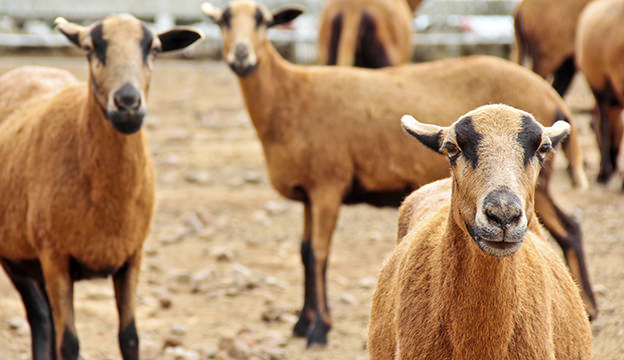
Conformation: Barbados Blackbelly ewes weigh about 100 pounds, rams tip the scales at 105 to 125 pounds and occasionally higher. They come in all shades of brown, tan or yellow, highlighted with black under parts with black extending down the inside of the legs, black noses and foreheads, and the insides of their ears are black too. Rams have a mane of thick hair growing down their neck as far as their briskets; some have manes that cover the shoulders as well. Both sexes’ coats consist of short, slick hair rather than wool; in Northern climates, some purebreds develop wooly winter undercoats that shed in the spring. Both sexes are polled (naturally hornless). Barbados Blackbelly sheep are alert, agile and reactive. These tendencies, when added to their color and body type, make them resemble small deer or antelope when viewed from afar. Ewes are attentive, protective mothers; they’re highly productive, twins and triplets being the norm. Barbados Blackbelly meat is milder tasting than lamb from most other breeds, and it’s leaner, too.

Special Considerations/Notes: Barbados Blackbelly sheep come as close as no-care sheep as any on earth. They adapt to all climates but do especially well in hot, humid places where wool breeds fail to thrive. They should not be confused with Barbado sheep, a breed developed in Texas by breeding Barbados Blackbelly sheep with Rambouillet wool sheep and wild mouflon to produce trophy rams with huge, curling horns. Two organizations register and promote Barbados Blackbelly sheep.

Categories
Animals Breeds Large Animals

Border Leicester Sheep

Use: The Border Leicester’s long, lustrous fleece with a spinning count in the 40s to 50s and a staple length of 6 to 10 inches makes it a favorite of hand-spinners. One ewe will give an average of about 8 to 12 pounds of wool a year. This dual-purpose breed also serves as a source of fast-growing, well-muscled market lambs.

History: Credit for improving the Leicester sheep breed goes to Robert Bakewell, a farmer living in Leicestershire, England who also had a hand in developing Longhorn cattle and Shire horses. Two friends of Bakewell’s, George and Matthew Culley, actually founded the Border Leicester breed in 1767 (two other Leicester breeds also exist today, the English and Blueface). No one knows for certain when this breed arrived in North America, but a 1920 census listed 767 purebred Border Leicesters in the United States.

Conformation: Remember the flock of sheep in Babe, that cute movie about a sheep-herding pig? Those unforgettable sheep were Border Leicesters. This alert-looking longwool breed is distinguished by a strongly-convex “Roman” nose and large, upright ears on a wool-free head emerging from a thick fleece composed of long, curled “pencil” locks. Rams stand about 32 inches high at the withers and weigh 200 to 225 pounds, while females weigh around 150 to 175 pounds. These long-backed sheep have a blocky profile thanks to their ample fleeces, which come in white and natural colors.

Special Considerations/Notes: Border Leicester ewes often give birth to twins and make good mothers to their robust, energetic offspring. Raisers describe this breed as fairly mellow and easy to handle, as well as hardy. Their luxuriant fleeces help these sheep weather rainy, chilly winters with ease.

Categories
Animals Breeds Large Animals

Cheviot Sheep

Use: Today’s American Cheviots are dual-purpose sheep predominately raised for luscious, mild-tasting lamb. They also produce white wool known for its low grease content, density, crimp, and staple length (Harris tweeds were traditionally woven using Cheviot fleece). Ewes average an eight to ten pound clip of fiber measuring 27 to 33 microns in diameter and a four to five inch staple.

History: Cheviot sheep (also known as Border Cheviots) originated in the windswept Cheviot Hills straddling the border between Scotland and Northumberland in England. As early as 1372, the wee, dun-faced ancestors of today’s Cheviots roamed these bleak, open hills. Originally called ‘Long sheep’ (a name used since at least 1470) or ‘White sheep’ (in contrast to the Scottish Blackface), Cheviots were a mountain breed of extreme hardiness that reliably produced meat and wool in the cold, wet, hill country. By 1791, Sir John Sinclair, then President of the British Board of Agriculture, said, “The highlands of Scotland, if covered with the coarse wool breeds of sheep, their wool might be worth 300,000 pounds of sterling, whereas, if the same ground were covered by the Cheviot, the true mountain breed, it would be worth at least 900,000 pounds sterling of fine wool”; he liked them so well, in fact, that he sent a flock of 500 Cheviots to Caithness and Sutherland in northern Scotland, where, crossed with Border and Longwool Leicesters, they evolved into today’s North Country Cheviot sheep (www.northcountrycheviot.com). Irish Wicklow Cheviots (www.wicklowsheep.ie) came about when native Wicklow Mountain sheep were crossed with Cheviots from Scotland; in Wales, Brecknock Hill Cheviots evolved in the same manner. Cheviots came to America as early as the 1840’s. In 1924, fanciers formed the American Cheviot Sheep Society and subsequently developed a longer-legged, meatier Cheviot for today’s market. However, the old-style Cheviot still persists in Great Britain and in the American Miniature Cheviot sheep.

Conformation: Modern American Cheviots are medium-size sheep. Ewes weigh between 130 and 170 pounds; rams go 160 to 200 pounds. They are white-faced, polled (hornless) sheep with wool-free faces and legs; somewhat Roman-nosed (convex) profiles; pricked, horse-like ears; and black noses and feet. Their small heads make lambing a breeze; ewes are prolific and milky. Like most other British hill breeds, they are easy keepers and very long-lived.

Special Considerations/Notes: Hardy and productive Cheviots are active, agile, intelligent sheep and they don’t display strong flocking instincts. In addition to being outstanding producers of prime lamb, Cheviots are ideal for advanced herding dog training purposes and they work unusually well in hobby farm situations where a friendly, rugged, dual-purpose wool and meat breed is desired.

Categories
Animals Breeds Large Animals

Clun Forest Sheep

Use: Clun Forests are marvelous triple-purpose sheep. They produce dense, uniform, creamy white fleece in the 28 to 33 micron range, with an average four-inch staple and six to eight pound clip. It’s unusually springy, thus easy to spin into soft, cushy yarn, making Clun Forest fleece a favorite with handspinners everywhere (fiber artists involved in weaving and felting love it too). In addition, fast-maturing Clun Forest lambs produce tasty, lean meat that fetches premium prices at market. Finally, Clun Forest ewes are very milky, producing about two pounds of six to nine percent butterfat milk per day on 135-150 day lactations, making them first-class household milk sheep.

History: Clun Forest sheep are named for the ancient market town of Clun (it rhymes with bun) in the mountainous, southwest corner of Shropshire, England. References dating to 1837 extol the virtues of hardy Clun Forest sheep, although the breed is much older than that–possibly as much as one thousand years old. Of them, W. J. Malden, writing in the 1892 edition of the Royal Agricultural Journal, said, “A well bred Clun ram, as it now stands, is an imposing animal, one which demands admiration for all who possess an eye for a sheep”. The British Clun Forest Sheep Breeders Society was founded in 1925, but it wasn’t until 1974 that American fanciers formed the North American Clun Forest Association, following importation of Clun Forests to Nova Scotia in 1970 and thence to the United States in 1973.

Conformation: Clun Forests are medium-size sheep; rams fall in the 175 to 200 pound range and ewes weigh between 130 and 160 pounds. Clun Forest sheep sport creamy off-white fleece with dark brown faces and lower legs; they are open-faced sheep with attractive, wooly topknots. Clun Forest sheep are amazingly adaptable and hardy; they’re eager foragers and easy keepers. Ewes lamb with ease (twins are the norm) and they’re outstanding mothers with plenty of milk to feed their offspring; thanks to the breed’s good teeth and great longevity, many ewes produce lambs well into their teens.

Special Considerations/Notes: The Clun Forest’s ability to thrive on grass, coupled with a fine degree of parasite resistance, make them ideal sheep for grass-fed and organic lamb production. Beautiful and hardy, they’re also a top choice for hobby farmers looking for fleece, meat, and tasty milk, all in a single, easily kept package.

Categories
Animals Breeds Large Animals

Coopworth Sheep

Use: The Coopworth is a dual-purpose meat and wool breed that produces 8 to 12 pounds of lustrous, well-crimped fleece with a count of 46 to 50 and staple length of around 5 to 8 inches.

History: During the 1950s and 60s, Professor Ian Coop of Lincoln College in New Zealand supervised the development of this high-performance sheep breed created from crossing Romney ewes with Border Leicester rams. The goal: a prolific, hardy, easy-to-manage breed that would excel in both commercial meat and wool production. The first little flock of this new breed arrived in the U.S. in 1979. Today, the productive Coopworth ranks as the second most popular sheep breed in its native New Zealand.

Conformation: The medium-sized Coopworth has a wool-free face with a slightly convex nose and a long body covered with lustrous wool in white or natural colors. Rams weigh in at 175 to 275 pounds; ewes, around 150 to 185 pounds. Described as quiet and calm, the motherly ewes generally give birth without assistance to multiple lambs. Their vigorous offspring grow well and yield a mild-flavored carcass.

Special Considerations/Notes: This breed has been developed and continues to be maintained on a foundation of performance recording and selection for production traits like ease of lambing and resistance to foot rot. Coopworths are also supposed to be adaptable to different environments and efficient foragers on pasture.

Categories
Animals Breeds Large Animals

Corriedale Sheep

Use: Thanks to the fine-wool Merino influence, Corriedales yield a soft, all-purpose fleece great for spinning and felting. Their wool has a distinctive crimp, a spinning count in the 50s to 60s, and a staple length of 3.5 to 6 inches. An adult ewe will produce around 10 to 17 pounds of fleece a year. Noted as efficient feed-converters, the breed also provides a high quality carcass and has been used in cross-breeding programs to produce premium lamb.

History: The Corriedale hails from New Zealand, land of many sheep. During the 1880s, James Little, manager of the Corriedale Estate on South Island, worked to develop a dual-purpose meat and wool sheep breed by crossing Merino ewes with English Lincoln or Leicester rams. In 1914, the breed made its way to the United States, and a few years later breeders founded the American Corriedale Association. Today, the Corriedale (pronounced Kor-e-dal) is one of the most numerous sheep breeds in the world.

Conformation: This polled, large-framed breed has a warm, dense covering of bulky wool on its body and legs in white and a range of natural colors from black to silver. A wool-free face and horizontal ears poke out of the Corriedale’s wooly head. Rams weigh around 175 to 275 pounds and ewes run about 130 to 180 pounds. The early-maturing ewes have a high rate of giving birth to multiples and tend to produce healthy, fast-growing lambs.

Special Considerations/Notes: Corriedale fans describe this breed as adaptable to a range of management situations and regions. Indeed, this breed can be found throughout the world, including such diverse places as Asia, North and South America, and South Africa.