Categories
Equipment

Buying Tools: Lifetime Guarantees

Ax
Courtesy iStockphoto/Thinkstock
Buying tools with a lifetime guarantee is a big draw when buying tools; however, some people prioritize other qualities in their tools. For example, I prefer my wooden-handled ax to an ax with a guaranteed fiberglass handle.

As I mentioned last week, a blog reader commented on comparing guarantees when considering which of two brands to buy. He makes a good point. I hate to say how many splitting axe handles my son and I have gone through. If I just bought a fiberglass-handled splitting axe with a lifetime replacement guarantee, I could stop supporting the hickory wood workers.

If only the decision was that simple. The problem is that I like the feel of the wooden handle. I like the way it slides through my hand on the down stroke. I even like the process of replacing a spent handle with a new one. It is a hassle and a minor expense, but as addictions go, it’s not too bad, so I’ll probably stick with my wooden handle.

However, when I was looking at battery pack tools, I went with the company promising replacement of the tool and the battery packs. It is increasingly hard to find a small tool repair shop, but more importantly, the industry has a bad reputation when it comes to replacement battery packs. Countless tools get thrown away each year because a battery pack is no longer available.

Even if a lifetime guarantee is offered, ask the tough questions. We have a garage door opener with a lifetime guarantee on parts. Recently the dealer told me our model had been discontinued, and parts would no longer be available. His solution was for me to buy a new opener. Mine was to call the company. The customer service department said it was discontinued, but they would replace it with a new opener if parts were not available. In this case, I’ll stick with the company, but I am looking for a new dealer. 

<< More Shop Talk >>

Categories
News

Food Safety Bill Signed into Law

Food Safety Bill Signed into LawThe Food Safety Modernization Act will give the FDA more power to regulate unsafe foods but continue to protect small-farm rights. The Food Safety Modernization Act will give the FDA more power to regulate unsafe foods but continue to protect small-farm rights.After a political roller-coaster ride, the Food Safety Modernization Act was signed into law by President Obama on Jan. 4, 2011.news, lkiviristFood Safety Modernization Act, Congress, President Obama, small farms, House, Senate, legislation, FDA, agriculture, small-scale farmersBy Lisa KiviristJanuary 4, 2011

White House
The Food Safety Modernization Act will give the FDA ability to enforce food-safety standards without inhibiting the productivity of small farms.

Congress’ final days of 2010 served up more than lame duck as a historic piece of legislation passed through the House and the Senate that will guide and influence our farms and food for years to come. After a political roller-coaster ride, the Food Safety Modernization Act was signed into law by President Obama on Jan. 4, 2011.

The Food Safety Modernization Act was first introduced in the House in 2009, partly in response to public outcry over a rash of recalls of basic kitchen staples, such as eggs, spinach and peanut butter. The core of this legislation aims to improve overall food safety by giving the Food and Drug Administration new powers to better monitor and help prevent food-borne disease outbreaks. It increases the FDA’s ability to trace problems to the source and hold those parties responsible.

The Food Safety Modernization Act took nearly two years of beating and criticism, from media-hyped false claims that this law would make home gardening illegal to a valid concern that it could adversely affect small-scale farmers through unnecessary regulations and paperwork.

The final round of the legislation got caught up in technicalities between the House and Senate versions. After various attempts and political wrangling, the bill officially passed the House on Dec. 21, 2010, with a vote of 215 to 144—it already passed the Senate in November.

“While the Food Safety Modernization Act is far from a perfect piece of legislation, the sustainable-agriculture community worked collaboratively to ensure that the rights of small-scale farmers like myself are fairly represented in this legislation,” explains Liz Henderson, a longtime organic farmer in New York and author of Sharing the Harvest: A Citizen’s Guide to Community Supported Agriculture (Chelsea Green Publishing, 2009). “On one level, the process this legislation went through represents the core of our democratic ideals with various viewpoints coming to the table. The National Sustainable Agriculture Coalition food safety working group was persistent, and Ferd Hoefner and his staff in D.C. represented us with great skill and integrity. The small farmer’s voice was not drowned out by the larger, well-funded industrial agriculture entities.”

Fortunately for small-scale farmers, the final legislation limits the FDA’s control of direct-sales farms, farms with their own label, farms with sales less than $500,000, and farms that sell directly in state or within a 275-mile radius. Farms that fall within the exemptions are left to the regulation of states and localities, much in the same way they have been historically.

The legislation does, however, grant the FDA food-recall powers. Before this legislation, the FDA could only suggest recalls once a food has been found tainted. Under this new legislation, the FDA must first give companies a chance to recall unsafe food on their own. If they refuse, then the FDA can issue a recall on its own. The Food Safety Modernization Act represents a fundamental shift in how the FDA approaches food safety from a position of reacting once an illness outbreak has occurred to preventing such contamination in the first place. The next steps will be the long process of the FDA writing the specific rules around these regulations which could take several years.

Next Steps
How the FDA writes and enforces the specific regulations behind the Food Safety Modernization Act will be the next field of opportunity—or contention.

“It’s obvious this final legislation is by no means perfect, as no legislation ever is,” says Stacy Miller, executive director of the Farmers Market Coalition, an organization active in advocating for the rights of small-scale farmers. “What it does do is provide a framework, with appropriate limits, on how the FDA can control the food supply in order to ensure its safety, and in that sense does protect ‘the little guy’ by creating scale- and risk-appropriate alternatives. As the baton gets passed to the FDA for translating the legislation into regulation, it will be important for all of us in the sustainable-agriculture community to stay informed, continue discussion and help our farmers take proactive steps to produce safe, healthy food.”


Categories
News

Hobby Farms‘ Top 10 of 2010

Discover the most popular articles, best tips and hot insider guides that kept hobby farmers and enthusiasts clicking for more on HobbyFarms.com in 2010.

1. Produce Bound Underground
Root cellars, the ancient technology that enables the long term storage of your farm’s bounty.

2. Hay and Feeding Advice for Livestock Owners
Hay is the mainstay diet for our livestock. Learn the intricacies of hay types, nutritional content and quality before purchasing your next load.

3. Making Your Own Hay
Learn about making your own hay. If you have access to a patch of hay land, the equipment and you’d like to produce the best possible forage for you pets and livestock, do-it-yourself haymaking can still spell dollars and sense.

4. Small-farm Tillage and No-till Equipment
When caring for a small farm, you don’t necessarily need large tractors or implements; smaller no-till and traditional tillage implements could be the best bet for your property.

5. Recipes for Animal Treats
Find recipes for animal treats from Hobby Farms and Hobby Farm Home food columns and more.

6. How Do I … Build Raised Beds
Growing in raised beds has many advantages: It can be easier on aging backs and knees, and the soil conditions inside a raised bed can easily be kept optimal.

7. Mushroom Farming
The mushroom farming industry could use a few more good growers. Learn how to begin this crop on your farm.

8. Keep Your Garden Protected
Protect your garden using planting strategies, fences and even owls—help keep deer and other critters away.

9. A Custom-Made Root Cellar
Root cellars are as practical today as they were in the past. Learn how to build your own root cellar.

10. Gravel Pathways
Whether pathways on your farm are used for walkways between garden produce or for thoroughfares between barns and pastures, there’s a type of footing for every situation.

Categories
News

Food Safety Bill Signed into Law

White House
The Food Safety Modernization Act will give the FDA ability to enforce food-safety standards without inhibiting the productivity of small farms.

Congress’ final days of 2010 served up more than lame duck as a historic piece of legislation passed through the House and the Senate that will guide and influence our farms and food for years to come. After a political roller-coaster ride, the Food Safety Modernization Act was signed into law by President Obama on Jan. 4, 2011.

The Food Safety Modernization Act was first introduced in the House in 2009, partly in response to public outcry over a rash of recalls of basic kitchen staples, such as eggs, spinach and peanut butter. The core of this legislation aims to improve overall food safety by giving the Food and Drug Administration new powers to better monitor and help prevent food-borne disease outbreaks. It increases the FDA’s ability to trace problems to the source and hold those parties responsible.

The Food Safety Modernization Act took nearly two years of beating and criticism, from media-hyped false claims that this law would make home gardening illegal to a valid concern that it could adversely affect small-scale farmers through unnecessary regulations and paperwork. 

The final round of the legislation got caught up in technicalities between the House and Senate versions. After various attempts and political wrangling, the bill officially passed the House on Dec. 21, 2010, with a vote of 215 to 144—it already passed the Senate in November.

“While the Food Safety Modernization Act is far from a perfect piece of legislation, the sustainable-agriculture community worked collaboratively to ensure that the rights of small-scale farmers like myself are fairly represented in this legislation,” explains Liz Henderson, a longtime organic farmer in New York and author of Sharing the Harvest: A Citizen’s Guide to Community Supported Agriculture (Chelsea Green Publishing, 2009). “On one level, the process this legislation went through represents the core of our democratic ideals with various viewpoints coming to the table. The National Sustainable Agriculture Coalition food safety working group was persistent, and Ferd Hoefner and his staff in D.C. represented us with great skill and integrity. The small farmer’s voice was not drowned out by the larger, well-funded industrial agriculture entities.”

Fortunately for small-scale farmers, the final legislation limits the FDA’s control of direct-sales farms, farms with their own label, farms with sales less than $500,000, and farms that sell directly in state or within a 275-mile radius. Farms that fall within the exemptions are left to the regulation of states and localities, much in the same way they have been historically.

The legislation does, however, grant the FDA food-recall powers. Before this legislation, the FDA could only suggest recalls once a food has been found tainted. Under this new legislation, the FDA must first give companies a chance to recall unsafe food on their own. If they refuse, then the FDA can issue a recall on its own. The Food Safety Modernization Act represents a fundamental shift in how the FDA approaches food safety from a position of reacting once an illness outbreak has occurred to preventing such contamination in the first place. The next steps will be the long process of the FDA writing the specific rules around these regulations which could take several years.

Next Steps
How the FDA writes and enforces the specific regulations behind the Food Safety Modernization Act will be the next field of opportunity—or contention.

“It’s obvious this final legislation is by no means perfect, as no legislation ever is,” says Stacy Miller, executive director of the Farmers Market Coalition, an organization active in advocating for the rights of small-scale farmers. “What it does do is provide a framework, with appropriate limits, on how the FDA can control the food supply in order to ensure its safety, and in that sense does protect ‘the little guy’ by creating scale- and risk-appropriate alternatives. As the baton gets passed to the FDA for translating the legislation into regulation, it will be important for all of us in the sustainable-agriculture community to stay informed, continue discussion and help our farmers take proactive steps to produce safe, healthy food.”

Categories
Animals

Midwinter Bugs

Sheep with parasites
Photo by Sue Weaver
Sheep like to rub against anything they can to scratch the itch caused by external parasites.

Our sheep have bugs! A few of the sheep started scrubbing themselves on things three weeks ago. Uzzi and I were worried that we’d get bugs too, so we booted up the computer read up on lice. This is what we learned:

Lice are teensy, bloodsucking insects; most mammals and birds can get lice. There are two kinds: sucking lice (sucking lice feed on blood and have mouthparts designed for penetrating skin and sucking blood) and biting lice (biting lice feed on feathers, hair and skin scales and have mouthparts designed for chewing). There are 460 species of sucking lice and 3,000 species of chewing lice throughout the world. Most are highly host-specific—that means they usually feed on a single species.

Lice are teensy but big enough to see with the naked eye. You can tell them apart because chewing lice have big heads that are wider than their middle body parts and sucking lice have middle parts wider than their heads. Lice can’t fly; they spend their entire lives on their hosts and can only be spread by direct contact. Goats and sheep share the goat biting louse (Bovicala caprae). Sheep share the horse biting louse (Bovicala equi) with horses, but we goats don’t get that kind of lice. Mom checked us all, including the horses, for lice but she didn’t find any. (Whew!)

Sheep with parasites
Photo by Sue Weaver
Smoke looks like he’s moth-eaten. He scratched off so much of his fleece because of the external parasites.

So she decided the sheep must have keds. Keds are tiny, hairy, wingless flies. Only sheep can get them. They’re spread by contact with ked-infested sheep and live their lives on host sheep, sucking blood. Keds mostly feed on sheep’s necks, shoulders and belly areas. Ked bites irritate their hosts, so ked-infested sheep rub against everything, trying to sooth the ferocious itch. They ruin their fleeces that way. Mom doesn’t want that to happen, so she checked for keds but she didn’t find any of those, either!

What do they have and how did they get it? It’s mystery, Mom says, because our sheep haven’t been in contact with any new sheep, but because they mostly rub their necks, backs, armpits, and tummies, she thinks somehow the sheep have keds. Yesterday, she and Dad wormed all the sheep with Ivermectin wormer. (It kills most external parasites on sheep and goats.) Now they’ll wait a week and if the itching continues; if it does, they’ll use pour-on wormer they know kills keds.

External parasites are a problem during the winter because we animals stay inside and crowd together for warmth, making it easy for parasites to spread from host to host. Also, our coats are longer and sometimes scruffier this time of year. Chickens, pigs, cattle, horses, turkeys, sheep, goats, and even cats, dogs and humans get lice!

If you want to know more, Cheri Langlois wrote a great article about livestock parasites that you should read. Then to learn what kinds of lice your animals could get, read Michigan State University’s bulletin, “Chewing and Sucking Lice.” It’s a good one! Finally, visit the Maryland Small Ruminant Pages’ external parasites links; if it’s about lice and keds, it’s there.

Will our sheep stop itching since they were wormed with Ivermectin? We don’t know! Stay tuned—I’ll bring you an update next week.

« More Mondays with Martok »

Categories
Urban Farming

Under Water

Horse stall under water

Photo by Audrey Pavia

All the heavy rains we’ve been having have made a mess of our stalls.

Southern California has a reputation for being sunny and warm nearly all year round. And for the most part, it’s true. So when we have occasional bouts of bad weather and complain about it, we are no doubt perceived by the rest of the country as spoiled whiners.

But the amount of rain that has come down on my urban farm community the last two weeks really is ridiculous. It’s been raining on and off—mostly on—since, well, before Christmas. 

The Santa Ana River runs through the northern part of town, bringing watershed down from the mountains that surround our valley. Normally when it rains, the river swells for a day or so and then subsides as it empties into the ocean about 30 miles away. But this year, the nearly constant deluge of rain proved to be too much. During a large downpour, the river breeched the banks and flooded a riding stable located way too close to this active flood plain.

TV crews were all over the place as horses, up to their chests in water, were evacuated from the stable. Pipe corrals were collapsing and it was complete chaos. One of the horses, an expensive roping stallion, opted to bolt in the opposite direction from the rest of the herd and was swept away in the rushing water. Despite flyovers by helicopters and small planes, he still hasn’t been found a week later.

Meanwhile, the horses at my urban farm must feel like they are going to be swimming soon. The normally bone-dry decomposed granite that provides the footing in their paddocks has turned to ankle deep mud. Picking manure out of such a mess is no easy task. It takes twice as long to clean the stalls and the strength of Hercules to move the trash bins filled with wet manure to get them out to the curb for pick-up. 

During brief periods when the rain stops, I rush to get my horses out of their stalls and onto the community trails so they can stretch their legs. It’s hard to find a dry arena to turn them out, so Rio, my 3-year-old, is pretty full of it as I try to pony him along the trail. The erosion from the water on the hilly sections has created deep ravines that we need to maneuver, and Rio uses these moments as an excuse to rear, buck and generally act like a lunatic. Thank goodness for Milagro, who has become a steady pony horse and helps me not fall off while dealing with my crazy baby.

The chickens aren’t very happy with all this rain, either. They joyously run out of their coop in the morning when I let them out and then droop with disappointment when they feel the drizzle hitting their backs. If it really starts to come down, they all huddle underneath a bench I have near my tack shed, waiting for the rain to stop so they can continue their never-ending search for bugs and seeds. I can only imagine their misery the night it rained so hard, the wooden coop roof became saturated and began to leak. Mr. Mabel, always the chivalrous one, took the worst spot on the roosting pole and came out in the morning soaking wet. 

The silver lining to all this is that when the clouds finally part and the sky turns blue again, those of us wading through the mud will be treated to a glorious sight: The mountains that surround our valley will be covered with snow. It’s something we warm-weather types never get tired of seeing. 

Read more of City Stock »

Categories
Urban Farming

Environmental Excellence Award

pollution prevention

TongRo Image Stock/Thinkstock

DEP employees will evaluate project submissions based on specific factors, including the applicant’s demonstration of pollution prevention.

The Pennsylvania Department of Environmental Protection is currently accepting applications for the 2012 Governor’s Environmental Excellence Award, open to any Pennsylvania business, government agency, educational institution, individual or farm that has created or participated in the development of a project (completed between Aug. 1, 2010, and July 31, 2011) that fosters environmental responsibility and economic growth.

Eligible projects include environmental technology innovation, clean energy innovation, pollution prevention and resource efficiency, community revitalization, environmental education or outreach, watershed stewardship, mine safety and more.

“This award is a gem because it recognizes environmental innovation, which makes a business or organization more competitive and efficient,” says DEP Secretary Mike Krancer. “The winners are creating a brighter and cleaner future for all Pennsylvanians. We want to showcase them as role models and say, ‘Thank you.’”

Evaluations of project submissions will be based on the applicants’ demonstration of teamwork; public service; environmental education and outreach; pollution prevention; economic impact, including potential job creation; the use of innovation technology; and how their project will protect the environment.

The Governor’s Environmental Excellence Award recipients will be honored during an evening reception, and winning projects will be listed on DEP’s website.

For more information on how to apply, visit www.dep.state.pa.us.

Categories
News

Ohio Farmers Show Preference for Non-GMO

Corn stalk
Jupiterimages/Comstock/Thinkstock
Ohio farmers are growing more non-GMO corn than their Midwest counterparts.

When it comes to a rapid adoption of transgenic corn hybrids across the Midwest, Ohio growers appear to be bucking the trend and holding more tightly onto their non-GMO (genetically modified organism) hybrids.

Although far more transgenic hybrids are available to growers than non-GMO hybrids, Ohio growers are snatching up non-GMO seed and planting more non-GMO acres than their Midwest counterparts, including those in Indiana, Illinois and Iowa.

According to Ohio State University Extension agronomist Peter Thomison, some reasons for this include economics, premiums and fewer pest problems.

“Most of these growers are looking at non-GMO from an economic standpoint. It’s less costly to buy non-GMO seed. In addition, we don’t have as much of a problem with insect pests, like the first-year rootworm variant, as states farther west do,” says Thomison. “Growers also like non-GMO hybrids to take advantage of premiums for non-GMO grain. In addition, farmers who grow their crop organically are required to plant non-GMO hybrids.”

Ohio has more non-transgenic corn acreage than any other state in the Corn Belt. Nearly 30 percent of the acreage is non-transgenic, while in other Midwest states it’s typically less than 20 percent.

“This year in our Ohio Corn Performance Trials, we tested nearly 40 non-transgenic hybrids, which is the most we’ve tested in several years,” says Thomison, who also holds a research appointment with the Ohio Agricultural Research and Development Center. “Many non-transgenic hybrids are still competing effectively with transgenic hybrids.”

Transgenic hybrids dominate the seed market, says Thomison, and the range and diversity of non-transgenic hybrids may be more limited for Ohio growers in the future.

“We tested over 275 hybrids in our trials in 2010, and nearly 80 percent of those hybrids were transgenic, with three or more traits protecting against pests and exhibiting herbicide resistance,” says Thomison.

Categories
Urban Farming

It Was a Merry Christmas!

Italian setting

Photo by Rick Gush

The view of the snowfall from my window was a romantic Christmas scene.

This Christmas Eve, I was finally able to write my blog from my new office. This move has been a long, arduous and expensive enterprise, but I think it’s all been worth the trouble. I moved the cats yesterday, and while they were quite skeptical at first, today they’re enjoying exploring all the new rooms and smells.

I don’t have a garden in the new location, but I do have my eye on an unused piece of ground across the small creek that runs right under my windows. The sound of the running water in the creek is really loud. At first it freaked me out a bit because it sounds sort of like some plumbing project gone horribly wrong. Now I like it, and I remember the Arabic gardeners who built all those fabulous gardens in Persia all considered the sound of running water to be an essential garden ingredient. I hope the folks in Frank Lloyd Wright’s “Fallingwater” house liked all that constant water noise—it must have been a deafening roar considering their creek is much larger than mine.

Car crash

Photo by Rick Gush

Christmas wasn’t so merry for this motorist, but at least he got his morning coffee.

It was a typical Italian post office Christmas this year, as we had two outbound and six incoming packages (all mailed almost a month ago!) that had not yet arrived at their destinations as of Christmas Day. Oh well, at least I can take comfort in knowing that the postal employees enjoyed a nice Christmas and didn’t need to bother sweating or increasing their efficiency just because it’s the holidays. My wife and I have already made an agreement with our niece that we will postpone all of our gift exchanging until early January. That’s the traditional time in Italy anyway, as the holiday known as the Befana, on Jan. 6, is when Italian children traditionally received their best winter holiday gifts.

The closest we came to a white Christmas was the snow we got last week. The rain washed it all away by Christmas, but I did get a few photographs. The photo above is of the view from my old office. Pretty romantic, isn’t it? We only get snow once every three or four years, and it always lasts only for a short period. All the tropical plants like bananas and hibiscus get burned, but then bounce right back in the spring. Once about 50 years ago it snowed and got so cold that some olive trees died.

In a not-so-merry report, a vehicle crashed into the creek fence just down the road from my new office (pictured right). He’s lucky the little pipe fence was there, because below that is a 30-foot drop to the creek bed. As it is, he got out of his vehicle after it crashed, then got into another passing car and went down to the closest bar to have his morning coffee before coming back to talk to the police on the scene. Quite Italian behavior. Forget Ferrari and Gucci. Not letting anything get in the way of one’s morning coffee is what the Italian lifestyle is all about.

Read more of Digging Italy »

Categories
Urban Farming

Testing Poultry Litter Use in Rain Gardens

Rain garden

Courtesy USDA/ Stephen Ausmus

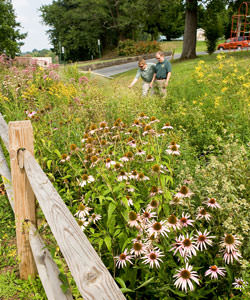
This rain garden made from local materials is being tested for its ability to reduce storm-water runoff, increase infiltration, and remove excess nutrients and other pollutants from the runoff water before it gets to streams or other bodies of water.

Rain gardens are increasingly popular with homeowners and municipalities and are mandatory for many communities nationally. USDA scientists are finding ways to improve rain gardens so they not only reduce runoff but also keep toxic metals out of storm drains.

Rain gardens are plantings in depressions that catch storm-water runoff from sidewalks, parking lots, roads and roofs. Rain gardens come in various shapes and sizes, from large basins carved by front-end loaders to small, artificial, streambed-like formations complete with pebbles. Rain gardens not only slow down water to give it time to soak into the ground and to be used by plants, but they also filter out sediment and chemical pollutants.

Plant physiologist Rich Zobel at the USDA’s Agricultural Research Service Appalachian Farming Systems Research Center, and research associate Amir Hass of West Virginia State University, are working to improve rain gardens. They are collaborating with ARS hydrologist Doug Boyer and ARS soil chemist Javier Gonzalez as well as colleagues at the ARS Southern and Eastern Regional Research Centers.

The scientists at the SRRC found that poultry litter biochar-activated carbons created from the charred remains of poultry litter is a powerful pollutant magnet. It can attract heavy metals such as copper, cadmium and zinc, which are ordinarily tough to snag from wastewater.

ARS chemists Isabel Lima and Wayne Marshall (now retired) at the SRRC developed the ARS-patented method for turning agricultural bio-waste into biochar. They created the biochar by subjecting poultry litter—bedding materials such as sawdust, wood shavings and peanut shells, as well as droppings and feathers—to pyrolysis, a high-temperature process that takes place in the absence of oxygen.

Hass and colleagues are testing the poultry litter biochar as well as other farm and industrial byproducts at two demonstration rain gardens in the Beaver, W. Va., area, as well as at plots at a county landfill and a mineland reclamation site.

Their research can be found in the November/December 2010 issue of Agricultural Research magazine.