Categories
Recipes

Turkey-vegetable Soup with Rice

Turkey-vegetable Soup with Rice

Ingredients

  • 1 whole turkey
  • 2 stalks celery with leaves, coarsely chopped; plus 1 cup chopped celery
  • 2 carrots, coarsely chopped; plus 2 cups chopped carrots
  • 1 onion, quartered; plus 1 cup chopped onion
  • 1 bay leaf
  • 8 cups water
  • 3 T. butter
  • 2 tsp. dried thyme
  • 1 cup rice
  • 1 cup frozen or fresh peas
  • 3 T. fresh parsley
  • salt and pepper

Preparation
Put coarsely chopped celery and carrots and quartered onions in a large stock pot. Add whole turkey, bay leaf and water and bring to a simmer. Simmer for 2 to 3 hours over medium-low heat. Strain and discard vegetables and bones. Reserve turkey stock and meat.

In a separate large pot, melt butter and cook chopped onions until tender. Stir in chopped celery and carrots, thyme, and rice, and toss to coat. Add turkey stock and bring to a simmer. Cook until vegetables and rice are tender. Chop turkey meat and stir 2 cups into pot with peas and parsley. Return to simmer and season to taste.

Serves 6.

Categories
Recipes

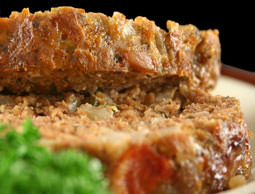
Venison Meatloaf

Cook your own Venison Meatloaf with Hobby Farms

In this recipe, venison, a lean meat, benefits from the addition of ground pork, bacon and sour cream for extra fat and flavor.

Ingredients

  • 1½ pounds ground venison
  • 1/2 pound ground pork
  • 1/4 pound bacon, put through a meat grinder or very finely minced
  • 2/3 cup finely chopped onion
  • 2/3 cup fresh bread crumbs
  • 1/3 cup sour cream
  • 1/3 cup currant, lingonberry or plum jelly
  • 1 large egg
  • 3 T. dry red wine
  • 1 tsp. lemon zest
  • 1 tsp. salt
  • 3/4 tsp. crumbled dried sage leaves
  • 1/2 tsp. ground allspice
  • 1/2 tsp. freshly ground black pepper

Preparation
Preheat oven to 350 degrees F.

Place all ingredients in a large bowl. Use your hands to mix until all ingredients are evenly worked into one another.

Place meatloaf mixture into a greased, 9- by 5- by 3-inch loaf pan. Pat the top of the mixture to make it level and cover with aluminum foil.

Bake for 1 hour or until meatloaf is firm and a visual check shows no pinkness. Remove from oven, remove foil and place on a wire rack to cool for 10 minutes. Using oven mitts, lift the pan and tilt gently to drain any collected fat.

Invert loaf onto a serving plate. Serve hot, or chill and cut into small cubes or slices to serve as an appetizer.

Makes 8 servings.

Categories
News

Sheep Can Profit Farmers

Sheep
Raising sheep for meat, wool or show can profit small-scale farmers, experts say.

Although volatile livestock and agriculture markets have caused producers headaches during the economic downturn, small-scale farmers hoping to earn a profit from their livestock might want to consider turning to sheep. According to reports from this year’s North American International Livestock Exposition, North American sheep producers remain optimistic despite tough economic conditions because of the viability of keeping sheep for meat, wool and show.

Sheep for Meat
Goat and lamb meat are two of the most consumed meats in the world, therefore the markets for them remain steady, says Stanley Poe, a sheep breeder who, with his sons, manages 500 sheep at Poe Hampshire Farm in Indiana.

Unlike beef and pork, lamb faces fewer religious restrictions on consumption, he says, which boosts its international sales. And global demand for lamb is expected to grow. In the United States alone, New York and New Jersey are consuming increased levels of lamb due to diverse ethnic populations.                       

Sheep for Wool
Sheep wool is also experiencing a steady market upswing and being sold at record-high prices, Poe says.

Demand for wool is especially high in foreign countries, suck as China, according to Dean Wallace, former sheep producer and a University of Kentucky county extension agent. A versatile raw material, he notes that in addition to the fiber materials, wool products include piano keys, tennis balls and insulation.

Show Sheep
Profitability from sheep does not only exist with sheep byproducts, but also with the buying and selling of show animals. Some sheep breeders make their money selling breeding stock, Poe says.

Many sheep-breeding programs produce successful show and market animals with desirable genetics and build. At the 2009 North American International Livestock Exposition’s Sale of Champions, the selling price for the champion market lamb was $13,000.

Although not every sheep entry is eligible for the Sale of Champions at the NAILE, sheep exhibitors can still make a sizable profit by selling their sheep at various county fairs or private auctions. Market lambs appeal to FFA and 4-H members because they can be bought, raised, exhibited and sold in the same year. Plus, they cost less to show than other livestock, like market hogs or market steer, says Poe.
 

Categories
Urban Farming

Model Law Makes Green Building Accessible

Green building

Courtesy iStockphoto/Thinkstock

The Center for Climate Change Law created a model green-building ordinance as a resource that can be implemented by small cities.

When it comes to green-building ordinances, size matters.

Big cities have bigger budgets, which means there’s more cash to spend on researching and writing ordinances that promote and regulate green building. Faced with smaller budgets, small-and mid-sized cities often lack sufficient resources to develop ordinances to encourage green building in their municipalities, and that can halt progress.

Michael B. Gerrard, director of the Center for Climate Change Law at Columbia Law School, wanted to change that. Along with a team of professionals, Gerrard spent months crafting a model green-building ordinance. His goal: Offer a thorough ordinance that can be used to promote environmentally sound construction to cities that don’t have green-building ordinances in place.

“We have done the work and streamlined the process so that small cities and suburbs that don’t have the budgets to develop their own green-building ordinances don’t have to,” he says.

In its most basic form, the ordinance requires that all applications for new commercial-building permits would meet LEED certification design standards. Residential buildings for fewer than two families would need to meet the requirements for Energy Star certification. Builders would not be required to pursue certification, just to prove their buildings are eligible as constructed.

“Improving energy efficiency in buildings has to be one major element in any comprehensive approach to climate change. Right now, 40 percent of our energy use in the U.S. comes from buildings,” Gerrard explains. “It’s important for municipalities to find solutions to climate change and implementing green-building ordinances is part of that.”

In order to develop the model ordinance, Gerrard and his team reviewed green-building ordinances from across the U.S. and noted a huge variance in their content and quality. Using those ordinances as a guide, the team wrote the model green-building ordinance to include the best aspects of similar ordinances nationwide. They paid special attention to avoiding some of the legal pitfalls present in other municipal ordinances.

The ordinance was made available in October 2010. Although it has yet to be formally adopted in any city, Gerrard has high hopes that will change in 2011.

“I’ve been getting a lot of calls about [the ordinance],” he says. “There is a lot of interest in using it.”

Gerrard declined to provide names of cities that might be considering adopting the ordinance, though he explains that it was designed for cities and suburbs with populations of less than 500,000. He also notes that municipalities in the Northeast seem most interested in adopting green-building ordinances because the prices of electricity are so high.

As cities begin thinking about adopting the model green-building ordinance, Gerrard and his team are available to answer questions.

“Our hope is that municipalities will see the model ordinance as a valuable resource and move forward to implement it and use it as a framework for developing environmental standards for building in their cities,” he says. “We’ve done the work and now it’s up to [cities] to take the next steps.”

The model ordinance is available for download through the Center for Climate Change Law.

Categories
Animals

Move Over, Rudolph!

Goats with jultomte
Illustration by T. Rasmussen/ Provided by Sue Weaver

Nowadays, reindeer are the Christmas critters du jour, but we goats used to bring on Christmas cheer! Mom wrote an article about the Yule goat, which you can read, if you want to.

Long ago, in Scandinavia, country folk believed in wee fairies. Swedish fairy spirits were called tomte; Norwegians and people in Denmark called them nisse. They believed the wee folk took care of their homes and children and protected them from misfortune, especially at night, when they were asleep. Tomte especially loved horses and sometimes braided knots in their manes and tails. If you picked and brushed the snarls out, that made the tomte mad. Then they played terrible tricks on the farm folk. Tomte could be dangerously scary!

Goats with jultomte
Illustration by Jenny Nyström/ Provided by Sue Weaver

After the Christianization of Scandinavia, variants of the tomte and nisse—called the jultomte in Sweden, julenisse in Norway and tontuu in Finland—started bringing the Christmas presents in Sweden and Norway, instead of the traditional julbock (the Yule goat). They wear red, but they’re still small—not big and jolly like Santa Claus—and they deliver gifts in sleighs drawn by goats or carry the presents pack-style on a goat’s back.

A lady named Jenny Nyström began painting Christmas cards starring jultomte and goats in the late 1800s. Her son, Curt Nyström Stoopendahl, followed in her footsteps, as did many Scandinavian artists. You can buy vintage originals and modern reproductions of these cards at eBay. Mom collects old ones (some of them are pictured above). You could too!
 

« More Mondays with Martok »

Categories
Urban Farming

The Miracle of Chicken Diapers

Black Cochin chicken

Courtesy Audrey Pavia

Maddie the Cochin hen will soon be spending all her time indoors.

When you keep livestock in the city, word gets around the office. I’m known throughout my department as someone who keeps chickens, and I’m occasionally posed with a question or two about chickens and their daily lives.

But the other day, I had a chance to do more than educate a coworker about charming rooster behavior or the tastiness of home-grown eggs. I had a chance to help a city dweller keep his pet hen.

It started when Kathy, a colleague of mine, came into my cubicle with a man I’d never seen before. He was new to the company and made Kathy’s acquaintance in the break area. Somehow, the subject of chickens came up and the newbie—lets call him Jim—mentioned that he had a pet chicken. Naturally, Kathy had to bring him over to introduce us. After all, chicken people must know each other.

After shaking my hand, Jim began to tell me all about his pet hen—lets call her Maddie—a black bantam Cochin. He lived in a town near the beach not exactly known for its livestock-friendly lifestyle and was worried that Maddie’s days with him might be numbered. He explained that Maddie lived in the backyard, but he didn’t know if chickens were legal in the city. In fact, he was pretty sure they weren’t. He was afraid someone might report him and he’d have to find a home for Maddie. He asked me if I was interested.

Because my flock consists of a few bantam Cochin mixes, I eagerly said “Yes.” I worried Maddie would have to deal with my bitchy leghorn hens, who would quickly drive her to the bottom of the pecking order, but I figured they would eventually accept her. Goodness knows the roosters would be happy to have her.

As Jim and I continued to chat, I began to realize that he was quite attached to little Maddie. He’d never had a chicken before and seemed to really love having her as a pet. It became obvious that it would be a sad day when Jim had to give up Maddie, and I no longer felt so enthusiast about adopting her.

“Have you thought about keeping her in the house so no one would know that you have her?” I asked him.

The stunned look on his face gave me my answer. “You can do that?” he said.

“Yes,” I answered him, following with an explanation of “chicken diapers.”

I’ve never used chicken diapers myself, but I’ve seen plenty of pictures online of chickens wearing them. Apparently, you can keep a chicken in the house without having chicken poop all over the place if you fit your chicken with a diaper.

That night, Jim sent me a picture of Maddie, thanking me for agreeing to adopt her if she needed a home. 

The next day, when Jim showed up at my cubicle, I thought it was to ask me if I was ready to take Maddie. Instead, he asked me how he could find chicken diapers. I referred him to ChickenDiapers.com and was thrilled at how excited he seemed at the thought of being able to bring his pet hen in the house. Thanks to chicken diapers, I think Christmas came early at Jim’s house this year.

Read more of City Stock »

Categories
News

Congress Prioritizes Farm-to-School Connection

Farm to school
Courtesy Jupiterimages/BananaStock/
Thinkstock
The passage of the Healthy, Hunger-Free Kids Act will help to expand U.S. farm-to-school programs.

If there’s one issue that unites all Americans, it’s improving the health of our children. Thanks to the collaborative organizing efforts of many grassroots groupsadvocating for improved children’s health, the House joined the Senate in passing the Healthy, Hunger-Free Kids Act (S.B. 3307) on Dec. 2, 2010. The bill now awaits the President’s signature.

This bipartisan legislation will make historic strides in improving children’s health by authorizing $4.5 billion over 10 years to raise the nutritional standards of food in schools. 

In a part of the bill that provides particular interest to small-scale farmers, Congress also made a first-time investment in farm-to-school programs, which connect K-12 schools with farmers’ fresh, locally grown food. While grassroots organizations have made laudable efforts over the years to increase fresh, local food in schools, the Healthy, Hunger-Free Kids Act will provide $40 million of funding to significantly expand farm-to-school efforts.

“Farmers will benefit from S.B. 3307 through establishing new markets serving schools, leading to increased revenues and an expanded customer base,” explains Debra Eschmeyer, outreach and communications director for the National Farm to School Network and a leader of the farm-to-school movement. “Schools will now have funding available to purchase directly from local farmers as well as develop healthy meal planning around what’s in season.”

Small-scale farmers, like Joel and Jai Kellum, who run King’s Hill Farm in southwestern Wisconsin, look forward to the new opportunities to expand their customer base.

“Having a contract to grow certain amounts of produce will definitely help my business’ bottom line, but farm to school goes beyond profit,” says Jai Kellum. “There’s a tremendous satisfaction and pride in knowing that the produce I raise will provide healthy meals for children in my area and hopefully even help rekindle their connection to our agricultural roots.”

As Kellum points out, the benefits of the farm-to-school expansion are two-fold. While farmers’ businesses may profit from the bill, children will reap the nutritional benefits.

Children consume up to half of their daily calories through what they what they eat in school cafeterias, according to the Child Nutrition Initiative, a child nutrition public education and advocacy campaign. As NFSN sees it, with one in three American children obese or overweight, the Healthy, Hunger-Free Kids Act will significantly ramp up improvements to various aspects of school nutrition, such as removing unhealthy food from vending machines and a la carte cafeteria lines and increasing the number of free school meals for children from low-income families. The benefits of the bill may also go beyond the cafeteria tray.

“Aside from great-tasting local food, farm-to-school programs help improve kids’ food literacy by teaching them what food is grown nearby, how their food is grown and what a healthy diet looks like,” says JoAnne Berkenkamp, local foods program director with the Institute for Agriculture and Trade Policy. “Schools can make farm to school part of their classroom curriculum through starting school gardens, taking field trips to local farms or teaching children to cook what’s sourced locally.”

If you’re a farmer interested in selling to local schools, contact the National Farm to School Network for resources, including contacts and information on what’s happening in your state. 

Categories
Urban Farming

Cyclamen Time

City cyclamen garden bed

Photo by Rick Gush

You can find garden beds of red cyclamen all over Rapallo.

It’s officially cyclamen season here, and there are thousands of the things planted around Rapallo these days. Lots of people that live in apartments put cyclamen on their terraces and the local municipalities are big cyclamen users. Rapallo is a bit like Disneyland in that there are flower beds all over the place.

The city has a nice big nursery and greenhouse complex where they grow potted rhododendrons and azaleas and other flowering plants. They change the city flower beds perhaps three or four times a year and generally do a really good job of keeping the beds tidy. That’s a bit surprising because, in general, Italians aren’t big on maintenance and upkeep. There’s a saying that “Italy is falling apart beautifully” — and they’re not just talking about the ancient ruins.

So who knows how to explain this Italian mania for municipal flower beds? In the past two weeks, the city gardeners have planted thousands of red cyclamens around town. The gardeners will clean off the old blooms every once in a while, and the plants will bloom all winter long, no matter how cold it gets. The cyclamen will last until spring, when they’ll be uprooted to make way for the spring plantings.

Although Rapallo has gone big into red cyclamen this year, some of the other cities use the white, pink and purple cyclamen, as well. All of these cyclamen varieties are grown specifically for greenhouses; the plants will come back reasonably well in the following years if stored in the shade during the summer.

Most people don’t bother digging up and moving the bulbs. They just throw the old plants away when the weather gets warm. I’ve always thought that was wasteful, but the plants I’ve rescued from the garbage haven’t ever grown nearly as well in the second year, so I’ve stopped. (Well, mostly. I do have one pair of plants that the neighbors were dumping last year, and each has five or six flowers.)

I only have one regular cyclamen in the garden, but I do have a bunch of the small, wild, lilac-colored cyclamen. We collected the bulbs on our vacations in Corsica and Elba, and they are now happily growing in a half-shady part the garden. I’m not usually too keen on digging up wild plants, but where we collected there were so many thousands of the bulbs that I don’t think we had a negative impact on the colony.

Read more of Rick’s Favorite Crops »

Categories
Urban Farming

Doctors Try a New Rx

Veggie Prescription

Courtesy Hemera/Thinkstock

As part of the Fruit and Veggie Rx pilot program, doctors prescribed coupons redeemable for fresh produce at farmers’ markets in addition to their patient’s regular medications. The results of the program’s effects on patient health will be released in February 2011.

“Take two and call me in the morning” is a common, if not dated, expression associated with doctors’ prescriptions. But what if the “two” were not pills or teaspoons of elixirs, but instead cups of spinach, servings of broccoli or apples? If the folks at Wholesome Wave, a nonprofit organization in Bridgeport, Conn., have their way, such prescriptions could soon be a reality in many medical offices—especially in pediatricians’ offices.

Perhaps best known for its Double Value Coupon Program—which, in 2008, began doubling the value of food stamps at farmers’ markets around the country—Wholesome Wave launched the Fruit and Veggie Prescription Program in summer 2010. Furthering its mission of “nourishing neighborhoods by supporting increased production and access to healthy, fresh and affordable locally grown food for the well-being of all,” the goal of Fruit and Veggie Rx (as it’s being called) is to encourage women and children in low-income rural and urban areas to turn to fruits and vegetables before more conventional prescriptions.

“Like all of Wholesome Wave’s expanding efforts, Fruit and Veggie Rx is designed to simultaneously serve communities, farmers and consumers,” says Michel Nischan, president and CEO of Wholesome Wave. “Each dollar put into the Fruit and Veggie Prescription Program does more than just reinforce healthy, proactive eating habits. These prescriptions have the power to directly benefit small- and medium-scale farmers and to bring additional resources into the local economies of under-served urban and rural communities, two of Wholesome Wave’s most valued goals.”

For the 2010 pilot program, Wholesome Wave partnered with Ceiling and Visibility Unlimited, a corporate development group. They selected community health centers with obesity clinics in Massachusetts and Maine to write the fruit and veggie prescriptions to women and children in 100 families in addition to their regular doctor’s orders. The prescriptions were redeemable at partnering farmers’ markets.

Program participants were then monitored to see how increased consumption of fresh produce affected blood pressure, weight and body mass index, as well as blood-sugar levels in pre-diabetic patients and weight gain in pregnant women. While the analysis of the Fruit and Veggie Rx pilot program is not yet complete (a full analysis of the program should be available by February 2011), Juliette Storch, Wholesome Wave’s chief operating officer, says the participating families were excited to get their vegetables by prescription and most redeemed their scripts regularly.

Categories
Crops & Gardening

Aphid Mummies

Aphid mummies
Photo by Jessica Walliser

I was so excited to find these aphid mummies in my garden.

I finally finished cutting down and cleaning out our front perennial bed. I managed to fill three more tractor carts with leaves and other plant debris. It is such a good feeling when the garden beds are finally put to bed for the winter.

While I was out in the garden, I came across something very interesting that I learned about while researching my book, Good Bug, Bad Bug, but I never had the opportunity to see in my own garden. I was cutting down some stems of Heliopsis when I noticed that there were hundreds of orange aphids all up and down the stem.

They were kind of beautiful, in a weird way, so I looked a little closer. Then I noticed that at the top of the stem were all these aphid mummies. The mummies are called such as they are just the exoskeleton of the aphid after a teeny tiny parasitic wasp called the aphidius wasp has parasitized it. The adult female wasp is so tiny that she can lay a single egg on the back of an aphid. The egg hatches and the resulting larva tunnels into the aphid, eating it from the inside out. The wasp larva eventually pupates into an adult while still inside the aphid, all the while turning it into a mummy. When the adult wasp has matured, it chews a perfect round hole in the back of the aphid mummy, emerges from it and flies away. And here, right in my very own garden, were a bunch of aphid mummies—and coming out of the back of one of them was a wasp! Sooooo cool to see.!

Of course, I ran inside and grabbed my camera to take a few pictures. They aren’t as close as I would like, but you can get the idea of what this is all about.  If you look carefully, you’ll see the brown aphid mummies and a small black wasp with clear wings.

Here is the biggest lesson to take out of this: If I had sprayed the aphids with a pesticide, blasted them off with the hose or even squished them with my fingers, I would have been killing all these beneficial wasps preying on them. Understanding how beneficial insects work in your garden is so very important to maintaining a healthy balance of both good and bad bugs.  How fun to see the whole cycle in my very own garden—and in December none the less!

« More Dirt on Gardening »