Categories
News

New Ag Chair to Face Farm Bill Challenges

U.S. Sen. Debbie Stabenow
Courtesy Office of Sen. Debbie Stabenow
U.S. Sen. Debbie Stabenow will take over as chair of the Agriculture Committee in 2011.

Let the post-election game of musical chairs begin. Based on the November election results, the leadership of various Congressional committees will change when the 112th Congress starts in January 2011. Among all the changes, the gavel for the U.S. Senate Committee on Agriculture, Nutrition and Forestry passes to Sen. Debbie Stabenow, D-Mich., a leader praised for championing small-farm issues. 

The 21 Agriculture Committee senators hold legislative oversight of everything related to the U.S. agriculture industry, including farming programs, forestry and issues related to nutrition and public health. The Agriculture Committee chair provides the vision and leadership behind what ultimately appears on America’s dinner plate.

Stabenow brings a seasoned experience to her new position, having served on the Agriculture Committee in the Michigan House of Representatives, the U.S. House of Representatives and the U.S. Senate. As the first woman from Michigan elected to the U.S. Senate, Stabenow quickly earned a reputation for building bi-partisan collaboration toward common goals and for working with diverse agriculture groups.

Farm Bill Priorities
Stabenow’s upcoming tenure as Agriculture Committee Chair comes at a crucial time in the national agenda as dialogue heats up regarding the 2012 Farm Bill. The omnibus bill serves as a cornerstone of all federal agriculture, food and nutrition policies.

“I look forward to working with my colleagues on both sides of the aisle, as we begin writing a new farm bill that once again recognizes the importance of America’s agricultural economy and rural communities,” Stabenow says.

Fortunately for small-scale farmers, Stabenow strongly supported small-farm interests in the 2008 Farm Bill, under which we currently operate. Because of her work, this Farm Bill is the first in history to recognize the importance of specialty crops like fruits, vegetables, nursery products and floriculture, which make up half of the country’s agriculture cash receipts. This new title in the Farm Bill added $3 billion toward specialty-crop programs, including organic research and the USDA Specialty Crop Block Grant Program, which aims to improve competitiveness of the specialty crops industry through grants supporting marketing, agri-tourism, research, sustainability and food access.

“Sen. Stabenow has been a champion for Michigan growers of fruit, including apples, as well as growers of vegetables, nursery and floriculture crops,” says Julia Baehre Rothwell, chair of the Michigan Apple Association. “All of agriculture should embrace an agriculture chair who understands and supports specialty crops, in addition to traditional livestock and row crops.”

Agriculture Roots
Stabenow’s commitment to agriculture stems from her home state of Michigan, where agriculture is the second-largest industry and employs a quarter of the workforce. Michigan farmers produce a strong diversity of more than 200 different crops and products, leading the nation in 19 of these commodities, including tart cherries, blueberries, dry beans and cucumbers for pickling.

Stabenow will have a bushel full of challenges as she takes on this new role in January. With new faces in Congress, many of whom were elected to cut federal spending, Stabenow will need to once again champion programs like those supporting specialty crops to make sure agriculture priorities are not slashed on the budget chopping block.
Categories
Homesteading

Nature’s Swag

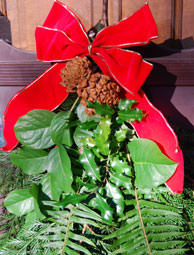
Holiday swag
Photo by Cherie Langlois
I couldn’t resist making holiday swags with debris leftover from last week’s storm.

A few weeks ago, a fairly impressive wind storm littered Douglas fir branches around our farm, plus snapped off the dead top of the big, old fir gracing our horses’ pasture. (Fortunately, it missed the horses, wisely holed up in their barn.) It seemed a shame to let all of those branches go to waste, and so—being in a holiday-decorating frame of mind—I spent a pleasant hour last week making Christmas swags for our front door and gate.

Making a swag from natural greenery found on your own farm is incredibly easy if you have the right kinds of evergreen trees, shrubs and plants available.  Here’s what I did:

  1. Armed with pruners, I gathered some of the fragrant, downed fir limbs and then wandered up our woodlot-bordered gravel drive snipping an armful of other pretty greenery to add to the swag: cedar and hemlock branches, sword fern, salal, and holly. (These are all Northwest natives except for the latter, which has sprung up here and there on our property from seeds spread by birds.)
  2. Back on our front porch, I separated this natural booty into two piles. First, I placed several long fir branches on the bottom, with the ones on either side sweeping slightly outward to form a balanced swag-like shape. Then I layered the rest in the following order, with each layer a shorter length than the last (snipping with the pruners as needed):  cedar and hemlock branches, sword ferns, and finally salal and holly.
  3. Gathering the branches and stems together at the top of the swag, I wrapped them securely with a length of flexible hotwire, leaving extra for hanging. (You can also find wire specifically for making wreaths at craft supply stores.)
  4. I keep a bag of velvety bows, pine cones, and other decorations saved from holiday wreaths and arrangements given to us in the past that I use to decorate swags. On one, I attached a red bow, pine cones and faux holly berries to the top. And to the other, I fastened a white bow and strands of gold and white beads.
  5. After attaching the wreaths to our front door and gate, I took a moment to adjust branches and ornaments and tried to creatively neaten up things a bit. These quickly-made swags are certainly nothing fancy, but I love their pretty simplicity and that they come mostly from nature, right here on our farm.

Happy decorating!

~ Cherie

« More Country Discovery »

Categories
Urban Farming

All Herbs, All the Time

Herbs

Courtesy Shenandoah Growers

Shenandoah Growers grows organic herbs in greenhouses so we can enjoy fresh herbs year-round. 

Despite a mild few days, the handwriting is on the wall. It’s time to pull out, tidy up and harvest thoroughly for the last time. In the suburbs, our landscape is all soft greys and browns now.

Recipe: Chermoula

Ingredients

  • 2 cups cilantro leaves (2 large bunches)
  • 1½ cups parsley leaves (1 large bunch)
  • 3 to 4 garlic cloves
  • 1/2 to 3/4 tsp. salt, to taste
  • 1 T. capers
  • 1/2 tsp. hot pepper flakes, or 1/2 to 1 small, fresh hot pepper
  • 2 anchovy filets, rinsed (optional
  • 2 tsp. cumin seeds, lightly toasted and ground, or 1½  tsp. ground cumin
  • 1 tsp. sweet paprika
  • 1/2 tsp. coriander seeds, lightly toasted and ground, or 1/2 tsp. ground coriander
  • 1/3 to 1/2 cup extra-virgin olive oil, to taste
  • 1/4 cup freshly squeezed lemon juice

Preparation

Remove the stems of the cilantro and parsley. Place the herbs in a food processor along with the garlic and salt, and chop. Add remaining ingredients and more olive oil or salt if desired. Serve with grilled fish and vegetables, or with chicken.

Makes approximately 1 cup. Can be frozen in 1/4 cup foil packets.

From my herb garden, I had sage and parsley for the Thanksgiving turkey stuffing and some rosemary (already moved into a sunny window) for the carrots, but of course, the basil has already been frosted. However, all year-round, Shenandoah Growers in Harrisonburg, Va., sends both organic living herb plants and organic fresh-cut, packaged herbs to the East Coast, Florida and Ohio markets. What began as an entrepreneurial small business now features 80,000 square feet of state-of-the-art, closed-system greenhouses and 125 local employees and seasonal, small-scale growers. Pipes below the plants carry warm water through the rows; computer-controlled vents in the vaulted glass ceilings ventilate; and giant curtains protect the young plants from too much or too little sunlight.

Marketing Manager Sarah Yoder tells me that basil is, by far, the most popular herb plant, followed by cilantro and mint. “You just snip the amount you want. The oils remain much more concentrated because the leaves aren’t being handled,” she explains. The growing plants last much longer than the cut bunches, as well. Six other popular herbs are available as plants through Shenandoah Growers.

“People often don’t really know what to do with herbs, so we include growing and cooking tips with the plants,” adds Yoder. Shenandoah Growers’ website offers many more tips and tempting recipes. The cut herbs come in a wide line of one-recipe amounts—from the 1/4-ounce size up to larger 4-ounce catering packs—and a line of Latin flavors, too. All the herbs are sold in recyclable packaging.

Using these smaller amounts, you can experiment with fresh-cut herbs to see what you like, and then plan on growing them yourself next spring. You’ll also develop cooking routines that let you make better use of the bunches you buy.

Here are three ways (plus a fourth afterthought) to use up the extra from a large bunch of herbs or to hold on to what’s still growing for you this year.

Herb Salt

Use aromatic and sturdy herbs like rosemary or thyme. Make sure the herbs aren’t at all damp, dice them and combine them with kosher salt—about 2 T. herbs to 1/2 cup salt. Wait a couple of weeks for the herb flavors to infuse the salt.

Pesto

An obvious use, but try a new combo. Chermoula is a parsley-cilantro pesto with capers, garlic and anchovies and no cheese (see recipe above). Or try mixed herbs whirred with roasted red peppers. Add almonds instead of pine nuts. Walnuts, cream, thyme, lemon? Leave out any cheese when you freeze your favorite, and add it in when defrosted. Of course, salsas and chimichurri use fresh herbs up nicely, too, but they don’t freeze very well.

Flavored Vinegar

What could be simpler? Half cider vinegar, half white wine in a pretty bottle; add sprigs of rosemary, tarragon, sage and mint together or use them solo; also try lemon or orange rind, garlic cloves, and black or red peppercorns. Let the bottles sit awhile to mellow. Use up dribs and drabs of unfinished red wine, too, but the clarity of the white combination is nicer for gifts.

Herb Afterthought …

While writing this post, I thought of another great herb use: If you chop up the herbs finely and mix them with dry mustard powder and the same white wine (or beer or fruit juice) into a smooth paste, you ‘ll make a dynamite gourmet herb mustard. Homemade herb mustard is burning hot to start so mix it up a few weeks before you use or gift it away.

Read more of The Hungry Locavore »

Categories
Equipment

Pritchel Hole, Horn, Step and Anvil Placement

Anvil - pritchel hole
Courtesy Hemera/Thinkstock
The anvil’s pritchel hole (the small, round hole on the right) is used as a base for punching holes in metal.

Anvil use can be as simple as a base for straightening bent metal or as complex as making metal bowls or other decorative work. One of the simplest features of an anvil is the pritchel hole. It is used as a base for punching holes in metal. If the anvil you find doesn’t have one, you can substitute a bolster block. It’s a multi-hole, rectangular steel block that you can place on the anvil, positioning the selected hole over the hardy hole. With different size holes to choose from, the results will be more precise.

The horn is just that, a cone shaped projection for rounding metal shapes as well as working hot metal, drawing it out over the surface of the horn. Some anvils have a horn at either end or small ones to the side for specialized work.

The step or table is another very simple and functional part of the anvil. If you are going to use your anvil for cutting metal, this is the place to do it. The step is softer than the face, making it easier to redress or resurface if a chisel damages the step. An alternative to using the step is to place a piece of steel over the face for a cutting surface, or simply use a cutting edge hardy hole tool.

Placing your anvil is very important to stability and function. Our farm anvil sat on a section of log. It was not anchored, which it should have been for safety purposes. Most anvils have holes or feet to be spiked, chained or otherwise anchored. Other bases include timbers bolted together or a steel base.

Next week, we’ll take a look at anvil options.

<< More Shop Talk >>

Categories
Beginning Farmers

Ag Day Emphasizes Climate-Smart Strategies

2010's ARDD featured over 400 representatives from all over the farming and science industries
Courtesy CIAT/ Neil Palmer
Participants at Agriculture and Rural Development Day 2010 drafted policy recommendations to improve agricultural development and address climate-change concerns.

More than 400 policy makers, farmers, scientists, and representatives from the private and public sectors gathered in Cancún, Mexico, on Dec. 4, 2010, for this year’s Agriculture and Rural Development Day. ARDD, which gave attendees an opportunity to discuss food security and the role of climate change in agriculture, was held in parallel to the United Nations Climate Change Conference, or COP16.

Billed as an event where climate change, food security and agricultural development intersect, ARDD 2010 showed how agricultural development can contribute to lower carbon emissions while adapting to climate change and supporting sustainable food security.

Presenters included Ignacio Rivera Rodríguez, Mexico’s vice minister for rural development; Inger Andersen, CGIAR Fund council chair and World Bank vice president of sustainable development; and Don McCabe, president of the Soil Conservation Council of Canada.

In his opening remarks, Rodríguez cited the common belief that agriculture part of both the climate-change problem and solution. He argued that climate change offers “an opportunity to change the way we produce, consume and develop, without compromising economic growth.”

According to Andersen, opportunity for agricultural development has the potential to be a triple-win that benefits the environment, farmers and food security. By using good land management and agriculture practices, including agroforestry systems, zero tillage, and improved water and fertilizer management, she said farmers could help cut carbon emissions by at least 13 percent.

While it’s farmers who implement climate-smart strategies, Rodríguez pointed out they can only do so with government support. The Mexican government, he says, is meeting this need through a concrete set of strategies and policies designed to reduce carbon emissions by 7.83 million tons over the next two years.

Offering a farmer’s perspective, McCabe noted that all farmers—regardless of their operation’s size—focus on profitability. He echoed Rodríguez’s call for governmental solutions, but emphasized the need for policy action independent of scale. All farmers can contribute to climate change mitigation, he said, and all farmers “live the cycles and impacts of policy.”

The theme of pursuing political solutions to agricultural concerns carried over into five parallel roundtable discussions that followed the plenary sessions. Participants in each roundtable discussed options for capitalizing on the intersections of rural development, agriculture and climate change. Each panel identified current knowledge gaps between the development, agriculture and climate-change agendas. Panelists also worked together to craft a set of recommendations for national and global policy makers.

Alongside the discussions ran an Ideas Marketplace, which featured more than a dozen organizations presenting their activities, policies and experiences along three themes: policies and technologies, achieving co-benefits through sustainable agriculture, and integrated approaches to agriculture and forestry.

A summary of ARDD’s presentations, roundtable discussions and policy recommendations was presented at a Dec. 6, 2010, COP16 side event titled “Enabling Agriculture and Forestry to Contribute to Climate Change Responses.” The results of Forest Day 4, held on Dec. 5, 2010, were also reported.

Categories
Urban Farming

Vertical Gardening for Accessibility

Vertical garden technique

Courtesy MSU Extension Service/ Gary Bachman

Window boxes placed on a stepladder-type stand is a verticle gardening technique that allows gardeners to water and harvest their plants without bending over.

Some gardeners depend on the popular urban farming concept of vertical gardening not only to save space but to allow greater accessibility to their plants. As the growing season winds down in many parts of the country, consider if physical limitations kept you this year from the garden tasks you once enjoyed. If so, now’s the time to make plans for next year’s garden setup. Use these ideas offered at the 2010 Fall Flower and Garden Fest in Crystal Springs, Miss., to kick off your garden planning.

Gardens for Bad Backs

Many gardeners with back pain have taken their fair share of ibuprofen and have spent considerable time with the heating pad. Gardeners with back problems can aim to eliminate pain by raising a garden off the ground using a bench with a stepladder design. Placing window boxes on the steps allows you to water and harvest crops without bending over.

Wheelchair-accessible Gardens

Gardeners using wheelchairs or scooters can implement a tabletop garden for a more accessible harvest. Grow vegetables or flowers in containers, and place the containers on a table at a height that allows you to wheel right up to your plants.

Gutter Gardens

Gutter gardens for growing leaf lettuce are designed to be accessible for gardeners at any height. Simply attach sections of plastic gutter to a wooden fence. The staff at the Fall Flower and Garden Fest adapted this garden technique from commercial hydroponic vegetable growers who need to control the amount of water to their gardens.

Hay Bale Gardens

Sometimes raising a garden to an accessible level is as simple as giving it something to grow upon. A popular and simple vertical gardening medium is the hay bale. Lay a round bale of hay on its side and plant vegetables, such as lettuce or tomatoes, in the vertical side. This allows you to have easy accessibility from a standing or sitting position.

Categories
Animals

Warm Water

Goat and water bucket
Photo by Sue Weaver
Dad brings us warm water in buckets twice a day during the winter.

It’s only December, but it’s really cold in the Ozarks this winter. Our water buckets keep freezing and that worries Mom a lot. That’s because us bucks and rams and wethers need to drink plenty of water year-round. Not drinking enough can lead to a deadly condition called urinary calculi. That happens when mineral stones made up of phosphate salts get lodged in our urinary tracts and we can’t pee. Does and ewes sometimes form calculi, too, but their urinary tracts are designed differently and they can pass stones—we usually can’t.  

Urinary calculi are mostly caused by poor diets. We guys need diets with a calcium-to-phosphorus ratio of at least 2:1. Grain contains a lot of phosphorus, so male sheep and goats (and llamas and alpacas, too) shouldn’t eat much grain. Nice grass hay and a balanced mineral supplement are perfect.

But we need to drink enough water, too, otherwise our urine becomes concentrated and that makes stone formation more likely. That means using a heated bucket in the winter. Or, do like our Mom and Dad who carry buckets of warm water to us at least twice a day. When it’s super-cold, Mom keeps two sets of buckets for each group of guys: When she brings out warm water, she takes the frozen buckets back to the house to thaw out. It works! We’ve never had a stone among us—and we don’t want to!

« More Mondays with Martok »

Categories
Urban Farming

Chicken Expressions and Lessons

Photo by Audrey Pavia

My chickens have taught me the true meaning behind certain expressions.

The English language is full of references to chickens. I never really paid much attention to these expressions until I became a chicken owner. My flock as helped me understand the true meaning behind many of these terms — on a personal level.

“Don’t be a chicken.”

The true meaning of this expression didn’t really hit me until the day I walked out of the garage holding a straw broom. In old movies, farmers’ wives use straw brooms to chase the chickens off the porch. My flock must have seen all those movies because when they took a look at that straw broom, they screeched and ran in a hundred different directions.

Lesson learned: Chickens aren’t the bravest creatures on the planet.

“Henpecked”

I used to have a Sebright hen named Shiva. I had to re-home her because she was a bully. She was always beating up the other hens. She would get them in a corner of the coop and peck, peck, peck at them until the poor victim couldn’t take it anymore and would run, only to be cornered again. Shiva would follow her and continue her assault.

Lesson learned: There’s nothing worse than being henpecked.

“When the chickens come home to roost”

Not a night goes by without my flock dutifully putting themselves to sleep in their coop. As soon as the sun starts to go down, they fly one by one onto the coop roof and make their way onto their roosting poles.

Lesson learned: Chickens always come home to roost.

“Rare as a hen’s teeth”

I’ve had to give oral medication to all my hens at various points in their young lives.

Lesson learned: Teeth on a hen are very rare.

“Pecking order”

When Baby Jo came into the flock as a tiny chick, born to Betty Jo, she was safe while she was under her mother’s care. But as soon as she became a pullet, she was on her own. The other hens made it clear: She was low hen on the totem pole. They demonstrated this by pecking her good and hard if she tried to eat something they thought was only worthy of a hen of higher standing.

Lesson learned: Chickens clearly have a hierarchal order, reinforced by pecking.

“Mother hen”

No more beautiful example of motherly love can be found anywhere in the barnyard than in the hen. When Betty Jo hatched her one chick, she cared for that baby like nothing I had ever seen. She was always at her chick’s side, showing her where the food was and how to eat it. Betty Jo bravely chased off the barn cat and the poor dog whenever they innocently wandered too close to her chick. Betty Jo’s entire world revolved around her tiny ball of fluff. And when Baby Jo grew to be a pullet, nearly the same size as her mother, Betty Jo still let her sleep under her wing on the roosting poll.

Lesson learned: There is no mother like a hen. 

Categories
News

Bond Claims Information for Stock Producers

Cattle
Livestock producers who haven’t received payment from Eastern Livestock Company can file bond claims through the USDA’s Grain Inspection, Packers and Stockyards Administration.

The USDA’s Grain Inspection, Packers and Stockyards Administration is informing cattle producers who have done business with Eastern Livestock Company, LLC, of their rights under the bond provisions of the Packers and Stockyards Act. 

Eastern began issuing unfunded checks to producers for livestock it purchased in different markets on or around Nov. 3, 2010. Headquartered in New Albany, Ind., with operations in 11 states across the Mid-South, Midwest and West, Eastern is registered with GIPSA as a cleaning service and as a market agency that buys and sells on a dealer basis.

Livestock producers who have not received payment from Eastern are encouraged to contact the GIPSA Midwestern Regional Office, Des Moines, Iowa, at 515-323-2579 for complete information on available financial protections and for forms necessary for filing a bond claim on payments due from Eastern. 

Bond claims must be filed within 60 days from the date of the transaction on which the claim is based.

The Packers and Stockyards Act is a fair trade practice and payment protection law that promotes fair and competitive marketing environments for the livestock, meat and poultry industries.

Categories
Urban Farming

My Waterfall and My Truck

Waterfall

Photo by Rick Gush 

After years living in the desert, I delight in living next to this waterfall.

One of the things I really like about living here in Liguria, Italy, is having lots of water features near my garden. I lived in Las Vegas for 15 years before moving here, and I still get a big kick out of living on a creek and a five-minute walk from the beach.

My Waterfall

My new studio is located on another little creek, so now I’ll have one at home and one at work. The creek below our home has a great waterfall a few hundred feet down the road. During the rainy season, like now, the creek swells and the waterfall gets nice and big. When there’s a big rainstorm, the creek really fills up and the waterfall has nothing to be ashamed. We can always tell how hard it’s raining at night by listening to the changing sounds of the water in the creek.  

I don’t even know how many different creeks there are in Rapallo. There are two big ones, more than 50 feet across and several dozen smaller ones. This whole area is riddles with creeks, so much so that several centuries ago, there were many dozens of water powered mills in the area. People from Tuscany would bring their bags of wheat up to this area in boats in order to have it milled. When we go hiking in the woods we see ancient crumbling mills all over the place. 

My Truck

INSERT ALT TEXT

Photo by Rick Gush

It’s time to put my construction truck (aka my Vespa) to work.

It’s construction time again, and as usual I’m using my Italian truck to haul supplies to the job site.  My truck, in this case, is actually my Vespa. I’ve owned a lot of different cars and trucks in my lifetime, and I’m happy to report that this Vespa is my favorite vehicle among them all. It’s a tank, very seldom breaks and costs almost nothing to fix when it does break.

Liguria isn’t built for big trucks. I have a friend who volunteered to help me move, and he has a regular-sized truck. His truck isn’t so big, but the angle to turn into my driveway is so sharp that he can’t make the turn. Phooey. Now I have to find a friend with a mini truck to help me move.

My Vespa will carry two bags of concrete or 12 big bricks. I once snapped the clutch cable when I had two sacks loaded. I pushed the Vespa—still loaded—to the nearest mechanic. He changed the clutch cable and charged me 5 euros. Fifteen minutes after breaking down, I was on my way again. Things didn’t work like that with my Isuzu Trooper back in the States. 

One of the things I’m excited about with the new studio is that it has a garage up front that I can use to work on my Vespa. The Vespa is more than 30 years old, and I’m planning to take it apart, paint everything and then put it back together. I did that about five years ago, but all this use as a construction truck has sort of beat it up, so this summer I’m planning to do it all again—only better.  

Read more of Digging Italy »