Categories
News

Time to Inventory Hay

Cows and hay
Courtesy Stock.XCHNG
Consult your local county extension services for help determining how much hay you’ll need to feed your livestock this winter.

Due to dry conditions, many livestock producers around the country are already into their winter feeding programs—some of which began as early as September. Farmers need to inventory their hay supplies now to ensure they have enough to last through the winter.

If you find you’re short on your hay supply, buying additional hay now can save you a lot of headaches later, says Tom Keene, hay marketing specialist with the University of Kentucky College of Agriculture.  

The good news in Kentucky, he says, is local forage producers had prime haymaking weather earlier this year and were able to get good yields because of adequate springtime moisture.

“During a normal season, we would have had a surplus of hay,” Keene said.

However, the timely rains diminished in July for some areas of the state and haven’t returned in significant amounts in most places since then. According to the most recent Kentucky Weekly Crop and Weather Report, about 90 percent of the state’s pastureland was rated either poor or very poor.

“Even if we get some much-needed rain, it’s unlikely that pastures will recover enough to provide very many grazing days before cold weather sets in during December and January,” he says. “So those currently feeding hay will probably be doing so through March 2011.”

When calculating the need for additional hay, farmers should consider their current supply, how much hay they feed their livestock each day and feeding and storage losses. You can get assistance determining these calculations from your county extension agent for agriculture and natural resources.

If the calculations show a need for additional hay, go ahead and purchase some, Keene says.

“By buying hay now, producers will have a bigger selection of quality hay, be more likely to find hay close to home and in the packaging they want,” he says. “The longer it’s put off, the more trouble [farmers] will have meeting these criteria.”

To get the most out of current hay supplies, farmers should have their hay tested.

“Hay testing helps [farmers] feed the correct amount of hay with the right amount of supplements to meet their animals’ nutritional needs,” Keene says. “It can help [farmers] feed hay more economically and efficiently.”

Categories
News

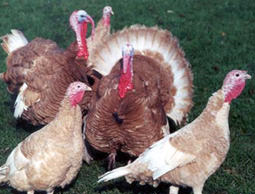
Conserving Heritage Turkeys

Heritage turkeys
Courtesy American Livestock Breed Conservancy/ Phil Sponenberg
Farmers interested in raising rare heritage turkey breeds, like the Jersey Buff, are helping to preserve a time-honored tradition.

With growing consumer demand for tasty heritage turkeys to grace holiday tables, more farmers are trying their hands at raising them. However, farmers often find themselves struggling to find production information specific to raising the colorful cousins of the Broad Breasted White turkey found in supermarket freezers. Since the industrialization of turkeys in the late 1950s, much of the knowledge and printed information on how to select, raise and breed traditional turkeys has slowly been lost.

In response to this demand, the American Livestock Breeds Conservancy released a new heritage turkey resource. Selecting Your Best Turkeys for Breeding is the second publication in the ALBC Master Breeder series, which is a collaboration of known master breeders, researchers and ALBC staff to codify knowledge and historic information about heritage-breed selection, husbandry and breeding.

The information found in Selecting Your Best Turkeys for Breeding was once widely available when small-scale agriculture and pastured poultry keeping was commonplace. Changes in agricultural practices have caused this information to be largely lost to subsequent generations.

“ALBC recognized that there was a knowledge gap when it came to raising and breeding heritage turkeys and many other rare breeds,” says Marjorie Bender, ALBC research and technical program director. “If we want to establish a sustainable market for these birds, we’ve got to give the farmers the tools they need to raise and breed quality animals.”

As recently as 1997, heritage turkeys were in danger of extinction. At that time, only 1,335 breeding heritage turkeys were found in the United States. Today, thanks to the efforts of breeders, producers and consumers, the heritage turkey’s numbers are on the rise, with 10,404 turkeys reported in the 2006 census.


Categories
Urban Farming

Student Who Patents Solar Motorcycle Rides On

Solar-powered motorcycle

Courtesy Purdue University

A Purdue University student patented a solar-powered motorcycle, and then started a club to work with other students on creating other electric vehicles.

Physics major Tony Danger Coiro, a junior from South Bend, Ind., received a provisional patent for his motorcycle that uses solar energy to cut his transportation costs down to well less than a penny per mile. The lead acid batteries also can charge from plug-in AC current.

After purchasing a 1978 Suzuki for $50, Coiro spent $2,500 redesigning and retrofitting the bike, which gives him a range of up to 24 miles per charge and a top speed of 45 miles per hour.

“The riding experience is surreal,” Coiro says. “I get instant, silent, constant acceleration that outpaces urban traffic. It’s like riding a magic carpet.”

Coiro co-launched the Purdue Electric Vehicles Club with Jim Danielson and Sean Kleinschmidt, both sophomores from suburban Chicago. Danielson and Kleinschmidt spent their summer after high school converting a 1987 Porsche 924S to electric power.

Kleinschmidt, a mechanical engineering major, translated that success into a summer internship at Tesla, where he helped develop batteries for the makers of the world-class, all-electric sports car. Danielson, who is majoring in electrical and computer engineering, spent his summer developing motor control electronics for Electro Motive Diesel, which designs and manufactures diesel-electric locomotives.

“Purdue Electric Vehicles will encourage enthusiasm for, and knowledge and development of, electric vehicles by students and the community,” Coiro says.

Coiro says the Purdue Electric Vehicle Club will patent and commercialize its breakthrough technologies and feed proceeds back into research and development of new prototypes. Coiro is already designing a 100-horsepower motorcycle that will travel up to 100 miles per charge, top 100 mph and draw even more of its energy from the sun. The all-wheel-drive bike will include motors in each hub and no drive trains.

“I’ve learned a lot building this first bike, and now I’m ready to make a game-changer,” he says.

Coiro, Danielson and Kleinschmidt oversaw construction of the 17 electric race karts that students built for the first-ever electric vehicle grand prix, held at Purdue in spring 2010.

In 2011, that race is expected to draw student teams from throughout the Midwest. The race was created by Purdue’s Indiana Advanced Electric Vehicle Training and Education Consortium to demonstrate the possibilities of electric vehicles and train a new breed of young engineers to improve them and reshape the auto industry in Indiana and beyond.

“Electric vehicles are four to five times more efficient than internal combustion engines—that’s a big difference,” Coiro says. “They’re not the solution to our energy problems, but they will be an increasingly bigger piece of the puzzle.”

When he graduates, Coiro plans to launch a company that develops electric vehicles. Eventually, he foresees launching a nonprofit energy company.

“Gas is not in infinite supply, so we need to go to another energy source in the future, be it nuclear fusion or fission, solar, or wind,” he says. “It’s going to be a lot easier to charge an electrical vehicle off of the grid.”

Categories
Animals

Giving Thanks

Baby goats
Photo by Sue Weaver
We are all thankful for Biscuit and Bijou. Bijou is already eating yummy leaves!

Did you know goats might have contributed milk and cheese to the first Thanksgiving feast? It’s true. The first Thanksgiving took place at Plimoth Plantation in Plymouth, Mass., in 1621. There were animals onboard the Mayflower and historians think some might have been goats. Otherwise, they came to Plymouth soon after that because a document called the Plymouth Colony Division of Livestock issued in 1647 mentions 22 “shee goats.” 

President George Washington proclaimed the first official Thanksgiving Day in 1786, but it didn’t become an annual event until 1863 when President Abraham Lincoln made it so. In 1941, President Franklin Roosevelt signed a bill into law making Thanksgiving fall on the fourth Thursday every November.

We’re thankful for lots of things this year:

  • Salem is thankful he didn’t eat any more yummy acorns than he did.
  • Big Mama, Bon Bon and Jadzia are thankful for the beautiful babies I helped them make this year. (I am such a studly guy!)
  • Sam the lamb is thankful for the milk Mom fed him after his real mama died, and for Miss Maple and Cordelia, who are his friends and slept with him and kept him warm.
  • The rams are thankful it’s rut and they have an excuse to make goo-goo eyes at the ewes and bash their heads together all the time. (What showoffs!) The ewes are thankful we have strong fences.
  • And Mom and I are thankful we write things for Hobby Farms and for all of you nice people who read my column every week.

Happy Thanksgiving! Here’s hoping you get pumpkin pie slivers, too!

« More Mondays with Martok »

Categories
Urban Farming

Dropping Like Flies

Stall roof

Photo by Audrey Pavia

Flies like to hang out in the stall roof.

Urban farmers in Southern California don’t normally have to deal with rain. Doing chores in wet weather just isn’t on our regular agenda.

But this past weekend, one of the first storms of the season blew into town and I had no choice but to do my outside work in the intermittent rain. This gave me an opportunity to do something I have always loved to do: kill flies.

When I was a kid hanging out at riding stables, I’d bring my fly swatter with me and go around smacking flies for what seemed like hours at a time. It wasn’t sadism that motivated me. It was my love for horses. I saw how the flies tormented the horses, crawling inside their eyes and biting viciously at their legs. In my mind, for every fly I killed, there was a happier horse. 

I didn’t realize it at first, but rainy days are a great time to kill flies. I found this out when I happened to look up at the ceiling of the stall roof over my three pipe corrals. I’ve often wondered where the flies go during cold weather and at night, the only times in this part of the world when they aren’t pestering the horses. It turns out flies like to hang out on the stall ceiling. They were lined up all over the place, probably 100 or more, from one end of the stall covering to the other. 

How often do you get to see so many flies all gathered in one place, immobile and vulnerable? Usually, they are buzzing around the horses’ faces or clustered on the horses’ legs. But here they were, chilled from the cold air, just resting on the stall ceiling.

I couldn’t pass up the opportunity to wipe out as many of them as possible. I ran to the tack shed and grabbed the most toxic fly spray I could find, but then reconsidered. If the flies died and fell to the ground, the chickens would eat them and ingest the toxic chemicals. So I instead opted for the all-natural fly spray, which, according to the label, killed flies with only natural ingredients.

Standing beneath the stall cover, I began firing away with my spray bottle, nailing one fly after another with the pleasant smelling insecticide. Most of the flies took off as soon as the stuff hit them, but others stayed where they were, staggering around in a drunken stupor. Those flies got an extra dose of spray for good measure until they dropped to the stall floor.

After 15 minutes of this anti-fly crusade, I decided I had done enough damage to the winged fiends. I’ll be interested to see if the fly population seems lesser in the next week when things warm up. If so, you can bet I’ll be outside armed with that fly spray bottle whenever it rains.

Read more of City Stock »

Categories
News

Test Soil Despite Drought

Dry soil
Courtesy Stock.XCHNG
Dry soil can affect soil-test results, and farmers should keep this in mind when testing soil for fertilizer needs.

Despite this season’s drought conditions in many areas of the country, farmers shouldn’t stop analyzing soil samples to determine lime and fertilizer needs, experts say.

“Accurate analysis of representative soil samples to determine lime and fertilizer needs is fundamental to crop production,” says Jim Camberato, an agronomist at Purdue University. “Unfortunately, persistent, dry weather resulting in prolonged periods of low soil moisture can affect potassium and pH, resulting in somewhat misleading results.”

Soil tests can be useful in dry weather if farmers understand the way low moisture can affect potassium and pH test results.

In a dry fall, soil test potassium levels often are lower than expected because most of the potassium the crop had taken up during the growing season remains in the crop residue. If there’s not enough rainfall, it doesn’t return to the soil.

Low rainfall totals during the growing season also can result in lower soil pH measurements because a high level of fertilizer salts remain in the soil at the end of the growing season. Those salts affect the electrodes used to measure pH and can result in an inaccurate, lower pH measurement.

While the end of the season was dry in Indiana, early-season rainfall was enough to ensure normal crop uptake of fertilizer. That means in most cases there was little fertilizer salt left in the soil to affect pH measurements, Camberato says.

“Bottom line, farmers should take advantage of the early harvest and dry soil conditions and continue soil sampling and fertilizing and liming where needed,” he advises. “Most of the potassium taken up by the crop remains in the residues, so farmers need not be alarmed if soil test potassium levels are lower than expected.”

Categories
Urban Farming

The Inheritance

Old wine bottles

Photo by Rick Gush

I inherited old wine bottles with my new studio and office. They will be perfect to use in my current art project.

The adventure at the new office/studio continues. One of the nifty parts is that I have inherited a whole lot of old stuff. I’m a junk fiend, and the stuff in my space that was left by the owner is treasure to me. There are a bunch of big, old wine bottles—10-liter and 25-liter sizes. That’s really swell, because my current art project uses old wine bottles.

There were also a bunch of old agricultural implements among the inheritance. Even though I already have a nice pick in the garden, getting two more picks and another hefty sledge hammer in my gift bag was a pleasant surprise. Among the stuff, there were also big coils of rope; two really nice wooden ladders; a little, old porcelain gas stove in great condition; and 25 boxes of ceramic tile from the 1960’s.  The Italians were pretty arty in the 60s, and all of this tile is in pretty wild patterns. I think I’m going to tile the floors in a few of the rooms. 

Grape squeezer

Photo by Rick Gush

I may use my new grape squeezer to make grape juice next year.

I also discovered a lot of old, fir flooring planks. There’s enough that I am planning to put a wood floor in the office room. Pictured to the right is my new grape squeezer. Some of my friends have these machines, and they use them to squeeze the juice out of their grapes before they make it into wine. Even if I don’t make my own wine right away, I probably will use the machine to at least make some grape juice next year. 
 
Stuck in a corner of the room that will be my new workshop were a whole raft of old construction timbers. Some of the planks have cement on them, but there are around 50 pieces, most about 4 meters long. I’ve already used some of that lumber to build a new lumber rack along one wall of the garage. It was quite the luxury to already have all the free eavy lumber I could want during the building. I’ve tucked away the rest of the old timbers, all the assorted smaller lumber pieces, and the whole recent delivery of plywood, composite and finish trim pieces in the new lumber rack. I know it might sound funny, but I get a big kick out of now having my own little lumber yard right in my garage. Life is good.

The bad news is that during the heavy rain a few days ago, a leak developed in the ceiling of the room I’m planning to use as my office. There’s a garden terrace overhead, and apparently some of the tilework is cracked. The building administrator has come out to take a look at the leak and to plan the repair work, but I know that will take some time. So I’ve had to change my plans slightly. I built a temporary desk and Internet connection in the space where I plan to build a rustic kitchen to hold my coffeemaker, microwave and mini fridge. No big problem. I’m having more than enough fun to make it through a few problems.

Read more of Digging Italy »

Categories
Crops & Gardening

Delicious Dinners, Last Leaves and Pond Problems

Brussels sprouts
Photo by Jessica Walliser
My Brussels sprouts made not one, but three delicious meals.

Well, I finally got around to digging the rest of the potatoes, and I managed to find another 5-gallon bucket full of them. Just enough for Thanksgiving dinner. We had our first Brussels-sprout dinner the other night, too, and they were just divine. Small, but beautiful and delicious. I’ll probably get two more meals out of what’s left.  They are such fun to grow, too. 

I’ve also been raking leaves like nobody’s business the past few weeks.  I’ve already managed to fill all three of my compost bin sections clear to the top. The chicken coop got cleaned, too, so that bedding and manure was added to the top of the leaves.  By next summer, it’s gonna be good stuff. The trees should be done dropping leaves by the end of this week (please, please, please!), so hopefully this weekend will be the last leaf clean-up day of the season. 

And, on a not-so-good note, it appears that our pond pump has died at long last.  It’s more than 6 years old, which I think is pretty good for a pump that runs 24/7 for nearly 365 days a year. (We do turn it off when the pond is frozen solid.) It shut off the other day, so I reset the GFI plug and turned it back on. It ran for a minute or so while making an awfully weird sound, then it shut off again. I figured the filter box was probably just junked up with goop. Saturday, I donned my fishing waders and hopped in to clear it out. After 45 minutes of scrubbing and hosing and freezing my buns off in that cold water, I put the pump back in and flipped the switch.  More awfully weird sounds, then it shut off again. I guess it’s time to get a new pump. I’m bummed because that means I’m gonna have to get back in there to set it up. Next time, I’m putting my insulated long-johns on under the waders.

« More Dirt on Gardening »

Categories
News

Senators Begin Food Safety Legislation Debates

Senators Begin Food Safety Legislation Debates
Courtesy Stock.XCHNG
The Food Modernization Act was prompted by the nation’s food recalls to basic kitchen staples, like spinach.

The workings on Capitol Hill may feel worlds away from farm life, but the Food Safety Modernization Act (S.B. 510), scheduled for debate today in the Senate, brings legislative issues to our front porch. A complex and controversial bill,
S.B. 510 warrants scrutiny and involvement, especially from the small, family farm community.

Let’s start with the core ingredients behind the Food Safety Modernization Act that everyone, in theory, agrees on: the fundamental right of all Americans to eat safe food and the need for improving checkpoints to achieve this.

While the concept seems simple and fundamental, when you start formulating the “how” behind ensuring such rights, complexity and controversy overflow. Over the past century, we evolved from a nation of farmers to an industrialized food system intricate in layers and players. As Americans, we leaped from a country where the majority of us regularly ate what’s now known as the “100-mile diet” to one where we can’t pronounce names on a soup can’s ingredient list, much less know where they came from.

The Act’s History

The current corporate agricultural system inherently increases risk in the food supply, and in many ways, the Food Safety Modernization Act is playing catch-up. It aims to regulate and control the nation’s food supply and the industrial-rooted problems created over the past 100 years.

Prompted by public outcry on recalls of basic kitchen staples like eggs, spinach and peanut butter, Senator Dick Durbin (D-Ill.) first introduced the bill in March 2009. The core legislation goal is to increase the power of the Food and Drug Administration to better monitor and prevent food-borne disease outbreaks, increasing the ability of the FDA to trace problems back to the source and holding those parties responsible.

While such general intents may sound reasonable, S.B. 510 has the potential to aversely affect small farms because of a “one size fits all” legislative approach. By forcing growers of all sizes and locations to adhere to the same regulations, small operations won’t be able to afford the associated costs, paperwork and time commitment.

Amendments Support Small Farms

“While the Food Safety Modernization Act takes important steps to improve corporate food safety rules, it is not appropriate for small farms and processors that sell to places like restaurants, food co-ops, farm stands and farmers’ markets,” explains Annette Higby, grassroots coordinator for the National Sustainable Agriculture Coalition, an advocacy group representing more than 80 sustainable-agriculture groups across the country.  “As we ramp up food-safety protections, it’s critical that we don’t inadvertently do harm by imposing expensive, ‘one size fits all’ rules.”

To address these concerns, small farm and sustainable-agriculture advocacy organizations like NSAC are championing two amendments that will be offered when S.B. 510 hits the Senate floor:

  •  The Tester-Hagan Amendment creates size-appropriate requirements and less costly compliance alternatives.  For example, farms that direct-market more than 50 percent of their product to customers through on-farm or retail outlets, such as farmers’ markets, would not need to register with the FDA.
  •  The Manager’s Amendment adds in multiple recommended changes that have arisen since the bill was first introduced to reduce paperwork and regulations for small farms and operations.

“Farmers need to remember that it is important that we share our stories and experiences with our elected officials and that we play an important role in the legislation process if we make our voices heard,” explains Gini Knight, a Wisconsin-based farmer who just finished the first growing season of her operation, Sweet Magnolia Farm. “Unfortunately, there are increasing barriers for small scale farmers and we must keep ourselves informed and engaged when legislation like the Food Safety Modernization Act comes up in order to preserve our nation’s family farms.”

Categories
Homesteading

A Tour of the World’s Food Plants

The book Cherie saw was too enticing to not purchase
Photo by Cherie Langlois
Reading the book Edibles takes me back to the markets of Venice, Italy.  

For the past month, I’ve been taking a trip around the world as I drink my morning coffee—the edible world, that is. Some time ago, while wiling away a drizzly afternoon in one of my favorite rainy-day sanctuaries (a book store), I found a wonderful book that I—a ravenous bookworm who also enjoys gardening and cooking—couldn’t resist. It’s called Edible:  An Illustrated Guide to the World’s Food Plants by National Geographic (Global Book Publishing, 2008), and it’s packed full of color photographs, botanical facts, historical tidbits and culinary tips for an astounding array of fruits, vegetables, grains, nuts, herbs and spices from all around the globe.  
 
Savoring this book slowly, like a delicious meal in a Paris restaurant, seemed like the thing to do, so I’m still only a little more than half way through it. (OK, I’ve been distracted off and on by other reading material.) Still, I thought it would be fun to share a few of the interesting things I’ve learned so far.
 

  1. According to Edible, the United States Supreme Court in 1893 ruled that a fruit refers to “a plant part usually eaten as an appetizer, dessert or out of hand.” To botanists, however, a true fruit is the mature plant ovary where the plant’s seeds are located.
  2. The Medlar, a tree fruit native to Persia once popular in Victorian England, has to sit around until it becomes nearly rotten before it’s soft enough to eat, a process known as “bletting.” Sounds yucky, but apparently it’s quite good.
  3. Hailing from South America, the Peanut Butter Fruit tree is a small, ornamental, tropical tree that produces fig-sized orange to red fruit that have a texture like peanut butter. 
  4. Melons, which consist of a whopping 95 percent water, have been grown in the Nile valley since ancient times. They were so ultra-popular with the European aristocracy that it was rumored people had died from bingeing on them.
  5. According to this book, vegetables are the “edible product of herbacious plants” which includes flower heads (broccoli), stems (kohlrabi), leaves (lettuce), tubers (potatoes) and fruit (pumpkin).     
  6. An essential staple crop in Africa, cassava plants produce starchy roots that are toxic unless cooked (sweet cassava) or specially processed (bitter cassava). What I want to know is, who figured out how to make these tubers safe to eat and how?
  7. The wild carrots that gave rise to our delicious modern cultivars came in every color but orange, purple being the most common hue. They tasted so strong and bitter the Greeks wouldn’t eat them at all.

Bon appétit!

~ Cherie

« More Country Discovery »