Categories
News

Good Husbandry Grants Available for 2011

Free-range chickens
Courtesy Stock.XCHNG
Farmers who promote increased outdoor access for livestock, such as raising free-range chickens, are eligible for AWA’s Good Husbandry Grants.

Animal Welfare Approved announced that it will offer a third year of Good Husbandry Grants. AWA is seeking proposals for projects to improve farm-animal husbandry practices with a concentration on three areas: increased outdoor access, improved genetics and improved slaughter facilities.

Animal Welfare Approved is a free certification for family farms raising their livestock with the highest welfare standards, outdoors on pasture or range.

“We have awarded funding for 65 projects in 25 states and are delighted to be able to continue these grants for 2011,” says Andrew Gunther, AWA program director. “The impact of these grants has been extraordinary—the finished projects prove that there is an inextricable link between high welfare, pasture- and range-based husbandry, and successful farms.”

Current AWA farmers and those who have applied to join the program are eligible for grants of up to $5,000.

Jeremy Vargo of AWA-certified Vargo Farms in Bullock, N.C, raises hogs and received a 2010 grant to improve his mobile housing system.

“The huts have greatly benefited my hogs by improving herd health and expanding our ability to rotate pastures while providing shelter from the elements,” Vargo says. “This grant program, like AWA, is a win-win for the whole farm.”

Organic Pastures Dairy Company, LLC, in Fresno, Calif., is the largest retail-approved raw and organic dairy in the United States. (California allows sales of raw milk in retail outlets.) It used a Good Husbandry Grant to improve its livestock shelters and allow its livestock greater pasture access.

“Our nutritionist has noticed an overall improvement in the health of our calves,” says farmer Aaron McAfee. “This project was very beneficial to our herd and overall AWA standing.”

Slaughter plants working with AWA farms are also eligible to apply but should contact the grants coordinator to discuss proposed projects before submitting a proposal.

The deadline for proposals is Oct. 1, 2010. Guidelines, FAQ’s, project profiles and an application form are available on the AWA website or by contacting grant coordinator Emily Lancaster at 919-428-1641.


Categories
Homesteading

Farm Biodiversity, Part 3

A bee going to a thimbleberry blossom
Photos by Cherie Langlois

Bumblebee flying to thimbleberry blossom.

Last summer, after much squinting to make out the smaller print in magazines and books, and much denial about how the ruthless passage of time was again messing with my once-accute vision, it finally dawned on me: I needed new glasses. 

A trip to the eye doctor netted me a new pair within a few weeks, and the next morning I put on my glasses and wandered outside to find the world in beautifully clear focus.

And what a buggy world I found!

Hundreds of garden spider hatchlings, each about the size of a pin head, clustered in a gauzy web on the sheep’s fence. 

A damselfly on a leaf
Damselfly

A delicate, electric-blue damselfly perched on a salmonberry leaf.  Tiny wasps and hover flies darted around my blossoming winter savory.  Burly golden and black bumblebees buzzed the butterfly bush. 

These are just a few of the mind-boggling array of arthropods—invertebrate animals with external skeletons, including spiders and insects—that make their home on our farm and fill me with wonder (or in the case of garden pests, extreme frustration).  Check out Martok’s blogs for more bugs, too.

I think our farm’s diversity of arthropods has much to do with our organic farming practices (i.e. no chemical pesticides, herbicides) and the rich diversity of native/introduced plants growing in our woodlot (part wetland during winter and spring), hedgerows, pastures, and garden. 

Our farm flora includes pretty wildflowers like trillium and wild rose, edible herbs such as stinging nettle and dandelion, bird-luring thimbleberries and red huckleberries, towering Douglas fir and cottonwood, and many others. 

Not only does all of this greenery provide food and shelter for the living creatures on our farm (including us), it also offers my family and I gifts of cooling shade, serene beauty and country-fresh fragrances. 

I wonder what grows on your farm?

~  Cherie 

   
« More Country Discovery »

Categories
News

USDA Hears Disease Traceability Concerns

St. Croix sheep
Courtesy USDA/ ARS
The USDA will gather feedback on the new animal-disease traceability framework.

As the USDA takes its final steps toward implementing a new animal-disease traceability framework, it will host a series of meetings in August 2010 to gather feedback to the approach from livestock industry representatives and the public. The meetings will be held in the following locations:

  • Aug. 18: Madison, Wis.
  • Aug. 20: Atlanta
  • Aug. 24: Pasco, Wash.

During the meetings, the USDA will share current information and plans for the new framework that will replace the current National Animal Identification System. Agriculture Secretary Tom Vilsack first announced the creation of the new framework in February 2010 as a less costly and more flexible alternative to tracking diseased and at-risk animals. The August meetings follow five other public meetings hosted by the USDA in May, June and July 2010, attended by an average of 60 people per meeting.

In the meetings to date, the public has voiced concerns over the cost of the program and market disruption, says Abby Yigzaw of the USDA’s Animal and Plant Health Inspection Service. These and other concerns will be considered for the proposed rule after the meetings commence. The USDA expects to publish the proposed rule in April 2011, followed by 60 to 90 days to gather comments from the public.

However, Yigzaw says many of the concerns of animal-disease traceability will be alleviated through the new framework.

“The framework only requires traceability for livestock moving interstate,” Yigzaw says. “Producers that raise livestock for their own consumption and process them at custom slaughter facilities would be exempt from the federal traceability regulations. However, other state regulations would remain applicable.”

She also said the new framework will not require electronic tags and assures the use of low-cost tags for traceability.

To learn more about the new animal-disease traceability framework, and to obtain more information on this month’s meetings, visit the APHIS website

Categories
Recipes

Apple Cobbler with Cheddar Cheese

Ingredients

  • 2/3 cup sugar
  • 1/4 cup flour
  • 1/2 tsp. cinnamon
  • 6 cups peeled, sliced tart apples
  • 1/2 cup raisins or dried cranberries
  • 1/2 cup chopped pecans

Topping

  • 1 cup flour
  • 1/2 cup packed brown sugar
  • 1½ tsp. baking powder
  • 1/2 tsp. salt
  • 1½ cups grated sharp cheddar cheese
  • 1/3 cup butter, melted
  • 1/4 cup milk

Preparation
Preheat oven to 400 degrees F.

In a large bowl, stir together sugar, flour and cinnamon. Add sliced apples, dried fruit and pecans, and toss to coat. Place in a buttered 9- by 9-inch pan.

Combine flour, brown sugar, baking powder and salt. Toss in cheddar cheese. In a separate bowl, mix melted butter and milk. Stir liquid mixture into flour mixture just until combined. Spoon topping evenly over apple mixture.

Bake until top is puffed and golden, about 25 to 30 minutes. Serve warm. Top with plain heavy cream or whipped cream, if desired.

Makes 8 servings.

Categories
Recipes

Mashed Root Vegetables and Apples

Ingredients

  • 1 pound sweet potatoes or yams
  • 1/2 pound parsnips
  • 1/2 tsp. salt
  • 1 pound apples, peeled, cored and cut into quarters
  • 3 T. butter
  • 2 T. milk
  • 1 cup coarsely grated white cheddar cheese
  • freshly ground nutmeg and/or black pepper

Preparation
Peel sweet potatoes or yams and parsnips, and cut into large, consistently sized chunks for even cooking. Place in Dutch oven or other pan with a wide bottom so vegetable chunks are not layered more than two or three deep. Add salt. Add water to cover by 2 inches. Cover, and bring to a boil over high heat. Reduce heat to a gentle boil and cook, covered, for 10 minutes, or until vegetables are about half-cooked. (You can pierce them with a fork, but they’re still quite firm and don’t break apart.) Add apples, replace cover and cook until vegetables are tender (easily pierced by a fork), about 10 more minutes.

Pour vegetable-apple mixture into colander to drain cooking water. Shake gently, then return mixture to hot pan; allow to steam dry for about 5 minutes.

In a separate pan, heat butter and milk until butter is just melted. Pour over vegetable-apple mixture, and mash by hand, using a potato masher or pastry blender, until mixture is fairly smooth but some chunks still remain. Pour into buttered, 1- or 11⁄2-quart casserole. Top with white cheddar cheese, and dust, to taste, with nutmeg and/or black pepper. (Be sparing with the nutmeg, as a little goes a long way.) Place under broiler just until cheese is melted and bubbly.    

Makes 6 to 8 servings.

Categories
Recipes

Apple Salad with Gorgonzola and Almonds

Ingredients

  • 1/2 pound crisp apples, any kind, cored but not peeled, chopped into bite-sized pieces
  • 1/2 cup chopped celery
  • 3 T. diced red onion
  • 1/4 cup crumbled Gorgonzola cheese
  • 1/3 cup sliced almonds
  • spinach, romaine or Bibb lettuce leaves

Dressing

  • 1 T. olive oil 
  • 1 T. lemon juice
  • 1 T. apple cider vinegar
  • 1 T. pure maple syrup
  • 1/2 tsp. stone-ground mustard
  • salt and freshly ground black pepper to taste

Preparation
Place apples, celery, onion and Gorgonzola in medium bowl. Combine dressing ingredients in a jar and shake until well-combined. Pour dressing over apple mixture and stir to coat. Add sliced almonds and toss gently. Serve on greens of your choice.

Makes four side servings.

Categories
Recipes

Low-fat, Low-sugar Apple-oatmeal Muffins

Apple Oatmeal Muffins - Photo courtesy iStock/Thinkstock (HobbyFarms.com)
Courtesy iStock/Thinkstock

Ingredients

  • 2 cups apples (see below)
  • 1½ cups all-purpose flour
  • 1 cup old-fashioned oats
  • 1/3 cup packed brown sugar
  • 1½ tsp. baking soda
  • 1 tsp. cinnamon
  • 1/4 tsp. salt
  • 1 cup plain, fat-free yogurt
  • 1/4 cup skim milk
  • 2 egg whites
  • 2 T. vegetable oil
  • 1 tsp. vanilla

Preparation
Preheat oven to 400 degrees F.

If using fresh apples, peel, core and grate apples into two equally packed cups. Dry grated apples on paper towels before adding to batter. If using frozen apples, thaw, place in colander to drain, and use your hands to squeeze out as much moisture as possible. If apples are in slices or large chunks, dice apples to equal 2 packed cups.

In a large bowl, stir together flour, oats, brown sugar, baking soda, cinnamon and salt. In a medium bowl, whisk yogurt, milk, egg whites, oil and vanilla. Add all at once to flour mixture, and stir just until combined. Stir in grated or diced apples.

Spray muffin tins with non-stick cooking spray. Spoon batter evenly into cups. Bake for 15 to 20 minutes, or until tops are browned and a toothpick inserted in the middle comes out clean.

Place muffin tin on a wire rack and allow to cool for 10 minutes. Then use a table knife to gently loosen the edges of each muffin; remove muffins from tin and allow to finish cooling before storing, or serve warm.

Makes 12 muffins.

Categories
Equipment

Farm-management Software

Farm record-keeping software
Red Wing Software offers agricultural accounting options that can be used by farm hobbyists.

Growing up on a large, diversified farm, I never saw my dad sit down at a desk to open a ledger or record a single number. He kept all of his financial records in his head along with a mental calculator that could outperform even today’s computer chips. While he was a successful farmer in his day, there were several problems with his farm business approach. He knew if he was making or losing money, but he couldn’t necessarily tell you how much or from where among the half-dozen enterprises he managed.

A lifetime of experience had told him his hogs would carry the farm business if dairy prices were down and vice versa. Our farm financial records consisted of receipts for sales and expenses that were retained by my mother for annual tax accounting. When my father borrowed money to buy land or for short-term cash-flow needs, it was largely on the strength of his reputation, not a financial spreadsheet.

Farm Business Today
Hobby Farms MagazineToday’s lenders require more. Just as important, a good farm manager needs records to make the best decisions possible and to plan for the future. Whether you have 10 cows or 100, 1 acre of strawberries or 500 acres of row crops, you need data and business management as much as you need to know what to feed an animal or a plant. That’s one of the first lessons a new farmer must learn, suggests Parker Forsell, program organizer for Land Stewardship Project. The Minnesota-based nonprofit offers a training program for new and prospective farmers called Farm Beginnings. The program is offered in a number of Midwestern states and as far east as New York.

“We often have to get participants to step back from their desire to learn production techniques, to setting goals, thinking about marketing and financial plans, and setting priorities,” says Forsell. “We introduce them to experienced farmers who think of their farms as businesses. We introduce them to record keeping, but there is no way to hold their feet to the fire once they finish the program.”

Brad and Leslea Hodgson are graduates of Farm Beginnings and operate a 100-acre farm near the town of Fountain, Minn. Brad Hodgson’s cabinetmaking is a good complement to Root Prairie Galloways, their growing grassfed-beef enterprise. In neither farm business does the couple have to hold their feet to the fire when it comes to financial record keeping.

“Everything has to be economically feasible,” says Brad Hodgson. When he and Leslea decided to start the beef enterprise, it was only natural to turn to QuickBooks, which he was already using for his cabinetmaking. “I just set the farm up as a new company,” he explains. “The program has parameters for different categories that are well-adapted to farming and the cattle business. It categorizes all the normal expenditures automatically, generates tax reports, and tracks incomes and expenses for our multiple enterprises.”

Even though they were new to beef production, their Farm Beginnings classes taught them they needed a way to track individual animal productivity. Just as Brad Hodgson was comfortable with QuickBooks, Leslea Hodgson developed an affinity for spreadsheets using Microsoft Excel. Doing so allowed her to concentrate on areas she wanted to track, such as the beef they market at the farmers’ market, through area stores and off the farm.

“Excel is totally flexible, and the inventory feature is a must-have for tracking cuts of meat available for sale,” explains Leslea Hodgson. “I have a spreadsheet listing every animal we’ve marketed by its tag number with live weight, carcass weight and dressed weight. We use the data for yield and cutability evaluation. I also have spreadsheets for the breeding herd that include information from the registration papers, breeding history and offspring.”

The Hodgsons use the spreadsheets to make culling and breeding decisions. In the past eight years, the original cow herd has been replaced by the next generation. Heifers that don’t make the grade for the home herd or for sale as breeding stock are direct marketed for meat. Bull calves are segregated from heifers and left intact until about 1 year of age, when they’re evaluated as potential breeders.

“Instead of castrating and implanting, we take advantage of the natural growth hormones and see if they have potential on the farm or for sale as purebred bulls,” says Brad Hodgson. “By taking linear measurements at a year, we can extrapolate their conformation into potential offspring.”

Farm-ready Records
While the Hodgsons chose separate software for production and financial analysis, other packages are available to do both. Red Wing Software has been offering agricultural packages they describe as “more than accounting” for more than 30 years. Customers range from hobbyists to corporate-style farming operations

“With our software, you can get profits by head, bushel or pound, depending on the commodity,” says Matt Hiton, agriculture sales consultant. “We offer a lot more management perspective, such as productivity analysis.”

One of the advantages to a commercial system versus designing your own is available support. Red Wing offers a “wizard” helper for setup and a 12-person, toll-free call center dedicated to answering users’ questions. The wizard walks the producer through a setup process that identifies commodities and all the business specifics. When it’s finished, the producer has a basic set of accounts that can be modified or deleted as needed.

The initial $995 cost of the package includes one year of customer care with unlimited phone support as well as upgrades. Extensions of the customer-care package run $379 annually, and Hiton says 85 to 90 percent of Red Wing customers extend yearly.

“There are always questions when setting up a system,” says Hiton. “From a management perspective, people want to know how to take advantage of the analysis tools and get updates. We have customers who have extended their care package every year for 25 years.”

Farm Files’ customers have chosen a third path. Whether a 1/4-acre strawberry farm in California or a cattle ranch in Kansas, they purchase a dedicated farm record-keeping system to help them manage their farm business, but like the Hodgsons, select Quick Books, Peachtree or one of many accounting packages to handle their tax needs. Jon House, president of Farm Files, sees no reason to duplicate accounting systems these companies have spent millions to develop and update.

Instead, he advises prospects to focus on production records and analysis software that fit their needs. “Most of the packages out there track all the essentials, just like ours does,” he says. “The difference is how intuitive they are and how quickly you can get data in and analysis out.”

The key, he says, is to try out the programs. Most software companies like his offer prospective customers a free trial of two weeks or more. “You aren’t going to be able to tell from a website what is right for you,” he says. “What you need depends on your situation.”

This article originally appeared in the September/October 2010 issue of Hobby Farms.

Categories
Crops & Gardening

Boutique Pumpkin Varieties

We have hundreds of pumpkin varieties to choose from with new hybrids in development all the time. While many of them are big and orange and make the perfect jack-o’-lantern, specialty pumpkins steal the show. These are the beautiful boutique varieties that literally stand out in the field. Boutique pumpkins are easy to grow, eye-poppingly gorgeous and surprisingly useful in the kitchen.

The Pumpkin Family

Pumpkins are members of the Cucurbita family, along with squash, cucumbers and melons. The official line between pumpkins and squash is a fine one, and there’s a lot of crossover and regionality in the usage of these common terms. Most experts consider pumpkins part of the winter squash category, along with Hubbard squash, Acorn squash and Butternut squash, all of which have hard skins and store well.

Pumpkins and other squash types fit into four primary species:

Cucurbita moschata

This species consists of many crookneck varieties, including Butternut squash and Cushaw squash. Members of this species are generally more resistant to pests and diseases, including squash bugs and vine borers. Cooking pumpkins tend to be in this group, as well, and it includes the most common varieties for canning.

Cucurbita pepo

This species includes most jack-o’-lantern pumpkin varieties; the miniature varieties; and most soft-skinned summer squash, including Scallopini squash, Patty Pan squash, zucchini and others. Gourds are also in this category.

Cucurbita maxima

This species consists of the biggest members of the family including Hubbard squash, Turban squash, Buttercup squash, and other large-fruited squash and pumpkins.

Cucurbita mixta

Members of this species are not as sweet and flavorful as the other groups and are often cooked with sweeteners. Many types are used as a source of edible seeds. They have good resistance to vine borers and drought. The most common C. mixta variety is the Cushaw squash, which you’ll see with white skin (the Johnathan pumpkin), green striped, and orange or yellow striped.

Regardless of their official familial lines, boutique pumpkins have a one-up on jack-o’-lanterns, especially at farmers’ markets. They’re downright interesting, and for a customer who wants to stand out from the crowd, a display of these unique fruits will get them all the attention they can handle.

“These types of pumpkins draw crowds and give people something unique to take home,” says Danny Neel, marketing specialist with the USDA and an advisor to the Virginia Pumpkin Growers’ Association. “It’s hard to know the demographics of pumpkin buyers, but we know it’s a diverse group.”

And, for now, these diverse customers can’t buy specialty pumpkins at the big box store—they have to either grow them or rely on a small farmer who’s willing to step out of the box.

Boutique Pumpkin Varieties

Many specialty pumpkins were bred decades ago for their use in the kitchen, and they continue to be so, though North America hasn’t caught onto it quite yet. The history of many of the heirloom pumpkin varieties is long, and the breeding efforts to develop new boutique choices continue. Here are some exceptional varieties:

Black Futsu

Jere Gettle, owner of Baker Creek Heirloom Seeds in Missouri, a retailer of specialty pumpkin and squash seeds, says, “The New York Times listed [Black Futsu] as their favorite pumpkin a few years back.” And deservedly so. The flattened, round fruit has heavy ribbing and a bumpy rind. They have dark green-black skin with golden, nutty flavored flesh. Gettle adds that this is a good variety for gardeners with limited space because the vine is more compact than other varieties. He also finds that it has moderate resistance to insects and diseases.

Galeux d’Eysines

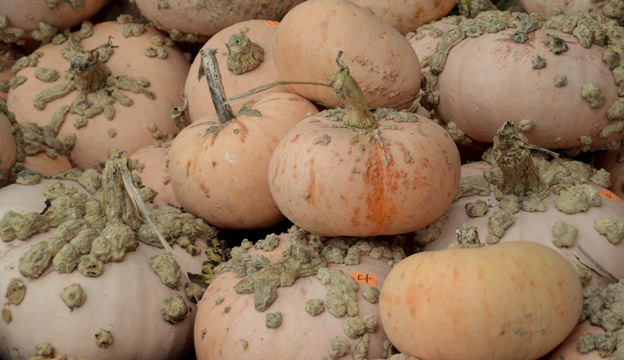
A French heirloom with salmon-peach skin covered in tan peanut-looking warts, this variety is a complete show-stopper. The longer these fruits mature, the wartier they become. This corking results from expanded fractures in the skin that occur because of the fruit’s high sugar content and thin skin. The flesh is very creamy and smooth and is a favorite for pies and soups. Its name means “embroidered with warts from Eysines”—the small city in France from which it hails.

Marina Di Chioggia

Sometimes called the sea pumpkin, this variety is surely one of the prettiest pumpkins you’ll ever grow. The 4- to 10-pound, round and flat fruits are a deep blue-green, and the skin is covered with innumerable smooth bumps. The flesh is bright orange and delicious.

Jarrahdale

Hailing from Australia, this variety produces 6- to 10-pound, slate-blue fruits shaped much like a flattened drum. They’re round with deep ribs and beautiful, smooth skin. The flesh is dry and smooth with a nice fragrance. The rind is very dense. Gettle says you may need an axe to cut it in half—but that thick skin pays off: Jarrahdale stores for up to two years!

Musque de Provence

Often called “the fairytale pumpkin,” these flat pumpkins are shaped much like a wheel of cheese and can weigh up to 20 pounds each. Their heavy lobes and deep ribs start out dark green and mature to a deep mahogany color. The variety hails from southern France, boasts decent pest resistance and keeps for up to one year in proper storage.

One Too Many

A recent introduction from the Rupp Seed Company, this pumpkin is a pale cream color with orange-mottled netting all over. The fruits can be either round or elongated and weigh 15 to 20 pounds each on average. It is said to have good tolerance to mildew.

Triamble

A tri-lobed heirloom pumpkin from Australia, Triamble ranges in color from a pale slate-blue to a deep green. It’s a novelty pumpkin with an excellent flavor. The skin is very hard, making it a long-lasting storage pumpkin, too.

Valenciano

These pure-white, flattened fruits are surprisingly elegant. The 12-inch-diameter fruit stands a mere 6 to 8 inches tall and has light ribbing.

Rouge Vif d’Etampes

Translated as “red life of the times,” this French heirloom is sometimes called the Cinderella pumpkin, as it looks much like the carriage-making pumpkin in the fairytale (shown on page 50). Large fruits ripen to a deep orange-red color. They are flattened, deeply lobed fruits that are reported to have been the variety served by the pilgrims at the second Thanksgiving. Gettle suggests harvesting them when they are 9 to 10 inches across, long before the skin hardens. “Pick them young, and fry them whole. They have an excellent flavor,” he says.

Red Warty Thing

The name pretty much says it all! Round, bowling ball-shaped pumpkins are bright red at maturity. They weigh 10 pounds or more and have hard, bumpy skin.

American Tonda

A beautiful, ribbed pumpkin. The skin is deep orange with green stripes between the ribs. Fruits weigh 4 to 6 pounds.

La Estrella

Grey-, green- and peach-colored skin that looks like it was watercolored onto the fruit. This is a newer variety that is the result of hybridization efforts at the University of Florida. Fruits weigh up to 10 pounds each and have deep-orange flesh.

Lumina

A pure-white, classic-shaped pumpkin measuring 8 to 10 inches across. Flesh is great for cooking.

Long Island Cheese

The smooth tan skin and flat shape of this pumpkin make it look much like a wheel of cheese. Weighing as much as 20 pounds each, Long Island Cheese is an excellent roasting and baking pumpkin with deep-orange, sweet flesh.

Baby Boo

A super-cute mini-pumpkin with stark-white skin, this variety is exclusively for decoration and is a real hit with children.

People may look at these distinctive pumpkin varieties and laugh. The laughter, though, translates into purchases. After all, their individuality is their appeal. It seems that these fruits have got the gutsy eccentricity most of us wish we had. They are special plants, indeed.

This article originally appeared in the September/October 2010 issue of Hobby Farms.