Categories
Animals

Cow Pie

cow manure
Photo by Sue Weaver

My mom is weird! Yesterday she was taking pictures of cow pie. Call it cow manure, cow pat, cow plop, or bull cookies, it’s just plain dung. When we asked why she’d want pictures of that, she said, “for my cow book.”

Mom has learned a lot about cow pie while researching her book. According to University of Wisconsin figures, a typical dairy cow makes 148 pounds of plop every day. That’s 4440 pounds a month or 54,020 pounds a year. We’re glad they don’t do it in our barn!

Cow manure is composed of spent fiber but also nitrogen, phosphorus, potassium, and micro-nutrients like sulfur and boron. Whatever a cow eats that doesn’t become meat or milk becomes manure.

Cow pie is also 92 percent moisture—that’s why it flops when it hits the ground. Mom says when she was a kid, she and her cousins held a cow plop war. They scooped globs of fresh flop up on the end of a stick, and then swung the stick overhand to fling the manure. Cousin Susan caught a glob in the face. She told her mom and everyone was in deep…you know what.

In the olden days on the prairie, where there were very few trees, Native American people used buffalo chips (dried buffalo flop) for fuel. It burns hot, clean, with a clear, bright flame and it has no nasty scent.

By the time white settlers arrived, the buffalo were gone but most everyone had at least one cow. So, they cooked their food and heated their sod houses with cow chip fuel. Gathering a winter’s supply was serious business, and an extra wagon load of chips could be taken to town and bartered for other goods.

In some parts of the world, people still use cow chip fuel. In India, where cow manure is called gober, cowherd men and women knead cow pat into melon-sized balls and dry in the sun for three or four days. Then the balls are stored near the kitchen for cooking fuel. In hot, dry areas of India, people also plaster interior walls in their homes with cow dung mixed with fiber. It’s like adobe and dried cow flop doesn’t stink.

Cows make a lot of urine, too, and you’ll never guess what an Indian organization is doing with that? They’re making a fizzy, soft drink called Gau Jal (Sanskrit for “cow water”) to take the place of America’s Pepsi and Coke. We asked Mom if she’d drink it and she said, “No way!” Would you?
« More Mondays with Martok »

Categories
Urban Farming

The 600-pound Puppy

Rio the Mustang

Photo by Audrey Pavia

Rio on his way to eating the camera.

Since I was a little kid, I’ve wanted to raise my own horse. I’ve finally gotten around to it.

His name is Rio, and he’s a Spanish Mustang. He was almost 2 years old when I had him shipped from Texas to California last December. Spanish Mustangs are rare, and ones with the LP gene that gives them spots like an Appaloosa, are even rarer, which is why he came from so far.

I bought him sight unseen. Just photos and a video of him as a little baby romping around with his mom. His breeder described him as a real character. I could totally see that in the video. He was a little imp, reminding me of my other Spanish Mustang, Milagro, whose nickname when he was young was “The Pest.” 

Rio has not only taken “The Pest” crown from Milagro, he has given the name a whole new meaning. I have never met a horse so unflappable and so nosy. It’s a good thing in a prospective urban trail horse. But it can drive you crazy around the house.

Our version of a turnout space is the small area around our pipe corrals. When we let Milagro and Red, our 22-year-old Quarter Horse, loose, they wander around and nibble on the coyote brush and rose bushes just behind the fencing, happy to be out of their stalls and “searching” for food that way horses are meant to do. 

But when Rio is there, look out! It’s like having a 600-pound puppy loose in your backyard. Everything goes in his mouth. I mean everything.

I once mistakenly left my cell phone sitting on a bench back there. Lucky for me, I happened to be looking in Rio’s direction when he decided to suck the phone into his mouth. I lunged for it just as it disappeared beyond his lips and ended up having to put my hand all the way past his back molars to retrieve it. As soon as I got it out, it started to ring. I was amazed it still worked, because it was dripping with horse saliva!

Then two days ago, Randy left a pair of riding boots on that same bench for my friend, Michelle, who was supposed to ride with me that evening but didn’t have her riding clothes with her.

“I’ll leave the boots on the back bench,” Randy told Michelle over the phone in the afternoon. But when Michelle came later to fetch them, no boots could be found. 

Michelle called Randy and told him she couldn’t find the boots. The two of them went back and forth for a while, each thinking the other was stupid, blind and/or insane because the boots were there, but no, they weren’t. When they hung up, Randy went outside to verify that he did, indeed, leave the boots on the bench. That’s when he realized that he had forgotten about the 600-pound puppy. After considerable searching, Randy found one boot in the bushes, and the other behind a manure bin.

Part of me is hoping Rio grows out of this mouthy thing, because it drives all of us crazy. Another part of me is thinking I should make use of it by training him to pick up dog poop. Because he’s too young to be ridden, that would be one way for him to earn his keep right now. Although I don’t relish the idea of having to fetch dog poop from beyond his back molars. On second thought, never mind.

Read more of City Stock »

Categories
Equipment

Hay Season Is Here

Haying season is here, and for me it is a sweet time of recollection. I’ve worked with small round bales, small squares and eventually large round bales. Each required specific equipment and skills. It is the small bales I recall most fondly.

The little round bales came first. Weather hardy, you could bale now and pick up later. If it rained on them, we’d just wait until they dried.

When I was about eight, my job was to steer a B John Deere between two rows of round bales while an older brother on either side of the hayrack, flipped bales to a third brother who stacked them five high. I still remember with chagrin the day a full load traversed an open badger hole on a hillside and bales and brother flipped off.

When we shifted to a square baler, I was still the designated driver, but on a 630 John Deere with power steering.  When my next older brother was drafted, I moved up to stacker.

This was a tricky job, balancing on the hayrack and building a tight stack five layers high with a single layer down the center top. At age 15, it was my pride and joy to build a 125-bale load that sat tight as a brick as the wagon bounced back to the barn.

When I returned from the army at 20, a kicker had been added. While it was easier, the art of stacking was gone. Also gone was the camaraderie of the stacker and driver working as a team, always trying to load the hayrack before the next empty arrived.

I miss those hot sunny days, bouncing across the fields on a hayrack and working with others to a common end.

<< More Shop Talk >>

Categories
Urban Farming

Bee Rescue

Swarm of bees

Photo by Rick Gush

I found a swarm of my neighbor’s bees in my backyard.

The excitement in our neighborhood this week was a big swarm of bees. I was walking back from the garden and noticed a lot of bees in the air. I looked around and saw a small mass of bees gathering on a little olive tree in my neighbor’s yard. I rushed up to the office to grab my camera and went back down to take some photos. Although I’ve never kept bees myself, I’m pretty sure bees aren’t particularly dangerous even when they’re massing, so I got pretty close with the camera.

Lots of people keep bees here in Rapallo, Italy. One sees most of the brightly painted hives along the edges of the city, but a few people with the larger gardens in the city center also have bee hives. Several of the small farmers who sell produce at the daily vegetable market also sell honey, beeswax candles and propolis. I often buy propolis myself to use as a general protectant and a wound sanitizer.

Although we do see a lot of Honey bees in our garden, I think the larger portion of the bees we see are solitary bees. In addition to Mason bees, there are a half dozen species of big solitary bees that come around when the tomatoes and squashes are flowering. Some of those are particularly good looking bees. I think the fact that all the populated zones in Liguria are surrounded by brush and woodlands helps keep the number of wild bees quite high.

Bee rescue

Photo by Rick Gush

My neighbor patiently scooped up the bees and returned them home.

The Honey bee situation here in Italy is, like the States, troubled by the Varroa mites, and beekeepers report a serious decline in hive population numbers. But there are so many people who do keep bees that even with the decline, there are a whole lot of Honey bees still flying around.

I get a kick out of the fact that the two of the most common vehicles here in Italy are called Vespas and Api, or Wasps and Bees. Vespas are scooters and Api are the common little three-wheeled vehicles, which actually are just a tiny truck body mounted on a scooter.  It cracks me up to see that inside the cab, instead of a steering wheel, there is a set of scooter handlebars.

So, while I was photographing the bee swarm, one of the neighbors who keeps bees came along with his gear to collect the bees, which were, in fact, his. He says the crazy wet and cold spring disturbs the bees, and they more frequently leave their hives to travel around.

Once he put on his hood and gloves, he gently scooped the center of the swarm (and the quee) into the transportation box and waited patiently while the swarm re-formed in the box. Then he carried the bees back home. The nonchalance of the whole situation was charming, as if he was just retrieving a lost goat. I walked by the spot about a half hour later, and where there had been thousands of bees previously, there wasn’t a bee in sight.

Read more of Rick’s Favorite Crops »

Categories
Crops & Gardening

Market Neighbors

farmers market stand
Photo courtesy Jessica Walliser

Jessica’s farmers market stand several years ago.

The peonies and German bearded iris have been lovely this past week.  Our front perennial bed is crankin’ it out with lots of larkspur, nepeta, red hot pokers, salvia and creeping phlox with lots more to come over the next few months.

Unfortunately, none of my leftover sunflower seeds sprouted in the front this year so I’ll be planting some new seeds tomorrow.

We have an ugly downspout on the front corner of the house that is masked perfectly with a gigantic, branching sunflower each year.  I don’t know why we don’t just paint the darn thing—I guess it’s more fun (and frankly a lot easier) to have the sunflower there anyway.

I was visiting with a farming friend over coffee this morning and catching up on her life.  We were farmer’s market neighbors a few years back and she is one of those people whose company is always appreciated and entertaining.  It’s been too long since we last connected so there was a lot of news to share about families and farms and lives.

She’s worried already about getting the early blight on her tomatoes again this year.  She, and many others, lost thousands of dollars last year due to the disease and she’s aiming for prevention this year.  I offered what advice I could and told her I would keep my fingers crossed.

Market started for her two weeks ago (we no longer sell there since we moved) and Karen and I had a long conversation about how that particular market has changed over the years.  They started with just a handful of farmers in the 1980’s and now have over 35 regulars, young and old, at the market selling everything from honey and flowers to fleece and handmade pasta.

Communities everywhere are hosting farmer’s markets and it is so very good to see them succeed.  She also told me about an old friend who will no longer be selling at the market.  My old neighbor, Paul, is now in his mid-90’s and no longer able to spend long hours in the field.

His daughter is happy he’ll be able to relax this year but I know that he is not.  Growing fruits and veggies has been his life for so many years and this will change everything for him.  I know that his customers and fellow farmers will miss him.  But I also know that he will miss them more.

« More Dirt on Gardening »

Categories
Urban Farming

2010 Late Blight an Unlikely Threat

Late blight tomato

Courtesy Purdue Extension/ Bethany Ratts

In 2009, late blight affected tomato and potato crop across the Northeast and Midwest, but the threat of the disease returning in 2010 is unlikely.

After late blight was such a burden in 2009, tomato growers in the Northeast and Midwest wonder if the potentially fatal disease will hit crops again this year. Experts at Purdue University say a repeat of last year’s outbreak is unlikely. 

Although late blight, which thrives in cool, damp conditions, should not return as aggressively as it did in 2009, tomato growers still should be aware of symptoms, says Daniel Egel, a plant pathologist at the Purdue cooperative extension.

“Late blight causes large brown lesions on tomato leaves and stems that under moist conditions are often ringed with the white fungus,” Egel says. “Symptoms caused by late blight may look like other common tomato diseases and, thus, may be easily missed if not sent for accurate diagnosis.”

Late blight, which is caused by a fungus called Phytophthora infestans, is spread by spores carried by wind, rain, or through seeds or transplants. It does not live in soil or dead plants. The late blight outbreak in 2009 is believed to have been caused by infected tomato transplants sold to homeowners at retail stores and spread to other plants before it could be stopped.

“These plants were grown in the South, where late blight is more likely to overwinter, and shipped north,” Egel says. “From homeowners, the disease jumped to commercial growers as well.”

Late blight tomato leaf

Courtesy Purdue Plant and Pest Diagnostic Lab

Late blight can affect a tomato plant’s leaves, stem or fruit. Send these parts to the lab when having your plant tested.

Tomato growers, including those who grow in containers, who suspect the disease is affecting their plants can contact a county educator and send a sample to a plant and pest diagnostic laboratory. Call your local cooperative extension to see if it offers this service.

Send the infected part of the plant to be tested, says Egel. Late blight symptoms can show up on the leaves, stems or fruit.

“Roots of tomato plants won’t show symptoms, but potato tubers might,” he says.

In the case of confirmed late blight, pesticides containing the fungicide chlorothalonil can be used to help stop the spread of the disease to uninfected plants. Organic growers may find that copper products will slow the spread of late blight.

If you notice your tomatoes showing symptoms of late blight, take these steps to extinguish the late blight fungus, and keep you and your 2010 crop safe:

  1. Do not eat the fruit. Plants infected with late blight can cause illness.
  2. Do not compost plants infected with late blight.
  3. Destroy this year’s volunteer tomatoes if your crop was affected by late blight in 2009.
  4. Do not use 2009 potato seeds when planting the 2010 crop.
  5. Avoid tomatoes or potatoes that overwintered in greenhouses. These plants potentially could have harbored the late blight fungus.
  6. Inspect tomato transplants before buying. Avoid buying those that show symptoms of disease.
Categories
Animals

What in the Whorl!

Aiah's Whorl
Photo by Sue Weaver

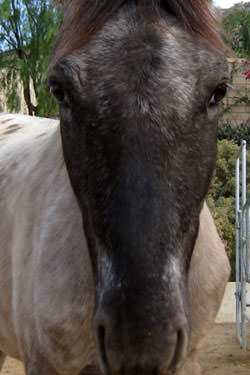
Did you know you can assess the dispositions of horses and cattle (but not us goats, darn) based on how hair grows in whorls (“cowlicks”) on their foreheads? You can!

For hundreds, maybe thousands of years, horse people examined their untrained horses’ heads to figure out how they would probably act in harness or under saddle. The shape of their ears, eyes, muzzles, and profiles were taken into consideration but so were the whorls of hair on their foreheads. Lots of modern people thought that was bologna until horse behaviorist Linda Tellington-Jones evaluated more than 1200 horses and wrote a book about it.

Mom loves that book!

In 2004, another animal behaviorist, Temple Grandin, published a study based on the whorl patterns of 1636 head of beef and dairy cattle sold through auction barns, noting whorl position (left, right, center) and height (high = above eye level, middle = at eye level, and low = below eye level).

She gave each cow a score of one through four (one meaning the cow stayed nice and calm and four, it went bananas. Cattle rating three or four were further rated on whether they displayed fight or flight behaviors. Normal whorls were defined as a single, spiral whorl between the eyes. These are her findings:

• Facial whorls were absent in 10 percent of the cattle

• 86 percent had a normal facial whorl

• 47 percent had middle-whorl placements

• Cattle with low whorls were more likely to have abnormal and off-centerline whorls

• Animals with higher reaction scores had higher facial whorls

• Females had more abnormal whorls than males; beef cattle had more abnormal whorls than Holsteins

• Reaction point scores were higher for females and animals with high whorls than for males and animals with low or middle hair whorls

That’s Aiah, Mom’s riding steer in the picture. Aiah’s whorl is in the center of his forehead, right between his eyes. He’s a smart and gentle guy. Way to go, Aiah!

Why do whorls indicate an animal’s disposition? According to Dr. Grandin, a fetus’ brain forms at the same time as its skin and hair, hence the connection. Whorls can even indicate handedness and other traits in humans. Who’d have thunk it!

« More Mondays with Martok »
 

Categories
News

Cattle Ranches Wrangle Sustainability

Cattle ranch
Courtesy Dickinson Cattle Co.
Americans view cattle ranching as one of the most sustainable professions, according to a national survey conducted by the Beef Checkoff Program.

When your office is the farm and your commute is on horseback, preserving and protecting the Earth is part of the job description.

In a national survey of American beef eaters, cattle ranchers and farmers were selected as the third greenest profession from a diverse list of jobs, with park rangers topping the list. This survey was conducted by IPSOS Public Affairs for The Beef Checkoff Program.

The fact that cattle ranching is viewed as a sustainable profession is no surprise to Gary Teague, a Colorado cattle rancher and environmentalist.

“We work every day to teach our three children what it means to be truly passionate about the land and the animals.  Preserving natural resources is how we make our living and how we secure our family business for our children and grandchildren,” he says

Two-thirds of United States’ 1 million cattle farms and ranches have been in the same family for two generations or more, according to data from Aspen Media and Market Research, 2008. American cattle farmers and ranchers have embraced the values of sustainability for generations, and Americans recognize that commitment. Eighty-six percent of Americans surveyed think cattle farmers and ranchers are committed to environmental preservation.

“It’s the right thing to do and our ability to keep feeding Americans depends on it,” says Teague. “As short-term stewards of this land, it’s our job to ensure it’s left in better shape for the next generation.”

In light of the survey, cattle ranchers celebrated different ways raising cattle can contribute to environmental sustainability. Cattle are raised in every state in the nation, in nearly every type of climate and geography. While cattle ranching practices may vary from state to state or region to region, the goal is the same: Leave the land in better shape for the next generation.

Among the sustainability practices are those that prevent erosion, maintain clean waterways, guard wildlife or recycle resources, while providing a flavorful source of protein. The survey found that Americans value these practices as important ways to protect the environment. Actions seen as very important by more than half of Americans surveyed include things common to cattlemen like planting crops and grasses to control erosion, rotating cattle pastures to manage grazing, and planting trees to provide windbreaks and shelter.

More Survey Stats

  • Park rangers were the clear leader when consumers were asked to choose green professions. However, there was no statistically significant difference between the second greenest profession, dietitians, and cattle ranchers and farmers.
  • An overwhelming majority of respondents (86 percent) believe farmers and ranchers are committed to protecting and preserving land and natural resources.
  • Most Americans’ impressions of farms and ranches are not from personal experience. Only 22 percent of people surveyed get their impressions about cattle ranches from first-hand experience with a rancher. Of almost equal proportion, 21 percent get their impressions from newspapers and magazine articles, and 30 percent from TV shows and movies about the American West.

Consumers aren’t the only ones who find the actions of farmers and ranchers critical to protecting our environment. For example, a group of sportsmen, conservationists and outdoor interests, including The Nature Conservancy, is collaborating on a new “Thank a Rancher” campaign in Wyoming that recognizes the importance of agriculture and ranching in maintaining our open spaces and conserving wildlife habitat.

Categories
Urban Farming

Rhubarb Confession

Rhubarb dessert

Photo by Judith Hausman

Vanilla-poached rhubarb with cornmeal-cardamom biscuits.

I walk past a rhubarb patch in (let’s call her) Mrs. Bloom’s yard nearly every day. Two years ago, I saw that while she is a wonderful gardener well into her 80s, Mrs. Bloom was not pulling her rhubarb. The gnarly flower stalk was unfurling and the tall, almost prehistoric, stalks were getting red, but it seemed to be going to waste.

One day, I fell into temptation. The gate to her lawn was open and her car was gone so here’s what I did: I stole some rhubarb.

I knew I should have asked her first, but I didn’t. I chopped and cooked the half dozen stalks with ginger and honey. Pretty soon, I was wracked with guilt. (Well, maybe not enough to keep me from loving that compote.)

Rhubarb garden

Photo by Judith Hausman

Mrs. Bloom’s rhubarb gone to flower.

But finally at our annual community picnic, I confessed to Mrs. Bloom that I had helped myself to her rhubarb. Of course, she laughed; she had just been chiding her grown son (“You never write, you never call. You never eat my rhubarb.”) for not eating it, and she was planning to pull out one of the big, proud plants. I never did stop back that year (more guilt) but I resolved to do so the next spring. This time, could I make her a pie in return? She waved me off. A pie was too much for her to eat alone, she said, but she’d take some tart, pale green jam instead.

This year, she had my jam jar ready to return to me. Mrs. Bloom’s rhubarb, basking in its sunny spot in the front of the garden, was ready before anyone else’s. I used it to make rhubarb compote at Rainbeau Ridge for the farm’s CSA. We cooked the first batch gently in orange juice and ginger and then after cooling it a little, sweetened it with local honey.

Next time, I’ll poach it in white wine with a real vanilla bean and nutmeg. These are the two palettes I like with rhubarb, which I can then swirl into yogurt or ice cream, top with granola or almonds, layer into a from-scratch or cheater pie shell over creamy, lightly sweetened goat cheese or vanilla custard. Some people like to eat it with roast pork or chicken as a sweet-tart relish, too.

There’s another part to the rhubarb story. Because I live in an older lake community, I knew people other than Mrs. Bloom had old-fashioned rhubarb patches, too, so I used our community e-bulletin board to e-broadcast a call to buy any rhubarb that was up and extra. I figured nobody would like to see the bright red, first fruit, with its poisonous elephant-ear leaves, go to waste. My neighbors were happy to give it to me and wouldn’t take a dime.

That’s part of what I love about my community: The early bounty of rhubarb and the good neighbors ready to share it.

Read more of The Hungry Locavore »