Categories
Equipment

Try Composting Before You Buy

Composting makes sense. It takes waste and turns it into a valuable soil additive.

Today, you can select electric and mechanical composters in barrel, box, ball and other styles. Some automatically or manually mix the compost, while others are more passive with the materials gradually breaking down.

All promise high-quality compost, easily made. While many, if not most, will do what they say, the reality is that making compost requires nothing more than a pile of organic materials.

A couple of guidelines include a good mix of brown (carbon source) and green (nitrogen source) materials, a way to retain them in a pile and a piece of tarp or section of plywood to protect the pile from excess rainfall.

A length of perforated drain tile is a simple way to maintain airflow through the pile.

You can do all of that and more with materials at hand. Cement block walls laid over a gravel base, hardware cloth framed with 2x4s or used wood pallets stood on end – all make adequate composting structures.

Heavy-duty wire livestock panels bent in a circle and tied, old woven netting or any type of barrier fence attached to a circle of steel posts will do for passive composting. The latter are especially well suited for leaves that can require several years for complete breakdown. For quicker results, use a garden fork to periodically mix the materials.

If you haven’t composted your kitchen scraps, lawn and garden clippings and livestock manure, you’re missing out. Look around your place, and you will likely find the materials you need. Your compost pile needn’t cost much; yet, it will produce a high-value product for years to come.

<< More Shop Talk >>


Categories
Animals

Loving’ Weeds

Bull Thistle
Photos by Sue Weaver

Mom likes lots of plants most folks call weeds. We do too, because they’re yummy!

Thistles are some of Mom’s favorite flowers, but here in the Ozarks she spends hours grubbing them out of places we animals graze. We like to eat them when they’re young, like Oran is munching Bull Thistle in this picture.

We love young Nodding Thistles too. Our mouths are tougher than you think!

If you have a fast Internet connection (it’s a big file), you can download an 88-page color guide to Arkansas’ Pasture Weeds that Mom says is better than most of the books she buys.

Or, visit the Weeds page at the Maryland Small Ruminant Pages (one of Mom’s favorite online resources) for more great links to pasture plant identification guides than you can imagine.

Mullein

Some pasture plants most people think are weeds are valuable herbal plants, like Mullein. That’s the fuzzy leaf that Oran is eating in the second picture.

Mom has dust allergy, so in the winter when she feeds hay, she tends to get congested lungs and that makes her cough. When she does, she makes Mullein tea. She crunches a small handful of dried Mullein leaves into her teapot, then covers it with boiling water and lets it steep for a half hour or more.

Then she strains it through cheesecloth (ingesting hairs from the leaves tickles her throat) and drinks up. Ahhhh! It’s tasty. Better she says than commercial tea. Uzzi and I don’t know about that, but to us, the young leaves are delicious eaten raw.

You can chew up a piece of Mullein leaf to poultice a bee sting and it helps. Mullein flowers, Mom says, can be packed into a little bottle and then filled to the brim with olive oil. After six weeks the oil sooths earaches. Mullein parts are used to treat many simple ailments. Read more about using herbal Mullein here.

Humans also use fuzzy Mullein leaves for toilet paper when they’re out camping. But what they may not know is that some people get itchy rashes when their skin comes in contact with Mullein leaves. They should test it on the inside of their arm and wait 20 minutes before using it for toilet paper. Yow!

« More Mondays with Martok »

Categories
Urban Farming

Birds in the Lamp

Photo by Audrey Pavia

Enterprising house finches made a nest in our antique hurricane lamp.

This morning was typical. I dragged myself out of bed to get ready for work, bleary-eyed from staying up too late watching episodes of Dexter (trying to get caught up since my husband Randy and I just discovered the series after 4 years — where have we been?). I fed all the critters — a 20-minute ritual — and then sat down to eat something. As I sat at the kitchen table in a stupor, listening to the toaster oven timer ticking away, something outside the window caught my eye.

A bird. Close to the house.

It flew to the slatted patio cover and then vanished. Where did it go, and what was it doing on the patio? Nothing there but some stuff hanging: windchimes and a couple of bells and old lanterns we picked up at antique stores. The bird feeders were in the front yard, where Foxy the Urban Barn Cat rarely goes. So why the avian interest in the patio?
 
I don’t do caffeine (doctor’s orders), so my morning stupor continued for awhile as I munched on my breakfast. While swallowing my last bite, I saw it again out of the corner of my eye — a bird.
 
Okay, something was going on. When you see a bird come back to the same place twice in a matter of minutes, there’s a reason. I went outside.
 
It was a female House Finch, a little brown bird native to Southern California but seen everywhere in the U.S. The boys are a bit more colorful than the girls. Their brown bodies are adorned with a red head and neck.
 
Lady Finch was hanging on the side of an old, cream-colored iron hurricane lamp we had picked up somewhere. When she saw me, she flew off. I then noticed twigs poking out of the bottom. Seems Lady Finch was building a nest inside the lamp.
 
The lamp’s ornate ironwork didn’t leave any spaces big enough for a bird to enter on the sides. I walked all around it as it swayed in the breeze. How did she get in there? Then I noticed that the bottom—where the twigs were poking out—had a hole in it big enough to fit a small candle. Seems that is where the female finch — and no doubt her mate — were getting in and out of the lamp.
 
I stood underneath it and looked up, wondering several things: Once the nest was built on top of the hole in the lamp, how would the birds get in and out? How would they stay dry in the torrential El Nino downpours we have been getting with such a “holey” roof to their home? And most importantly, how would the baby birds stay inside a nest that was built over a hole?
 
The answers to these questions remain to be seen. You can be sure I’ll be keeping a close eye on the Finch Family as they tackle life in a hurricane lamp.

Read more of City Stock »

Categories
Crops & Gardening

Historical Wisteria

wisteria
Photos by Rick Gush

All the wisteria here is blooming now, and it’s fairly spectacular.  The purple flower clusters are almost unimaginably lush as they hang in thick sheets from fences, walls and patio trellises.

Wisteria is a big vine, so it’s not used so much in the smaller gardens, but for all the big villas it’s practically a landscape requirement like the figs, laurels and olives.

When driving along the sunny coast road where many of the villas are located there are many stretches where the whole road seems purple these days. The big bloom is in the early spring, but some plants continue a sporadic smaller blooming for the whole warm season. The purple wisteria is by far the most common, but there are a few white or pink wisterias also to be seen.

Hannibal's bridge

Some of the historic villas have extremely old specimens of wisteria vines still growing in their gardens.  One fancy monastery near Portofino has a wisteria said to have been planted at the beginning of the nineteenth century when Napoleon ruled northern Italy.  The thick trunks of this two-hundred-year-old patriarch wisteria flop messily above a large courtyard that looks out over the water.  When in bloom it supports hundreds of thousands of purple blossoms. Quite impressive.

We’re finally at the point in our own garden where we’ll be ready to plant a wisteria at the top of the garden complex next year, so I’ll buy a few dormant plants at the local ag fair in January.  In two hundred years I’ll imagine it will look great dripping down from the top of the big cliff.

The second photo is of Hannibal’s bridge in Rapallo.   The main river used to run where the street is now, but was diverted west a hundred yards about a hundred and fifty years ago.  After Hannibal and his elephants crossed over the Alps just a bit north of here, they passed through Rapallo and around 217 B.C. Hannibal’s troops built a bridge over the river in Rapallo, so they could continue their march south toward Rome.

So, it’s a bit sad, but this will be my last blog for Hobby Farms.  It’s been an enjoyable year and more.  Blogging has a pleasurably cathartic effect on me, and I’ve met a bunch of interesting gardeners who have written to me.

The good news is that I get to start blogging on the sister Urban Farm site.  I hope some of the HF readers will take a glance over there and find me.  I’d also appreciate it if even more of you would write to me.  And if you’re ever in Northern Italy with an hour to spare, please come visit Rapallo and my garden.

<>

Categories
Urban Farming

Respect for Small Farmers

Italian marketplace

Photo by Rick Gush

Everyone in Italy likes to eat local.

Italy is quite different from the U.S., and I, quite frankly, think it offers a good role model for American agriculture. I wouldn’t want to copy the idiotically criminal Italian political system or the tendency for Italian mothers to do the laundry of their 40-year-old sons who still live at home. As far as I’m concerned, the most impressive feature of Italian society is the fact that small farmers are respected here. More than respected—almost revered.

Small farmers and their products are highly prized, and their products sell for fair prices that do not fear low-cost foreign import competition. It’s hard for us Americans to understand the depth of Italian rigidness and pickiness concerning the food they eat.  When I was courting my Italian wife, I once brought freshly baked cookies from a local bakery to dinner at her house. She asked me where the cookies were from and I described the bakery. 

“Oh, we don’t eat things from them” she said, “They use cheap butter.”

She thereupon dumped the cookies into the garbage. I was shocked, but gradually I’m realizing most Italians will not compromise at all with their food.

It is no surprise that Italy is the largest organic-food consumer and producer in Europe.  In Italy, people insist on paying more for top-quality ingredients for their kitchens. It’s a great place to be a small farmer. Even being a really small farmer is quite alright. Mom-and-Pop operations are numerous and thriving here. A huge number of Italians work regular jobs and also farm part-time and a great number of their products make their way into the marketplace.

Italian television participates enthusiastically in the general reverence for small farmers.  Every day, the television stations will broadcast programs that feature the operations and products of small farmers. The weekends are loaded with agricultural television content.  I counted 11 hours of agricultural shows last Saturday. Italy is also a great place for someone who enjoys watching television shows about small farmers.

This is not to say that farming is easy in Italy. Far from it. Italy is the land of heroic farming, where even the steepest areas are cultivated on thin terraces that are created by the extremely laborious process of building rock walls and backfilling with soil. Not far from our house is the Cinque Terre, where the seaside cliff terraces are so steep that the grape harvest was once lowered directly into boats anchored in the water.

My diet has certainly changed since I married my Italian wife. We have personal relationships with most of the stores and vendors from whom we buy our food. We know the people who make lots of the cheese we eat, the guy who grows a lot of the vegetables we eat and the grower of much of the olive oil we use.

I am really enjoying my own gardening activities here. I score a lot of points within my Italian family for my ability to contribute quality fruit and vegetables to our diet. All in all, I find that the plants and the bugs and the dirt are all quite similar to America here in Italy. The biggest difference is the societal respect for small farmers and their products. 

Read more of Digging Italy »

Categories
News

Prevent Respiratory Acidosis in Calves

Newborn calf
As soon as a newborn calf is delivered, focus on establishing respiration.

Cattle producers expecting a calf crop should take time now to review procedures to combat respiratory acidosis in newborn calves. Calves with respiratory acidosis are unable to rid their lungs of excess carbon dioxide its body produces and are less able to obtain nutrients from colostrum

“Every baby calf born is in a situation where there is a build-up of carbon dioxide and its byproduct, lactic acid, during the delivery process,” says Glenn Selk, Oklahoma State University Cooperative Extension cattle reproduction specialist.

Delayed passage through the birth canal in the face of uterine contractions that pinch off the umbilical cord compromises oxygenation of the calf. Although the calf is able to breathe as soon as its nose passes the lips of the vulva, expansion of the calf’s chest is restricted in the narrow birth canal.

Continuous forced traction can seriously aggravate the situation, Selk says. “As soon as the calf’s head has passed the lips of the vulva, traction should be interrupted, the nostrils cleared of mucus and cold water applied to the head.”

When the calf is completely delivered, primary attention is directed toward establishing respiration. Mucus and fetal fluids should be expressed from the nose and mouth by exerting pressure using the thumbs along the bridge of the nose and flat fingers underneath the jaws, and sliding from the level of the eyes down toward the muzzle.

Selk says the practice of suspending the calf by its hind legs to clear the lungs must be questioned.

“Most of the fluids that drain from the mouth of these calves probably come from the stomach, and the weight of the intestines on the diaphragm makes expansion of the lungs difficult,” he says. “The most effective way to clear the airway is by suction.”

Respiration is stimulated by many factors, but only ventilation of the lungs allows the cattle producer to render help immediately.

“Brisk rubbing of the skin and tickling inside the nostril with a piece of straw also has a favorable effect,” Selk says. “The phrenic nerve can be stimulated with a sharp tap on the chest slightly above and behind where the heartbeat can be felt.”

Find additional recomenddations on cattle management by contacting your local cooperative extension.


Categories
Crops & Gardening

Rennet Apples and Wild Bluebells

bluebells
Photos by Rick Gush

Bluebells

The apples are just about the last fruit trees to bloom in the garden, and they’ve finally started flowering. 

The plum trees bloomed almost a month ago and are now loaded with tiny fruits.  I’m trying to get my wife interested in making some jam or something with the bumper crop of wild plums we’ll get this year. 

I’ll have to put out big nets underneath the trees to catch a significant portion of the falling fruits.  My wife’s not crazy for them, but I am, and a few of the neighbors are too.

I’ve got one apple planted on the side arm of the garden where there is a thin bed at the bottom of a twelve-foot cement wall.  I planted the apple there a few years ago and have been training it to grow flat against the wall.  It’s doing very well and last year we harvested the first fruits. 

rennet flowers
Rennet Flowers

This tree is a Rennet apple, a very common variety among the small farmers around here.  I think it’s common in the south of France also.  Rennet is a very old variety, but has maintained a reasonable market share.  Both the small markets and the supermarkets sell Rennet apples.

The fruit, which keeps very well, looks sort-of like a russet, but the flesh is not as crisp.  The fruits are slightly flattened and covered by an unattractive dull green-yellow skin.  The flesh is neither crisp nor mealy, but very flavorful and perfumed.  The fruits can be huge. We had a few fruits last year that were the size of softballs.  It’s a great cooking apple, but we mostly eat them fresh.

The second photo shows a patch of bluebells that are also flowering at the moment.  This is one of the wild plants I found on the cliff when I first started clearing the slopes. 

The ten bulbs I dug up five years ago have taken well to bed plantings and have multiplied nicely, to the point that I give bulbs to friends as gifts. 

The blue flowers are a nice foil for all the reds and yellows in bouquets, and the cut bluebells last very well in a vase.  We’ve got a big patch of bluebells in the bed where we grow basil in the warm weather.  We can use a lot of basil, so we usually grow almost a hundred plants packed together in a narrow bed.  The bluebells are in the same bed, and they don’t mind the summer basil growing on top of them.

Being an ex-nurseryman myself, I’m always embarrassed when a nurseryman makes a mistake.  The Rennet apple we’ve got espaliered now was supposed to be a local Genovese apple variety with small red fruits.  Oh well, at least it’s growing well. 

<>

Categories
Crops & Gardening

Good Things to Come

strawberry blossoms
Photo by Jessica Walliser

My daffodils and tulips are pretty much finished blooming and are being replaced by lots of blooming perennials, especially in my shade gardens. 

So far the deer haven’t found my hostas (I give them another month at most) and the rabbits have steered clear of all my emerging annual seedlings (I give them until their babies grow up and they all leave their dens—hungry).

The vegetable garden looks glorious.  I got lots of free leaf compost from my municipality and used it as a mulch. 

Sure, I had to shovel my own and fill up the back of my Subaru numerous times with overflowing buckets of the stuff, but it is so worth it to see that dark, rich brown compost rather than cracked clay when summer arrives.  The plants are happy too.

My peas are up several inches and are nearly grasping onto the grapevine and branch teepees we erected.  The radish are almost ready for saladizing; and the carrots, kohlrabi, and beets have emerged from the dirt and are ready for all those little bunnies to find their way underneath the fence slats. 

Last year our blueberry crop was pitiful so I added elemental sulfur last fall in hopes of righting the pH and giving them a boost.  Payoff!  They are loaded with blooms and bees right now.  Hopefully I can keep the birds and chickens off them this year and we’ll get enough to make some jam.  The strawberries are blooming too. 

Always exciting to know how many good things are to come. 

« More Dirt on Gardening »

Categories
Equipment

The Scents of Building Fence

If you walked your bounds as I suggested in my last post, you may have found a section of fence that needs work or even replacing.

Fixing or replacing fence was constant on the farm where I grew up. For some, fencing memories may be all creosote posts and hard steel. For me, fencing is the smell of fresh-cut wood and damp earth. You see, on our farm a fencing project began in the woods. The dirt smells came later.

My dad was an oak-post man. Corner posts were eight-feet long and 10 to 12 inches in diameter. Fencing as a process began by selecting a good, white oak and chain sawing it into workable lengths.

Watching my dad work a tree was like watching a sculptor turn a block of stone into a work of art. He seemed to instinctively know where to place the splitting wedges to quarter the larger logs and split lesser logs. Still smaller sections of log might make single posts.

Bark was stripped, posts loaded and only then did we head for the fence line. In my later years on the farm, hydraulic front end loaders and rear mounted posthole augers changed the way we did things.

However, my earliest memories of fencing are of holes being dug by hand. I recall my brothers taking great delight in lowering me into a corner posthole to “test the depth.”

The hole may only have been three feet deep, but it seemed like a mile to a boy of five or six. Is it any surprise that more than 50 years later fencing still brings back that little boy’s wonder and the smells of fresh cut wood and moist dirt?

<< More Shop Talk >>

Categories
Homesteading

April Showers

Water barrels save time, energy and water
Photos by Cherie Langlois

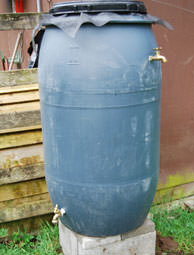
One of our new rain barrels.

After our dry, sunny late winter and early spring spoiled us rotten, we’re back to spring weather as usual here in western Washington.

I have to admit, at this moment I’m not feeling ultra-enthusiastic about the return of the rain, even though I know we need April showers to bring May flowers, and I know it would be a huge pain if our well ran dry this summer, and I know how crucial water is for sustaining our crops, our livestock, and us.  Oh, and don’t forget the rest of life here on Earth, too.

I know all of this, but right now I just really, really want to garden with the sun on my back and without wallowing in mud.

Looking on the bright side, however, I do feel pretty enthusiastic about another project my husband crossed off THE LIST a few days ago:  installing two plastic rain barrels to catch the copious quantities of rainwater flowing off our house and pump house roofs.

For a few years now, we’ve been catching rain off the horse/sheep barn and pump house roofs with metal wash tubs, and using it to water the animals and our fruit trees.

The water from a rain barrel can be used to water your plants
Our blossoming apple tree.

This practice conserves fresh, potable water and the electricity it takes to run our pump, plus helps cut down on rain run-off which carries soil sediment and manure nutrients into local waterways.  We’ve also found catching rainwater actually saves us a bit of time spent wrestling hoses (dip the bucket, carry, pour).  Now, we can catch and store more water in the barrels and, because they’re outfitted with spigots, attach a hose to irrigate garden plants.

This summer, we’d like to install two more aesthetically-pleasing wine keg rain barrels under the downspouts in front of our house, too.

I know it might sound odd—trying to conserve water in a place where it pours from the sky a good chunk of the year.

But the more I learn about this precious resource, and about the impacts that growing populations, droughts, and other factors are having on water supplies around the world, the more guilty I feel about wasting it.

Here are just a few sobering water facts, gleaned from the April 2010 special water issue of National Geographic:

• Only 2.5 percent of the Earth’s water is fresh, and nearly 70 percent of this is frozen.  Salt-water makes up the majority of water on Earth.

• While Americans use on average about 100 gallons of water a day, millions of poor people in developing countries survive on fewer than 5 gallons.

• World-wide, one out of eight people lacks access to clean water.

• In 15 years, it’s predicted 1.8 billion people will live in regions of severe water scarcity.

~  Cherie   

« More Country Discovery »