Categories
Crops & Gardening

Easter

Local blessings of palm fronds are held on Palm Sunday in Rapallo
Photo by Rick Gush

Last Sunday was Palm Sunday, so I went with my wife to the local blessing of the palm fronds down on the bay.  There were hundreds of the local folks, all carrying little palm decorations.

Here in Rapallo, they use very attractive woven palm pieces with sprigs of olive mixed in.  The booths in the vegetable market downtown sell a variety of these woven palm leaves, and at the blessing site a group of craftspeople are making new ones as quickly as the people come to make a donation and take the finished pieces. My wife bought palm weavings for herself, her mother and her sister.  She even sends some of these to my own mother in California sometimes.
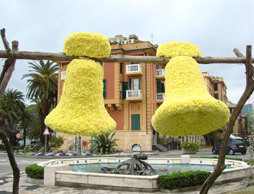
These floral Easter bells were in downtown
Photo by Rick Gush

Everybody holds these palm and olive decorations up in the air when the priest blesses them, then they take them home and put them up on the wall somewhere.  The decorations are used for a year and then replaced with new ones.  The old ones are supposed to be burned, not thrown away.  I don’t take much part in all this, but I do get the job of burning the old palm decorations every year.

The first photo is the group of woven palms my wife bought.  The second photo is a shot of the floral Easter bells mounted downtown.  Rapallo does a pretty good job of putting up lots of different flower beds and other floral decorations.

This Sunday is Easter.  We’ll eat lunch with the family, and it’s sort of like Christmas in that people give each other gifts of chocolate and sweets.  The tradition here is to give hollow chocolate eggs that have “surprises” inside.

For the kids there are a ton of different big eggs a foot or more in height in the markets, and they all contain surprise gifts.  Most of the gifts are cheap plastic toys and jewellery, but one can easily find eggs with real jewellery, real toys and nice stuff.  Of course there are chocolatiers that will seal up whatever gift one brings them.  I myself have sealed a surprise gift, a cute watch, inside a paper mâche egg for my wife, and I have chocolate eggs for my other relatives.

I also brought my mother-in-law some flowers in pots yesterday, as she loves stuff that one gets for free.  One of the plants I brought was a fresh potting of some marguerite cuttings I rooted in the manure-heated coldframe.  They were quite robust and already flowering in the rooting bed.

The second flower was a pot full of blooming chionodoxa, part of the booty from a raid my wife and I made on an abandoned villa above Camogli last fall.  The gardens of the villa had been nice at one time and I harvested a number of bags full of aspidistra, daffodils, bergenia, violets, agapanthus, ivy and ripe persimmons.  It was a great harvest, and most of the stuff is now doing great in the garden.

<>

Categories
Crops & Gardening

Nursery Visit


Photo by Jessica Walliser

Bleeding Heart.

Over the Easter weekend we visited my family in Eastern Pennsylvania.  Since one of my favorite nurseries—Esbenshade’s—is out that way, I lugged my mother, father, nieces and my son for a visit.

We spent three hours there on Good Friday and left with two cartloads of goodies.

In addition to purchasing some cool-season veggie transplants, I got three big bags of organic potting mix, some algae-relief for my pond, three new perennials (Dicentra ‘Burning Hearts’, a beautiful blue Pulmonaria, and Pennsylvania Dutch Thyme—I wonder how it’s different from standard thyme?), five pounds of ‘All Blue’ potatoes, a handful of Oriental lily bulbs and a horseradish root.

We had a great time walking the aisles of the greenhouses enjoying the Easter flowers and checking out all the water plants.

There is something so relaxing to me about browsing through a place like Esbenshade’s; walking around, smelling the smells, reading the seed packets and thinking about all the possibilities.

I always seem to fall in love with a $200-glazed pot and some amazing shrub that isn’t technically hardy where I live.  I don’t buy them, of course (not because I don’t want to, but because I would blow my gardening budget in one afternoon), but I love to browse and gawk and dream about what my garden will be like when we win the lottery…

I have always had a true admiration for family-run nurseries, having worked in one for many years.  It’s a lot of work and there is no such thing as a vacation for these folks.  Places like it always make me smile cause I know that someone’s heart and soul walks out that door every time someone like me buys a plant.

What’s special about your favorite local nursery?

Categories
News

Young Farmers Rank Agriculture Concerns

American Farm Bureau Federation
Courtesy Iowa Farm Bureau/American Farm Bureau
Optimism abounds for young farmers like Eric Goodman, one of many recent college graduates who are still finding plentiful job opportunties in agriculture despite the slumping economy.

The top three concerns facing young farmers and ranchers in 2010 are profitability, the increase of government climate-change regulations and the impact of activist groups, according to a survey conducted by the American Farm Bureau Federation.

However, 80 percent of those responding to AFBF’s 18th annual survey of young farmers and ranchers say they are more optimistic than they were five years ago, while 82 percent say they are better off than they were five years ago. 

“Last year was a tough year economically for many sectors of agriculture,” says AFBF Young Farmers and Ranchers Committee Chair Will Gilmer, a dairy farmer from Lamar County, Ala. “But despite the challenges, the survey shows young farmers and ranchers are optimistic and hopeful. We expect a bright future ahead.”

The informal agricultural survey shows young farmers and ranchers have a high level of concern about government climate-change regulations, with 79 percent of those surveyed expressing high or very high concern.

Additionally, a majority of young farmers and ranchers surveyed expressed concern about the impact of activist groups on their farm and ranch operations. A total of 85 percent were concerned or very concerned about activist groups. Only 7 percent expressed little or no concern.

“Activist groups are becoming more and more vocal, so that is something we always have to keep our eyes on,” Gilmer says. “There is also a great deal of concern about all the ways the government wants to regulate us, whether it’s cap-and-trade or different Environmental Protection Agency rules.”

Young farmers and ranchers ranked their top three challenges: 24 percent ranked overall profitability as the top, followed by government regulations at 23 percent. Two other concerns tied for third on that list: Competition from more established farms and ranches and willingness of parents to share farm-management responsibilities each received 9 percent.

And when it comes to what steps the federal government can take to help farmers and ranchers, 23 percent ranked cutting federal spending No. 1. Boosting U.S. agricultural exports followed with 14 percent of the respondents, and providing greater help to beginning farmers came in third, selected by 11 percent.

A sizable majority [83 percent] of young farmers and ranchers surveyed said they believe farm income should come totally from the marketplace, while 17 percent said farm income should be supplemented by government farm-program payments.

Young farmers and ranchers are also committed environmental stewards, with 68 percent saying that balancing environmental and economic concerns is important for their operations. The survey says 58 percent used conservation tillage on their farms.  The majority of those surveyed, 57 percent, plan to plant biotech crops this year, while 43 percent said they do not plan to do so.

The survey also shows the Internet is an important tool for young farmers and ranchers. Nearly 99 percent said they have access to and use the Internet, with the vast majority, 72 percent, saying they have access to a high-speed Internet connection. Only 20 percent rely on slower dial-up connections, and 8 percent turn to more costly satellite connections.

The social media website Facebook is popular with young farmers and ranchers. Nearly three-quarters of those surveyed have a Facebook page. Ten percent of the young farmers say they use the micro blogging website Twitter, while about 12 percent say they post YouTube videos.

Communicating with consumers is also important, with 77 percent saying they consider reaching out to the public about agriculture and their operations an important part of their jobs as farmers and ranchers.

“We’re recognizing that we need to get out there and talk with our consumers, and we are doing so,” Gilmer says. “Social media is just one more avenue for us to reach those who buy and consume what we produce.”

In addition, the Internet is an important tool for the group to access both general and farm news, with 84 percent saying they use the Internet for news. Seventy-two percent said they turn to the Internet to collect buying information for their operations, as well.

The survey also reveals the group’s strong commitment to agriculture, with 96 percent saying they consider themselves life-long farmers or ranchers. They also express hope for the next generation, with 98 percent saying they would like to see their children follow in their footsteps; 85 percent believe their children will be able to follow in their footsteps.

“Young farmers and ranchers share the same traditional hopes and values that have always guided agriculture,” says Bob Stallman, AFBF president. “This survey shows that the future of American agriculture is in caring and capable hands.”

The informal survey of young farmers and ranchers, ages 18 to 35, was conducted during AFBF’s 2010 Young Farmers and Ranchers Leadership Conference in Tulsa, Okla., in February. There were 373 respondents to the informal survey.

Categories
Crops & Gardening

Nursery Fun

A visit to Esbenshade's nursery proved to be a fantasy visit for Jessica
Photo by Jessica Walliser

Bleeding Heart.

Over the Easter weekend we visited my family in Eastern Pennsylvania.  Since one of my favorite nurseries—Esbenshade’s—is out that way, I lugged my mother, father, nieces and my son for a visit.

We spent three hours there on Good Friday and left with two cartloads of goodies.

In addition to purchasing some cool-season veggie transplants, I got three big bags of organic potting mix, some algae-relief for my pond, three new perennials (Dicentra ‘Burning Hearts’, a beautiful blue Pulmonaria, and Pennsylvania Dutch Thyme—I wonder how it’s different from standard thyme?), five pounds of ‘All Blue’ potatoes, a handful of Oriental lily bulbs and a horseradish root.

We had a great time walking the aisles of the greenhouses enjoying the Easter flowers and checking out all the water plants.

There is something so relaxing to me about browsing through a place like Esbenshade’s; walking around, smelling the smells, reading the seed packets and thinking about all the possibilities.

I always seem to fall in love with a $200-glazed pot and some amazing shrub that isn’t technically hardy where I live. I don’t buy them, of course (not because I don’t want to, but because I would blow my gardening budget in one afternoon), but I love to browse and gawk and dream about what my garden will be like when we win the lottery…

I have always had a true admiration for family-run nurseries, having worked in one for many years.  It’s a lot of work and there is no such thing as a vacation for these folks.  Places like it always make me smile cause I know that someone’s heart and soul walks out that door every time someone like me buys a plant.

What’s special about your favorite local nursery?

« More Dirt on Gardening »

Categories
Equipment

What’s in Your Tractor Toolbox?

As you fire up the tractor for spring tasks, check the toolbox.

If you’re a highly organized individual, you may take inventory of the toolbox before tackling each new job. Working on a farm where you might toil on a dozen different tasks in a day’s time (three planned and the rest occurring on the fly), taking inventory and restocking before each is not an option.

For example, it might be nice to finish disking last year’s corn stalks before fixing the fence. However, if not fixing the fence means letting the cow herd graze and trample the newly emerging alfalfa, you stopped disking.

For that reason and others, a typical tractor toolbox probably held a fence pliers (a multi-purpose tool you should never be without), large straight edge and Phillips screwdrivers (also work as pry bars and punches respectively) and adjustable wrenches (if lucky, both a crescent and a vice grip).

Look closer and you would see cotter pins, various lengths of wire, staples, nuts, bolts and washers. It is that extra hardware that will come in most handy when you least expect it. It is amazing what you can do with a piece of wire when needed.

While it would be nice to think even these tools will always be handy, the reality is that they won’t. Most often the tool that is there is the one you needed and finally went back to get for the last emergency. So don’t sweat what’s in or not in the toolbox. Take a deep breath of fresh spring air and get to work. If a problem comes up, do what farmers have been doing for millenniums…improvise.

<< More Shop Talk >>

Categories
Homesteading

Dealing with Ducks

Keeping the duck population down is a yearly goal for Cherie
Photo by Cherie Langlois

The excited Muscovy parents-to-be.

You would think after keeping them on our farm for near twenty years, I’d have discovered a consistent, efficient, responsible way to deal with my Muscovy flock’s obsession with reproduction (I suspect they’re plotting to take over the farm, then the world). 

But no.  For example, spring has barely sprung and already a teen mother wannabe—one of last summer’s ducklings—has been sitting over two weeks on a clutch of 16 eggs. 

This is not a surprise, because past experience has taught me to expect R-rated Muscovy behavior and fertile eggs anywhere from March to November. 

Since we haven’t been able to bring ourselves to eat surplus ducks (yet) and I don’t want our farm over-run with super-poopy pet fowl, I try to be diligent about gathering duck eggs (great for baking, by the way), except for the annual summer clutch I let one mother duck hatch out for these reasons:

1.  The growing ducklings devour lots of slugs and other pests, providing eco-friendly pest control around the farm. 

2.  Inevitably, we suffer winter duck losses due to predators—usually eagles or raccoons—so keeping two or three of the ducklings each year helps maintain our flock at five to seven birds, the optimum number for our farm.

3.  Ducklings are just so darn cute and fuzzy.

Unfortunately, my ducks don’t give a quack about limiting population growth.  They have their own reproductive agenda, with the females—determined to give us duckling surprises whenever possible—stashing their eggs in secretive places, from a dim corner in the sheep’s stall to underneath the pump house. 

This time, though, the nest was an easy find (in the duck pen), so the fault is mine:  I slacked off on duck egg-gathering, and then when Tally the duck started incubating, I procrastinated about removing the eggs until too much time had elapsed to do so without feeling guilty about it.  So given the Muscovy incubation period of around 35 days, it’s now only a few weeks until D-day.

Then what?

In past years, I’ve bartered surplus ducklings to my feed store for feed or sold them myself to other farmers.  The downside is that I can never be sure what happens to my ducklings down the road.  Maybe they live happy-ducky-ever-after lives, but maybe they don’t.  What if they become victims of neglect—starved, or dumped on a city pond somewhere? 

Every year I argue with myself that it would be more responsible to raise any extra ducklings with respect, kindness, and good care, and then humanely send them to the freezer.  After all, Muscovies were domesticated for just this purpose:  to provide humans with food.  

So how do you other duck-raisers deal with your ducks?

~ Cherie

« More Country Discovery »

Categories
Animals

Here Comes Baby!

Shebaa before her belly bump was visible
Photos by Sue Weaver

Shebaa in March.

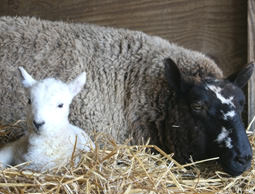
Yesterday morning Shebaa had a lamb! Mom knew she would, so she was there to give Shebaa a hand. If you learn to read the signs you’ll know when your mama animals are going to give birth too. Here are some ways you can tell.

Use an online gestation calculator to see when your mama is due, then research her species to see how long before and after that date normal babies are born. Sheep usually lamb from five days before to five days after their due dates, so Shebaa was right on time.

Shebaa's baby is clearly visible with her belly
Shebaa the day before giving birth.

Watch her udder! Most sheep and goat mamas get strutted udders (that means the udder gets full of milk and stretched almost to bursting, with teats taut and sticking out a little bit to the sides) a day or two before giving birth.

At the same time structures in her hindquarters will start to relax. The muscles beside her tail head soften and her vulva gets long and soft. Goat people check their does’ tail ligaments; when they’re “gone,” expect kids within 24 hours. It’s harder to tell with sheep but if you look at these pictures, you can see how Shebaa’s body got smooshy and soft.

The udders swell late in the pregnancy
Shebaa’s udder the day before giving birth.

Sometimes friendly moms sometimes get offish and offish ones get friendly A day or two before giving birth. Bon Bon dashed around with her ears stuck out to the sides. Shebaa baahs really loudly and really often starting just a few hours before she lambs. When a mama acts weird, it’s nearly time!

Most species “nest” before giving birth. They go off by themselves and dig in the dirt or bedding with their hooves. They sometimes act as though they’ve already had their baby but misplaced it. (“Now where in the world did he go!”)

Sometimes they talk to their unborn babies in sweet, low murmuring we call

Shebaa and her son Fosco
Shebaa and son

“mama voice.”

Finally, first stage labor begins. That’s when the mama feels pain. She’ll go to her chosen birthing spot and lie down, get up again, plop back down, trying to position Baby just so. She might pant, sweat, yawn, grimace, throw back her head or stick out her ears as each contraction hits, then lumber to her feet and re-position herself again.

To be continued…

P.S. Shebaa had a big white ram lamb named Fosco. He’s cute! Wren’s lambs are due on Saturday. Will they be girls? We can hardly wait to find out!

« More Mondays with Martok »

Categories
Crops & Gardening

Local Color

Rick's scooter is easy to drive and carries more than one would think
Photo by Rick Gush

One of my favorite things about life in Italy is the different rhythm of my life here.  In the States, my weekend responsibilities would include tasks like washing the cars and mowing the lawn.  Here my responsibilities include buying the fruit and fresh cheese and I have no lawn and no car, just a vegetable garden and a Vespa.

There is an open-air vegetable market in the center of the pedestrian zone in the city center and it’s open every day until lunchtime. 

On Saturdays even more vendors come in and the whole thing stays open until evening.  My particular assignment is related to a group of growers up near Alessandria that pools their produce for the marketing efforts.  They have a booth here on Saturdays, and it’s my job to buy fruit for the family, some for my wife and I, some for her mother, and sometimes some for her sister. 

Chores in Italy differ greatly from those in the United States
Photo by Rick Gush

At the moment we’re enjoying what will probably be the last pears available for the season, and even the apples will disappear in a month or so when the other fruit starts appearing.  Thursday used to be my soft cheese buying day at the weekly market, but the cooks in my family are not using much soft cheese these days, so I don’t have that responsibility at the moment. 

OK, it’s been a year since I lauded my Vespa, so here goes again.  This is definitely my favorite form of transportation ever.  Parking’s a breeze and driving a scooter is a lot of fun because it’s sort of like flying.  The streets here are so narrow that driving a car is nervewracking, a collision with this or that is always threatening. 

When riding a scooter, it’s so narrow and agile that the chance of hitting something is really low.  And even though it’s just a scooter, I do manage to carry a lot of baggage when required.

I never go so fast as to get in trouble if there’s an accident.  I ride so slowly that I could just get off the scooter if there was an impending collision.  I actually did that a few years ago when another scooter pulled out in front of me from behind a parked truck. 

I had about a millisecond of time before the crash, and I did manage to put my feet on the ground and sort of stand up. 

My scooter kept on going and the other scooter crashed into it, but I was pretty much uninvolved.

Here’s a photo of my Vespa being used as a truck to carry a sack of concrete and some building blocks.  I’m quite susceptible to the attractions of automobiles, and I’ve owned a bunch, but without a doubt, the Vespa is the favorite mode of transport I’ve ever owned.

<>

Categories
Crops & Gardening

Onion Snow

The onion snow indicates when to plant the onions for Jessica
Photo by Jessica Walliser

Earlier this week we had our “onion snow.”

Not sure if the whole world knows what “onion snow” is, but it’s what my mom calls the season’s last light dusting of snow (it might be a Pennsylvania Dutch thing, I don’t know).

The name comes from the fact that the presence of said snow indicates that it’s time to head out to the garden and plant your onion sets.  So, with trowel and preschooler in tow, I did just that.

Together my four-year-old companion and I planted 60 onion sets, half-yellow and half-red.  He did pretty well remembering that the pointy end goes up and to space them a few inches apart from each other.

It was the longest period of time he and I spent side-by-side in the garden actually “working” together. Forty-five minutes of maternal bliss for this garden mama.

After the onion sets were watered in with the little plastic elephant watering can, he wondered off to chase a chicken and I set to work erecting the first of our pea/bean tepees.  It looks pretty darned good if I can say so myself.  I

planted Sugar Daddy snap peas around it and will fill the underneath with fresh straw to make a snug hide-out.  It felt really good to dig—extra good, as a matter of fact, after such a long, life-sucking winter.

I promised we would plant carrots next and lettuce and broccoli, but it will have to wait until after the Easter holiday.  We’re heading East to visit my family.  We’ll get to spend some time in my mother’s garden while we’re there.  I know my son will love that.  Maybe his Nona will let him plant onions with her too.

« More Dirt on Gardening »

Categories
News

Reduce Soil Compaction this Spring

No-till farming
Courtesy Stock.XCHNG
Keep tires properly inflated and practice no-till farming to reduce soil compaction on your farm.

With late harvests, a wet fall and slow-melting snow, farmers across the nation are facing more soil compaction issues than usual this spring. 

Soil compaction destroys the farm’s soil structure and leaves ruts, which can increase spring planting problems like poor plant establishment, putting a ceiling on yield potential. Heavy equipment driven on wet or saturated soils increase the risk for soil compaction.

No-till farmers may be in better shape than others, says Randall Reeder, Ohio State University Extension agricultural engineer.

“Farmers faced a late harvest and a wet fall, and with so much snow, they haven’t had the opportunity to get into their fields and prepare the ground for planting.”

No-till fields are probably less rutted than soil that was tilled prior to last season.

“However, if ruts exist, do the least amount of light tillage necessary to smooth the field enough for the planter or drill to operate,” Reeder says. “This is no time to try deep tillage. Look for signs of compaction during the summer, and then consider subsoiling or planting a cover crop to correct it after harvest.”

That’s especially good advice for farmers who like to chisel plow in the fall.

Farmers can better manage soil compaction in the future with these tips:

  • Practice continuous no-till farming. OSU research has shown that continuous no-till farming resists soil compaction better than soil that was deep tilled or subsoiled.
  • Plant cover crops to keep plants on the farm year-round. Doing so mimics Mother Nature, because soil structure, organic matter and other “living” components are in a steady state, says OSU Extension educator Jim Hoorman.
  • Practice controlled traffic—a method whereby all farm equipment is driven in the same paths year after year.
  • If you’re not using controlled traffic, run tires at the correct pressure to reduce soil compaction. “Many farm tires are over-inflated, which reduces the tire footprint, increasing compaction,” says Reeder. Over-inflation also reduces traction.
  • Remove excess weights that make a tractor heavier than necessary. Extra ballast needed
    for a tillage operation could be removed when pulling a planter.
  • Add more tires, or switch to bigger tires or rubber tracks: The more rubber that comes into contact with the ground, the less pressure on the soil.
  • Consider improving surface and subsurface drainage. A good drainage system helps the soil dry out faster, reducing the potential for soil compaction.

“These practices could lead to better soil structure and minimize yield losses in future years,” Reeder said.