Categories
Recipes

Cream of Asparagus Soup

Cream of Asparagus Soup
Courtesy Hemera/Thinkstock

Ingredients

  • 1 pound fresh asparagus, cut in 1-inch pieces (set tips aside)
  • 1/2 cup chopped onion
  • 1/4 cup chopped celery
  • 2 T. butter
  • 4 cups chicken stock
  • 1 cup milk
  • 1/2 cup light cream
  • 1½ T. flour
  • 1/4 tsp. salt
  • 1/8 tsp. paprika pepper to taste (optional)

Preparation
Melt butter in large saucepan. Add onions and celery and sauté over medium heat until onions are translucent. Add chicken stock and asparagus stalks. Bring to boil, then reduce heat and simmer about 1/2 hour, until stalks are soft. Remove from heat and process in batches in a blender; return to saucepan and set aside.

In a small pan, combine milk and asparagus tips. Bring to boil, then reduce heat and simmer until tips are tender; remove from heat. Strain tips, reserving milk; set tips aside. Using a small whisk, combine flour with reserved milk to make a roux, whisking until there are no lumps. Return saucepan with blended asparagus to medium heat, and when steaming, add a small amount of asparagus mixture to the roux and whisk well.

Gradually add tempered roux to saucepan, stirring constantly. Add cream, salt, paprika and pepper; blend well. Heat until soup thickens slightly, about 8 to 10 minutes. Add asparagus tips, heat another 1 to 2 minutes, then remove from heat. Serve immediately, topped with croutons or a dollop of sour cream.

Serves 6 to 8.

Categories
Homesteading

Picking Potatoes

These All Blue potatoes were part of a St. Patrick's day feast
Photo by Cherie Langlois

My husband made a yummy, all-blue potato dish sprinkled with herbs and onions.

Yikes, today is St. Patrick’s Day!  That means:

A.  I’ve got to find something green to wear.  However, I’m not too worried about this, because green is my favorite color, so I’m bound to have something green to put on unless it’s buried in the dirty laundry.  By the way, did you know that, according to Wikipedia, the color blue used to be associated with St. Patrick’s Day instead of green?  That’s just weird.

B.  I need to make sure we have all the fixin’s for our traditional St. Patrick’s Day supper of corned beef (one of the few times I eat beef during the year), homemade Irish soda bread, cabbage and potatoes.

C. Potatoes!  That’s it!  I’ve got to order my potatoes.

While I always save some seed potatoes from the previous year’s crop to replant, they never seem to produce quite as many potatoes as newly-ordered certified seed stock potatoes.  Also, I like trying out a new “Heirloom” variety each year for the fun of it.

I buy my seed potatoes from Seed Savers Exchange, who send out their potato shipments until the end of April, but if you wait too long they sell out of their most popular varieties.

According to Seed Saver’s potato-planting guide, you can plant potatoes in the early spring whenever the ground can be worked, so I try to get them planted by the end of March or so.

Now the fun part:  which new variety should I try this spring?   Last year, we grew French Fingerlings, a potato with flushed-rose skin and creamy flesh that had the most wonderful flavor and melt-in-your-mouth texture when cooked—almost like it had been buttered already.

Sadly, we’ll be devouring the last of them in our St. Patty’s Day feast tonight, except for the off-limits bag of seed potatoes I saved.  We’ve also grown Purple Viking, a pretty dusky-purple skinned potato with white flesh, and All Blue, which to me looks deep purple inside and out.

This year, the Seed Savers catalog offers me 15 potato varieties to choose from, including All Red, described as a red-skinned potato with pale pink flesh and a low starch content; Carola, a normal-looking brownish potato declared their most popular variety; and Caribe, another cool purple potato, but with snow-white flesh, that carries the admonition to PLEASE ORDER EARLY before they sell out.

By the way, if you’re a member, you can choose from a whopping 483 potato varieties!

I have a weak spot for purple potatoes, so right now I’m leaning toward Caribe—if they haven’t sold out already.

Happy St. Patrick’s Day!

~ Cherie

« More Country Discovery »

Categories
Equipment

Prepping Implements

There is nothing quite like pulling into a field in the spring and beginning the planting process.

Once you have taken part in this annual rite of farming, those warm, spring days when the soil is still too cold and wet can nearly drive you crazy. The only thing to do is to bury yourself in pre-season maintenance. Not only will it extend the working life of the equipment, it will also reduce the potential for breakdown in the field. With that in mind, check your operator manuals for maintenance and service suggestions, and get busy.

Pull the unit out of storage, and give it a careful visual check, making note of any unusual wear marks. This is also a good time to check bolts for loose or missing nuts. Cotter pins should also be checked and replaced if worn.  Check moving parts to be sure they move freely and smoothly when not under load.

If there are hydraulics involved, give the hoses a careful once over, feeling for rough spots or possible leaks. Replace kinked or worn hoses. Look for any sign of fluid leaking around fittings and replace as needed. 

Check, clean and grease fittings on bearings. Replace any Zerk that either appears blocked or where the spring-loaded ball has failed. Don’t over grease. An over-greased bearing can overheat. A rule of thumb is to only inject grease until resistance is felt. 

These steps, along with other recommended service, will keep your equipment working better, longer. Perhaps even more important, they will keep you busy until your fields are as ready for the planting season as you are.

<< More Shop Talk >>


Categories
Animals

We Showed ‘Em!

One half of Martok's set of twins, Latka
Photo by Sue Weaver

Latka

Remember back in June when I told you I was Feeling Frisky?

That’s when I wanted to breed Big Mama and Mom said I couldn’t. That wasn’t fair! Big Mama is really old but she’s beautiful; husky and strong, with long white pantaloons and a beard (you’ve gotta love a woman with a beard). Big Mama and I wanted to make kids.

So on October 14 (Mom wrote it on the calendar just in case), Mom was working at her computer when she glanced out the window at my pen. Big Mama was backed up to the fence and I was standing on my hind legs with my front legs through two openings, having fun.

She leapt up, raced out and took Big Mama away. She thought, “They couldn’t have done it—could they?” But we did!

Big Mama with her new baby, Simka
Photo by Sue Weaver

Big Mama and Simka

Two months ago, Big Mama started getting bigger. And bigger and bigger and bigger. Mom was worried because Big Mama isn’t supposed to have more kids; she got sick after her last kids were born and two of her triplets died. So Mom has been pampering Big Mama, feeding her extra minerals, homeopathic remedies and lots of yummy food like black sunflower seeds, goat pellets and alfalfa hay. And, she’s been checking on Big Mama every few hours around the clock (Mom hasn’t been getting much sleep).

Today Big Mama had twins! They are so cute and they’re my prettiest babies so far. Mom named them Simka and Latka after characters on Taxi, one of Dad’s favorite vintage TV shows. Mom is going to keep them. Yay!

And you know what? All that pampering paid off. Big Mama gave birth without a hitch. She’s happy, healthy and proud of our through-the-fence boy and girl.

Now Bon Bon is getting ready to have our kids. I heard Mom telling Dad that Bon Bon was acting squirrelly today, racing around with her belly bouncing, her udder flopping from side to side and her ears stuck out like The Flying Nun (Uzzi and I don’t know who that is but when Mom told Dad, he laughed).

That’s out-of-character for Bon Bon; does often act weird before they kid. She’s due this Friday but Mom doesn’t think she’ll wait that long. Maybe I can show you more baby pictures next week!

« More Mondays with Martok »

Categories
Crops & Gardening

Black Plastic and Hose Bibs

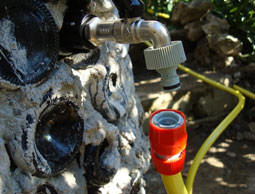
hose bib
Photo by Rick Gush

Hose bib

I finally got around to reworking the irrigation pipes in the lower part of the garden this weekend, and I now have two new spigots down there.  I’m building a new terrace and took the opportunity to run the water pipes under and through the new walls as I was building them.

When I lived in the states I did a whole lot of garden-water pipe installations, and I always used the straight, white plastic PVC pipes and the fittings that needed to be glued together. 

Here in Italy, nobody sells that system and they use instead the rolls of black plastic pipe that is greasier and cannot be glued. The fittings are all screw-down pressure fittings.  At first I was dismayed, but after a few jobs I’ve become a big fan of the black pipe systems.  No more worrying about glue, and the system has the added benefit that the connections can be taken apart and re-positioned whenever appropriate. 

The fittings are much more expensive though, and while a PVC elbow might cost 50 cents or less, a pressure elbow costs about three euros.

pipe fittings
Photo by Rick Gush

Pipe Fittings

My project this weekend involved the installation of two new hose bibs and the complete installation took only about fifteen minutes.  Most usually I need to double check the system and re-connect a fitting or two that is leaking, but this time everything worked perfectly on the first try.  Most excellent!

The hose bibs are a bit different here too, as are the hoses.  Italian hoses don’t generally come with the threaded fittings already affixed to the ends.  The nurseries sell hose tubing at about two euros a meter, and then the hose tube can be fitted with ends. 

I use yellow hoses in the garden, but some of the big nurseries sell green, blue, red and even pink hoses.  Most garden faucets come with a fitting that screws onto the spigot threads and offers a male fitting over which a hose end can be pressed and then secured with a hose clamp. 

Many gardeners use instead the orange plastic Gardena-type pressure fittings that allow a hose to be “clipped” to a hose bib.  The plumbing stores also sell some cool brass versions of the same style.  The hose bib has to have a special fitting that fits inside the hose coupler end, but in the end, this clipping and unclipping hose connection system is way more convenient than the types of hoses I used in the states where I always had to screw and unscrew hoses to move them.  I know they do sell Gardena hose couplers in the states, but I was always somehow not motivated to use them. 

It always feels good to me when I install new spigots in the garden.  Having water where it is most convenient is a key part of building a garden I think.  I have eight hose bibs in the garden now and the most recent I was clever enough to position very conveniently on a wall by breaking one of the bottles that are used instead of bricks to build the walls and then running the pipe through the wall.  Ahh!  

<>

Categories
Crops & Gardening

Flower Shows

The Philadelphia Flower Show was last week and every year I swear I’m going to go and here passed another year without a trip. 


And this was certainly the year to go. With all this snow, a little ‘green’ pick me up was certainly in order but it was not to be. Family priorities, travel hassles and expense too often get in the way of that kind of stuff. 


I heard from a friend who had the fortune of visiting the show that it was just phenomenal. Did anyone go? What did you think? Have a favorite exhibit? 


Since I didn’t get to Philadelphia, I took a mini-‘green’ trip to my favorite local nursery on Monday afternoon. 


My husband has wanted to get a large house plant for our front room for the past several months. Admittedly I’m not a house plant person. It’s hard enough for me to take care of all the plants outside (and all the people and animals inside!) that adding house plants to the list has not been a priority. 


I do think it’s a great idea, though, so I suggested he check out the web and try to figure out what kind of plant would work there. 


We don’t get much direct light in that window and something tall and upright is best suited to the area so after much searching, he came to me with his selection – a mother-in-law’s tongue (otherwise known as a snake plant). 


Not quite the exciting, tropical, lush look I had in my head, but they are kind of cool in their own sparse way. So, my trip to the nursery resulted in ordering a 4-foot-tall mother-in-law’s tongue that is expected to arrive in a week or two. 


I hope I can keep it alive! 


« More Dirt on Gardening »

Categories
Crops & Gardening

Celebrating America’s Gardening Traditions

Popular Gardening Series - Vegetable Gardens, Spring EditionHobby Farms Presents®: Vegetable Gardens, Fall Edition™
If you haven’t tried late-season planting or you simply want to increase your knowledge about gardening, look no further. The fall edition of Vegetable Gardens focuses on all things autumn—what to plant, when to do it, ways to maximize your harvest, how to prepare your garden for winter and much more.


Popular Gardening Series - Vegetable Gardens, Spring EditionPopular Gardening®: Vegetable Gardens, Spring Edition™
As winter gives way to spring, the sunshine returns and the days grow warmer, heating the soil in your garden to a temperature that’s ideal for planting. Crisp peppers, juicy tomatoes, refreshing cucumbers, flavorful thyme … all can become a homegrown reality. Whether you’re a gardening greenhorn or a planting pro, this revised edition of Vegetable Gardens, which focuses on the spring growing season, provides an excellent starting point for planning and maintaining your herb and vegetable garden.


Popular Gardening Series - Tasty TomatoesPopular Gardening®: Tasty Tomatoes™
Eat your vegetables—and your tomatoes! This command might lack the gravitas of a simpler phrase like “eat your veggies,” but it’s technically more accurate. The edible part of the tomato plant is, in fact, a fruit—the ovary of a flowering plant, which distinguishes it from a vegetable, typically the leaf, stem or root of a plan. We appreciate the tomato for qualities such as its tasty flavor, health benefits and beauty in and out of the garden—all of which are explained and embraced in Tasty Tomatoes, the fifth installment of the Popular Gardening Series.

Popular Gardening Series - Vegetable GardensPopular Gardening®: Vegetable Gardens™
You probably remember the first time you fell head-over-heels in love with vegetable gardening.  Maybe you haven’t had the opportunity to make your own memories in the garden. Well, now’s your chance. Vegetable Gardens, the fourth issue in the Popular Gardening Series, is here to guide you through all of the aspects of developing a vegetable garden.

Popular Gardening Series - OrchardingPopular Gardening®: Orcharding®
Popular Gardening® Series: Orcharding has everything you need to know about starting a new orchard or restoring an old one. With beautiful photos and in-depth articles, Orcharding is a must-have for every gardener and farmer. It has recipes from apple cider to candy apples to apple preserves, as well as helpful and interesting information about growing fruits and nuts, maintaining healthy trees, caring for soil health, integrated pest management, organic certification and more.

Popular Gardening Series - Heirloom Farm & GardenPopular Gardening®: Heirloom Farm® & Garden
Before the advent of hybrid technology, farmers saved seeds for the next year’s garden and sprouted new plants each season. Seeds saved from generation to generation, known as “heirlooms,” are said to be seeds that have been saved for at least 50 years and grow true to their parents. Heirloom Farm & Garden has everything you need to know about returning your farm to its heirloom roots. With beautiful photos and in-depth articles, Heirloom Farm & Garden is a must-have for every gardener and farmer.

Popular Gardening Series - Organic Farm & GardenPopular Gardening®: Organic Farm® & Garden
“Organic” is the buzzword in the world of agriculture and food production these days. However, the principles behind organic farming are far from being new. In fact, organic is the way “things used to be” before industrial fertilizers, pesticides and herbicides made their way into farming practices. Popular Gardening® Series’ Organic Farm & Garden has everything you need to know about returning your farm to its organic roots. With beautiful photos and in-depth articles, Organic Farm is a must-have for every gardener and farmer.

Categories
Homesteading

Stop the Treadmill!

One of the black-tailed deer that enjoy spending time in Cherie's yard
Photo by Cherie Langlois

Do you ever feel like you’re running on a treadmill with the speed set too high?  One without a big red “stop” button, so you’re stuck there, knowing you’ll fall off the back if you slow down (highly embarrassing, even if you don’t get hurt), but too scared of what might happen if you jump off, so you just keep running, exhausted and out of breath?

(By the way, before I joined an athletic club this winter, I’d never run on a treadmill before, and so I didn’t know how terrifying they can be when you accidentally punch in a super-high speed.  And this one did have a red “stop” button, thank goodness!).   

Anyway, I’m sure you know the feeling.  And yes, it’s been one of those weeks. 

So this morning I’m dashing around on auto-pilot feeding the menagerie, trying to get everything done fast because the treadmill has sped up again, thanks to our horse Toby choosing this week to have his first-ever hoof abscess, with no concern whatsoever for the articles I have due or the mountain of dishes waiting to be washed or the fact that I’m dead-tired of running.

And then, lugging a bucket of warm water out to the horses, I see them:  two lovely Black-tailed deer reclining in the far pasture, their big ears flicking as they ruminate—the very picture of serenity. 

That’s when it hits me that this self-imposed treadmill I’m on does, in fact, have a red button.  So I push it.

The deer clear the fence with ease when they leave
Photo by Cherie Langlois

I stop and watch the two does, which don’t do much but ruminate and groom themselves, and after a bit, arise and pick their way delicately across the pasture to nibble blackberries.  Belatedly, I think of my camera and return to the house to fetch it, then spend the next fifteen minutes trying to sneak closer to the pair so they’ll actually look like deer in the photos, and not small gray blobs with spindly appendages. 

Every time they look up, ears swiveling in my direction, I freeze like in a game of Red Light, Green Light.  Then I move closer when they start browsing again.  Eventually, the deer realize something is fishy here (or human-y?) and trot to the fence near our woodlot, leaping it with such effortless grace I catch my breath.

Finishing my chores, back on the treadmill again—but at a saner pace, I revel in the way this wild discovery has changed the whole feel of my morning.  I’m happier, calmer and more in control of this day.

Right now, I know there’s a stop button and I’m not afraid to push it.

~  Cherie        

« More Country Discovery »

Categories
Equipment

Picking Out A Chainsaw

If you don’t have a chainsaw, you may be thinking of getting one to clean up winter storm damage. Like most tools, there isn’t any one size that is best for all situations. Before buying a chainsaw, it’s a good idea to first think about where and how you will likely use it.

I have had several chainsaws, large and small, over the years. Currently I have a Stihl 029 with an 18-inch bar. It would be considered a mid-weight saw for cutting trees up to 18 inches in diameter, although I certainly have cut larger trees on occasion. It is more than capable of handling most chainsaw work I encounter. Heavyweight chainsaws with bars of 20 inches and up are generally considered professional grade.

For my money, chainsaws are one place where bigger is not always better. While I have been happy with my 029, at more than 14 pounds, it is really too big for many common jobs around the farmstead. It is ungainly when working with smaller trees and brush and very limited for trimming branches. It is in these situations that a smaller unit with an 8 to 10-inch bar is handier and safer to use.

This isn’t to say a chainsaw of any size is safe. By its very nature, it is one of the most dangerous tools most of us will ever use.  So pick your chainsaw carefully, use it with caution, and it will serve you well for many years.

<< More Shop Talk >>

Categories
News

Perform an Annual Well Inspection

Well cap
Courtesy National Ground Water Association
Check your well cap for cracks and problems with the seal to help eliminate bacteria and other contamination entering the ground water.

Nearly 45 out of every 100 Americans use well water in their homes for drinking. As part of Ground Water Awareness Week, March 7 to 14, 2010, the National Ground Water Association is encouraging farmers with wells to perform an annual maintenance check on their system to make sure the water is safe and clean.

A properly functioning well system is especially important for farmers who use the water for growing crops and feeding livestock on the farm.

“Irrigation accounts for the largest use of ground water in the United States,” says Bob Stallman, president of the American Farm Bureau Federation. “Some 58 billion gallons of ground water are used daily for agricultural irrigation from more than 378,082 wells.”

A poorly maintained irrigation well system on the farm could lead to contamination in the aquifer, says Cliff Treyens, the public awareness director at NGWA. This contamination can come from nitrates, bacteria from animals and crop care chemicals.

Trey wrote in his brochure “Eight Tips for Maintaining Your Well,” that 80 percent of private well owners surveyed never had a well-maintenance inspection. The NGWA advises that inspections should be performed by a certified contractor who will check your well system’s water flow and level, pump motor performance, pressure tank and pressure switch contact and water quality.

The contractor should also check for sanitation and ensure that the well equipment meets all local code requirements. Tests can be performed on the water for problems that are local concerns, such as tests for coliform bacteria or nitrates, and for problems related to plumbing such as iron, manganese, water hardness and sulfides. Other tests might be recommended if water appears dirty or has an odor, if bacteria are detected, or if the system isn’t working properly

Performing these checks on an annual basis can save you financial expenses and safety concerns.

Following the inspection, the well owner will receive a report detailing the results of the tests and recommendations for well maintenance. The NGWA recommends well owners take the following steps between inspections to ensure safe and clean ground water:

  • Maintain proper separation between your well and buildings, waste system and chemical storage areas. Speak with your contractor about local codes regulating these separations.
  • Keep hazardous materials at least 50 feet from the well. These materials include paint, fertilizer, pesticides, motor oil and waste from livestock and other animals.
  • Regularly check your well cap for cracks and make sure it’s properly sealed. “A damaged well cap can allow the entry of bacteria or other contamination into the well,” says John Pitz, an NGWA board member. “It’s one of the easiest things to check and a well owner can do it.”
  • Keep well records in a safe place. These records include the construction report and your well inspection report.
  • Get your well tested if you notice a change in the taste, odor or appearance of your water, or if the well system is serviced.

To have an inspection performed on your well, you can find a contractor in your area at Wellowner.org by clicking on “Finding a Contractor” then “Contractor Lookup.”

“NGWA operates the only national certification for water well drillers and pump installers, who must pass exams and take continuing education courses,” Trey says.

The listing will show whether the contractor is NGWA certified.