Categories
News

New Test More Effectively Detects Sheep Parasites

Sheep
Barber pole worms cause internal bleeding in sheep, leading to anemia and decreased wool production, among other symptoms. A new test for the parasite will produce results in as little as two days.

Researchers at Oregon State University and the University of Georgia have developed an improved, more efficient method to test for barber pole worms, the most serious of the parasitic worms in sheep. Barber pole worms (Haemonchus contortus) result in hundreds of millions of dollars in losses every year for the global sheep and wool industries.

The technology is now available, and will allow a faster, easier and less expensive method to test for the presence and quantity of barber pole worms, a species that is very pathogenic to sheep, goats and llamas. It’s a lectin staining test based on a peanut agglutinin that binds to eggs of the barber pole worm and can be easily seen with a microscope using ultraviolet light. The test is an improved version of previous technology developed by scientists in Australia that was slower, less effective, more expensive and required more advanced training to perform, researchers say.

The test will help sheep ranchers deal with worms more quickly and effectively, optimize their management practices, and sometimes avoid costly therapies.

Findings about the new test were published in Veterinary Parasitology, a professional journal.

“This particular parasite is much more pathogenic in sheep than other worms, and previous methods to detect it were very labor intensive and often not commercially practical,” says Michael Kent, an OSU professor of microbiology. “Now ranchers and veterinarians can test for this problem and target their management or treatment strategies much more effectively.”

The barber pole worm causes significant production losses in sheep. In some cases, it’s the limiting factor to sheep production on pasture lands. The parasites can cause internal bleeding, which in turn can lead to anemia, poor food conversion and growth, low protein levels, reduced lamb production and wool yield, and, in some cases, death.

Also known as wire worms, barber pole worms are blood-sucking parasites that pierce the lining of the sheep’s stomach. They are prolific egg producers, releasing up to 10,000 eggs per day, and often cause problems in warmer climates or during the summer. Once barber pole worms infect a sheep, expensive treatments or complex management strategies are often needed to address the infection.

The lectin staining test was developed by microbiologists and veterinary doctors at OSU and UGA, and is now available through those institutions. Its use should continue to expand and become more readily available to sheep farmers around the world, Kent says.

The test may also be valuable to farmers interested in organic production of sheep, goats and llamas, who try to avoid use of chemical treatments in maintaining the health of their animals. 

“One of the current testing tools commonly used by sheep and goat farmers in dealing with H. contortus is the FAMACHA method in which the farmer compares the animal’s lower eyelid color to swatches on a card to determine the animal’s anemia status,” says Bob Storey, a UGA researcher who co-developed the lectin staining test. However, this method works only if the barber pole worm is the primary parasite in a sheep herd’s worm population.

“For the veterinarian dealing with an anemic animal and a heavy parasite burden, the lectin staining test provides quick feedback as to whether the anemia is parasite-based or may be due to another cause,” Storey says.

The test requires only a small amount of a sheep’s feces. Results are available in as little as two days. Farmers interested in obtaining the test can get information on sampling, test results and fees from the Veterinary Diagnostic Laboratory at OSU (541-752-5501) or Bob Storey at the Department of Infectious Diseases at UGA’s College of Veterinary Medicine (706-542-0195).

As with any animal health concerns, results should be reviewed with a veterinarian so that proper treatment programs can be put in place, researchers say.

Categories
Animals

Goat Coats and Lambie Jammies

lamb sweater
Photo by Sue Weaver

Cecil in a sock.

This is the time of year when baby animals are born (hint: yesterday was Uzzi’s birthday and mine is March 4) and since it’s cold in barns, sometimes it’s hard to keep new babies warm.

Some people hang heat lamps in their barns to warm baby animals but it’s a dangerous thing to do. Fallen heat lamps and heat lamps installed too close to combustibles can burn down barns!

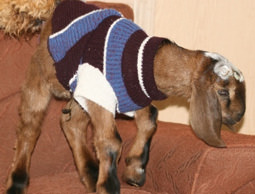
Instead, do like our mom does and make coats and jammies for your newborn kids and lambs (bigger versions work for foals, calves and baby crias, too).

For tiny babies like Cecil, the teensy lamb in this picture, make warm, cushy sweaters from big men’s wool socks. Snip off the top to make the sweater. Use the cuff for Baby’s collar, cut two holes for legs, making sure the fabric doesn’t cover a boy baby’s penis, and there you are!

goat sweaters
Photo by Sue Weaver

The twins wearing readymade goat coats.

Or, make a comfy covering for a slightly bigger baby using a sweat pants leg, the kind with stretchy elastic at the ankles. Make it just like Cecil’s sock sweater. It’s easy!

An option for bigger babies like foals: buy a child-size wool cardigan sweater at the used-a-bit shop. Snip off the sleeves, then fit the body of the sweater to Baby by feeding his legs through the arm holes and buttoning the cardigan along his back.

Imbir’ the horse says when he was born in the midst of a Minnesota blizzard, Mom made him a coat like this out of a child’s goose down vest!

Crafty people can knit, crochet or sew neat baby coats by following instructions posted on the Internet. Check these resources, they’re good ones!

Or, buy a readymade outfit like the stretchy dog sweater Kerla is wearing in this picture (its acrylic, so it’s fine to keep Baby warm in a chilly house but not warm enough for winter in the barn) or a specially made kid or lamb coat. You don’t need dangerous heat lamps to keep your babies warm!

« More Mondays with Martok »

Categories
News

Agriculture Department to Develop New NAIS Framework

cows and sheep
Photo courtesy USDA/ Dean Anderson
The USDA announced it will revise NAIS to allow for more flexible animal-disease traceability.

The USDA will be developing a new framework to trace animal diseases in the United States, Agriculture Secretary Tom Vilsack said in an announcement on Feb. 5, 2010.

Flexibility will be the focus of the new system as the USDA tries to respond to feedback from the current National Animal Identification System. The changes are being made in response to concerns from states, tribal nations and producers received during a listening tour on NAIS. One concern raised during the tour was that NAIS does not benefit small-farm production.

“One of my main goals for this new approach is to build a collaborative process for shaping and implementing our framework for animal disease traceability,” Vilsack said.

The USDA says the new animal-disease traceability system will:

  • Only apply to animals moved in interstate commerce
  • Be administered by states and tribal nations
  • Encourage the use of lower-cost technology
  • Be implemented transparently through federal regulations and the full rule-making process

As the USDA develops the new animal disease-traceability system in the next few months, it will be looking for input from farmers, ranchers and the public during the process.

Read the USDA’s factsheet on the new animal disease traceability framework to learn more.

Categories
Crops & Gardening

Broccoli Weather

broccoli
Photo by Rick Gush

In Italy, these last days of January are called Giorni del Merlo, or the days of the robin, and are usually the coldest days of the year. 

It’s cold here in Rapallo, about 0 degrees Fahrenheit last night, but at least we’re having mostly sunny days.  It’s raining and snowing in the rest of Italy, so we’re relatively well off here. And at least the days are getting visibly longer now.

Merlos are cousins of the robins we have in the states, but they do not have red breasts.  There’s another bird here called the pettirosso, or red-breast, but it’s much smaller than a robin, and more like a fat canary. 

The merlos are really smart birds, and have the same sort of spoiled rotten children that actually become larger than the adult birds.  It’s amusing to see the big adolescent merlos sitting in the trees squawking loudly while the two parents rush around frantically trying to find enough food to fill their offspring’s mouth.  

The news in the garden is that the broccoli harvest has finally started.  Italians seem to eat more broccoli that Americans, and I’m definitely eating more since I moved here. 

black kale
Photo by Rick Gush

My wife and I eat a lot of steamed broccoli, and sometimes we eat pasta with broccoli and sometimes my wife includes broccoli in the mix for vegetable pies.  These are all delicious recipes, but there’s something about the rich green color of lightly steamed broccoli that radiates healthiness.

I grow both regular broccoli that makes big heads and also a local variety that just makes little individual shoots.  The local variety is really popular around here and it is even listed among the market tax lists from 500 years ago in Genoa. 

The big head broccoli also produces a copious amount of secondary shoots once the central head is harvested.  The little shoots are the broccoli most commonly used in pasta dishes and we’ll probably be able to keep harvesting shoots until April, so there’s a lot of pasta with broccoli in my future.

Another plant in the garden that is ready to start harvesting is the black kale shown in the second photo.  This is unusual leaf vegetable is eaten steamed, in soups and in vegetable pies.  Eating black kale is reputed to have particular health benefits.  Me, I like it steamed and with mustard.

So, tomorrow is Feb. 6, and that means Valentine’s Day is a little more than a week away.   That still confuses me because for many years in California, Valentine’s Day was when I would plant my first tomatoes.  There’s no way I’ll have tomatoes planted this Valentine’s Day, because the ground’s still to wet to work and it’s still too cold to plant tomato seeds in the coldframe.  Phooey.

<>

Categories
Equipment

Bringing a Story to Life

For me, the best thing about being a writer is the opportunity to explore diverse subjects and to get to know people. On occasion, the subject and the source changes my perspective or even ignites new goals for my future. That happened with my recent Hobby Farms article (January/February 2010) while exploring the art and science of permaculture.

In this and the following blogs this month, I would like to share some thoughts on the subject and resources I have found helpful.

Permaculture is…what you make of it. For some, it is looking at how one lives through a cultural lens that encompasses the big picture, how one’s actions affect other people and the world around us.

For others, it is cultivating the best possible use of vertical and horizontal space in garden and yard, field and forest to maximize productivity and enjoyment with limited external inputs. For many like myself, it encompasses some degree of both.

Perhaps that was why I had an instant appreciation for Mark Shepard, one of the sources in my story.

For the past 16 years, he has made permaculture concepts central to how he farms and how he lives. From his multi-crop fields that combine orchards, nuts, herbs, flowers and vegetables to his production and use of biofuels and other alternatives to his activities in local soil and water conservation efforts and those practices on his farm, he truly walks the walk.

His down-to-earth dedication to the subject is one reason I turned to Mark for advice on further exploration of permaculture through books, classes and life. 

Next week, I will share some of my thoughts and his on both.

<< More Shop Talk >>

Categories
Crops & Gardening

Tee-pees and Grapevines

Pole beans and peas become intertwined in Jessica's garden
Photo by Jessica Walliser

Pole beans and peas twine around the wooden
tee-pees Jessica creates in her garden.

Since the weather has been slightly above freezing here the past week, we’ve been spending some time in the woods.  It’s with purpose, though—much to my husband’s chagrin. 

When we had our ‘bigger’ farm (20 acres), I used to make enormous wooden tee-pees for our pole beans and peas to ramble on.  Now that we live on our ‘smaller’ farm (2 acres), I want to do it again, but on a more manageable scale.  And that, of course, requires that we collect all the materials now, while the leaves are off the trees and we can see what’s out there.

So, last Saturday we set off on the trail that runs out the end of our small road and into the woods.  As we walked, I had one eye trained on the woods looking for materials and the other eye on the massive boot-sucking mud holes my 4-year-old son was likely to get mired in if we didn’t encourage him to step carefully. 

We (well, mostly John) managed to collect 10 thick, straight branches about 2 inches in diameter and 8 feet tall, enough to make two good-sized tee-pees.  We dragged them out of the woods and into the back yard.  That was the easy part.

Getting the grapevines is always the hard part.  After I put up the tee-pees in spring, I like to wrap them with wild grapevines.  It gives the plants more to grip on.  My husband is NOT a gardener and tries his best to tolerate my crazy ideas.  Most importantly, he is generally willing to do whatever ‘heavy-work’ that’s physically above me.  Grapevine pulling fits into this category. 

Wild grapevines run rampant in Western Pennsylvania so finding them isn’t a problem, but in order to get them out of the trees, you need to yank the heck out of them.  If you’re lucky, they come down with little trouble; if you’re unlucky, they don’t come out no matter how hard you heave and you end up having to find a new vine to wrestle. 

Our first selected vine came down with a few good tugs.  I wrapped all 40 feet of it into a coil and John slung it over his shoulder to carry out.  The second vine took a bit more effort, Tarzan-style.  John put all his weight into it several times without more than a budge from the vine, then he hung from it with his feet off the ground and bounced.  Another budge.  With advice to my son to “Stay there and do not move,” I jumped onto the vine and we pulled together.  Eventually all 50 feet or so came down and it too was coiled and hauled home.

No injuries and all fingers still attached.  Phew.   

So now the tee-pee ‘ingredients’ are leaning against the back fence and waiting for spring.  Just like me.        

« More Dirt on Gardening »   

Categories
Animals

Meet General Kerla

Martok meeting Kerla, the newest Ozark Jewel
Photo by Sue WeaverMartok meets the newcomer.

It happened.

On January 22, my apprentice and future son-in-law was born. Mom and Dad brought him home from Ozark Jewels five days later, after he was disbudded (that means he got his horn buds burned so he won’t grow horns).

That evening freezing ice began to fall and then it started to snow. It snowed until there were 11 inches of snow on the ground, with three-foot drifts. That’s a lot of snow in northern Arkansas.

Little to their knowledge, Jadzia and Kerla would become partners
Photo by Sue WeaverJadzia meets her small, but
to-be-studly, future husband.

Since it was really cold and slippery, Uzzi and I didn’t go to the house to compute and Mom and Dad didn’t bring the interloper out to our barn. He got to sleep in our warm bottle-baby bed in the house. We were stuck in our Port-a-Hut for days!

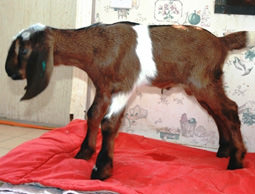
But yesterday, Dad carried him out to meet us. He’s a little brown goat with long white splotches on his sides and a black stripe running along his back.

His name is Ozark Jewels General Kerla and he’s named after a Klingon general, just like me. I thought I wouldn’t like him but he’s kind of cute!

Jadzia looked him over up and down (her brother, Curzon, sniffed him up too). When Dad took Kerla back inside the house, we asked Jadzia what she thought of her husband-to-be. “He’s cute and he has nice ears,” she said, “but he’s so little!”

When we told her that by fall he’ll be a big, burly buck, she sniffed and went back to eating. I don’t think she’s impressed.

Newcomer Kerla learning how to use the pee pad
Photo by Sue WeaverKerla learns to use the pee pad.

Mom’s doing something different with Kerla, though. She’s teaching him to pee on a mat on the kitchen floor! He doesn’t have to wear diapers the way that Uzzi and I did. That doesn’t quite seem fair.

To train him, Mom takes him out of his baby crate at intervals and carries him to the pad. She sets him down and tells him to pee-pee—and he does! Next she’ll clicker train him to go there by himself.

Soon, he’ll be big enough to move outside with the rest of us goats but he won’t move in with me and Uzzi until he’s full grown. That’s because Uzzi protects me and he has horns. So Kerla will live with my nephew, Edmund, and Mopple the sheep-geep until he’s really big. Then there will be two studly bucks at our farm!

« More Mondays with Martok »

Categories
Homesteading

Country Walks Revisited: Early Spring and Staying Alive

tree frog
Photo by Kelsey Langlois

Are chorusing tree frogs signaling the beginning of spring?

During January we experienced unusually warm temperatures here, thanks in large part to El Nino, a cyclic warming of the Pacific Ocean’s surface. 

This spring-like weather has been wonderful for escaping outside to walk the country roads around my farm, but it also seems to have caused confusion among the local animals and plants.  Or maybe they know something we humans don’t?

Could winter be over already?   

For instance, last week my friend and I discovered (and rescued) a little rough-skinned newt, which should have been hibernating still, moving in slow motion across the road.  Then, returning home, I spotted a purple primrose in full bloom.  Yesterday, we passed a clump of pussy willows covered in furry catkins, and later I heard tree frogs chorusing, another harbinger of spring around here. 

I’ve noticed the warmer weather has lured more people out to walk or run our country roads this winter.  Since I’ve also observed too many rural pedestrians flirting with disaster, I’d like to share a few road walking safety tips.
         
1.  Walk or run facing traffic.  Walking on the left side of the road (on the shoulder if possible), facing oncoming traffic, can allow you to take evasive action if needed.  The only time I break this rule is when I’m on a blind hill or curve where oncoming cars can’t see me.  Also, when I hear a vehicle approach from behind, I cast glances over my shoulder to check that it’s in the right lane, or that another car hasn’t pulled out to pass it. 

2.  Look, listen and stay alert.  Walking on a road is not the time to text, yak on your cell-phone, listen to your I-Pod and/or daydream (though I admit I’m guilty of the latter).  Defensive walking means keeping your senses alert.   

3.  Make yourself visible, assume you’re invisible.  Don bright colors (neon yellow really stands out), use reflective clothing and a light at dusk (better yet, don’t walk when visibility is poor), and assume you’re invisible to drivers.  For example, if someone is pulling out from a drive or side road, I won’t cross in front unless he stops, catches my eye and motions for me to proceed.

4.  Use positive reinforcement.  I always give a wave and smile to drivers who politely move over to allow me plenty of space, or who wait until an approaching car passes to proceed.  Hopefully, this positive reinforcement will increase the likelihood they’ll give me room next time, too, as well as drive safely past the next pedestrian they meet.

~ Cherie  

« More Country Discovery »         


Categories
Farm Management

Farmers Need to Protect Their Hearing

Farmer hearing protection
Photo by Lesley Ward
Farmers can protect their hearing when using loud farm machinery by wearing custom earplugs, ear muffs or a combination of the two.

As small farmers take precautions to stay safe when working the fields, they must not forget about their ears. Loud noises produced by farm machinery can put farmers at an increased risk for hearing loss.

A study performed at Eastern Washington University’s Department of Communication Disorders showed that more than half of farmers surveyed in eastern Washington state had been educated on the hazards of not wearing hearing protection. For those who learned about hearing loss—mostly younger farmers—the information was usually passed to them informally through word of mouth or through other means of self-education.

Whether they’ve received education on the hazards or not, farmers need to wear some sort of hearing protection, be it earmuffs or earplugs, says Fuller.

“Ideally, farmers who wish to preserve their hearing should consider custom earplugs,” he said. “Custom plugs are molded to the contours of the individual’s ear, thereby providing an excellent seal within the ear canal against intense noise.”

One reason the farmers gave for not using hearing protection was not being able to hear farm equipment if it malfunctioned. Custom earplugs cut down on the intensity of the noise but allow for a range of frequencies. In other words, the farmer can hear how the farm equipment is working but at a quieter level.

One drawback to custom earplugs, however, is that they cost about $100 to $150 dollars.

“For those who cannot afford them, a combination of hearing muffs and non-customized plugs should be used,” Fuller said. “The two in combination cuts down more on the intensity of farm equipment than either one alone.”

For farmers who have gone a long time without using hearing protection, Fuller advises they see an audiologist to determine the extent of their hearing loss, if any.

“Whether or not the farmer has a hearing loss, the audiologist can assist the individual in obtaining custom-made earplugs,” Fuller said. “Audiologists are an excellent source of education on the hazards of noise and how to prevent further damage to the hearing mechanism.”

Categories
Crops & Gardening

Fiera!

The air fiera has around 500 merchant booths
Photo by Rick Gush

Today was an exceptionally fun day for me because it was the day that the big open air fiera (fair) came to Rapallo.

The fiera, which includes almost 500 merchant booths, is strung out all along the waterfront, and several of the streets closest to the shoreline are closed to traffic and filled with booths.   Along the river there are about fifty agricultural booths selling grapevines, fruit trees and an assortment of different nursery merchandise.

I was at the fiera by 8 a.m. and by 8:30 a.m., I had already purchased a new kumquat and two cherry trees and carted them home on my scooter.  By 9:30 a.m., I was back at the fiera taking a walk around with my wife.    At 11 a.m., I walked around a bit with Richard, my friend who has a small farm up on the hill, and then as usual I enjoyed a hot sausage and pepper sandwich at one of the booths that features enormous whole roast pigs.

The booths feature everything from underwear to hot sausage booths
Photo by Rick Gush

The joke among the locals is often about how the fiera is a good place to get new underwear.  There are in fact an amazing amount of underwear booths selling everything from styles from the nineteenth century to considerably more frisky wear.

The fiera is pretty crowded, and the swarms of wandering people clog the aisles make it difficult to walk around.  There are a lot of people talking loudly, kids shrieking, dogs barking and dozens of the booths are occupied by salesmen equipped with microphones who are enthusiastically and loudly demonstrating the latest food slicers, cooking pans, window cleaners, and even fancy pruning shears.

It can be either exciting or exasperating, and the scene is generally one of an orgy of consumerism.  I did my part and found a couple of swell knapsacks for only five euros each, but I did not find the big booth selling work gloves.

Unfortunately, my wife and I also learned that the Tuscan factory that makes the old-fashioned rustic pottery that we use in our home has shut down, so we were unable to replace our broken dishes from this year.  I suppose we’ll have to start looking around in some of the interior valleys to locate some stores that still have stocks of these charming dishes.

My wife and I ate lunch at 3 p.m., and I received the news that my mother-in-law had expressed a desire for a potted kumquat for her own terrace garden.  That’s great news for me, because I usually have trouble thinking of appropriate gifts for her.  So, I hopped on my scooter again and made yet another trip down to the fiera and brought home another tree.  What a fun day!

<>