Categories
Crops & Gardening

The Neighborhood

Rapallo features a bevy of small groceries
Photo by Rick Gush

I love Via Betti , which is the street on which we live.  It runs alongside the big creek that empties into the bay in downtown Rapallo and goes all the way up to the top of the coastal mountains.

On one side of the road runs the creek and the other side of the street is filled with buildings.  Many of the buildings have shops on the ground floor with apartments above.  About three quarters of a mile up the creek, the businesses stop and the density of the buildings lowers.

The last business on the street, about a hundred yards below our home, is a charming little food market called Adele’s.  The photos this week are both of Adele’s, which is a real breath of quaint air for a Californian accustomed to shopping in huge supermarkets.

There are a bunch of other food markets on the street as well, and when I first moved here I would pass eight little food markets during the fifteen-minute walk along the creek to reach my office in downtown Rapallo.  There are a lot of other stores along the creek too, like butchers, bakeries, tobacco shops, newspaper stands, pharmacies, pet stores, fresh fish stores, dry cleaners, hairdressers and bars.

One of the things I really like about Rapallo is the proliferation of all the various business types in a town with a population of 30,000 people.  I’ll bet there are twenty butchers, fifteen fresh fish shops, and maybe a hundred different little general food stores, not counting the four or five actual supermarkets.
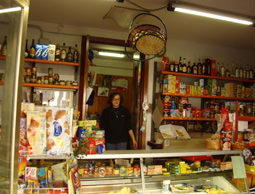
The inside of a typical small grocery
Photo by Rick Gush

The creek has a lot of history behind it.  Just today one of my neighbors was telling me about how when he was a child, the local kids would swim in the water and the local women did their laundry in the creek.  There are still the visible remnants of two of these communal washing areas.

Further up the mountain there are still the ruins of several old water wheels that powered mills that ground grain for the locals until the beginning of the twentieth century.  Somebody once showed me where the old Etruscan bride was near our house, and on the other side of the bay of Rapallo there is a bridge that Hannibal built to cross the larger river that flows into the bay there.

All along the top ridge that is the edge of the watershed for the creek one can still see the sites of the German lookout stations leftover from the Second World War.  The street itself was renamed Via Fratelli Betti (Betti Brothers) in 1946 to honor the memory of two Rapallo brothers who lived alongside the creek when they were young and were killed in the war.

Today the quality of the water isn’t perhaps what it once was, but it’s still clean enough to host a huge fish population.

The big Cephalo in some of the ponds are two and three feet long, and once in a while we see big eels that have come up the creek.  The strip of greenery winding up through the tall buildings acts as a nice park, and we particularly enjoy being able to hear the splashing water at night from our bedroom.

<>

Categories
Crops & Gardening

Snow Cover

The snow is flattening some Jessica's plants, but others are still upright
Photo by Jessica Walliser

I’m beginning to think we will have snow on the ground until the end of March!  I can’t remember the last winter here in Western Pennsylvania that we’ve had such consistent snow cover, though it’s good for all those perennials I planted very late in the season. 

They’re prone to heaving with all the freeze-thaw cycles we usually have around here during the winter.  Hopefully this year they’ll stay nestled in the ground with no heaving and root freeze to speak of.  Only time will tell.

There are very few perennials left standing in my gardens; the rest have toppled under the weight of all the snow.  The buddlea is still upright and the branches are covered in peanut butter-birdseed-pinecone birdfeeders made by my son.  The tri-lobed coreopsis is standing tall and my ornamental grasses continue to look quite nice. 

Looking out my living room window, I can see the tops of my hellebores and some of my Echinacea seed heads.  Not much else is sticking above the snow.  I guess it’s a lean year for all the birds around here. I’ve been trying my best to keep the feeders and suet cages full. 

The deer have been frequent visitors throughout the winter thus far (surprise, surprise…).  I’ve covered the boxwood and hollies with netting (lesson learned last season on that one!).  There’s a cage around the pink buckeye tree that was a gift from some treasured friends at the local Horticultural Society and I even covered my redbud tree just incase the deer decided to have a little taste of something new.  Better safe than sorry.      

What I haven’t protected from the deer, and it appears that I probably should have, is my oakleaf hydrangea.  It’s one of my favorite flowering shrubs for its 4-season interest (oak-like foliage, white conical flowers, glorious autumn foliage, and interesting bark and form).  The deer have nipped off the ends of all the branches and I suspect they’ll go even further during February if all this snow sticks around.  Perhaps a trek in the snow with some more netting is in order for the coming days.    

« More Dirt on Gardening »

Categories
Farm Management

Reduce Energy Costs and Consumption

Simple energy-saving steps can help you cut back on costs
Implement ways to reduce energy around your farm home this winter, such as sealing drafts around doors and windows.

If after a couple months of harsh winter weather you took a look at your electric bill and thought, “Yikes!” then start thinking about how you use your energy. Cold weather might make your energy consumption soar through the roof, but it’s not too late to take energy-saving action.

According to the Edison Electric Institute, small farmers can take steps to reduce their energy consumption, including conducting an energy audit, applying for tax incentives, and making small changes around the home and farm.

Energy Audits
An energy audit is an evaluation made by an electric utility company that shows how much energy you use and how to reduce your energy consumption or energy cost.

Performing an energy audit on your house is a simple process. The auditor will note opportunities and problems regarding energy conservation measures (ECMs) and operation and maintenance measures (O&Ms) and take photos. You will then receive a report with information about your monthly energy consumption and a list of ECMs and O&Ms.

“The easy part is getting the audit, but the hard part is making the recommended changes.  Most people don’t follow through and get the work done,” says Keith Voight, a spokesperson for EEI.

However, there are things to keep in mind if you want an energy audit performed on your farm, according to the National Center for Appropriate Technology. Because energy audits only assess electricity usage, they will not take into account the cost of propane, diesel fuel and natural gas. If you have a larger farm, the cost of the audit might be higher than your energy or cost savings, and you might want to consider energy reliability over cost. You also may need an auditor with specialized training in your area of agriculture if, for example, your farm has a greenhouse or you raise chickens.

“Note that every utility is offering different programs and services, so it is not possible to give you a single answer as to what [you] will get from [your] utility,” Voight says. “But every utility has information on energy efficiency, and many have programs with financial assistance.”

Energy Tax Incentives
The U.S. Department of Energy offers tax incentives for both home energy efficiency and renewable energy. Through these programs, you can receive tax credits on 30 percent of improvement or technology costs.

Energy Efficiency for Existing Homes: Homeowners can receive up to $1,500 on improvements for roofing, windows, installation, and heating and cooling equipment. Changes must be implemented by Dec. 31, 2010.

Renewable Energy for Existing or New Homes: Homeowners can receive assistance with renewable energy technologies such as geothermal heat pumps, photovoltaic systems, solar water heaters and small wind energy systems. There is no limit on how much you can receive. Installations must take place by Dec. 31, 2016.

In addition, the USDE offers tax credits on new homes and automobiles. You can also check to see what your state or utility offers.

Small Ways to Conserve Energy
While thinking about bigger ways to reduce your farm’s energy consumption, there are things you can start doing today to make your energy impact a little lighter. Try some of these tips offered by the EEI to reduce your annual energy use:

  • Turn down the thermostat a couple degrees.
  • Clean or replace your air conditioner and furnace filter.
  • Keep the water heater temperature no higher than 120 degrees F.
  • Caulk and weather-strip around windows and doors.
  • Use compact fluorescent light bulbs.
  • Wash and dry full loads of clothes.
Categories
Recipes

Maple Dressing

Recipe: Maple Dressing
Photo by Stephanie Staton

Ingredients

  • 3/4 cup maple syrup
  • 1/2 cup natural rice vinegar
  • 1 tsp. sea salt
  • 1 large clove garlic, minced
  • 1 ½  tsp. ground mustard
  • 1 cup extra-virgin olive oil

Preparation
Combine all ingredients in a blender and blend until smooth. Serve at room temperature; store unused portion covered in.

Categories
Recipes

Breakfast Bake

Ingredients

  • 6 eggs, lightly beaten
  • 2 cups cubed, stale bread
  • 8 slices bacon, crisp-fried and crumbled
  • 1 cup chopped mushrooms
  • 1 cup fresh chopped chives
  • 1/2 cup chopped green peppers
  • 6 ounces cheddar cheese, grated
  • 2½ cups milk

Preparation
Place bread in the bottom of a lightly greased 9- by 13-inch baking pan. Sprinkle with cheese and bacon, then vegetables. Combine milk and eggs and pour over mixture in pan. Bake at 325 degrees F for 1 hour, until firm.

Makes 16 to 20 servings.

Categories
Equipment

Understand Your Technology

I like to do things myself; however, I have no problem hiring an expert tradesman to do repairs or even seasonal maintenance.

I might be able to do the work myself, but I expect them to do it faster, better and with an awareness of possible problems I might not notice.

The further down the technology road we go, the more inclined I am to rely on “experts.” When I was trained as a mechanic by the U.S. Army 40 years past, things were pretty simple under the hood. Between pollution control devices and on-board computers, I have no problem turning my car over to my mechanic.

Unfortunately, simply trusting an expert to know what they are doing isn’t smart. When we built our house in the mid 1990s, air exchange systems were relatively new. I trusted the installation crew to do the job right. Years later we discovered they had installed the unit improperly.

Looking back, I realize I failed to understand the way the technology worked. I didn’t need to know how to rewire switches or even compute airflow. However, I should have asked the installer to explain how the system worked and how the air was “exchanged.”

In doing so, he and I might have seen the mistake he had made. If my mechanic makes a repair on my car, I know he can explain what he did and why. The same should be true for any “expert” we hire.

With the rapid advances being made, we can’t be experts in everything. However, we owe it to ourselves to understand how the things we depend on in our daily life do work. If the expert you hire can’t explain it, perhaps he doesn’t know either.

<< More Shop Talk >>

Categories
Recipes

Quick Mustard Sauce

Whip this Quick Mustard Sauce up for any meal from Hobby Farms
Photo by Stephanie Staton

Ingredients

  • 1/2 cup apple cider vinegar
  • 1½ T. butter
  • 1/4 cup light brown sugar, packed
  • 3 T. white sugar
  • 1/3 cup prepared yellow mustard
  • 2 eggs

Preparation
Place all ingredients except the eggs into a medium-sized saucepan and whisk until smooth. Beat eggs slightly, add to mixture in saucepan, and whisk or beat with an electric mixer until well-blended. Heat and stir over medium-low heat until mixture thickens, about 2 to 3 minutes. Serve warm or at room temperature.

Makes about 1½ cups.

Categories
Animals

Try Chickens

Chickens are a great starter animal for newcomers
New chicken owners need to consider the chickens’ coops and nutrition needs in order to keep them healthy.

If you’ve never tried your hand at poultry before, start with chickens. Chickens, even newly hatched peeps, aren’t excessively fussy and there are scores of breeds and varieties of chickens to choose from.

Chickens come in all sizes—from 12-pound Jersey Giants to 2-pound Silkies—in breeds selected for laying eggs, producing meat or both. Chickens don’t require fancy housing, they’re relatively gentle and, except for roosters, they’re quiet birds. With all these ideal traits, it’s hard to go wrong.

Home Sweet Coop
When you get chickens, set up a predator-proof coop, preferably with an exercise yard attached. Alternately, where hawks and other predators aren’t problematic, chickens can free-range by day and return to their coop at night to sleep. Chicken coops must be ventilated to provide summer comfort and fresh air year-round and insulated in colder climates. Bed your coops with 4 to 6 inches of chopped straw, wood shavings or a reasonably dust-free litter.

An average-sized adult layer needs 3 square feet of floor space in the coop and adequate room to exercise outdoors. Meat chickens require 1 square foot of floor space up to 10 weeks of age and at least 2 to 3 square feet after. Skimping on space leads to aggression and cannibalism, so don’t take on more chickens than you can comfortably house.

Chicken Resources

Dig into this information-packed reading to find out if chickens are right for you.

Provide nest boxes in the coop for hens to lay their eggs. One nest per four hens will do. While roosts are optional, chickens will appreciate the extra space. Allow 6 to 8 inches of roost space per average-sized bird.

Meal Time
You’ll also need to include feeders and watering devices. Allow 1 linear inch of feeder space for chicks up to 2 weeks of age, 2 inches for the next four weeks, and then 3 to 4 inches for older chicks and adult chickens. A 1-gallon watering fountain is sufficient for 10 adult chickens. Provide at least two watering receptacles and feeders. no matter how many chickens you keep. Otherwise, aggressive chickens may hoard food and water, and their meeker flock mates will not be able to eat or drink.

Because protein levels and nutrition levels in chicken feed remain the same from batch to batch, commercial chicken feeds are a good bet. If you’re unsure which type of feed chickens require at any given age, carefully read the labels or—better yet—consult your veterinarian or county extension agent. Commercial organic chicken feeds are available in some areas.

Lightweight layers, such as Leghorns, eat about 90 pounds of chicken feed per year. Heavier breeds eat about 110 pounds or more. Industrial-breed (commercial) broilers and fryers consume about 13 or 14 pounds of feed per chicken if slaughtered at 8 weeks of age.