Categories
News

Winter Farmers’ Markets Catch On

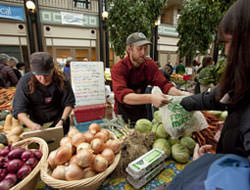
The farmers' market in Fort Collins, Colorado features a bevy of organic goods
Photo courtesy Be Local Northern Colorado/ Dan Bihn
The more than 40 vendors at the winter farmers’ markets in Fort Collins, Colo., sell products like storage vegetables, meats, wine and cider, cheese, baked goods, coffee, and crafts.

It’s around this time of year that farmers’ markets shut their doors until the spring, but across the country, some farmers’ markets will continue to provide for their customers through the winter.

Consumers’ demand for locally produced goods and their willingness to support local farmers continues to rise. From 2008 to 2009, the number of farmers’ markets increased 13 percent to 5,274 farmers’ markets nationwide, according to USDA statistics. This demand is not likely to decrease because of cold weather.

“We do hear of more farmers’ markets trying to find ways to extend their seasons,” says Erin Barnett from Local Harvest, a website that provides a comprehensive database of U.S. farmers’ markets. “Some offer a once- or twice-a-month schedule through the winter, or at least until the end of the calendar year.”

In New York, for example, more than 60 farmers’ markets continue operations throughout the state at both indoor and outdoor locations.

“Many farmers’ markets across the state have extended their stay and are decorated for the holidays, offering a wide variety of locally made or produced products that can make appealing gifts or additions to your holiday feasts,” says Patrick Hooker, the state’s agriculture commissioner.

However, winter farmers’ markets can provide more than holiday appeal. While products offered at winter farmers’ markets vary by region, they also differ from the spring or summer markets, Barnett says. The focus turns to animal and nonperishable products, such as meat, cheese, eggs, honey, preserves, syrups, crafts and storage vegetables.

The winter farmers’ market in Fort Collins, Colo., run by Be Local Northern Colorado, draws in two kinds of consumers: craft shoppers and regular farmers’ market goers. The market started in 2006 with one market in December and, because of its popularity, expanded this year to 10 markets between November and March.

The market, which features more than 40 vendors, is also serving as the launching pad for a future year-round, indoor, “European-style” market, says Hill Grimmet, co-director of Be Local Northern Colorado.

For those lacking a nearby winter farmers’ market and who don’t feel grocery store food will suffice, the key is to plan ahead.

“Next year, people should start thinking about winter in the summer,” Barnett suggests. “They can grow extra food and preserve or store it, or stock up on storage crops at the farmers’ markets in the fall and keep things in their basements, freezers or refrigerators until needed.”

For more information on how to shop local this winter, see the HobbyFarms.com Buy Local Food resource page.

Categories
Large Animals

Italian Dogs

I’m crazy about dogs.  My cats don’t permit me to have a dog myself, but luckily, I get to play with a lot of dogs on the streets of Rapallo.

While in the States most people keep their dogs in the backyard; here in Rapallo most people live in condominiums, which means that they regularly walk their dogs on the street.

I think not being kept in a backyard also makes the dogs of Rapallo friendlier because they don’t develop territorial protection tendencies.  This means that just about any dog that I see out and about is friendly and happy to receive a few minutes of adoration and cuddles from me.  The first few years I lived here I routinely carried dog biscuits in my backpack and I made a lot of dog friends.

Although the dogs of Rapallo are generally pampered, there are a few exceptions.  Up the road from our house there are a few hunters who keep packs of hunting dogs that they use to hunt wild boar in the forests.

We’ve encountered these dogs a few times when we were hiking in the woods during boar hunting season.  They put big bells on the dog’s collars and the dogs flush the boars out of their hiding places.  I actually discovered my garden when I climbed up the cliff behind our home to rescue a lost hunter’s dog that had climbed up there during a driving rainstorm and was stuck on the cliff.

I put on my mud boots and slicker and climbed up to find the dog and carry him back down. Fortunately, he had a telephone number on his collar and I was able to call the owner and he came and got his dog.

That climb gave me the confidence that I could manuever on the cliff and it was a few months later that I decided the sunny cliff would be a better spot to make a garden than the shady gardens I was using at my office.

I suppose the one bad feature of having so many dogs in Rapallo is that not infrequently some owner fails to clean up after their pet.  I call walking on the streets of Rapallo the “sidewalk lottery,” because it is inevitable that sooner or later one will step in some dog crap.  Not fun, but a small price to pay for having so many friendly dogs to play with.

My cats are less enthusiastic about all these dogs, but they do a good job of avoiding them.  The cats are always quite interested in me when I come home from one of my walks, and they sniff all the dog smells on my hands and give me looks that effectively communicate their disgust with me for associating with those uncouth beasts.

Categories
Urban Farming

Winter Farmers Markets Catch On

Winter Farmers' Markets

Courtesy Be Local Northern Colorado/Dan Bihn

The more than 40 vendors at the winter farmers markets in Fort Collins, Colo., sell products like meats, wine and cider, cheese, baked goods, coffee, and crafts.

It’s around this time of year that farmers markets shut their doors until the spring, but across the country, some farmers markets will continue to provide for their customers through the winter.

Consumers’ demand for locally produced goods and their willingness to support local farmers continues to rise. From 2008 to 2009, the number of farmers markets increased 13 percent to 5,274 farmers markets nationwide, according to USDA statistics. From 2012 to 2013, the number increased 3.6 percent to more than 8,000. This demand is not likely to decrease because of cold weather.

“We do hear of more farmers markets trying to find ways to extend their seasons,” says Erin Barnett from Local Harvest, a website that provides a comprehensive database of U.S. farmers markets. “Some offer a once- or twice-a-month schedule through the winter, or at least until the end of the calendar year.”

In New York, for example, more than 60 farmers markets continue operations throughout the state at both indoor and outdoor locations.

“Many farmers markets across the state have extended their stay and are decorated for the holidays, offering a wide variety of locally made or produced products that can make appealing gifts or additions to your holiday feasts,” says Patrick Hooker, the state’s agriculture commissioner.

However, winter farmers markets can provide more than holiday appeal. While products offered at winter farmers markets vary by region, they also differ from the spring or summer markets, Barnett says. The focus turns to animal and nonperishable products, such as meat, cheese, eggs, honey, preserves, syrups, crafts and storage vegetables.

The winter farmers market in Fort Collins, Colo., run by Be Local Northern Colorado, draws in two kinds of consumers: craft shoppers and regular farmers market goers. The market started in 2006 with one market in December and, because of its popularity, has expanded this year to 10 markets between November and April.

The market, which features more than 40 vendors, is also serving as the launching pad for a future year-round, indoor, “European-style” market, says Hill Grimmet, co-director of Be Local Northern Colorado.

For those lacking a nearby winter farmers market and who don’t feel grocery store food will suffice, the key is to plan ahead.

“Next year, people should start thinking about winter in the summer,” Barnett suggests. “They can grow extra food and preserve or store it, or stock up on storage crops at the farmers markets in the fall and keep things in their basements, freezers or refrigerators until needed.”

Categories
Homesteading

Winter Hunger Pangs

Cherie has learned to take the steps to ensure the safety of her animals
Photo by Kelsey Langlois

The official first day of winter falls on December 21, still several weeks away as I write this, but you would never know it from our weather here in western Washington. 

Instead of somber clouds and rain, we have glacier-blue sky and crisp sunshine this morning. Last night, the temperature plummeted to 18 degrees (here that’s c..c..cold), turning water buckets to ice buckets, frosting the trees and making our hungry wild neighbors even hungrier.

Several nights ago, one or more clever raccoons snagged and partially ate two chickens through the wire of their pen.  Last evening, chaos erupted during tuck-in time (our birds free-range by day)—not surprisingly, the remaining ducks and chickens were reluctant to enter their pens after the attack. 

In the confusion and fading light, my special Muscovy duck friend, seven-year-old Velma, remained outside without our knowing it.  From the looks of it, the raccoons killed her as she slept on the pen roof.

I’m not sharing this in order to ignite hatred of raccoons (or other wild predators), but as a cautionary tale.  Yes, I feel sad and frustrated, as well as angry at myself for allowing this to happen. 

I don’t feel too pleased with Mr. or Ms. Raccoon and family right now either; however, I’m not out for their blood.  As a former zoo keeper who worked closely with raccoons, cougars, wolves, and other maligned predators, I can’t help but respect and like these fascinating animals. 

Raccoons are extremely adaptable, smart, and often very bold.  Talented climbers and good swimmers, these dexterous, mostly nocturnal omnivores dine on pretty much anything they can get:  crayfish, insects, fish, berries, grains, carrion, eggs, baby mice, cat food, and more. 

They possess an insatiable curiosity; we’ve had individuals—adorable babies to adults—climb up on our Adirondack chairs to peer in the living room windows, often coming nose-to-nose with our excited Coonhound mix, Pippin.  This collection of attributes has helped raccoons flourish from Canada to Central America, but it also brings them into conflict with humans.      

I can’t blame these masked bandits for doing what they must do to survive, but I can take steps this winter to prevent them from surviving on my ducks and chickens—and so can you:  Tuck your birds into secure enclosures during the night, when many predators are most active. 

Check coops/pens regularly for holes, gaps and weakened/rusted wire where intruders can enter or reach through (we’re currently beefing up our pens with plywood and hardware cloth; the coons tore right through the old chicken wire).  Don’t leave food outside at night for pets, or purposely feed raccoons.  Consider a trained livestock guardian animal for 24/7 security (many farmers swear by them). 

~Cherie 

« More Country Discovery »


Categories
News

U.S. Celebrates Terra Madre Day

U.S. Celebrates Terra Madre DayTerra Madre, local food, Slow FoodCommunities hold events for Terra Madre Day to promote local food.Communities hold events for Terra Madre Day to promote local food.news, ufnews, rbruggerCommunities hold events for Terra Madre Day to promote local food.Rachael Brugger, Associate Web EditorDecember 9, 2009

The Terra Madre conference in Torino, Italy
Photo courtesy Slow Food/ Alberto Peroli
Slow Food founder Carlo Petrini speaks at Terra Madre 2008 in Torino, Italy. The international conference will reconvene in 2010 for its third meeting.

The desire to buy local food is taking root. In November, U.S. Agriculture Secretary Tom Vilsack announced that 16 organizations would receive funding to provide access to healthy, local food. And this month, on a more grassroots level, people around the world will celebrate Terra Madre Day.

Terra Madre is a large conference that has been held biannually in Torino, Italy, since 2006 with farmers, producers and other interested groups from around the world discussing how to improve food systems.

This year, the focus turns local. On December 10, 2009, communities across the world will hold events to focus on providing good, clean and fair food to their community members. This is the philosophy perpetuated by Slow Food, the organization driving the day’s celebration.

In the U.S., from coast to coast, an array of events, from film screenings to food tastings to people dressing up in bee costumes, will take place to provide a platform of discussion on the tenets of Terra Madre and the importance of local food.

The 7 Pillars
In San Francisco, the Slow Food movement has already gained a strong following of 1,000 members. In observance of Terra Madre Day, the chapter’s holiday-themed cookbook and recipe exchange will bridge the conversation about one of Terra Madre’s seven pillars: language, culture and traditional knowledge.

“In San Francisco, everyone is very virtual, and creating community around food is a good place to start creating great conversation and change,” says chapter president Dava Guthmiller, referring to changes in the food system and awareness of small farms.

The seven pillars of Terra Madre Day take the idea of “eating locally” to a level of action. The pillars are: access to good, clean and fair food; agricultural and food biodiversity; small-scale food production; food sovereignty; language, culture and traditional knowledge; environmentally responsible food production; and fair and sustainable trade.

Slow Food in Asheville, N.C., will focus on the pillars of small-scale food production and environmentally responsible food production with its “There’s No Place Like Hive” event.

“We will have a woman dressed up in a bee costume who will speak about colony collapse disorder and the need for more research to find causes and solutions,” said Cathy Cleary, the president of the local Slow Food chapter. In addition, they will provide a sampling of local honey products.

Emphasizing “Local”
For a fishing and farming community in Bellingham, Wash., the idea of eating locally is nothing new, but this year they will be celebrating Terra Madre Day with a tuna canning party.

“We’ve been doing the albacore canning for upwards of eight years,” says Jeremy Brown, who will host the event. “It began in our kitchen. A few friends joined in. More asked if they could, and before long, my wife had kicked us out and told me we needed a better space.”

The canning became an annual event in the community, and then officially became a Slow Food event when a chapter started in their area.

“Our focus has been to encourage people to get their hands into food preparation and preservation,” Brown says, noting the local focus requires people to participate in the food process and develop their own standards.

The showing of the film “Fresh” in Rockford, Ill., will raise awareness of people (like the group in Washington) who are reinventing food systems, says organizer Constance McCarthy. Because there is no Slow Food chapter in her area, she works with the Local Foods Working Group to distribute local food directories and hold other related events.

“Our aim is not to force a viewpoint on people, but to educate them about the questions they can ask to be sure the food they are buying is in line with the values and principles that are important to them.”

A Slow Food chapter in Cincinnati, Ohio, however, is taking a more policy-oriented approach. At the Symposium on Smart Growth, they will discuss regional developments in food sustainability and formation of a Food Policy Development group, says event coordinator Katie Draznik.

“Local food is important because it ties us to our community and the soil we live on. It gives us connection to our land and keeps us ‘rooted’ in our community, literally,” Draznik says. “Local, responsibly produced food allows for biodiversity, which is nutritive to our soils and our bodies.”

Visit the Terra Madre Day website for information about events in your area.


Categories
News

U.S. Celebrates Terra Madre Day

The Terra Madre conference in Torino, Italy
Photo courtesy Slow Food/ Alberto Peroli
Slow Food founder Carlo Petrini speaks at Terra Madre 2008 in Torino, Italy. The international conference will reconvene in 2010 for its third meeting.

The desire to buy local food is taking root. In November, U.S. Agriculture Secretary Tom Vilsack announced that 16 organizations would receive funding to provide access to healthy, local food. And this month, on a more grassroots level, people around the world will celebrate Terra Madre Day.

Terra Madre is a large conference that has been held biannually in Torino, Italy, since 2006 with farmers, producers and other interested groups from around the world discussing how to improve food systems.

This year, the focus turns local. On December 10, 2009, communities across the world will hold events to focus on providing good, clean and fair food to their community members. This is the philosophy perpetuated by Slow Food, the organization driving the day’s celebration.

In the U.S., from coast to coast, an array of events, from film screenings to food tastings to people dressing up in bee costumes, will take place to provide a platform of discussion on the tenets of Terra Madre and the importance of local food.

The 7 Pillars
In San Francisco, the Slow Food movement has already gained a strong following of 1,000 members. In observance of Terra Madre Day, the chapter’s holiday-themed cookbook and recipe exchange will bridge the conversation about one of Terra Madre’s seven pillars: language, culture and traditional knowledge.

“In San Francisco, everyone is very virtual, and creating community around food is a good place to start creating great conversation and change,” says chapter president Dava Guthmiller, referring to changes in the food system and awareness of small farms.

The seven pillars of Terra Madre Day take the idea of “eating locally” to a level of action. The pillars are: access to good, clean and fair food; agricultural and food biodiversity; small-scale food production; food sovereignty; language, culture and traditional knowledge; environmentally responsible food production; and fair and sustainable trade.

Slow Food in Asheville, N.C., will focus on the pillars of small-scale food production and environmentally responsible food production with its “There’s No Place Like Hive” event.

“We will have a woman dressed up in a bee costume who will speak about colony collapse disorder and the need for more research to find causes and solutions,” said Cathy Cleary, the president of the local Slow Food chapter. In addition, they will provide a sampling of local honey products.

Emphasizing “Local”
For a fishing and farming community in Bellingham, Wash., the idea of eating locally is nothing new, but this year they will be celebrating Terra Madre Day with a tuna canning party.

“We’ve been doing the albacore canning for upwards of eight years,” says Jeremy Brown, who will host the event. “It began in our kitchen. A few friends joined in. More asked if they could, and before long, my wife had kicked us out and told me we needed a better space.”

The canning became an annual event in the community, and then officially became a Slow Food event when a chapter started in their area.

“Our focus has been to encourage people to get their hands into food preparation and preservation,” Brown says, noting the local focus requires people to participate in the food process and develop their own standards.

The showing of the film “Fresh” in Rockford, Ill., will raise awareness of people (like the group in Washington) who are reinventing food systems, says organizer Constance McCarthy. Because there is no Slow Food chapter in her area, she works with the Local Foods Working Group to distribute local food directories and hold other related events.

“Our aim is not to force a viewpoint on people, but to educate them about the questions they can ask to be sure the food they are buying is in line with the values and principles that are important to them.”

A Slow Food chapter in Cincinnati, Ohio, however, is taking a more policy-oriented approach. At the Symposium on Smart Growth, they will discuss regional developments in food sustainability and formation of a Food Policy Development group, says event coordinator Katie Draznik.

“Local food is important because it ties us to our community and the soil we live on. It gives us connection to our land and keeps us ‘rooted’ in our community, literally,” Draznik says. “Local, responsibly produced food allows for biodiversity, which is nutritive to our soils and our bodies.”

Visit the Terra Madre Day website for information about events in your area.

Categories
News

Consider Alternatives to Farm Animals as Gifts

HobbyFarms.com gives you alternative gifts to give your farm animal
Giving a farm animal as a gift during the holidays can be dangerous for the animal. Instead, consider buying your loved one a membership to an animal organization.

Although giving a new goat or chicken to a family member to grow their hobby farm might seem like the perfect holiday gift, you should consider a different way to appeal to your loved one’s inner animal lover.

Mississippi State University veterinary experts, who agree that animals generally do not make good gifts, suggest people can donate to an animal-health-care group in someone’s name instead.

“Think how hard it is for people to say when they don’t like or don’t want a gift such as an item of clothing or an appliance,” says Dr. Jennifer Burgess, who specializes in animal behavior at MSU. “Saying no is even harder when the gift is a living, breathing being. This often puts too much pressure on the recipient and can result in an unhappy animal, too.”

Instead of giving a farm animal as a gift this year, consider these alternatives:

  • Contribute food, supplies or time to a local animal shelter and make this donation in honor or memory of a friend or family member.
  • Start a shelter-supply drive in the neighborhood and designate a friend or family member as the honorary chair of the effort.
  • Buy a certificate to spay or neuter if someone has acquired a new cat or dog.
  • Volunteer at an animal shelter with a friend or family member. Enjoy the time together caring for animals.
  • Join an animal rescue group and encourage a friend or family member to join at the same time.
  • Encourage a friend who wants a new farm animal to adopt one from a rescue organization.
  • Volunteer to farm-sit for a friend or family member on holiday vacation.
  • Make a donation to an animal group. Convey how the gift should be used.
  • Buy a friend’s membership to an organization devoted to animal welfare and care.

It’s important to remember that farm animals are not toys or objects, and their well-being needs to be considered, especially during the holiday season.

“Giving a pet as a gift is risky,” says Phil Bushby, a professor of Humane Ethics and Animal Welfare at the MSU College of Veterinary Medicine. “If the recipient doesn’t want a pet or doesn’t want the particular pet selected, the animal may end up being relinquished to a shelter.”

Bringing a new animal to the farm during the holidays is especially stressful for the animal. A surprised owner has no time to prepare a place for it. Plus, many families spend the holiday season entertaining, cooking and shopping. Those activities often mean less time to spend attending to the needs of the animal.

Animals that are already part of the farm can be stressed when a new animal is introduced to the herd or flock. While the transition can be easy for some animals if done properly, others might not be compatible with the new addition. There is risk of injury or harm to the animals when this situation occurs.

Selecting an animal for the farm is a highly personal decision. The owner and the farm animal must get along for the arrangement to work. This can be accomplished only when the recipient is actively involved in the decision to get a farm animal and the selection of a particular breed, Bushby says.

Categories
News

2009 Holiday Wish List

Just for Us

Lisa: Boots, Just for Pampering
This year, I hope Santa brings me a pair of sassy boots, like these Lucchese Lucianas from the Burns Cowboy Shop in Park City, Utah (featured in “Shop Spotlight,” January/February 2009 Hobby Farm Home.) What is it about these boots that makes me swoon?  I wear the heck out of my western boots—around the farm, in the saddle, to events (farm and otherwise) and out on the town—and I tend to keep them for a long time. I’ve always wanted a pair of custom boots that are comfy, ornate and made just for me. If I get these, I promise I’ll think twice before subjecting them to the wear and tear of farm life. Photo courtesy Lucchese Boot Company.

Stephanie: Digital Camera
I’m holding out for a nice digital camera this year. A Canon EOS Rebel T1i EFS 18-55 IS with megapixels and zoom capabilities coming out of my ears would be perfect for capturing mouth-watering recipes for the pages of Hobby Farm Home, not to mention my adorable son and out-of-control dogs. Photo courtesy Canon USA.

All I Want For Christmas…
Visit our message boards to tell us what you are wishing for this holiday season.

Rachael: Juicer in a Box
I love wheatgrass, the newest member of my windowsill garden, because of its amazing immune-boosting capabilities and how easy it is to grow. Topping my holiday wish list this year is a wheatgrass juicer. The Omega 8005 is great because not only can I make myself a daily wheatgrass shot, but drink up the other fruits from my garden (or the local organic grocery store). Can you imagine sipping freshly juiced apples or oranges every morning, perhaps with a slice of fresh ginger or sprig of mint thrown in from your very own garden? Photo courtesy WheatgrassKits.com.

Krissa: Pink LED Christmas Lights
I’ve always dreamed that my wedding would look like a pink paradise of lights and candles in an evening garden. I’m still working on the garden theme, but getting these Pink LED lights for Christmas to drape in the ballroom for my June wedding will put me well on my way to achieving a pink paradise. Plus, the energy-efficient bulbs are good for the environment and are guaranteed not to go dim during the party.  Photo courtesy Christmas Light Source.

For Our Farms and Homes

Lisa: Some Help Backing this Up
I have a beast of a 30-foot gooseneck trailer that I pull with a 3/4-ton truck. I’ve come a long way in my accuracy—if not speed—of getting my trailer in and out of where I need to go. I still sometimes have to stop, jump out, run behind the trailer to see how close I am to that fence or barn, and get in to readjust the rig. It would be glorious if I could do all of that without having to take off my seat belt. This Vision Stat Portable Camera could be the way to go. Photo courtesy Mobile Awareness, LLC.

Stephanie: Fencing to Keep the Dogs Out
Each year my husband and I take our garden to the next level. In the first year, we had a raised bed that our dogs loved to use as a launch pad. The second year, we fenced in the garden with plastic mesh and thin wooden strips. And last year, we replaced the broken strips with lattice. Each time our dogs have penetrated our apparently lame attempts at protection, so in 2010, I want try wire fencing, such as Aubuchon Hardware’s welded wire fencing, hidden behind the decorative lattice. Photo courtesy Aubuchon Hardware.

Rachael: Apartment Composting
Trying to live the local-minded, self-sustainable life from a second-story, one-bedroom apartment isn’t easy. To help my New Year’s resolution of reducing waste as much as possible, I would love this Plus XE compost bin from NatureMill. Its compact size would squeeze perfectly under my kitchen sink, and its odor-reducing capabilities would make my nose happy. Best of all, when the compost is ready, I can add it to my potted tomatoes and haul the excess to a local community garden. Photo courtesy NatureMill.

Krissa: VerTerra Single Use Dishes
I love to host parties, but would rather bypass the clean-up work (who wouldn’t?!). With these VerTerra disposable dishes made entirely of fallen leaves and water, I can throw a dinner party, then toss them into the compost pile. They will naturally compost in just two months. With no clean-up and no damage to the environment, these dishes set a fun, guilt-free, chic party in motion. Photo courtesy VerTerra Dinnerware/ Theodore Samuels.

For Mankind (or Animalkind)

Lisa: Colic Research
My holiday wish is for more research into colic, a terrible condition that strikes horses of all ages for any reason (or seemingly no reason at all). This year, I had to put down my 21-year-old horse, Red, because of a colic episode. I remember one Christmas (probably 15 years ago), my grandmother gave me boxes and boxes of sugar cubes for Red. It probably would’ve been a lifetime supply of treats for most horses, but I was a sucker for his big, brown eyes—so Red polished them off before his birthday four months later. This Christmas, I won’t be able to give Red sugar cubes, but my wish for more colic research might help another horse get his. Photo courtesy Lisa Munniksma.

Stephanie: Cross-cultural Sustainability
Instead of going with the old trusty standby “World Peace,” I’m going to tone it down a notch and wish for a sustainable lifestyle that is predominant in all cultures. (I did say it was toned down just a notch.) I think it’s feasible for people to curb their appetite for a disposable lifestyle, but it’s not going to be easy. People will resist for various reasons, but no matter how you look at it we’re destroying that which sustains us: the Earth. We don’t need to live granola-hippie lives, but I would love to see a world where each and every person makes an effort—in some large or small way—to conserve the life-giving forces of the world in which we live.

Rachael: Localvorism as the Rule, Not the Exception
Why can I drive 10 minutes in any direction and pass three to five large chain grocery stores, but when I talk about farmers’ markets and CSAs, my friends eyes glaze over? The green movement is making progress in turning waste makers into proponents of self-sustainability, but I long for the day when supporting local farmers and businesses is the norm.


Krissa: More Time
Is it possible to stretch the week so we have one extra day set aside to simply do nothing but enjoy those people closest to us?

Categories
Animals

A Day in the Life

Sue's animals get into all sorts of antics on a daily basis
Photo by Sue Weaver

Jadzia before she got the plastic
net stuck on her head.

On Saturday, a little girl interviewed Mom and asked her what a typical work day for a writer is like. Uzzi and I looked at each other and shrugged. Mom’s not the one to ask.

Today she got up at 7 a.m. She milked Bon Bon and fed us important dairy goats and Carlotta the pig, then the Boers and the sheep.

Our horses and donkey and steers are wasteful, so she forks them hay from a big round bale, across the fence. She ripped the plastic net off and put it on the hood of the truck so no one would accidentally wrap the net around their feet.

But my daughter Jadzia (she’s a chip off the old block) reared up to look and got it stuck on her head. Then she streaked around the yard with the net steaming behind her and Mom in hot pursuit.

After that, Mom went to her office and worked for awhile, then decided to hang tarps. Those go around the dairy does’ shelter during the wintertime to help keep them warm. The other goats and Mopple the sheep-geep helped her but Uzzi and I were in our pen so we had to watch. That is, Uzzi watched; three of the does are in heat today so I put on a studly show for them instead.

It started to rain just as Mom got to our side of the gates between the shelter and our pen, so she ran the Boers and sheep to their places and shut them in. With the girls gone, I had nothing to do, so I helped Uzzi help Mom.

We nibbled the tarps and rubbed against Mom but she kept nudging us away. Then she sat on the ground to fasten some ties and I told Uzzi, “Watch this!” I tiptoed up behind her and twisted sideways and zapped her with a stream of pee. She leapt to her feet and grabbed her hair and howled, “ARRRGGGH!” That got her attention!

After she washed her hair with Go-Jo (that’s mechanic’s hand cleaner and it takes out buck scent like a dream) and changed her clothes, she put Uzzi and me in the yard while she finished tying the gate tarps down.

Next, she drove to town to buy more tarps and ties and then it was time to feed and milk again. After that, she chased down big Dyan and crabby Maire (our ancient, retired race horses) in the dark and dressed them in their waterproof turnout sheets.

Now it’s 8 p.m., and she’s in her office again, tapping out a Hobby Farms article about chickens and things. That’s a typical work day for our Mom (but she says she wouldn’t have it any other way).

« More Mondays with Martok »

Categories
News

San Diego County Farms Remain Under Quarantine

Pests have put San Diego County farms under quarantine
Photo courtesy USDA/ Scott Bauer
The Mediterranean fruit fly is one of two invasive species found in San Diego County, Calif., causing area farms to be under quarantine.

San Diego County, Calif., has been under quarantine since mid-November and will continue to be so until two invasive insects threatening the county’s citrus trees and other fruits and vegetables are removed.

As a result of the quarantine, small farmers and local gardeners are being asked not to move fruits and vegetables they grow off their property and to consume them only on-site, according to a statement released by the California Department of Food and Agriculture.

The agriculture department will be implementing two methods to eradicate the pests.

To target the Asian citrus psyllid, the agriculture department is treating plants with a ground application of Tempo, made with the synthetic insecticide cyfluthrin, and following with soil injection of Merit. The same method was used to contain the pest in Los Angeles in September 2009.

The Asia citrus psyllid can carry the citrus greening disease huanglongbing (HLB), but no cases of HLB have been found in California, said Steve Lyle, CDFA spokesperson.

An organic treatment, Naturalyte, made with the naturally occurring bacteria spinosad, is being used to target the Mediterranean fruit fly. The use of this treatment followed the release of sterile Medflies into the area and the removing of fruit from trees within 100 miles of infested sites, according to the CDFA.

Suzie’s Farm, an organic farm affected by the quarantine, has not experienced any damage from the pests, but owner Robin Taylor supports the quarantine and eradication methods.

“The product being sprayed is a bait to attract any other Medfly in the area,” she said. “If this will save our products in the future, then I’m all for it.”

The quarantine will be lifted once the CDFA stops detecting the pests, Lyle said.