Categories
Crops & Gardening

Red Hot Pokers

The Red Hot Pokers are native to South Africa
Photo by Rick Gush

Some of my favorite flowers, the Red Hot Pokers, are just starting to come into flower in our garden these days. 

These hardy perennials native to South Africa were called Tritoma uvaria for several hundred years, but there was some confusion due to the fact that there was a genus of beetles that also used the same name. 

Finally in the twentieth century, the Botanical Congress cleared the confusion by changing the plant’s genus name to Kniphofia, to honor an 18th century German botanist named Johan Kniphof. 

So now, the plants are still called Tritomas, but their official botanical name is Kniphofia.  There are about twenty species in the Kniphofia genus, but this one species, Kniphofia uvaria, is responsible for about 95 percent of the horticultural trade.

Tritomas are fairly rugged plants and will tolerate a fair amount of cold, perhaps down to 14 degrees Fahrenheit, and they are often called for in drought-tolerant landscape designs. 

The young plants are a bit slow to spread at first and while they may flower when young they don’t make a good show until the clump is three or four years old and there are at least five or six plants in the clump.  I’m happy that my oldest clump has 16 flower spikes coming up this year, as that will make a really good show. 

I’ve also got several other younger clumps and will get a handful of blooms from each of those, but nothing like the huge lamp produced by the main clump.

Although I have also planted a few yellow blooming Tritomas, the main variety we have in the garden is the classic orange Pfitzer type. 

Wilhelm Pfitzer was a famous German nurseryman in the mid-18th century and he developed this superior strain from wild plants.  Pfitzer was a big developer of new varieties of dahlias, cannas and gladioli and he is certainly one of the reasons that these garden species are so popular in the gardens of today. 

His was one of the dominant nurseries in Europe for more than seventy-five years, up until the Second World War, and many of the varieties that he developed (like Kniphofia uvaria var. Pfitzer) are still dominant in their categories.  

The plants don’t show up in retail nurseries too often because their foliage is unkempt in containers and when the plants bloom they are too top-heavy to display well. 

Luckily the mail order and internet suppliers have a large range of different Kniphofia for sale.  The little plants one buys will take a few years to really get going, but once they are established, they will last for many years without needing to be divided.  In our garden, the Tritomas will flower from now until January and will attract nectar loving birds like hummingbirds and other sugar eaters.

Amazingly, both wild and feral Red Hot Pokers are often considered a weed in South Africa and feral plants have spread widely in Australia.  One can find a number of websites that give advice as to how to get rid of this pest!

<>

Categories
Animals

Bull Cookies

  • 4 cups uncooked old-fashioned oatmeal
  • 8 tablespoons of flour
  • 1/2 cup molasses
  • 3/4 cup water

Preheat oven to 350 degrees F. Combine all ingredients in a large mixing bowl. Stir until mixture is the consistency of thick cookie dough. Drop tablespoons of dough on a greased cookie sheet, spacing cookies 1 inch apart and flattening slightly to form portions about the size of a silver dollar. Bake approximately one hour, until crisp.

Find more animal treats on Monday’s with Martok, a blog by Martok the goat.

Categories
Animals

Martok’s Tasty Tidbits

  • 1 cup sugar
  • 1 cup flour
  • 1/2 cup additional tasty tidbits such as finely diced raw apples, lightly crushed peanuts, grated carrots, raisins or other dried fruit
  • 1/2 cup molasses
  • 1/2 cup vegetable oil or corn oil

Preheat oven to 350 degrees F. Combine sugar, flour, and crushed or grated items, then add oil and molasses. Stir until well blended. Mix should be sticky; if runny, add a little flour; if it’s too thick, add a dab of molasses. Divide into small balls, place on greased cookie sheet and bake for 10 to 15 minutes or until crisp.

Find more animal treats on Monday’s with Martok, a blog by Martok the goat.

Categories
Animals

Imbir’s Horse Treats

  • 1 cup sweet feed for horses
  • 2 cups bran
  • 1 cup flax seed
  • 4 large carrots
  • 1 cup molasses
  • 1/2 cup brown sugar
  • 1 cup applesauce

Preheat oven to 350 degrees F. Combine molasses, brown sugar, carrots and applesauce in one bowl and dry ingredients in another one. Slowly combine molasses mixture with dry ingredients, adding only enough molasses mixture to form thick dough. Drop tablespoons of dough on a greased cookie sheet, spacing cookies 1 inch apart and flattening slightly to form portions about the size of a silver dollar. Bake for one hour; turn and bake approximately 45 minutes until crisp.

Find more animal treats on Monday’s with Martok, a blog by Martok the goat.

Categories
News

Hoop Houses Connect Community

The  Bluegrass Community and School Garden Network is working to build a more sustainable city
Photo by Rachael Brugger
The Bluegrass Community and School Garden Network plans to build six hoop houses by the 2010 World Equestrian Games.

When it comes to living sustainably, it’s all about connections—connections to the Earth and connections to the community.  At least that’s how Jim Embry sees it.

Embry is actively involved in the Bluegrass Community and School Garden Network (BGCSGN) in Lexington, Ky., as a way to promote the growth of a more sustainable city and grow more localized food systems. The network’s initiative, Grow Lexington!, focuses on growing green spaces, food spaces and the local economy instead of big industries that contribute to global warming, but aims to involve the community in the process as well.

In November 2009, Embry supervised the construction of Lexington’s first community hoop house. BGCSGN intends to construct at least six hoop houses before the city hosts the World Equestrian Games in the fall of 2010, with the help of a grant provided by a local donor.

The contributions of people of every age help build the hoop houses
Photo by Rachael Brugger
Members of a youth group help build compost bins that will be placed inside the hoop houses.

The Lexington hoop houses, from construction to operation, are meant to be a community endeavor.

“When you build something, not only are you building community, but you are building the community’s capacity to build things,” Embry says. “We need things like that to build that sense of community. The hoop house, in a sense, is the urban application of a barn raising.”

People from all walks of life joined in the “hoop house raising,” from a youth group to biomedical engineer university students to long-standing members of the community. 

“We had people helping out who had never used a chainsaw,” Embry says, but it gave him an opportunity to teach about citizenship and sustainability.

Modeled after Will Allen’s Growing Power in Milwaukee, Wis., the hoop houses will include worm composting and aquaculture systems.

According to Mary Wilson, who led a youth group of 32 students from Hope First Church of God in Mt. Sterling, Ky., to help with the project, by learning about the purpose for the hoop houses they were about to build, Embry learned the importance of self-sufficiency and how composting reduces greenhouse gasses.

The hoop houses will also be used to grow seedlings that will be distributed to school and community gardens around Lexington. The food coming from the hoop houses and the gardens will be sent to the area’s food banks and homeless shelters.

“The number of people we are feeding at the shelter has tripled because of the current economic situation,” says Frank Brangers, a community volunteer who donated the supplies to build the first hoop house. “We’ve got to do what we can to offset the people who are marginalized. Lots of [the people we feed] work in the gardens, which gives them a sense of purpose.”

The site of the first hoop house sits on the property of Fresh Approach, a facility that processes foods for local restaurants and employs developmentally challenged adults. Fresh Approach will tend to the hoop houses built on its property, says director Walt Barbour.

Eventually, BGCSGN wants to build a hoop house in every council district as part of urban garden resource centers, where people can have meetings, pick up mulch, compost and grow food year-round. Embry expects to begin construction on the next hoop house in January 2010.

Categories
Equipment Farm Management

Permaculture: Getting Started

Learning about permaculture ahead of time will help you set up a permaculture garden
If you want to start a permaculture garden, begin studying permaculture practices and your property for potential garden placement.

The wonderful thing about permaculture is how easy it is to practice. At its heart— whether applying it to your life or your garden, yard or farm—it is using your time, energy, soil, water, plants or other resources in a more self-sustaining manner.

When I began studying permaculture, I envisioned a massive landscaping effort like Dan Halsey carried out. (For more on this project, see “Change Your Garden … Change Your Life” in the January/February 2010 issue of Hobby Farms.) However, the more I read, the more I realized I was already practicing some elements of permaculture in my yard and on my farm. My challenge became discovering how I could integrate other elements that would increase my productivity and personal return on investment.

Our Accidental Permaculture Garden

Our garden is on a south-facing slope and comprises multiple 10- to 12-foot terraces. Several years ago, we planted a mix of native and non-native perennials on the slope between the lower two terraces. The terraces were created by pulling logs into place and backfilling with soil. The logs will eventually break down. In the meantime, they absorb and release moisture throughout the season. Below the logs are day lilies. Above them are chives and four apple trees.

The slope is home to coneflowers, autumn sedum, phlox and rudbeckia. All these flowering plants near my apple trees attract beneficial bees, wasps and other predator insects throughout the growing season. They also hold the soil and retain moisture.

The lowest garden-bed terrace was filled with raspberry beds until this fall. We plan to replace the berries with mixed beds of vegetables and flowers next spring. We will also introduce insect-loving perennials and self-seeding annuals to the slope between this terrace and the next level up. I am considering introducing low-growing berry bushes to both slopes.

Stepping into Permaculture
Venturing into permaculture is doable if you take baby steps. Here are some ideas to help get you started:

      1. Check books, articles and websites on permaculture. Join local permaculture groups and study your property.


      2. Review current permaculture practices for companion-planting opportunities, such as pollinator- and predator-friendly flowers.


      3. Examine your landscape for the placement of run-off water retention structures, such as pools and swales.


      4. Identify existing fruit or nut trees and bushes that can serve as a focal point for a “guild” or combination of complementary plants.


      5. Sample soils and integrate a compost and soil-supplement application. Then introduce beneficial plants that build soil fertility and health.


    6. Create flexible, short-, mid- and long-term goals and plans that fit your needs for recreation and personal pleasure, as well as sustainable vegetative productivity.

In the end, adopting permaculture is a matter of adapting its practices to your land, be it a garden, yard, field or forest. Changes can be made as quickly or slowly as it fits your situation and your comfort level. Whether you plant an acre in a day or in a year is up to you. Either way, the land and your plants will be better for it.

Categories
Recipes

Roast Pork Shepherd’s Pie

Make Roast Portk Sheperd's Pie with Hobby Farms

Ingredients

  • 4 T. butter
  • 1/4 cup finely chopped onion
  • 1/4 cup flour
  • 1/2 tsp. salt
  • 1/4 tsp. poultry seasoning
  • 1/4 tsp. ground black pepper
  • 1 10 1/2-ounce can condensed chicken broth
  • 1/4 cup water
  • 1 1/2 cups diced roast pork
  • 1 1/2 cups mixed peas and carrots, cooked
  • 2 cups mashed potatoes
  • 1/2 cup shredded traditional cheddar cheese
  • 1/2 cup shredded white cheddar cheese

Preparation
In a large, heavy-bottomed saucepan, melt butter; add onion and sauté until tender, about two minutes. Stir in flour until well-blended; add salt, poultry seasoning and pepper. Gradually add broth and water; cook and stir until thickened and bubbly. Add pork and vegetables, and heat through. Pour into a buttered 1 1/2-quart casserole dish. Spoon mashed potatoes evenly over top. Bake at 350 degrees F for 25 to 35 minutes. Top with cheese during the last five minutes.

Serves 4.

Categories
Farm Management

Lemons Versus Lambs: What to do When You Inherit the Family Farm

Use these steps to make sure the inheritance process goes smoothly
Photo by Lisa Munniksma
When it comes to inheriting the family farm, planning ahead will assure that your relatives’ wishes are met.

Since 1784, generations of the Poindexter family have called our patch of Virginia clay “home.” When my father departed to that big barn in the sky, he left behind a farm with sheep, rusty fencing, and a bumper ironweed crop in addition to a tradition of determination and family devotion. Most agribusiness heirs face the same decisions that confronted our family. The following considerations unify what our family members wish we had known about our family farm before our father’s passing and what we have learned in the years that followed. 

1. Develop a transition plan.
Discuss your relatives’ wishes for the family farm before a health or financial crisis arises. An attorney who specializes in estate planning can guide you in determining arrangements that are appropriate for your family’s needs, such as a deed with lifetime rights for the current farm owner, a revocable living trust or a traditional business structure (i.e. sole proprietorship, partnership or limited liability corporation). Additionally, your local cooperative extension offers invaluable farm-transition workshops. Successful transition from the farm’s past to its future relies upon communication and collaboration. 

2. Put your cards—and money—on the table.
Encourage the current farm owner and the farm’s accountant to discuss the financial status of the farm.
 
Request clarification of the following:

    • Current value of the farm’s assets and investments, including revenue from products or services

    • Operational expenditures plus labor costs 

    • Marketing strategies and production practices

    • Payment schedules, interest rates and rate caps on any loans (Is refinancing a possibility? Do the loans require payment in full at the time of the borrower’s death?)

    • Taxes (What are the inheritance and estate taxes? Does the farm qualify for a lower property-tax rate through a Land Use Program? Contact your county’s revenue commissioner for a list of the requirements.)

3. Protect the farm.
Discuss how the farm property can be safeguarded from lawsuits, especially those involving bankruptcy or a divorce settlement. A prenuptial agreement, family limited partnership agreement or incorporation of the farm might be beneficial depending on your state’s laws. 

Furthermore, consult your insurance company to see if a farm or umbrella liability policy is warranted and to ensure that the farm’s vehicles and equipment are adequately covered. 

4. Take inventory.
Note the number and condition of seedbeds, livestock, and large equipment. Establish and maintain accurate records.

5. Establish goals that are important to you and your family.
Realistically evaluate your interests and capabilities in order to attain your aspirations for the farm. Decide what you want to achieve: improved quality of life; supplemental income; tax deductions; retirement property; preservation of the family farm for subsequent generations; personal satisfaction; et cetera.

6. Organize.
Use a calendar, a notebook, a Microsoft Excel spread sheet or agribusiness software to record your farm’s income and expenses. Keep receipts and record mileage for farm business. Confer with your tax professional for advice, and review the Internal Revenue Service website. Read “Publication 225 Farmer’s Tax Guide” and “Ten Things You May Not Know About Farm Income and Deductions.”

7. Learn by doing.
Read, research and ask questions about the farm. Know what purposes best suit your farm’s land and location. Should your farm produce lemons or lambs?  Experiment with traditional or innovative crops, livestock and services. Seek advice from a mentor, such as a retired farmer. Attend workshops offered by your local cooperative extension, farm service agency or college. Join agricultural cooperatives or associations. Additional information in your area of interest can be obtained from your state’s agriculture department and cooperative extension service as well as the USDA.

8. Pennies make dollars.
Be wary of the old joke “How do you make a small fortune by farming?  First, begin with a large fortune.” Ascertain the needs versus the wants of the farm. Budget funds accordingly, and always compare prices for supplies. 

9. Know thy enemies and thy local laws.

Your county cooperative extension agent will work with you to determine the best ways to resolve dilemmas from coyotes to cutworms as well as soil erosion or land encroachment.

10. Give back your time and talents.
Support your local 4-H Club and FFA. Promote agriculture by purchasing a farming license plate for your car or truck. Advocate for agricultural policies by contacting your senators or representatives in Congress. Foster global farming initiatives by donating to charities such as Heifer International.

About the Author: Judy Burns is a 1984 graduate of Virginia Tech.  She lives with her family in the Central Virginia area, teaches high school history, and raises hair sheep and companion donkeys.

Categories
News

Looking at Cambodian Water Buffalo

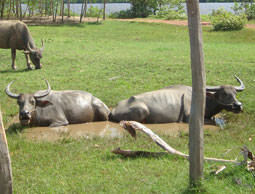
Water buffalo near a river in Cambodia
Photo by Rachael Brugger
Water buffalo graze in a field near the Kampot River in Kampot, Cambodia.

Traveling through the provinces of Cambodia on an old rickety charter bus, I was glued to the window. Cambodia is an agrarian economy; you venture 10 minutes outside the capital city of Phnom Penh and are in the throws of the “countryside.”

In the rainy season, when crops begin their growth, endless waves of green rice paddies stretch as far as the eye can see, with 20-foot palms scattered throughout the fields serving as the horizon’s only interruption. Cattle freely walk the streets, often with a small child following behind to herd. And water buffalo poke their heads and horns out of deep mud puddles.

I loved seeing the water buffalo escaping the tropical heat with a dip in a puddle. It added an unexpected softness to the massive beast. Contrary to what their pointy horns and gigantic snouts imply, Cambodian water buffalo are gentle creatures and a staple to Cambodian farmers, especially for people living and working in the flood plains, where cows are less useful. 

Water buffalo are more useful on flood plains because of the water factor
Photo by Rachael Brugger
In Cambodia’s flood plains, water buffalo are more useful on farms because cattle dislike water.

Water buffalo are often regarded as a precious inheritance. In rural areas, where the average income is less than $500 per year, farmers must own a water buffalo or a cow in order to earn a living. Often people will own two water buffalo—owning more indicates that the family is well off. 

During his preschool years, Kimsoeun Seat watched over his grandparents’ water buffalo in the eastern province of Kompong Cham. He recalls the animals being gentle and hardworking and most of all easy to take care of, considering he was doing it at such a young age. 

However, in a country steeped in tradition, the livelihood of Cambodian water buffalo includes more than just hard work. During the country’s festival of the dead, in which the Cambodian Buddhists pay homage to their dead ancestors, people engage their water buffalo in races, among other games.

“Everyone decorates their water buffalo with colored fabric streamers,” Seat says. The water buffalo races add a spark of fun to a rather somber holiday.

As an outsider in a foreign country, I was taken by the way water buffalo are a part of society. They eat, sleep and work alongside their human counterparts. They are not cast off in a field with the other livestock. The relationship between water buffalo and humans in Cambodia is integral to continuing their agricultural way of life.

Categories
News

Tractor Test Drive

Test driving a tractor is important to determine how well its feels and fits your needs
Photo courtesy Massey Ferguson
When buying a tractor, ask your tractor dealer if you can take it for a test drive alone. During the test drive, note how comfortable you feel in the tractor and how easily you can maneuver it.

Life on your small farm can get busy with various projects, but having a tractor that can assist you in your daily chores can save you lots of time and energy. However, finding the right tractor that works well with you and the unique needs of your farm is key.

The search for the perfect tractor can be overwhelming. Regardless of your level of experience operating a tractor, a good dealer should give you the help you need in choosing the right model and set you up to test drive the tractor.
Roger Harrod, a Massey Ferguson dealer in Roopville, Ga., who sells a number of compact tractors, encourages customers to test-drive the tractors they are considering buying.

“A consumer shouldn’t make that investment without getting a feel for its maneuverability, ease of operation, comfort and power,” Harrod says.

He recommends that before purchasing a new tractor (or beginning a test drive), customers should ask their dealer for a full explanation of the tractor and the controls on the model they are interested in purchasing.

“Ask the dealer to review tractor safety features prior to the demo drive. After you are comfortable with operating the machine, it is perfectly acceptable to request that you explore the tractor on your own,” Harrod says. “Most people enjoy privacy while test driving, although we are always on hand to provide tips on how best to operate the tractor.”

Harrod says customers who do their homework before visiting the dealership are more comfortable completing a test drive and have a better idea of what they need and want in a tractor.

Harrod first points them to TractorAdvisor.com, a website operated by AGCO, to learn about tractors that will work for their specific jobs and property type, whether it be a perfect sub-compact, compact or economical utility tractor with less than 65 horsepower. The site offers a printable tractor test-drive checklist that prospective buyers can use to set their priorities and rank the models for easy comparison.

He also offers this list of things to look for during a test drive:

 Is the tractor easy to operate?

    • The tractor controls should be within close reach and should limit obstruction during operation. During your test drive, be sure the pedals, handles and controls are easily accessible and feel comfortable to use.

• Do you feel comfortable on the tractor? You will be spending a lot of time around your hobby farm performing various jobs, so it’s important that your tractor is comfortable. Make sure the seat is adjusted correctly and cushioned to your liking. Also, be sure there is enough leg and hip room while still being able to reach levers, handles and pedals. Finally, pay attention to how easily you can enter and exit the tractor platform.

 Is the tractor’s maneuverability and responsiveness in line with how you plan to use it? Turn in tight circles with and without the turning brakes (if available). For tasks like loader work where you are making a lot of directional changes, test for smooth forward and backward changes.

• How easy is the tractor to service? Note the essential service points: oil, oil filter, air filter, battery, radiator and fuel.

• Does the tractor meet your specific needs? If you are going to use the tractor in the winter for snow removal and other chores, you may want to ask the dealer if the specific model requires an engine heater. Also, consider lighting. For example, you may need extra lights if you are going to be using your tractor in heavily wooded areas or other dark areas.

 What implements do you need? Ask questions about operating implements and attachments for your tractor such as a loader, mower or backhoe. Try raising the loader up, and dump and curl the bucket. Cycle through the loader hydraulics to test the comfort and responsiveness of the joystick. Test the loader’s cycle speeds, which correlate to productivity.

Choosing the right tractor should be fun, easy and satisfying. When you find the right tractor, it becomes an invaluable and reliable tool that allows you to enjoy the work on your hobby farm.