Categories
Equipment

Hay Baler Comparison: Square vs. Round for Small Farms

When choosing a hay baler for your farm, the decision often comes down to square vs. round bales. Because each type of bale is made with a different kind of hay baler, choosing which type will be most ideal for you is an important step—you don’t want to buy the wrong equipment and discover too late that you’d prefer to be making a different type of bale.

There aren’t many things more satisfying than having a farm that is as self-sufficient as possible, and when it comes to livestock nutrition and feeding your livestock, making your own hay is a great idea. The two most common types of hay bales are small square bales and large round bales. There are other types as well, such as large square bales and small round bales, but they aren’t as common.

Square Hay Baler Pros & cons

Small square bales are very common because they’re simple to produce and easy to handle—they typically measure about 3 feet long by 1½ feet wide and are a bit more than a foot tall. They’re a great choice for a small farm without a lot of hay to bale.

Pros

  • Small square bales are lightweight compared to their larger counterparts, weighing approximately 40 to 60 pounds. This makes it easy for a single person to move them around, stack them or carry them to hungry livestock. It’s not hard to carry a small square bale through an ordinary door or down a flight of stairs, something that can’t be done with larger bales.
  • Thanks to their small size, you’ll be able to produce a large number of small square bales using the same amount of hay that produces only a few large square bales or round bales, making it easier to move just the right amount of hay from place to place.
  • Small square bales can be neatly stacked to fit a lot of hay into a small shed or barn.
  • With small square bales, very little hay goes to waste—it’s easy to distribute it carefully and make sure that all is eaten, rather than trampled or used as bedding.

Cons

  • Even though having lots of small bales can be a pro, it can also be counted as a con—depending on the size of your haying operation, you might have hundreds or thousands of bales to handle and stack, which requires a lot of effort and time.
  • You’ll likely need a large team of people to get the job done because there will be many bales to work with.
  • Because of their size, rain can spoil the finished bales, meaning that they need to be moved to a protective storage place as soon as possible after being baled.

Round Hay Baler Advantages

Round balers, as their name implies, produce enormous round hay bales that can weigh hundreds or even thousands of pounds and upward. Here are some of its pros…

  • Thanks to their large size, you can fit lots of hay from large fields into relatively few round bales, which is a convenience if time and manpower are limited and you’re unable to handle hundreds of small square bales.
  • While they are still susceptible to spoiling in the rain, the large size of round bales means that less hay will be affected if a rainstorm hits before they are transported under cover. Some farmers even leave the bales in the fields after baling, often with covers to try to give them a little protection.
  • Because each bale contains a lot of hay, many livestock owners often place a round bale in a pasture and let their livestock feed themselves for days at a time.

Round Hay Baler Disadvantages

    • As mentioned above, round bales are very heavy and require machinery to move them around.
    • Because of their shape, round bales can’t be stacked like small or large square bales and can take up more space as a result.
    • For hobby farmers with only a few animals, feeding with round bales can be more unwieldy than feeding small square bales.
    • With round bales, significantly more hay can be wasted than with small square bales; the percentage varies depending on feeding methods, but as much as half of a round bale can be wasted through trampling and soiling by livestock.

Frequently Asked Questions About Hay Balers

Q: What is the difference between a square hay baler and a round hay baler?

A: A square hay baler produces rectangular bales that are easier to stack and transport, while a round hay baler rolls hay into large, cylindrical bales. Square bales are often better for smaller farms or operations needing manageable bale sizes. Round bales are generally more efficient for large-scale operations and can handle wetter conditions better.

Q: Which hay baler is better for small farms?

A: For small farms, a square hay baler is typically preferred. Square bales are lighter, easier to handle manually, and more convenient for feeding small livestock or selling in smaller quantities. They also require less specialized equipment for handling.

Q: Are round hay balers more efficient than square ones?

A: Round hay balers are more efficient for large-scale hay production. They require fewer labor hours and produce larger bales that can be left in the field until needed. However, they also require equipment like front-end loaders or spear attachments for moving the bales.

Q: What type of hay baler is easier to store bales from?

A: Square hay balers produce bales that are much easier to stack and store in barns or sheds, making them a better choice where space and organization are priorities. Round bales take up more space and require specific storage strategies to avoid spoilage.

Q: Do round hay balers cost more than square balers?

A: Round hay balers tend to cost more initially and may also require additional equipment to move and feed the bales. However, they can reduce labor costs in the long term due to the larger bale size and faster baling process.

Baling hay of any type requires plenty of machines and a lot of time and effort, but with some planning, you’ll be well on your way to feeding your livestock with hay from your fields.

This article comparing hay balers was written for Hobby Farms magazine. Click here to subscribe.

Categories
Poultry

What Chickens Lay Pink Eggs: 7 Breeds to Consider

What chickens lay pink eggs? This article discusses seven pink egg-laying chickens to add color to your egg basket and personality to your flock.

1. Speckled Sussex

One of the most common brown egg-layers kept in backyard flocks, the Speckled Sussex is a well-loved breed. However, while the breed is known for its brown eggs, it may be surprising that this popular chicken can also lay pink eggs.

This breed’s hens are curious and friendly, thriving on human interactions. Speckled Sussex hens are active and need plenty of mental stimulation to keep them happy. In mixed flocks, Sussex can bully more docile breeds.

Speckled Sussex hens lay an average of 4-5 medium light brown to pink eggs weekly (150 eggs annually). While they may not put out the same number of eggs per year as other breeds, the number rarely decreases for the first four years of their lives.

Speckled Sussex Chicken Color Varieties

Speckled is the only common variety in the United States.

speckled sussex chicken standing in grass is on the list of what chickens lay pink eggs
Adobe Stock/Jason

2. Java

The Java is a fair egg layer, producing three to four large eggs weekly (about one hundred to one hundred and fifty eggs annually). Eggs vary in color from light to dark brown to orange, pink, and green. One of the most exciting things about Java hens is that one hen does not consistently lay the same colored egg, as egg color varies significantly throughout the laying season.

Java chickens are calm, sweet, and friendly. Their docile nature makes them ideal pets for children. This breed does well in a mixed flock with other docile breeds.

Java hens are also known for their quiet temperaments.

Java Chicken Color Varieties

Black and Mottled (Mottled is the most popular color option in the U.S.).

3. Black Australorp

Perfect for the novice, the Black Australorp can be an often overlooked choice when considering what chickens lay pink eggs. Primarily considered a brown egg layer, Australorp hens occasionally lay eggs tinted pink.

The breed’s sweet nature makes it ideal for young children and novices. Although black Australorp hens may appear shy at first, they quickly forget their shyness if handled frequently.

Australorp hens are egg-laying rockstars, averaging 5 – 6 light brown eggs per week (about 220 – 240 eggs per year), and lay an average of 4 years.

Black Australorp Chicken Color Varieties

Black is the primary color available in the U.S.

4. Orpington

The golden retriever of the chicken world, Orpingtons, are sweet, friendly, people-loving chickens. The breed is one of the most popular chickens kept in backyard flocks, and it’s easy to see why. With their exceptionally soft, golden-colored feathers and endearing personalities, the Buff Orpington is an ideal choice for children, novices, and veteran chicken keepers alike.

Buff Orpingtons lay an average of 3 – 5 light brown or pink eggs per week (120 – 150 eggs annually) and will lay for three years.

Orpington Color Varieties

Black, Blue, Buff, Jubilee, Lavender, and White, with Buff being the most common color.

5. Silkie

With their hair-like feathering, sweet temperaments, and excellent mothering abilities, Silkies have proven they are no ordinary chicken.

Silkies make excellent family pets. Their sweet, docile, and endearing nature makes them hard to resist, even for non-chicken-loving people. However, their sweet, docile nature disadvantages them in mixed flocks. To prevent this breed from being severely bullied, housing them separately from aggressive breeds is advised. Silkie hens are also wonderful mothers, happily sitting on eggs and raising chicks.

Silkie hens are good bantam egg layers, averaging 3-4 small light tan, cream, or pink eggs weekly (100-150 eggs annually).

Silkie Color Varieties

Black, Blue, Buff, Gray, Partridge, and White.

6. Salmon Faverolles

What chickens lay pink eggs and have five toes? Salmon Faverolles. This breed has won the hearts of many backyard flock owners. These curious and energetic chickens make lovely pets and love interacting with people of all ages. They are also an ideal breed for the novice.

Both the hens and roosters are adaptable (although they should not be allowed to free-range) and have a calm and gentle disposition.

Salmon Faverolles hens are good egg producers, averaging four tinted, light brown, or pink medium-sized eggs weekly (about 150-200 eggs annually).

Salmon Faverolles Chick Color Varieties

The American Poultry Association (APA) recognizes the breed in two colors, Salmon and White. Salmon is the only color available from most hatcheries.

7. Easter Egger

What chickens lay pink eggs? Easter Eggers! This delightful chicken doesn’t just lay pink eggs but also blue, green, or brown eggs, earning this breed its name. Easter Egger hens are excellent producers, averaging 4 – 6 large/extra large pink, blue, brown or green eggs weekly (250 – 280 eggs annually).

Easter Egger hens have earned their popularity not only with their colorful egg baskets but also with their charming personalities. This chicken’s curious, gentle, and social personality is ideal for families with children, as it thrives with human interactions.

Their calm and gentle nature makes them easily bullied by more aggressive breeds, so care should be taken to ensure these gentle birds are not bullied.

Easter Egger Chicken Color Varieties

This unique chicken comes in many colors that do not breed true.

Chicken Breeds that Lay Pink Eggs: Conclusion

Now that you know what chickens lay pink eggs, consider adding one of these seven pink egg layers — Speckled Sussex, Java, Salmon Faverolles, Australorp, Silkie, Orpington or Easter Egger — to add color to your egg basket. This is a pretty, easy and fun way to add variety to your backyard chicken flock and eggs.

This story about what chickens lay pink eggs was written for Hobby Farms and Chickens magazines. Click here to subscribe.

Categories
Farm & Garden Sponsored

Virtual fencing takes root as U.S. farmers find new efficiencies without the fenceposts.

Across the U.S., farmers are facing steeper costs, from fuel to labor and feed. Many are looking for practical ways to keep operations efficient without sacrificing land quality or animal care. That’s where virtual fencing is starting to make a real difference.

Virtual fencing is helping American producers manage their land, time, and resources more efficiently by replacing physical fences with flexible, digital boundaries. It empowers farmers to make informed grazing decisions, adapt quickly to changing conditions, and maximize the potential of every acre.

One of the leading companies in this space is Nofence, which offers a GPS-based technology developed by farmers for farmers. Their collars allow livestock to graze within virtual boundaries set by a mobile app, making it possible to reclaim hard-to-reach land, cut input costs, and simplify some of the time consuming tasks farmers face, all while promoting sustainable practices, enhancing animal welfare, and contributing to biodiversity.

Unlocking the potential of farmers’ lands

For Idaho cattle farmer Tyson Coles, the shift to virtual fencing—and Nofence in particular—has brought significant benefits. “Virtual fencing has completely changed how I manage my cattle,” he says. “I can create smaller paddocks, rotate them efficiently, and extend my grazing season by up to two months. That’s $8,000 saved in hay costs this year alone.”

Tyson’s operation now runs with more flexibility and less wear on equipment. “I used to spend seven hours a week feeding hay in winter. Now, I spend just three hours setting up a week’s worth of feed—and I save $2,000 a month in tractor fuel and wear,” he says.

It has also meant more time with his family, which he values just as much as the financial gains.

Will Oberton and Erin Gervais, a father-daughter team in Minnesota, are seeing similar results. Using Nofence to graze 80 cows, they’ve tapped into steep, marginal areas of their land that were once unusable. “We’ve got some land that’s not ideal for traditional farming, but Nofence helps us unlock its potential—and turn it into profit,” Will says.

The duo estimates a $25,000 annual savings from increased grazing efficiency and reduced feed use. “The cows seem a lot calmer,” Erin adds. “They can move through different grazing areas that are more natural for them. We’re seeing healthier animals because of it.”

A user-friendly app

At the heart of the technology is Nofence’s user-friendly app, which was developed with the assistance of Nofence software engineer Malin Kildal. From the outset, her focus has been on making the app’s sophisticated technology as user-friendly as possible, with livestock at the heart of it. With a few taps on a smartphone, farmers can set or shift grazing areas, monitor herds in real time, and receive alerts if an animal crosses the set boundaries. Malin notes that farmers are “at ease just by knowing where their animals are, they can go on vacation if it’s just a week a year. They can do that now with Nofence.”

The flexibility of Nofence’s virtual fencing allows farmers to rotate grazing more precisely and reduce the need for costly infrastructure. Tyson notes that he’s avoided $35,000 in fencing costs and opened up 100 additional acres for grazing. It also opens up underutilized areas of land, allowing animals to roam and graze in areas previously restricted by physical barriers.

That level of control is most appealing to farmers like Stephanie Mathis, who manages a goat herd on 14,000 acres of rugged land in Santa Barbara County, California. “I’m not very tech-savvy, but the Nofence app is so intuitive. It makes managing my goats simple, even on steep hillsides and dense brush,” she says.

Malin has seen firsthand how the technology serves as a valuable tool for farmers, supporting their work in caring for both their land and livestock. “Our customers using managed grazing see improvements in soil quality and plant growth,” she says. “Grazing in controlled areas prevents nutrient depletion and keeps grasslands robust, which is vital as we adapt to climate impacts.”

As Nofence continues to expand in the U.S., its promise is simple: better land use, lower operating costs, improved livestock management, and a better quality of life for the people who make farming work.

Want to see what virtual fencing can do for your land? Visit Nofence.no/us for more information on Nofence’s virtual fencing product and to explore how land managers are transforming their pastures.

Categories
Farm & Garden Sponsored

Trimec® Platinum: There’s Excellence Right in the Name

Did Gordon’s® really name a product “Platinum?” Yes, we did: Trimec® Platinum All-In-One Weed Control. And we know that’s a strong word. Platinum has come to mean “the ultimate.” It represents excellence; Jewelers love its combination of beauty and durability. And platinum stands for accomplishment – it’s so rare that a platinum-selling album is a higher achievement than gold. It’s “the ultimate.” Enter Trimec.

Original Trimec herbicide was introduced to the professional lawn care industry more than 55 years ago, and it revolutionized broadleaf weed control. But at Gordon’s, we don’t like to rest on our laurels. We kept improving Trimec over the years. We developed new formulations that controlled more weeds, like Trimec® Crabgrass Plus, and formulations that worked faster, like Trimec® Speed. Then came the ultimate: Trimec® Platinum.


Trimec Platinum delivers dependable control of the most common broadleaf weeds, including dandelion, clover and ground ivy. It also controls tough grassy weeds like crabgrass and foxtail. And Trimec Platinum also controls nutsedges and kyllingas. Trimec Platinum starts working immediately – you see results in hours. And Trimec Platinum does it all with just one product, saving you time and money. So does Trimec Platinum live up to its name? Try it and see for yourself.

Categories
Poultry

3 Critically Endangered Chicken Breeds for a Backyard Flock

These three critically endangered North American chicken breeds are at risk of extinction in the United States and beyond.  

The United Nations Food and Agriculture Organization (FAO) estimates that we lose approximately two domestic animal breeds to extinction every single week, with more than 300 breeds of poultry, cattle, donkeys, goats, horses, pigs, rabbits, and sheep vanishing in the past 15 years.

To help conserve disappearing breeds, the Livestock Conservancy compiles an annual Conservation Priority List, calling attention to the breeds facing the possibility of extinction in the United States. The parameters by which breeds are evaluated vary according to the species. The five main classifications are the following.

  • Critical
  • Threatened
  • Recovering
  • Watch
  • Study

The chicken breeds currently listed are further divided into three groups: North American breeds, breeds imported before 1900 and breeds imported after 1900. Of the breeds developed in North America, three chickens are classified as Critical, with fewer than 500 birds remaining in the U.S. and less than 1,000 total in the world. Here are the three breeds.

1. Cubalaya 

Developed in Cuba in the 1800s, the Cubalaya originates from cross-breeding Malay and Sumatra chickens with European gamefowl. The resulting bird was triple purpose: meat, eggs and sport.

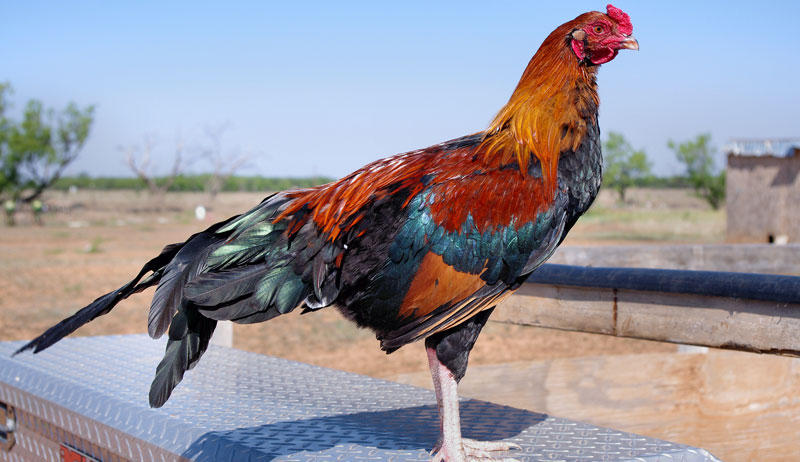
The Cubalaya is known for its “lobster tail”—its plentiful tail feathers angle downward with an elegant drape. Another remarkable feature is that the Cubalaya does not develop spurs, quite a plus for both chicken owners and the breed’s flock mates.

Despite its pea comb, the Cubalaya is not cold hardy but rather thrives in warm climates. It forages actively and is best suited for free-ranging flocks raised on acres of grass.

The Cubalaya is slow to grow: it reaches adulthood at about 3 years old, although it can reproduce at 6 months of age. Hens lay approximately 150 rounded eggs per year. Cubalaya chicks are very friendly and will eat from their humans’ hands from Day one.

They are also curious and fearless, and do not comprehend the dangers predators pose until taught by older birds.  

Cubalayas come in many color varieties, but only three—White, Black and Black-Breasted Red—are recognized by the American Poultry Association (APA). The Black Cubalaya is extinct in the U.S. and found only in Cuba.

Wheaten Cubalayas, though not officially recognized, are very popular because of their cinnamon color and tame disposition toward humans. They do not get along with other chicken breeds, which seem drawn to attacking the Cubalaya’s ornamental tail. While raised for meat and eggs in Cuba, in the U.S., the Cubalaya is mainly raised as a show bird or pet.  

2. Holland 

Despite its name, the Holland chicken was developed at the Rutgers Breeding Farms in New Jersey. In the 1930s, people wanted white eggs—believed back then to have a finer, more delicate flavor than brown eggs—but America’s small farms preferred to raise dual-purpose birds, which typically lay brown eggs.

holland chicken in grassy yard is a critically endangered chicken breeds
Adobe Stock/Bastiaanimage Stock

To satisfy this need, the agricultural scientists at Rutgers decided to develop a heavyweight, well-fleshed bird that produced white eggs. The base bird used for this project originated in the Netherlands and, after much cross-breeding with White Leghorns, Lamonas, Rhode Island Reds and New Hampshires, the White Holland came to be.

This variety—now sadly extinct—was soon followed by the Barred Holland, developed by cross-breeding White Leghorn, Brown Leghorn, Australorp and Barred Plymouth Rock chicken breeds. The Holland was recognized by the APA in 1949.  

 The Holland is the perfect bird for backyard flock owners. It is cheerful, calm and friendly, and enjoys interacting with humans. Like the Orpington, it is cold-hardy but may suffer frostbite on its single comb in extreme weather.

The Holland is low-maintenance, quiet and forages well. Holland hens lay approximately 220 eggs each year; they also tend to go broody. By raising Holland chickens, flock owners help conserve what is considered to be America’s rarest chicken.  

3. Java 

Like the Holland, the Java chicken got its name from its base breeding stock, believed to have originated near Java in Indonesia.

The Java is America’s second-oldest chicken breed, developed around or before 1835. The Java was brought to England from America in 1885, an important fact because some poultry breeders mistakenly claim their birds’ lineage comes straight from the island of Java via England, not knowing (or purposely ignoring) that the breed originated in the U.S.

This breed served as a base bird itself, playing a crucial role in the development of the Jersey Giant, Plymouth Rock and Rhode Island Red.  

1905 illustration of a black java rooster for the american poultry standard
An illustration of the ideal Black Java rooster in the American Standard of Perfection circa. 1905 Courtesy Wikimedia Commons

The Java is an active forager and is best suited for a free-ranging flock, although it tolerates confinement. Java hens go broody and are excellent mothers, but the chicks tend to be excitable before settling into the calm, friendly temperament for which the breed is known.

Java hens are quite cold-hardy and lay well into winter. They produce about 180 eggs per year and continue production for years.

Java roosters are similarly cold-hardy hardy but their single combs need to be protected from frostbite. Javas tend to flock tightly together, but they also get along well with other breeds. They come in four color varieties: the Black and Mottled are recognized by the APA, while the White and Auburn are not. The latter two are being bred by conservation farmers hoping to get these varieties recognized and out of danger of going extinct.  

Preserving Critically Endangered Chicken Breeds: Final Thoughts

Preserving critically endangered chicken breeds like the Cubalaya, Holland, and Java is more than a nod to poultry history—it’s an essential step in protecting genetic diversity and building resilient, sustainable flocks for the future. Each of these rare breeds offers unique traits, from temperament to foraging ability, that make them valuable additions to backyard coops and conservation efforts alike. By choosing to raise and support these heritage birds, small-scale farmers and poultry keepers play a vital role in keeping these irreplaceable breeds from disappearing forever.

This article about critically endangered chicken breeds was written for Hobby Farms and Chickens magazines. Click here to subscribe.

Categories
Farm & Garden

First Aid Kit List for Emergency Prepping

A first aid kit list is important to have when prepping these days. Prepping is a common topic, especially with natural disasters in the news. There are so many things to consider when it comes to preparedness that it can be difficult to know where to begin. What if there is an emergency? What do we need to be prepared?

That’s where Low-Cost Emergency Planning by Julie L. Jesseph comes in handy. In her book, she teaches people to live better on less. The book is full of ways to be prepared without breaking the bank. Below are Jesseph’s level one and two emergency first aid kit lists from the book. They can give a head start and organization to emergency planning.

Level One: Portable First Aid Kit

Many of these ingredients can be found at discount stores, however, some are better found online. When making these kits, consider your essential medical needs. All of these medical supplies can fit into a small bag. For trail use, compactness and portability are essential.

Portable First Aid Kit Supplies

This kit will cost about $30-$40 to put together.

· 2 (4-inch square) gauze pads

· 2 (4-inch square) non-stick pads

· 1 large Israeli trauma pad

· 2- 25-gram size QuickClot or Celox

· 4 nitrile gloves

· 4 alcohol pads

· 1 pair of splinter tweezers

· 1 roll of one-inch adhesive tape

· One moleskine pad

· 1 container of tincture of iodine

· 6 half-inch band-aids

· 6 three-quarter-inch band-aids

· 2 two-inch band-aids

· 2 half-inch band-aids

· 2 quarter-inch steri-strips

· 2 half-inch steri-strips

· 4 butterfly closures

· 1 container of instant glue

· 3 maxi-pads to absorb bleeding

· 1 container of Visine

· 1 nail clipper

· 1 small flashlight

· 1 container of hand sanitizer

· 5 Q-tips

· 1 tube of chapstick

· 1 tube of antibiotic ointment

· 16 (200-mg) doses of ibuprofen

· 8 (2-mg) doses of an anti-diarrhetic

· 8 doses of antihistamine (for allergies)

· 8 multi-vitamins

Level Two: Home First Aid Kit Supplies

This is a larger emergency kit, but it’s beneficial to have all the supplies in one spot so you don’t have to hunt around the house for what you need.

This kit will cost between $100-$150 to put together.

Home First Aid Kit Supplies

· CPR mask

· Gloves

· Wet wipes

· Hand sanitizer

Instruments

· A flashlight

· Scissors

· Splinter tweezers

· Sharp tweezers

· Large nail clipper

· Large safety pins

· Single-edge razor

· Knife

For Wounds

· 1 (20-cc) irrigating syringe

· Assorted sizes of bandages

· Steri-strips

· Butterfly tape

· Duct tape (it comes in handy for many things)

· Adhesive tape

· Teragerm (a non-adhesive film by 3M, a breathable band-aid and one of the more expensive parts of the kit)

· Moleskin

· 4-inch square gauze pads

· 2-inch square gauze pads

· QuickClot gauze

· Non-stick gauze pads

· Roll of gauze

· Israeli trauma pad

· Q-tips

· Nylon suture

· Cyanoacrylate glue (yes, folks, “superglue”)

· 1 3-inch ACE wrap

· Triangular bandage

· Roller dressing

· Pills and Other Supplies

· Tylenol

· Ibuprofen

· Aspirin

· Claritin

· 1% hydrocortisone cream

· Anti-diarrhea pills

· Fever thermometer

· Alcohol pads

· Cold pack

· Lip balm

· Triple antibiotic ointment

· Salonpas pain relief patch

· A pen

Remember to customize these lists to your needs. And remember, all the first aid gear in the world is of limited value if you haven’t learned how to use it in an emergency. To that end, it’s recommended to take various Red Cross first aid courses. Also, it’s beneficial to study natural remedies and herbalism.

This has been shared from Low-Cost Emergency Planning – A DIY Guide to Family Disaster Preparedness by Julie L. Jesseph, with permission from Skyhorse Publishing, Inc.

This article with a Level One and Level Two first aid kit list was written for Hobby Farms magazine. Click here to subscribe.

Categories
Poultry

What Is a Broody Hen? 6 Things to Know

What is a broody hen is a commonly asked question among first-time chicken owners. When a hen goes broody, it is her body’s way of telling her that it is time to stop laying and hatch out chicks.

During this time, a hen’s egg production will slow and may cease entirely. If the hen is allowed to sit on some eggs, she will lay a small number of eggs (called a clutch) before sitting on the eggs for twenty-one days until they hatch.

Once the chicks hatch, a good mother hen will spend the next two to three months raising her chicks. Once the chicks have “flown the nest,” she will resume laying again.

Here are six things you should know before attempting to have a hen brood eggs.

#1 Not All Hens Go Broody

If you have ever researched what is a broody hen, you may have also discovered that some chicken breeds are more prone to broodiness than others. And it’s true, not all hens go broody.

Some chicken breeds like Brahmas, Cochins, Orpingtons, Plymouth Rocks, Silkies, and Sussex are more prone to broodiness than other breeds such as Hamburgs, Leghorns, Sex Links and Welsummers.

However, each hen is different and has a distinct personality. Not all individuals in the broody breeds will have a desire to hatch and raise chicks. On the other hand, some individuals in the non-broody group may make excellent broodies and mothers.

#2 Inexperienced Broody Hens Often Make Mistakes

Discovering what is a broody hen is only the first step in a learning journey toward brooding your own chicks. If the broody hen is a first-time mother, she has just as much as you to learn. Possibly more.

First-time broody hens are more likely to make mistakes than hens who have experience hatching and raising young. Common mistakes to look for include:

Refusing to stay sitting: Younger hens and first-time broodies often grow bored when sitting, so it isn’t uncommon for them to call it quits a week or two in. If this happens, have a backup incubator on standby, or slide the eggs under another broody.

Disinterest in chicks: First-time mama hens may show a disinterest in their newly hatched chicks. This happens when the hen is still geared toward protecting the eggs, not the chicks. The behavior can often be remedied by relocating the hen and chicks to a new location away from the nest site. Keep an eye on the new family to see if the hen resumes her mothering duties. If not, move the hen back to the coop and have a chick brooder on hand in case the plan goes awry.

#3 Broody Hens Are At Risk of Predator Attacks

One of the most critical things to learn when researching what is a broody hen is that broody hens are at an increased risk of being picked off by a predator.

There are several reasons for this since a broody hen’s job is to protect her nest, eggs, and eventually her young, but not herself. Even more predators are attracted to the eggs and chicks than they are to an adult chicken. Broody hens usually nest on the ground or floor of the coop, where it’s easier for predators to get a free meal.

If you want to keep the eggs safe and successfully raise chicks, protecting the broody hen is critical. Provide a safe area entirely enclosed in half-inch 16-gauge hardware cloth for the hen to hatch and raise her young. If possible, the coop or other enclosure should have a concrete floor. Be sure to be extra vigilant when checking both the outdoor perimeter and the coop and run to ensure no gaps larger than one-half inch are found.

Surrounding the perimeter of the coop and run with half-inch 16 gauge hardware cloth will help prevent digging predators from accessing the hen or her young.

#4 Broody Hens Need Proper Nutrition

Broody hens can quickly become dehydrated and malnourished while sitting on the nest. Some hens will refuse to leave the nest entirely during the brooding stages, so the hen may need to be physically removed and blocked out away from her nest for several minutes in the morning and again in the evening.

Keep time away from the eggs limited to about five to ten minutes per session. This is enough time for the hen to eat, get a much-needed drink, and relieve herself, without causing the embryos stress by the eggs becoming too chilly.

#5 Broody Hens Can Become Aggressive

What is a broody hen and why do broody hens show aggression, are two questions that go hand in hand. The change of hormones in a hen’s body is what causes her to go broody in the first place and also to act aggressively.

If your hen is broody, she may try to peck the hand you slip under her to collect eggs, or she may try to attack you using her wings, beak, and feet in attempts to protect her nest and young. If this happens, the best reaction is to stay calm and not react, so she doesn’t continue to view you as a threat. Once the broodiness is broken and she resumes egg laying again, she will return to acting like her old self.

Some broodies may turn aggressive toward their chicks. If a hen acts aggressively toward her chicks, simply remove the chicks from her and raise them in a safe brooder until they are old enough to join the flock.

Keep in mind that hens who act aggressively toward chicks should not be allowed to brood eggs again, as this behavior is not easily corrected.

#6 Hatching Eggs Equals Roosters

If you have researched what is a broody hen, you probably have not seen anything about roosters for sale. But, did you know that when hatching eggs, the chicks are usually fifty percent hens and fifty percent roosters. Some hens will hatch out significantly more roosters than hens.

While this may not seem like a problem immediately, once the cockerels (the name for male chickens under one year of age) begin to mature, you will quickly figure out you need a backup plan for your extra roosters, as it’s challenging to find homes for extra roosters.

Butchering your own roosters or having someone else butcher them for you is the most common option. However, if you can’t bear the thought of someone eating your chickens, setting up a separate coop and run, and starting a bachelor pad is another good way to handle the excess rooster problem.

Raising chicks with a broody hen is fun and well worth the effort.  Knowing what is a broody hen and how to care for a broody hen is critical knowledge will help you know what to expect, what problems could arise and help you enjoy the brooding experience.

This article about what is a broody hen was written for Hobby Farms and Chickens magazines. Click here to subscribe.

Categories
Animals

Five Goat Playground Ideas for Your Herd to Enjoy

Goat playground ideas come in many shapes and sizes and can be constructed out of many different things. If you’re raising goats, here are five fun and safe goat playground ideas for your herd to explore.

Why Build a Goat Playground

Goats are fun-loving, adventurous, and full of life, but when bored, they can get into trouble. Goat playground ideas help to keep your herd out of trouble by providing them with fun, enrichment ideas while helping to instill natural behaviors such as jumping and climbing.

No matter the goat breed, goats who live enriched lives have reduced stress levels, live longer lives, and have fewer health problems. An enriched life also means you have less chance of your favorite caprine becoming bored and leaping the pasture fence to nibble on your neighbor’s garden. Goat playground ideas also work perfectly for getting your animals outdoors during goat barn cleaning time.

Goat Playground Ideas: Safety First

Goats can be destructive and love to chew and butt anything they can get. When browsing for some new and enriching goat playground ideas, always be sure that they are safe for your herd. Even though ideas may look fun, some goat playground materials may be harmful or even fatal if ingested. Before creating a goat playground, be sure to check to see if tree limbs and stumps (more on that later) and any material on man-made playground accessories are safe for goats.

As goats age, they may not be as sure-footed as they were in their younger years. If older goats are in the picture, be sure to remove any playground equipment they may fall off of to prevent injuries and accidental deaths.

Always be sure to allow plenty of space between the playground ideas and the fence to prevent goats from jumping the pasture fence.

1. Stumps and Limbs

If you have access to forests, tree lines, or have a tree planted in your yard that has been damaged by a storm, you can use these limbs and branches for some fun goat playground ideas.

Lay large branches that can hold up to the weight of several goats at a time in the pasture and watch the fun begin. Goats love to climb tree branches and perch in the top branches, surveying their surroundings.

If you have small apple trees that your herd can safely and easily climb, don’t be surprised to see your goats climbing trees. Goats love to climb and will even climb their fence if bored.

Safety Tip: When selecting tree limbs and branches for goats, stay away from red maple, oak, cherry, apricot, peach, and plum trees, almond trees, and yew, as these varieties are toxic to goats.

goats playing in a tree
Adobe Stock/OldskoolPhotography

2. King of the Mountain

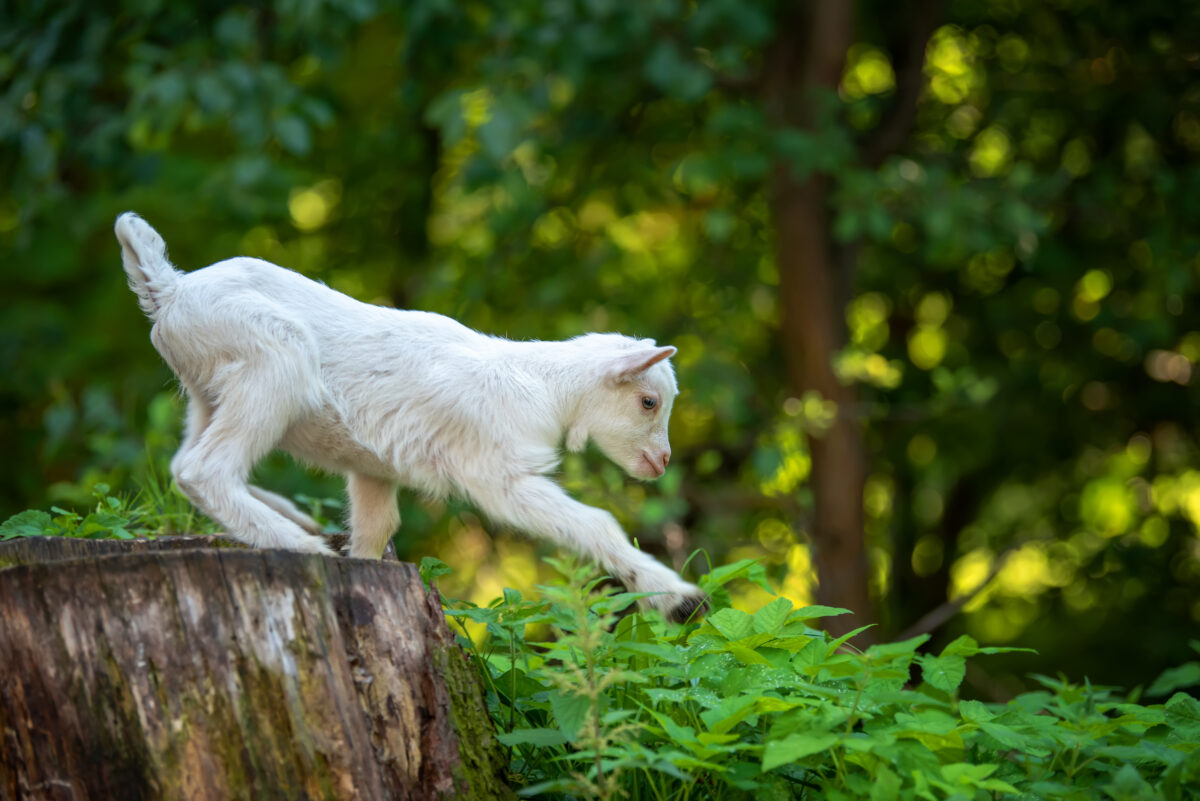
Playing king of the mountain on tree stumps is not only one of the simplest goat playground ideas, but it will probably be one of your herd’s favorite pastimes.

Goats love to jump on tree stumps, push each other off, and some will even lay on a stump to take a nap and chew their cud. For more fun, lay some tree stumps on their sides for a more difficult balancing exercise for your herd to master.

While tree stumps are a hit with goats of any age, they are especially popular with kids and young adults. There is nothing more fun than watching kids kick up their heels and do a little victory dance on top of their favorite stump.

3. Agility Equipment

Dog agility equipment is the most often overlooked of the goat playground ideas discussed in this article. From agility teeters, ramps, and A-frames, goats will enjoy trying out your dog’s agility equipment.

Have a goat who is super intelligent?  You may even be able to teach them to walk through the weave poles or leap over jumps. Just be sure to make the jumps low enough to avoid injuries.

Safety Tip: Most agility equipment is safe for goats, but stay clear of agility tunnels, as goats will chew and eat them. Ingesting even just a small bit of a tunnel may result in your goat requiring expensive and risky surgery. Err on the side of caution and always leave the tunnels to the dogs.

4. Old Tires

Old tires provide several goat playground ideas. Stand the tire on end for goats to climb on, or place them in a pile for young goats to leap on.

Tires are a fun enrichment for goats, so if you have any tires you no longer want, why not repurpose them into a goat playground?

Safety Tip: Tires are hard for goats to nibble on, but if you have an especially curious goat, check the tires every few days and remove them if goats try to chew on them.

5. Build a Goat Tree

If you are looking for some fun DIY goat playground ideas, look no further than a goat tree. Just like cat trees, goat trees can be built with multiple levels, ramps, and even steps. However, unlike cat trees, goat trees should be built without the use of fabric and other materials, as goats will chew and ingest them.

Use your imagination and have fun, but don’t forget, when building a goat tree with multiple levels, make it tall enough to prevent your herd from getting stuck between levels.

Safety First: Never use pressure-treated wood to construct a goat tree, as goats will chew on the wood, ingesting the harmful toxins used to preserve the lumber. Choose a safe wood, such as pine, to construct a goat tree and stay clear of using lumber that is toxic to goats.

These are just a few goat playground ideas you can construct for your herd. With a little imagination and following these safety tips, you can create a fun playground for goats that will enrich their lives for years to come.

This article about goat playground ideas was written for Hobby Farms magazine. Click here to subscribe.

Categories
Equipment

Pneumatic Tires vs. Solid Tires: Pros and Cons

Pneumatic tires vs. solid tires—which is better? There are pros and cons to both types, and while pneumatic tires are widespread, farmers may prefer “flat-free” solid tires in certain situations.

What are pneumatic tires?

Pneumatic tires are the kind you find on automobiles and most farm equipment. Two main types exist: bias tires and radial tires. Both types must be inflated with air (at a certain number of pounds per square inch (PSI) of pressure, which varies depending on the tire) in order to hold their shape and perform their duties. Without air, you have a flat tire.

Pros and cons of pneumatic tires

Pneumatic tires are popular because they offer tons of advantages. The biggest is a smooth ride; the air inside cushions the vehicle (and the operator) from bumpy terrain. They also offer superior traction (especially radial tires) when compared to solid tires, and they’re lightweight for their size.

But there are downsides to these tires. You must keep the air pressure at the correct level to achieve the best performance; in cold weather, pressure can drop, requiring you to add air. Plus, pneumatic tires can be damaged by nails and other sharp objects, or by blows to the sidewall. If a pneumatic tire loses its ability to hold air, you’ll have to repair or replace it.

What are solid tires?

Solid tires don’t need to be inflated with air. They’re solid all the way through and made from materials such as rubber, foam, or plastic. Since they don’t contain air, they can’t go flat (though they’re not completely immune to other types of damage).

Pros and cons of solid tires

The main upsides of solid tires are reduced maintenance and increased durability. You don’t have to check or maintain air pressure, and they can take quite a beating while remaining serviceable. Since they’re incapable of going flat, they’re commonly used to support the heavy loads carried by forklifts. (You may hear the confusing term “solid pneumatic tire” in conjunction with forklifts; this refers to a solid tire that otherwise resembles a pneumatic tire.)

However, solid tires aren’t perfect. Since they’re solid and inflexible, they generate a bumpy ride over uneven terrain. Traction isn’t as good and they’re worse than pneumatic tires at dissipating heat, so they shouldn’t be used at high speeds. Solid tires are also heavier than pneumatic tires of similar size (which can be a pro if you need the weight to counterbalance heavy loads on the front or rear of the vehicle, but a con when it comes to installing or removing the tires). And solid tires can be expensive, though this is offset in many cases by their long lifespans—they can last around three times as long as pneumatic tires.

Which Tires Should Farmers Use?

In most cases, farmers should opt to use pneumatic tires on their farm equipment, capitalizing on the many advantages they offer. The smoother ride alone is a big benefit if you’ll be driving a tractor through bumpy fields.

However, if you have a machine like a skid steer or forklift and plan to lift a lot of heavy loads or navigate through ground that would put pneumatic tires at risk (like a construction or demolition site), solid tires may be the better choice. Or, on a simpler level, you can install solid tires on yard carts or small trailers when a smooth ride isn’t critical and you want to eliminate flat tires and the chore of maintaining air pressure.

This story about tractor tires was written for Hobby Farms magazine. Click here to subscribe. 

Categories
Poultry

Starting a Conservation Flock: Raising Heritage Breeds

Starting a conservation flock is a rewarding way to support rare and endangered poultry breeds while enjoying the benefits of backyard chicken keeping. Whether you’re a seasoned homesteader or new to raising chickens, starting a conservation flock allows you to contribute to biodiversity and sustainable farming practices. By choosing heritage breeds recognized by organizations like The Livestock Conservancy, you help preserve genetic diversity and traditional farming history. In this guide, we’ll walk you through the essentials of starting a conservation flock—from selecting the right breeds to creating a suitable environment for long-term success.

What is an Endangered Breed Classification?

When compiling its annual Conservation Priority List, the Livestock Conservancy evaluates whether the founding stock for a pure breed still exists, whether the breed is being raised in different locations throughout the United States, and whether the global population for that breed is threatened.

The list is divided into five categories that reflect a breed’s level of endangerment:

  1. Critical – Breeds with fewer than 200 annual registrations in the U.S. and estimated global populations of less than 2,000. These are the most vulnerable and at highest risk of extinction.

  2. Threatened – Breeds with fewer than 1,000 annual U.S. registrations and global populations less than 5,000. While slightly more stable than critical breeds, they still require immediate attention.

  3. Watch – Breeds with fewer than 2,500 annual U.S. registrations and a global population under 10,000. These breeds are recovering but still need support to ensure long-term viability.

  4. Recovering – Breeds previously on the list that have shown substantial improvement in population numbers and conservation efforts. These breeds no longer meet the criteria for inclusion on the more urgent parts of the list but are still monitored.

  5. Study – Breeds that are of conservation interest but require more information to determine their status. This may include recently imported breeds or those with unclear genetic backgrounds.

Conservation Priority Successes

Several chicken breeds once listed on The Livestock Conservancy’s Priority List have made remarkable recoveries thanks to dedicated conservation efforts. Breeds like the Plymouth Rock, Orpington, and Wyandotte were once on the brink of disappearing but have gradually regained numbers through small-scale farming, breeder networks, and public awareness. These recovered chickens now serve as shining examples of how strategic breeding, education, and community involvement can reverse decline and ensure genetic diversity for future generations. Their resurgence highlights the impact hobby farmers and backyard keepers can have in preserving America’s agricultural heritage.


Read more: Consider adding these 5 critically endangered chicken breeds to your flock.


Starting a Conservation Flock

While many municipalities prohibit rooster ownership, other towns and cities allow homeowners (and renters) to breed backyard poultry flocks. Should you wish to aid endangered breeds by keeping a flock of your own, check with your local ordinance director to make sure your town’s regulations allow for chicken breeding. Then contact the national breeders association for the chicken breed of your choice to learn how to get chicks or adult birds to start your own conservation breeding flock.

When starting a conservation flock, bear in mind that raising a heritage flock involves a little more work than your basic backyard flock. Egg production, for instance, is a wonderful bonus from your birds, not their main purpose.

Using artificial lighting to extend layers’ production is frowned upon, as the shorter daylight months are crucial to a hen’s natural recovery from the taxing laying season. Know that when starting a conservation flock and keeping it successfully, owners are also encouraged to allow their birds to live their natural lifespan. In other words, hens are not sold off once they reach two or three years of age. Instead, they remain with their flocks, guiding younger birds and helping rule the roost.

Final Thoughts for Starting a Conservation Flock

Starting a conservation flock is more than a hobby—it’s a meaningful way to safeguard rare poultry breeds and contribute to agricultural biodiversity. By choosing heritage chickens, supporting recovery efforts, and practicing mindful breeding, you play a vital role in preserving valuable genetics and farming history. Whether you raise a few birds in your backyard or manage a small homestead flock, your efforts help ensure these unique breeds thrive for generations to come. With the right knowledge and commitment, your conservation flock can be both a personal joy and a powerful legacy.

This article about starting a conservation flock was written for Hobby Farms and Chickens magazines. Click here to subscribe.