Categories
Poultry

Chicken Names: 65 of Our Favorites

Chicken names can only mean one thing—you can’t eat them. Haha! At some point, chickens were relegated to the world of farm commodities. Flocks of poultry were kept to provide meat and eggs and little else. Times have certainly changed. Today, chickens are an endearing—often spoiled—part of the homestead, and each has its own distinct personality. To us, nothing seems more obvious for chickens than distinct labels: names.

The methods for picking chicken names for your egg-laying pets are countless. (If you need help, naming a bird, here are our tips.) Some draw on the birds’ physical features or idiosyncratic habits with names such as Mr. Feathers or Peepers, while others turn to pop-culture icons, such as the Kardashian sisters, for inspiration. Still, others opt for tongue-in-cheek descriptions of their chickens’ future destinies: Lo Mein, Parmesan and Curry, to name a few. Then who can resist the pun-tastic names playing on words related to all things chicken: Cluck Norris, Sir Clucks-a-Lot, Princess Lay-a, Yolko Ono … the list of eye-rolling names continues to grow.

Chicken names are novelties and can elicit a chuckle out of skeptics who scoff at the idea of making the flock part of the family. In the oh-so-practical world of farming, naming chickens gives farmers a chance to have a little fun.

If you’re adding chicks to your flock and are starting to think about names, we’d like to offer a little help. We asked our readers to share some of the funniest chicken names they’ve come up with. Perhaps it will help get your brain churning.

For the Silkie in Your Life

  • Mr. Fluffy Pants
  • The Fluffer Butters
    (for a whole gang of Silkies)
  • Princess Fluffy Butt
  • Cosmo Kramer

For Pop-Culture Junkies

  • Lindsey LoHen
  • Mrs. Burns
    (wife of Mr. Burns on The Simpsons)
  • Roo-Paul
    (a Showgirl)
  • Cher
    (another Showgirl)
  • Betty White
  • Lucille Ball
  • Chick Norris
    (a Buff Orpington)
  • Bruce Lee
    (Australorp/Easter Egger cross)
  • Elvis and Priscilla
    (a bantam couple)
  • Edward Scissor Beak
  • Conan O’Brien
  • SharkWeek
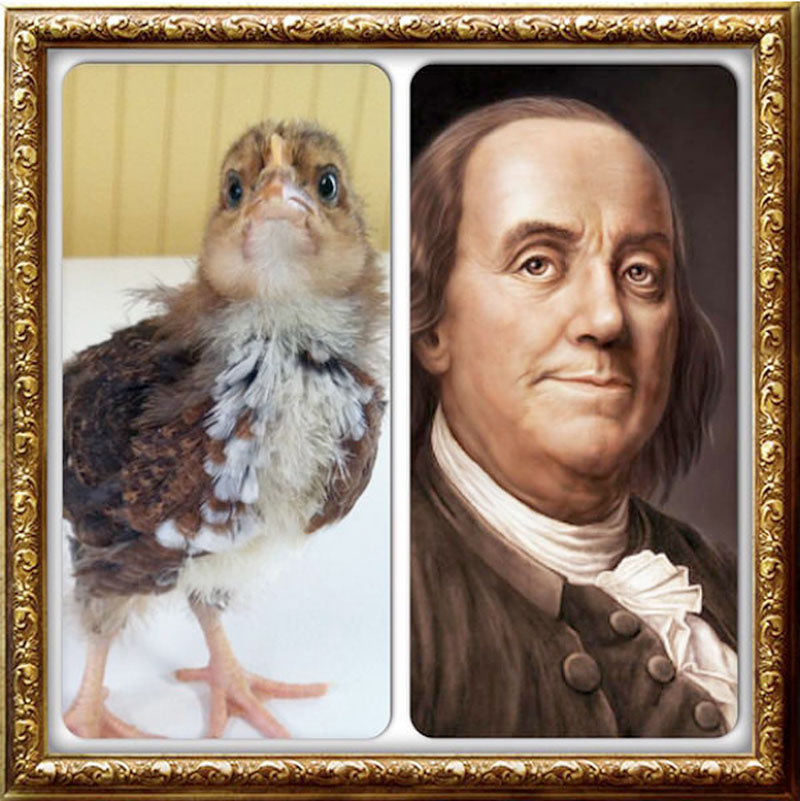
  • Benjie
    (A Speckled Sussex that looked exactly like Benjamin Franklin when she was little.)

favorite chicken names

  • Miss Selena Gomez
  • Snookie
    (a Jersey Giant)
  • LaFonda
    (She just looked like a LaFonda.)

Chicken Names If Rhyming Is Your Thing

  • Hewy, Dewy, and Louie
  • Helen the Felon
  • Fatty and Patty
  • Pickle Tickle

Chicken Names for a  Rooster

  • Fabio
    (He has long blonde feathers.)
  • President Fitzgerald Grant
  • Obi and Kenobi
  • Wooster

favorite chicken names

  • Rock the Cock
  • John HanCock

For the Punny Among Us

  • Tyrannosaurus Pecks
  • Heidi Plume
  • Sir Cluckington von Coopenheimer
  • Larry Bird
  • Annie Yolkley
  • Eggdar Allan Poe
  • Dixie Chick
  • Mary Poopins
  • Chickstina Eggpera
  • Foodie Favorites
  • Bok Bok Choy
  • Baked, Broiled, Fried, Stew, Noodle and Soup
  • Chicken Fingers
  • Barbecue, Garlic and Teriyaki
    (all Ameraucanas)
  • K, F, and C
    (three brown hens)
  • Dinner!

Chicken Names: Inspiration From Kids

  • Pink Sparkle Moon
    (And there’s no shortened version—we have to say the whole name every time!)
  • Twilight Diamond Sparkle
  • Gooey, Gross, and Monster
  • Harry Potter
  • Peter Pan
  • Nausea

And there’s a lot more where those came from. Tell us more of your favorite chicken names in the comments below.

This article about chicken names was written for Chickens magazine. Click here to subscribe.

Categories
Poultry

Can Ducks and Chickens Eat the Same Food?

Can ducks and chickens eat the same food? This is a question you may have if you raise both chickens and ducks that share living quarters. The short answer is yes, rest assured that they can eat the same feed. Although commercial waterfowl feed is available in some areas, it can be hard to find, and if you let your chickens and ducks roam freely together, providing different feed for each won’t work, as both will happily eat anything you put in the feeders.

Beware Of Too Much Protein

There are feeds on the market labeled for mixed flocks, but most are formulated for meat birds. These formulas are higher in protein and encourage fast growth—exactly what you don’t want when you’re raising ducks as pets or layers. Ducks that grow too fast can develop leg and foot problems, so be sure to read the label and steer clear of anything labeled for broilers or meat ducks if you’re raising a flock for eggs.

Too much protein can also lead to a condition in ducks called angel wing in which their wings start to curve away from their bodies rendering them unable to fly. While it’s merely a cosmetic issue in domestic ducks that can’t fly anyway, in wild ducks the condition can mean a death sentence because they’re unable to migrate or escape predators. (Adding some raw oats to the feed can help lower the protein levels and prevent this condition.)

What To Feed A Mixed Flock?

A mixed flock can be fed regular chicken layer feed. Ducks do require slightly higher levels of niacin than chickens, so adding some brewer’s yeast is a good idea. Brewer’s yeast (up to a 2.5 percent) can help ducks’ bones grow correctly and is beneficial to chickens, as well. Ducks will self-regulate their eating just like chickens, so feed can be left out all day for them to eat as much or as little as they need.

If your flock free-ranges, your ducks will eat all kinds of bugs, grass and weeds to help supplement their diet, which can result in a lower feed bill. If your flock is penned up, a few handfuls of greens in their water tub is a great way to amuse ducks and give them some added nutrient-rich treats. Ducks also need free-choice grit and calcium just like chickens do.

Can Ducks and Chickens Eat the Same Food: A Caution About Feeding Ducklings

Ducklings can be fed regular chick feed, but it should not be medicated. Because they aren’t as susceptible to coccidiosis as baby chicks, they don’t need the Amprolium that’s in the medicated feed. However, brooding ducklings with baby chicks isn’t a good idea. Not only do ducklings grow much faster than chicks, they splash around and make a huge water mess, which can lead to wet, chilled chicks.

Additionally, ducklings should only be on chick starter feed for the first two weeks (in contrast to eight weeks for chicks), and then switched to the lower-protein grower feed until they are about 18 weeks old. At 18 weeks, they can switch to the layer feed and be integrated into a flock of adult ducks or chickens.

This article about can ducks and chickens eat the same food was written for Chickens magazine. Click here to subscribe.

Categories
Equipment

ATV Attachments: 21 Options for Farming

ATV attachments are important since ATVs and UTVs with more powerful engines and more robust frames and drive trains are proving capable farm tools. Their lower cost and maneuverability often give them an edge over their larger counterparts in some situations. Perhaps you’ve discovered the value of a winch on your quad, but there are plenty of other attachments and implements that give these four-wheel wonders unexpected versatility. Here are 21 to consider…

Snow ATV Attachments

Playing in the snow or just going for a winter’s drive down a quiet trail can be delightful, so why not enjoy the task of removing snow with your quad? Here are some attachments and other accessories to help.

#1 Tire Chains

Off-road tires are great for trails and a little mud, but tire chains give your vehicle extra bite when working on dirt, snow or ice. They’re relatively inexpensive, are available for nearly every tire size, come in a variety of patterns and install quickly.

#2 Blades

Snow removal blades come in two varieties: V-shaped and straight. V-blade attachments push snow from the center to both sides for a balanced push, while straight blades can be slanted to push all the snow to one side or the other. If your quad lacks hydraulics, look for a model with an electric winch to raise and lower the blade. Numerous blades in various sizes are manufactured to fit vehicles of various size, including ATVs and 1-ton trucks.

#3 Snow Throwers

If just pushing snow around isn’t good enough for you, consider a full-blown snow thrower with an auger feed. With its own air-cooled engine for power, it makes short work of making a trail out to the barn and woodpile, clearing driveways, or even throwing snow off the pond for ice fishing or a game of hockey.

Hay ATV Attachments

Draft horse attachments for cutting, raking and hauling hay are still being manufactured, and older ones in working condition often show up at farm auctions. Replace the harness with a drawbar and hitch it up to your quad, and you have the means to harvest your own hay.

#4 Sickle-Bar Mowers

Wheel-driven sickle-bar mowers that are originally designed for horse farming adapt well to ATVs and UTVs. There are several companies that manufacture them, but if you keep your eyes open, you may find one at a farm auction.

These are easy to find for quads: Just look for yard rakes. They often show up at auctions, but you’ll be bidding against people who just want to use them for yard ornaments.

#5 Hay Dolly

Like an ant moving several times its weight, a quad can easily lift and move a 1,000-pound bale of hay on a two-wheel dolly. The less expensive units use a hand winch or come-along to lift the bale, while the powered lifts use an electric winch or hydraulic cylinders. The quick and maneuverable quad hay dolly may be become your go-to hay mover even if you have a full-sized tractor.

Cultivation ATV Attachments

Many attachments can be pulled behind just about any vehicle—the key is to find an implement that matches your vehicle while staying within the power limits of your quad. Working at high-power output and slow speeds is a recipe for overheating and can be stressful to the drive train, so don’t attempt to substitute your vehicle for a tractor unless it’s up to the job.

#6 Plow

Plowing is one of the most horsepower-intensive tasks you will ask of your quad, and the long, sustained pulls will test the cooling system and transmission. They typically use an electric winch to raise and lower the plow, and may require additional weight to match the vehicle to the task.

#7 Tiller

There are several manufacturers of tillers for ATVs and UTVs. These pull-behind units have their own power supply, which takes a lot of the load off of the vehicle. Even so, working for hours at slow speed means less cooling airflow over the engine, so you need a vehicle with an external oil cooler. What better way to till a large garden than to sit in the shade of a UTV cab with a cold drink and your favorite music?

#8 Harrow

Finish off the ground preparation with a harrow for a smooth, even surface ready for planting. (Harrows are also great for preparing arenas for shows.) Tight maneuverability and a light footprint make quads an ideal workhorse for these tasks.

#9 Cultivator

For shallow soil preparation and the creation of evenly spaced rows, a cultivator is the tool of choice. Even a small quad can pull an old-fashioned walk-behind cultivator, but equipment designed for quads is much faster and more efficient, though much more expensive.

#10 Disk

Pulling a disk can be one of the toughest jobs a quad can do because this operation usually takes place after plowing to break up large clumps of dirt or sod and to fill in the furrows. Large wheels with tractor tread and high ground clearance make the going easier. Make sure the disk is appropriate size for your quad’s weight and power.

Pasture & Woodlot ATV Attachments

Large-scale land maintenance takes brute strength. Mowing, brush clearing and heavy lifting are typically tasks for 150-plus horsepower tractors and crawlers, but with some clever attachments, ATVs and UTVs are very capable tools for mowing, brush clearing, pulling, and lifting on the hobby or small-scale farm.

#11 Brush Cutter

Some heavy-duty brush hogs available for ATVs and UTVs will take down small saplings and heavy brush. They’re available with their own gas motors, so you just attach them behind your vehicle and you’re ready to go. If you have hydraulics, there is also a front-mounted brush mower.

#12 Log Arch

Your vehicle can be indispensable for moving logs out of the woods. Whether you have a sawmill or just need firewood from a woodlot thinning, log arches save wear on the machine and avoid making ruts in the ground by lifting the log onto its own axles for an easier pull. A well-designed arch automatically lifts a log as it’s pulled and drops the log to provide drag when going downhill.

#13 Power Loader

If you have a heavy load to move but don’t have a front-end loader, you can attach a power loader, which uses an electric winch to lift up to 250 pounds off the ground and set the load in the front carrier. This makes it a perfect tool for taking mineral blocks, sacks of feed or a bale of hay out to the feedlot or for lifting sandbags when you need more front weight. The power loader fully retracts out of the way, allowing the vehicle to be used for other tasks without removing it.

#14 Auger

There are several options for drilling holes in the ground. The simplest one is a bracket that holds a one-person gas-powered earth auger and lowers it straight down into the ground with a winch. Auger diameters range from 3 to 12 inches, though the larger ones may not do well in hard or rocky soil. The stability of the vehicle takes a lot of stress out of drilling post holes, and you can disconnect the auger and use it manually, if you’d like.

#15 Livestock Feeder

You may already be delivering feed in a trailer behind your vehicle, but to speed up the chore, a power feeder might be just the ticket. Mounted on its own wheels, it can carry around 500 pounds and features a 12-volt electric auger that dispenses the feed without requiring the operator to leave the vehicle.

#16 Sprayer

Sprayers are typically self-contained units that have their own power and pump. Boom sprayers direct the spray down in a line behind the vehicle and are best suited to ground application over open areas. Wand sprayers position the spray directly where needed and are well-suited to brush and tree work. Large sprayers are trailer-mounted, while smaller ones sit on the front and/or rear carrying racks.

#17 Dry-Material Spreader

A dry material spreader can save a lot of time when seeding and fertilizing wildlife plots or lawns or spreading salt on sidewalks to melt the ice. These typically attach to the quad with a pin or ball hitch, and models are available with electric spreaders or with a dispersal mechanism driven by the wheels. Hopper sizes range from 85 to 600 pounds.

ATV Attachments for Moving Dirt

Moving dirt is one of the most demanding jobs for a quad. This is another application where the high power/slow speed can overheat an engine, unless it’s liquid-cooled or equipped with an oil cooler. You might also consider adding extra weights to the vehicle.

#18 Tumblebug

The tumblebug dirt mover dates back to the days of horse-drawn equipment and the building of the railroads. Although it’s not as common as it was a hundred years ago, it’s an inexpensive tool that allows you to scoop up a load of dirt or manure, transport it and dump it—all without leaving the seat of your vehicle.

#19 Rear Blades

The simplest dirt-moving tool is a straight blade that mounts to the back of the vehicle. Although it’s compact and maneuverable in tight places, it tends to dig in, especially with an ATV that has a short wheelbase.

#20 Graders

A dolly-mounted grader blade naturally cuts into the hills and fills the valleys for overall smoothing larger areas, such as driveways, yards and arenas. The unit attaches to a trailer hitch, so it can be pulled by a variety of vehicles.

#21 Backhoe

One of the most complex and expensive attachments for an ATV or UTV is a backhoe. Whfile not heavy enough for most commercial work, it’s a viable tool for digging electric or water lines, foundation for sheds, planting trees or landscape work. Some attach directly to the vehicle—which means you’ll need a front counterweight—while others have their own wheels. Most models contain their own motor and pump to meet the demand for high flow rates and pressure. Once on the job site, stabilizing outriggers support the weight and hold the backhoe steady.

ATV Attachments: Considerations

Is your quad up to the job? Using an ATV or UTV to push, pull, carry or haul can be an ideal solution for hobby farms, but it’s important to understand the limitations. These vehicles are much lighter than the tractors that traditionally do many of these tasks, and air-cooled engines are not well-suited to working under a load at low speeds. Here are a few things to consider when looking at farming with a quad.

  • Four-wheel drive gives more traction and can get you out of tough spots.
  • Shaft drives are much more robust than chain drive.
  • The quad needs at least a 400-cc engine, depending on the application. Check with the implement manufacturer about power requirements.
  • External oil coolers are critical for engine cooling at low speeds.
  • Disk brakes give more positive stopping power than drum brakes.
  • A receiver hitch is a versatile attachment that is either welded or bolted to the frame so that the quad can pull without causing any damage.

ATVs and UTVs are relatively inexpensive and versatile tools for hobby farms, maintaining food plots or managing woodlots. Of course, you can always go out and just have fun with it, as well—or better yet, have the fun of off-roading while you work.

This article about ATV attachments was written for Hobby Farms magazine. Click here to subscribe.

Categories
Equipment

Tire Ballast: Pros & Cons Of 5 Different Liquids

Tire ballast to improve your tractor’s stability is important when covering different farm terrain. Adding liquid ballast to your tractor tires is an option that can significantly improve performance in so many respects.

You will increase traction and lower your tractor’s center of gravity (a plus for negotiating sloping terrain). Also, you’ll also be able to counterbalance the weight of heavy implements, improving performance and safety.

But with so many types of liquid ballast to choose from, it’s hard to know which offers the best solution for your specific needs. Let’s explore the pros and cons of five common liquid ballasts:

#1 Water

Pros: Adding water is certainly the simplest way to gain tire ballast. It’s inexpensive, readily available and safe to use.

Cons: At 8 pounds per gallon, water isn’t as heavy as other options. It also freezes at a relatively warm temperature (32 degrees F), which introduces the risk of expanding ice separating the tire from the wheel rim. As a result, water isn’t suitable ballast in areas with cold winter weather. The last thing you need is frozen tractor tires when you’re ready to plow the driveway or snowblow you fields.


Read more: Here are 5 ways to counterbalance your tractor.


#2 Antifreeze

Pros: By definition, antifreeze is designed to resist freezing. A 50/50 antifreeze/water mixture will remain liquid at much colder temperatures than straight water—down to approximately -35°F. A higher 70/30 mixture of antifreeze/water can perform even better in colder temperatures, but don’t assume straight antifreeze will serve best of all. Antifreeze needs to be mixed with water to perform—left by itself, antifreeze will freeze at a little less than 0°F.

Cons: Antifreeze is more expensive than water, and ethylene glycol antifreeze is very toxic. Consider using propylene glycol antifreeze instead, which is somewhat safer.


Also Read: Tractor Talk: Tires, Ballast & Fuel Stabilizers


#3 Calcium Chloride

Pros: Calcium chloride has historically been a go-to choice for several reasons. When mixed with water, the solution can withstand temperatures down to -50°F or -60°F. It’s also inexpensive and weighs about 40 percent more than straight water.

Cons: Calcium chloride is famously corrosive and can cause significant damage to wheel rims. Inner tubes can help alleviate the issue, but calcium chloride can also be hazardous to handle, making it a less desirable choice than in the past.

#4 Beet juice

Pros: An increasingly popular option, beet juice is heavier than water (weighing about 11 pounds per gallon) and resists freezing down to -35 degrees F. Even better, it’s not corrosive or toxic, avoiding the major cons associated with other liquid tire ballasts.

Cons: Really the only disadvantage to beet juice is the price. It’s a more expensive solution.

#4 Windshield washer fluid

Pros: A relatively inexpensive solution, windshield washer fluid freezes at a much lower temperature than water—typically -20 degrees F or less, depending on the formula.

Cons: Windshield washer fluid isn’t any heavier than water, so as far as ballast goes it’s not an improvement in warm-weather locations. In addition, many windshield washer fluids contain methanol, a highly toxic alcohol. It goes without saying windshield washer fluid shouldn’t be ingested. And care should also be taken to avoid breathing vapors or allowing the fluid to come into contact with your skin or eyes.

This article about liquid tire ballast for tractors was written for Hobby Farms magazine. Click here to subscribe.

Categories
Animals

Goat Stanchion: How to Make a Simple & Sturdy Stand

A goat stanchion is an important piece of equipment for dairy goat owners, particularly when the goats are being milked. A stanchion restrains the goats, making hoof trimming, clipping and medicating them easier, but it’s almost essential when the milking time rolls around: When a doe is on a stand, her udder is easily accessible.

Steel or aluminum stanchions are readily available from commercial suppliers, but they can be expensive. Alternatively, you can make your own durable, sturdy milking stand from lumber for less. It takes just a few tools and about a day of effort. The goat stanchion featured here was designed for standard-size goats, but I also use it for my smaller Nigerian Dwarf goats.

Tool, Cut & Hardware Lists

Tools

  • electric drill
  • 1⁄8-inch drill bit
  • 11⁄32-inch drill bit
  • 13⁄16-inch drill bit
  • Phillips drill bit
  • hammer or pneumatic finish nailer
  • jigsaw
  • sander and sandpaper
  • saw
  • square
  • tape measure

Cuts

When purchasing lumber for building this goat-milking stanchion, nonpressure-treated lumber is recommended to avoid possible milk contamination from chemicals used to pressure-treat lumber.

  • (1) 8-foot 2-by-4 (See note on A leg length in Step 1.)
  • (3) 10 foot 1-by-4s
  • (1) 6-foot 2-by-2
  • (1) 10-foot 1-by-8

Hardware

When assembling the various portions of the goat stanchion, it’s important to tack the pieces together first (using the 1-inch finishing nails) to make sure the assembly is correct and square. After verifying everything is assembled correctly, use the 1⁄8-inch drill bit to predrill holes for the screws near the spots used to tack the lumber together. Then use the 2-inch exterior deck screws to screw everything together and finalize the construction of each section.

  • (1) box 1-inch finish nails (for tacking)
  • (1) box 2-inch exterior deck screws
  • (4) 3-inch exterior deck screws
  • (1) 1⁄4-inch-by-#20-by-2½-inch, slotted, round head bolt
  • (1) 1⁄4-inch-by-#20 hex nut
  • (2) 1⁄4-inch flat washers
  • (1) 4-inch hook-and-eye latch

    Also Read: Miniature Dairy Goats Are Perfect For Small Farms!


Step 1

Cut lumber to the sizes described below. Note: The legs of the goat stanchion can be made a different length depending on your breed. I built this stand for Nigerian Dwarf goats and wanted the legs to be long so my small goats would be higher. I later shortened the legs to 12 inches instead of 21 inches because my goats had trouble getting on the stand when they were pregnant. Lesson learned: Starting with a shorter leg length (12 inches for dwarf or 14 inches for standard breeds) is more reasonable, or you could also shorten the legs later.

A (legs): 2-by-4 cut into (4) 21-inch pieces
B (end pieces): 1-by-4 cut into (2) 20½-inch pieces
C (sidepieces), J1 and J2 (neckpieces): 1-by-4 cut into (4) 36-inch pieces
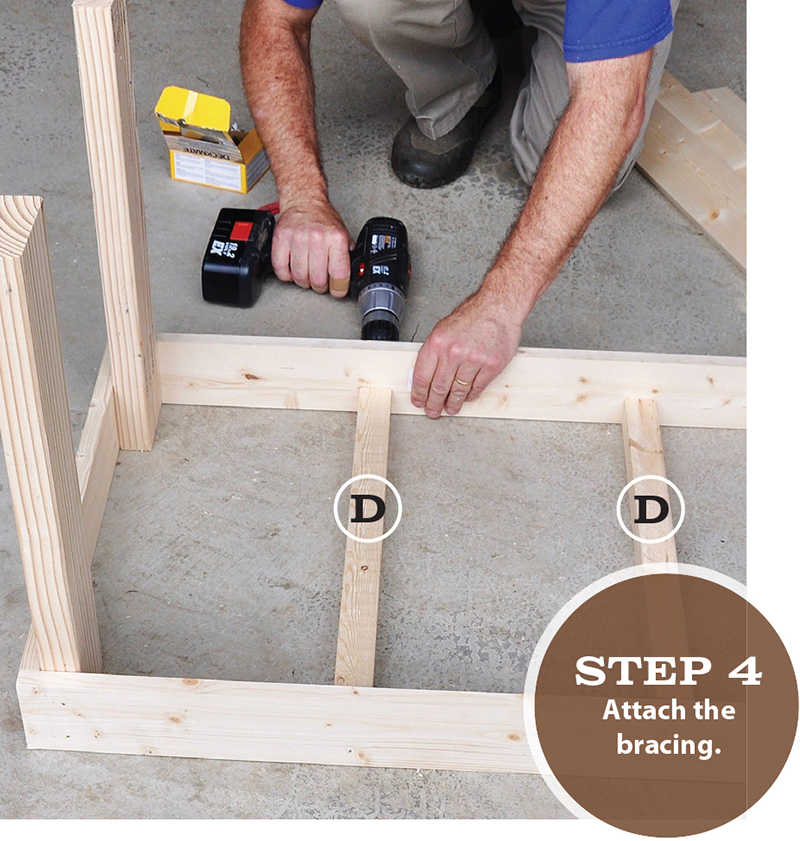
D (bracings): 2-by-2 cut into (3) 20½-inch pieces
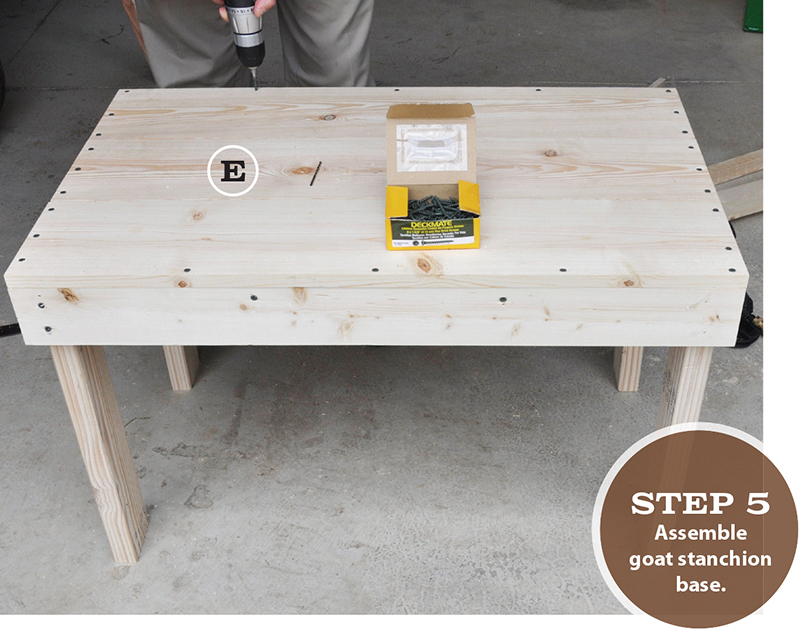
E (deckings): 1-by-8 cut into (3) 36-inch pieces
F1 and F2 (head gate guides): 1-by-4 cut into (2) 18½-inch pieces
G (head gate supports): 1-by-4 cut into (4) 21½-inch pieces
H (head gate feeder supports): 1-by-4 cut into (2) 4½-inch pieces

Step 2

making a goat stanchion step 2

In this step, we’ll put the legs and endpieces together. Tack two A legs and one B endpiece together so that the legs are even with the top of the endpiece and square to each other as shown in Step 2 photo. Repeat the process for the other two legs and endpiece.

Step 3

making a goat stanchion step 3

Tack C sidepieces to leg-and-endpiece assemblies.

Step 4

making a goat stanchion step 4

Tack two D bracings to the sidepieces with centerlines spaced 12 inches apart.


Also Read: Breed Profile – Angora Goats


Step 5

making a goat stanchion step 5

Tack three E deckings to the top of the assembly as shown in the Step 5 photo. Make sure the assembly is square, then predrill holes using the 1⁄8-inch drill bit near all tacking locations. Use the 2-inch deck screws to screw the assembly together.

Step 6

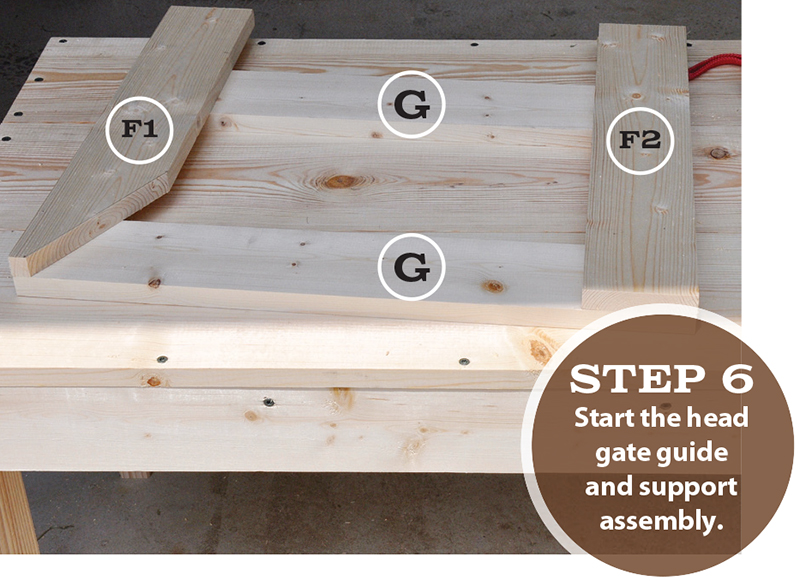
Take the head gate guide labeled F1 and measure at the top from one corner over and mark at 3 inches. Then measure down the side from the same corner to 5½ inches and mark again. Draw a line from the first mark to the second and cut this angle with your saw.

making a goat stanchion step 6

Take both head gate guide pieces and position two head gate supports across, with the top G piece even and bottom G piece 4 inches from the ends of F1 and F2 as shown in Step 6. Tack in place with finish nails.

Step 7

Turn the assembly over, and tack the remaining two G pieces in the same location as the first two so that the F1 and F2 pieces are between the G pieces as shown in Step 7. Predrill holes and use the 2-inch deck screws to screw the assembly together from both sides. Avoid hitting screws coming from the first side when screwing together the second side.

making a goat stanchion step 7

Create the neck hole in J1 and J2 neckpieces by using the jigsaw to cut starting 4 inches down from the top and ending 17 inches from the top. Cut each to a depth of 1½ inches, and curve the cut at the top and bottom as shown in the Step 7 photo.

Measure from the inside corner of J1 across 3 inches and make a mark. Then measure down from the same corner 4½ inches, and make a mark. Draw a line connecting the two marks, and cut this angle in J1.

Sand all corners and surfaces of the neckpieces, particularly J1, as this is the movable portion of the head gate and will need to move freely.

Step 8

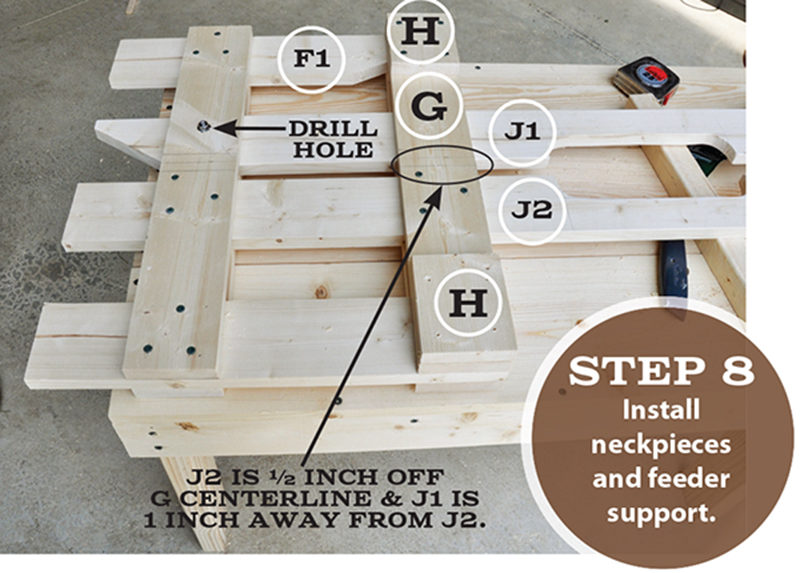
Position J2 between the G pieces, and align it vertically 1⁄2-inch off the centerline of G pieces and 4 inches below the bottom. Tack in place. Position J1 between G pieces and align it vertically 1 inch away from J2 and 4 inches below the bottom G piece as shown in Step 8. Verify J1 has been sanded sufficiently to allow it to freely move within the head gate and that the angles on F1 and J1 are in the right orientation.

making a goat stanchion step step 8

Use the 11⁄32-inch drill bit to drill a hole through the lower G pieces and J1. Switch to the 13⁄16-inch bit, and countersink the hole on each side to a depth of 1⁄4 inches to allow the slotted round bolt and hex nut to recess within the assembly. Place one 1⁄4-inch washer on the round bolt, insert through the drilled hole, place another washer on the bolt, add the hex nut and tighten.

Place H feeder supports on the upper G piece aligned with the end of G, and tack in place. Make sure the assembly is correct, and square and then drill starter holes (using the 1⁄8-inch bit) near the locations where the assembly is tacked together. Screw the assembly together with the 2-inch deck screws.

Step 9

making a goat stanchion step 9

Place the remaining D bracing centered over H as shown in Step 9. Predrill holes and screw in place with the 3-inch deck screws. Adding the bracing this way allows a removable feeder to be placed in the head gate. Inexpensive removable plastic feeders can be purchased at ­animal-supply stores and used to feed the goats grain while they are being milked.

Step 10

making a goat stanchion step 10

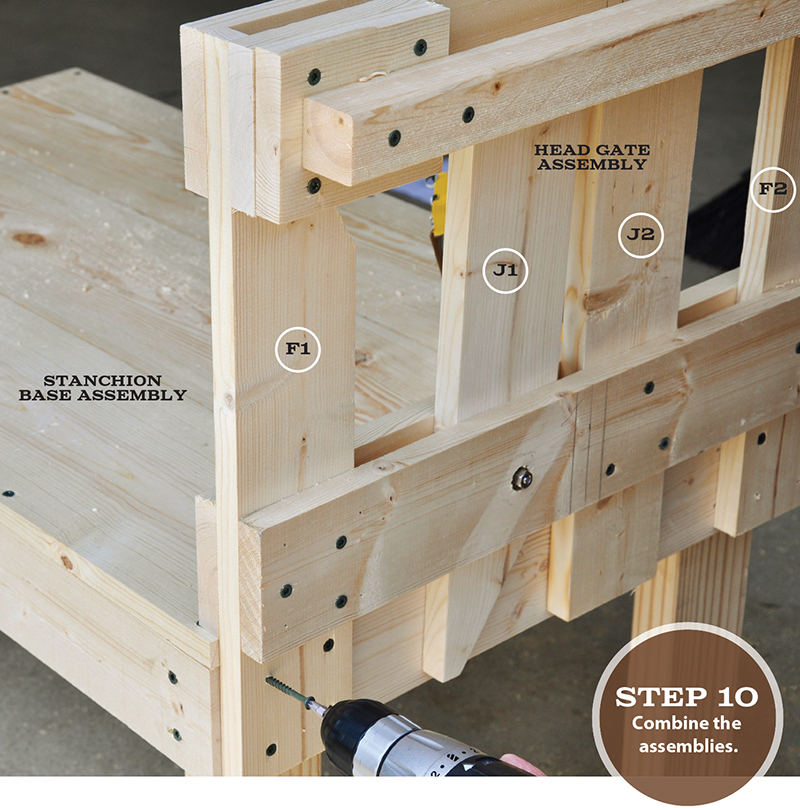
Sand all surfaces of the goat stanchion so that they are smooth, and round all corners so they are not sharp. Place the head gate assembly (with the feeder support bracing facing away from the stanchion base) so that the bottom of G sits on top of E. Attach the head gate assembly to the stanchion assembly by predrilling holes and then using the 2-inch deck screws to screw F1, J2 and F2 to the stanchion base. (Do not screw through J1.)

Step 11

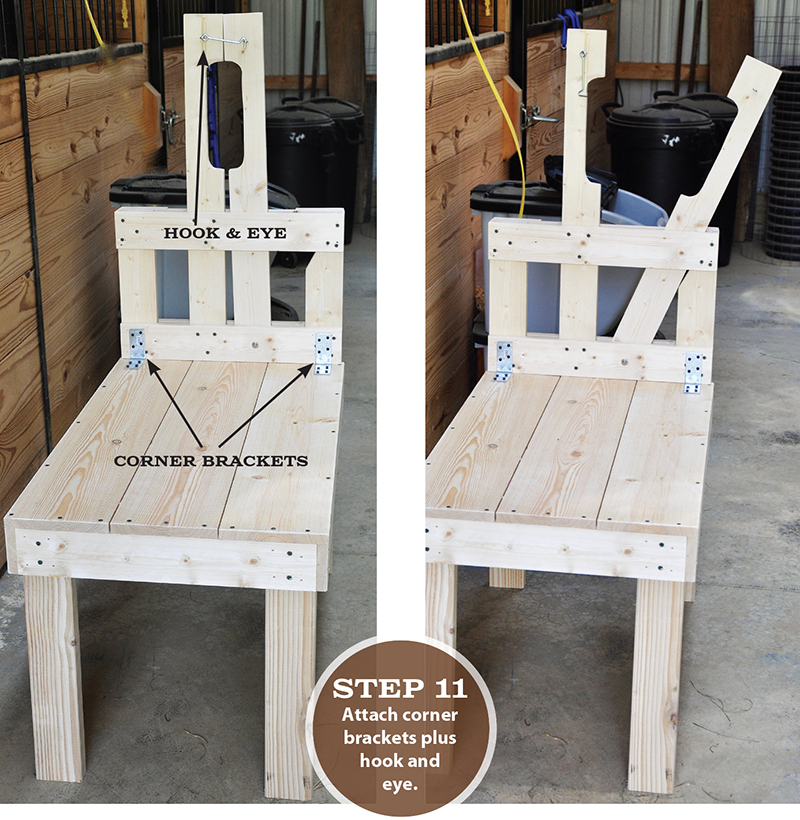
Attach the two corner brackets and the hook-and-eye as shown in step 11. Extra eyes can be added so that the tops of the J1 and J2 do not touch when the hook and eye are closed, if goats with thicker necks will be using the stand.

making a goat stanchion step 11

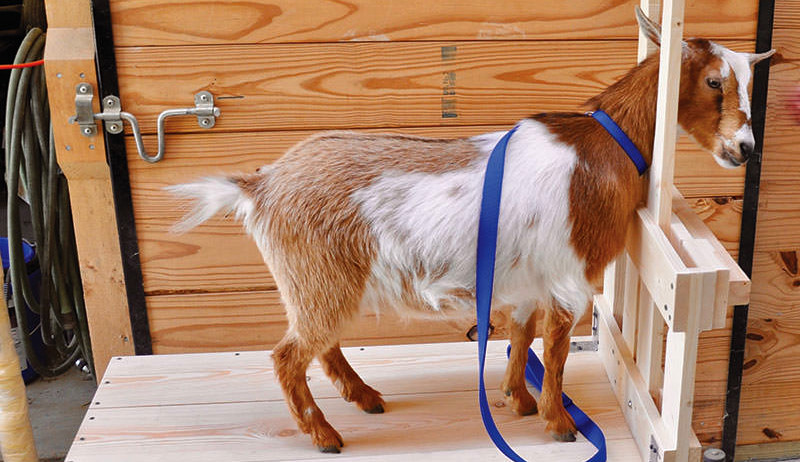
Now that you have a completed goat stanchion, you just need to add an animal! If you are looking for a strong, long-lasting goat-milking stanchion, this design provides just that. The stanchion shown in this article was built in 2010, and it’s still going strong today!

goat in a stanchion being given a treat

This article about how to make a goat stanchion was written for Hobby Farms magazine. Click here to subscribe.

Categories
Homesteading

Lilac Flowers: 4 Ways to Capture Their Essence

Lilac flowers in bloom have an intoxicating fragrance that’s almost impossible to save beyond spring. Let’s face it, products made with a synthetic lilac fragrance just don’t smell like the real thing and they are also made from toxic chemicals. Here are four ways to keep spring lilacs around a bit longer…

Now that lilacs are in bloom
She has a bowl of lilacs in her room
And twists one in her fingers while she talks.
—T.S. Eliot, Portrait of a Lady


Also Read: DIY Rose Water Facial Toner


#1 Lilac Fritters

Lilacs (Syringa spp.) are in the olive family. Native to the rocky hill slopes of Eastern Europe, the shrubs generally grow between 4 and 5 feet high, though they can grow as tall as 20 feet. The flowers are edible, but with their floral, astringent and slightly bitter flavor, they generally work best as edible garnishes.

However, lilac blossoms are delightful in fritters, made similarly to the more traditional elderflower fritters. Here’s a recipe, adapted it from an old-fashioned elderflower fritter batter, to wow your friends and family.

Ingredients

  • 3/4 cups flour
  • 2 eggs
  • 1/2 cup milk
  • 1 T. sugar
  • 1/2 tsp. salt
  • 10-12 lilac blossoms with leaves removed, washed and patted dry
  • oil for frying I use sunflower oil, as it is light and has no flavor
  • confectioner’s sugar for dusting

Preparation

In a large, shallow bowl, whisk the flour, eggs, milk, sugar and salt into a thin batter.

In a deep frying pan over medium-high heat, heat oil until a drop of water sizzles when it hits the oil.

Dip the flower blossom into the batter and remove it. Holding over the bowl of batter, shake off the excess batter. Place the batter-covered flowerhead into the oil. Turn if necessary, so all sides are brown. Once a golden brown color, remove and place on a dish covered with a paper towel to absorb the excess oil.

Dust with powdered sugar, or drizzle with honey. Serve while warm.

#2 Lilac Facial Toner

Medicinally, lilac leaves and flowers have traditionally been considered a tonic, a febrifuge (meaning they can help lower a fever), a vermifuge (to expel worms and parasites), an antiperiodic (preventing the return of a disease) and it has been used in the treatment of malaria.

Externally, lilac is beneficial for the skin and can be used in the same way as aloe vera. To make a simple facial spray, simply fill a jar with lilac blossoms, and pour very hot water over them. Allow the lilacs to steep in the water for 30 minutes, and then strain into a bottle. Apply to the face after washing using a cotton pad, or transfer into a spray bottle and mist the face and neck. It should last about 2 weeks if kept refrigerated.

You can make a slightly more involved, but still very easy, lilac facial toner with lilac blossoms and witch hazel. Organic witch hazel has a low alcohol content (usually 14 percent), so it’s not too drying and has no other added ingredients. The bit of alcohol helps to preserve the solution and helps prevent it from getting moldy.

What You’ll Need:

  • 16-ounce mason or other types of jar with a cover
  • lilac blossoms
  • witch hazel to fill the jar

Preparation

Allow lilac blossoms to dry overnight on a paper towel, to let most of the moisture to evaporate. They will be slightly wilted.

Cut or chop wilted lilac blooms into small pieces and put into your ason jar. You may include flowers, stems and leaves. Cover plant matter completely with witch hazel.

Cover the jar, and label it with the date and contents. Allow to infuse for 2 weeks, occasionally giving the jar a gentle shake to mix the contents. After two weeks, strain into a bottle and label. Compost the solid plant matter.

Apply lilac facial toner to your face after washing using a cotton pad or soft cloth. Keep refrigerated if desired, though the alcohol in the witch hazel acts as a preservative.

#3 Lovely Lilac Oil

Pick lilac flowers and allow them to dry overnight on a paper towel. Do not wash the flowers, as this can result in the oil becoming rancid. If there is any unwanted organic matter, simply shake the blossoms to get it off.

Place wilted lilac blossoms in a jar, and cover them with the oil of your choice. Make sure the flowers are completely covered with oil; push down with a spoon or chopstick if necessary. Cover and label the jar with contents and date. Allow the oil to infuse in a warm place for four to six weeks.

Strain flowers from oil, bottle, and use as a facial, body or massage oil.

#4 Lilac Infused Honey

Remove individual flowers from the lilac flowerhead, and place them in a jar. Cover with honey and infuse overnight. No need to strain, as lilacs are edible. Enjoy on fruit, toast or in tea.

This article about lilac flowers was written for Hobby Farms magazine. Click here to subscribe.

Categories
Animals

5 Friendly Goat Breeds for Small Farms

Friendly goat breeds make excellent pets, and many also excel at milk production. If you hope to add goats to your backyard, these five friendly breeds may be the perfect fit for your family.

1. Pygmy Goats

Pygmy goats top the friendly goat breeds chart, and it’s easy to see why. These mini goats have endearing personalities and their small size makes them ideal for novices and families with children. The breed loves interacting with humans, climbing, and kicking up their heels outside in the backyard. Whether begging for a treat or following you around the yard, Pygmy goats thrive on human attention.

three pygmy goats in a barn
Courtesy Diane Keith/NPGA

Hailing from Africa, Pygmy goats are exceptionally hardy. They tolerate heat and dry conditions and, when given adequate protection from wind and snow, should tolerate winter without any problems.

four goats standing in front of a barn
Courtesy Savannah Desmond/NPGA

The smallest goat breed worldwide, Pygmies, requires less feed and water, making them an ideal choice for those on a budget. Despite their small size, Pygmy goats have good milk production ( averaging one to two quarts daily per doe) and are meat producers and prolific breeders.

two pygmy goats standing together one white one black
Courtesy Savannah Desmond/NPGA

This delightful breed is disease-resistant and lives an average of ten to fifteen years or longer. More information about pygmy goats can be found through the National Pygmy Goat Association.

2. Boer

Boer goats are easily recognized by their large size, distinctive brown heads, and white bodies. Tipping the scale at over two hundred pounds, Boers are the largest goat breed in the world. But don’t let their giant size intimidate you; these gentle giants are even-tempered and calm, making them an ideal choice for novices.

Full of personality, Boer goats make fun and entertaining pets, as their antics never cease to amuse. Some things that set Boer goats apart from other friendly goat breeds are their sense of humor and ability to understand what you are saying. These goats are full of character and personality and make endearing family pets.

Bred for meat production, Boers are fair milk producers (though they do not produce the same amount as dairy breeds) and make excellent mothers.

Despite being prone to internal parasites, Boer goats are a hardy breed that live an average of ten to twelve years.

3. Saanen

If you are looking for an excellent milk producer with a friendly personality, look no further than the Saanen.  Calm, docile, and easy-going, Saanens make affectionate pets and are one of the most popular friendly goat breeds.

A Saanens’ mild temperament makes them a good pet and one of the easiest goats to milk in the milking parlor. As a dairy breed, Saanens thrive on routine.

Saanens are prolific milk producers. Each goat averages one and a half gallons of milk daily, with some does producing as much as three gallons daily.

Due to their lack of undercoats, Saanens are more cold-hardy than many other breeds. They thrive best in cooler climates and can thrive through winter with proper care and shelter during the cold winter months. However, the breed is prone to heat stress.

Saanens live an average respectable lifespan of ten to fourteen years.

4. Nigerian Dwarf Goats

Nigerian dwarf goats are the second smallest breed in the world and the smallest of the dairy breeds. They are calm, friendly, and respectable milk producers. This breed’s quiet, gentle, and playful nature makes it ideal for children and novices.

One thing that makes Nigerian Dwarfs stand out from other friendly goat breeds is their work as companion animals for older people. The Nigerian Dwarf’s gregarious and calm nature makes this breed the perfect choice for older people.

What the Nigerian Dwarfs’ milk production may lack in quantity, compared to other dairy breeds (each doe averages one to two quarts daily), it makes up for in taste. Nigerian Dwarf milk has a creamier, richer taste than cow milk and is easier to digest.

This breed is exceptionally hardy and can thrive in almost any climate. Nigerian Dwarves live an average of ten to twenty years, with an average of fifteen years.

5. Nubian

The “attention seeker” of the friendly goat breeds, Nubians are sociable goats who thrive on human and other caprine interactions. Their calm, friendly, and affectionate dispositions have earned the Nubian’s continued popularity.  Nubian goats have endearing personalities that have won the hearts of many goat owners.

The downside to owning Nubians is that they love to talk and can be quite loud. This trait puts the breed at a disadvantage if you have neighbors nearby.

The most popular milk goats in the U.S., Nubian goats, are good milk producers, averaging four to five quarts daily. While some Nubians may produce as much as four gallons daily, most do not exceed five quarts. Feed good nutrition and provide excellent care for the best milk production.

Nubian goats are a hardy and healthy breed, living an average lifespan of ten to fifteen years.

All Caprines are a delight to own, but the experience can be even more fun by choosing one of these five friendly goat breeds.

This article about 5 friendly goat breeds was written for Hobby Farms magazine. Click here to subscribe.

Categories
Food

Fermenting Food: Four Common Problems & Fixes

Fermenting food at home is tasty and nutritious, but because you’re dealing with wild cultures—not a controlled, cookie-cutter process—sometimes these projects go awry. Sauerkraut can turn mushy, pickles look funky or there’s an unsettling fuzz covering the brine. A lot of people find themselves asking, “What did I do wrong?”

The good news is you’re most likely not creating a deadly concoction in your kitchen.

“There is no recorded case of food poisoning from fermented vegetables,” says Sandor Katz, the Pied Piper of all things fermented and author of The Art of Fermentation (Chelsea Green Publishing, 2012). “You don’t have to be afraid to taste it.”

Yet, for those of us with less experience fermenting, staring into a bucket of vegetables that don’t quite look like the photos we saw online or in a book makes us wonder what went wrong and what can be done to correct it. Here are four common fermentation mistakes you might run into and how you can prevent them.

#1 Bloated Cucumbers

Eric Hurlock of Pennsylvania has been fermenting vegetables for three years and has experienced a few puzzling ferments. One of them included fermented cucumber pickles that turned out hollow and mushy.

“I put in some oak leaves for the tannins, plus some dill and maybe some onion,” he says. “I’ve done it before, and they came out fine, but after a week these were super mushy and completely hollow.”

A bloating occurs because of too much carbon dioxide build-up in the cucumber. On a positive note, Katz says it’s not dangerous to eat—it’s just not desirable. The addition of a high-tannin ingredient, like oak leaves, grape leaves or horseradish, can help slow the fermentation process and keep the cucumbers crisp. What you use depends on availability and what you prefer for taste.

With fermenting there are a number of variables that affect the process, including heat, the amount of salt (if any) and time, and rarely do two ferments turn out exactly the same. Because cucumbers are typically ripe at the height of the summer heat, Katz notes that this can also be a contributing factor to the firmness of the cucumber ferment. Using smaller, pickling cucumbers can help achieve a more appetizing final product.

#2 Soft Sauerkraut

Because sauerkraut is one of the most popular ferments, particularly by those fermenting for the first time, it’s one that raises a lot of questions.

Cabbage is often a successful vegetable ferment because it’s typically ripe in the fall when the temperatures are cooler and fermentation can occur more slowly, though this isn’t always the case. If you’re making sauerkraut in the summer with a spring cabbage, the heat of your environment can lead to a softer end product. To combat this, keep the bucket or crock holding the fermenting cabbage in a cool area instead of on your kitchen counter in 90-degree F heat.

“You can’t leave it out for weeks or it will turn into baby food,” Katz says. It’s still edible, but not many people will enjoy it at this stage.

This also raises the question of the amount of salt that should be used. The primary reason for salt is to help pull moisture out of the vegetables and to slow down the fermentation process. You can use pretty much any salt that doesn’t have iodine or other additives, though some people shy away from the chunky salts because they don’t dissolve as well. Katz says our grandparents and great-grandparents had to store a winter’s worth of vegetables by fermenting them, so they had to use enough salt to keep the vegetables from being completely soft by spring. But for us, it’s more a matter of taste.

“You don’t have to make it extremely salty,” he notes. “People’s palettes are varied to what tastes good.”

Add enough salt to make your ferment flavorful, but if your vegetables are breaking down too quickly, add a little more to slow it down or cut down your ferment time.

#3 Moldy Carrots

Another issue you might come across in your ferments is mold. Hurlock experienced this with his fermented carrots, which turned a blueish hue, so he tossed out the entire batch. The mold could have occurred, he says, because the carrots weren’t submerged all the way under the brine.

If you’ve found mold growing in one of your ferments, you’re not alone. Molds happen, Katz says.

“Most types of surface molds are white,” he notes. “But there are definitely molds that can be very toxic.”

If you find a white mold on the surface, he recommends skimming it off and throwing away any affected vegetables. However, if you come across any other colored molds, like blue or orange, use caution and destroy the batch.

Having the carrots exposed to air instead of being submerged was probably the vector needed to produce the blue mold. Plus, a shorter fermentation time could be appropriate for vegetables, like carrots, that have higher sugar content, Katz says. Adding spices also often inhibits mold growth, in addition to providing exceptional flavors.

#4 Fruit Fly Nesting Site

Kombucha is a delicious beverage made by fermenting sweet green tea using a SCOBY (symbiotic culture of bacteria and yeast). During the first ferment, the tea takes on a vinegar-like flavor the longer it sits out, and then the liquid is placed into an airtight container with fresh fruit or fruit juice during the second ferment to create a bubbly and tasty drink. As with any ferment, though, there are factors that can compromise the final product.

One risk with kombucha, particularly during the summer months, is the presence of fruit flies, which can lay eggs in the SCOBY. If you see small worm-like creatures growing in your kombucha, throw out the SCOBY and find a fresh one. Kombucha and other ferments can be protected from fruit flies by securing a cloth over the container with a rubber band.

With more people delving into home fermenting, there are bound to be blunders along the way. The good news is everyone has made them. Follow the simple guidelines of using salt to your taste, keeping your vegetables under the brine, and providing the proper temperature and adequate time, and you can avoid a few common mistakes and enjoy your healthy vegetables in a new and delicious way.

This article about fermenting problems, what they are and how to fix them was written for Hobby Farms magazine. Click here to subscribe.

Categories
Poultry

Broody Duck Mamas: Understanding Nesting Instincts

A broody duck may not be as common as a broody hen, but this mama-to-be can be equally as dedicated to her nest and young as her chicken cousins. If you are considering having your broody duck sit on eggs, here are a few things you should know before embarking on this new adventure.

a clutch of duck eggs sitting in a nest of leaves
Adobe Stock/Sandra

How Long Do Ducks Sit On Eggs?

A female duck becomes broody when her hormones signal that she should stop laying eggs and hatch out young.

Before sitting, a broody duck will lay a small clutch of eggs. Once she has a nest full of eggs (the number of eggs hatched will largely depend on the size of the female), she will then sit on the eggs for twenty-eight days (thirty-five days for Muscovy eggs), only leaving the nest for twenty minutes once or twice a day to eat, drink, swim, and defecate.

If a male duck (drake) is present, he may also show signs of broodiness and take turns with the female sitting on the eggs. Some drakes will help to raise the young, but caution should be used as other drakes may try to kill ducklings.

How to Tell If a Duck Is Broody

Unlike their chicken cousins, who seem to withdraw themselves and try to become invisible, a broody duck can be quite loud.

Broody ducks will stand with their feathers all puffed out, quacking loudly in an irritated manner anytime a flock member, human, stray cat, or family dog wanders by. The quack is usually a high-pitched, raspy sound, unlike the deep, happy quack female ducks typically make.

A broody duck will also refuse to leave the nest, often needing to be manually removed. However, unlike chickens, a broody duck is rarely aggressive, so there is no need to worry about being pecked or bitten.

One of the best ways to tell if there is a broody duck in the flock is to watch the drake. A drake is tuned in to his ladies and will act more aggressively to any humans trying to “steal” his broody girl’s eggs.

A drake’s main job is to guard the broody duck and her nest, so don’t be surprised if mild-mannered Daffy behaves aggressively while Daisy is raising ducklings. Drakes will attempt to bite your hands, arms, and even your face, so use caution during this time.

Safety First

Never allow a broody duck to nest outside or in an outbuilding with a dirt floor. Providing a broody duck with a safe place to brood and raise her young is critical to successfully hatching and raising ducklings. This is especially important as you want to provide protection for your ducklings should the broody duck decide to abandon her eggs or young (more on that later).

The first rule for providing a safe brooding area for your potential duck mama is to provide a completely predator-proof barn or coop. Even if you think your coop or barn is safe, always check over it again before letting your broody duck begin to nest.

Small snakes, weasels, and rats may not bother your adult ducks, but they pose a risk to ducklings. Also remember to consider your barn cats, as they too will eagerly turn ducklings into a tasty meal.

No Dirt Floors

It may seem natural to allow your broody duck to nest in a building with a dirt floor, but this one mistake alone has cost many duck keepers a broken heart.

Dirt floors offer no protection from predators, allowing predators to access your birds by digging underneath the coop. The alluring smell of eggs or ducklings will often cause a predator who was just wandering through your yard to take a second look.

If your barn or coop does not have a concrete (preferred) or wooden floor, do not allow your duck to sit on and hatch out eggs, no matter how much fun it sounds.

Forget the Nesting Box

Broody ducks don’t require nesting boxes the way chickens do, preferring to nest on the coop or barn floor. Always provide protection from the rest of the duck flock to ensure that the nest and eggs don’t become trampled by other flock members.

Swim Water, Please

A broody duck requires access to swimming water every day. Allow your duck to swim for about ten minutes before returning to the nest. The duck must return to the nest wet, as the wetness in her feathers will provide the eggs with the humidity needed to help the developing ducklings not stick to the eggshell.

3 Common Broody Duck Mistakes

A broody duck can make mistakes and often requires two to three attempts at broodiness to successfully hatch and raise young. But take heart; with time, most broody ducks will get it right. Ducks are not usually as exceptional mothers as chickens, so be sure to look for these common mistakes to protect your future flock members.

#1 Leaving the Nest Early

Some ducks will abandon the nest early before the eggs have fully formed. Just like chickens, this behavior is usually seen only in first-time mothers. Have an experienced sitter or an incubator on standby in case of an emergency.

#2 Attentive Nester 

A first-time broody duck will often show extreme attentiveness to the nest, abandoning her newly hatched ducklings for the nest. If this behavior happens, try relocating the duck and her hatchlings to a new safe location away from the original nest site. Check on the new family often over the next few hours. If the duck does not bond to the ducklings, you will have to hand-rear them yourself.

#3 Aggression 

Even if you are raising ducks for a friendly flock, some ducks will show aggression toward the ducklings and will even kill and eat their young. If you notice any aggressive behaviors, remove the ducklings right away.

Think Before You Hatch

Hatching ducklings is an exciting time, but before letting your broody duck begin nesting, take a minute to consider what you are going to do with those twelve new additions. Do you have room for a dozen more ducks, or are you planning on selling some of them? Even if you plan on selling some, ducklings don’t always sell the best, so be sure to have a plan in place should ducklings not sell.

By planning in advance, you will have a better idea of how you want to expand your flock. You may realize that you only want three new duck additions, in which case you can remove some of your broody duck’s eggs and replace them with ceramic eggs. At least some of the eggs will be males, so if you don’t want additional drakes in the flock, it might be best to forgo hatching at this time.

Also, consider the health of your current flock. If current flock members have genetic issues such as angel wing or curled toes, do not breed these ducks. Breeding healthy stock with no known health issues or concerns will help establish a healthy flock for years to come.

Choosing a Broody Duck Breed

Choosing a broody domestic duck breed can be more challenging than choosing duck breeds to raise for eggs as ducks are individuals and may not go broody even if their breed is prone to this trait. However, some breeds are more prone to this behavior than others, so if you are looking to raise your own ducklings, these five breeds may be a good choice.

#1 Muscovy

Muscovy ducks are hands-down the best mothers and make wonderful broodies. Before acquiring this unique breed, be sure to check with your local fish and wildlife experts to attain permits to own, hatch, and sell Muscovies.

Follow through on other guidelines provided by wildlife officials for owning these ducks, as Muscovies are considered to be an evasive species.

muscovy duck with her babies
Muscovy Duck. Adobe Stock/electrochris

#2 Ancona

Ancona ducks generally do not go broody, but when they do, these beautiful ducks make exceptional mothers.

#3 Mallard

Whether domestic or wild, Mallards make wonderful broodies and mothers. Before acquiring a Mallard to be your next broody duck, be sure to check with your local wildlife experts to attain permits to own, hatch, and sell Mallards, and follow through on other guidelines to owning these beautiful ducks.

mallard duck with babies
Female Mallard Duck and Babies. Adobe Stock/Wildspaces

#4 Welsh Harlequin

Welsh Harlequin ducks are reported to be good mothers and broodies. However, from personal experience, these ducks have never shown an interest in becoming a broody duck or mother.

#5 Pekin

While often overlooked as a potential broody duck, many Pekin females will go broody, hatching eggs successfully.  Another plus to this delightful breed is their ability to adopt ducklings even when they have not sat on eggs.

broody pekin duck sitting on eggs
American Pekin duck. Adobe Stock/mwhaskin

While some duck owners may view a broody duck as a nuisance, if you are looking to hatch and raise ducklings naturally, there is no greater joy than watching these delightful ducks hatch and raise their young.

This story about broody ducks was written for Chickens magazine. Click here to subscribe.

Categories
Crops & Gardening

Cabbage Collars: DIY Steps To Prevent Root Maggots

Cabbage collars are a great way to prevent problematic cabbage root flies (Delia radicum/Hylemya brassicae) from damaging cole crop plantings. Although gardeners have been making cabbage collars for years to protect plants from this pest, these are a little different from the flat cabbage collars others use. Their shape affords an added layer of protection and it works like a charm.

What Are Cabbage Root Flies?

Adult cabbage root flies look a lot like bristly houseflies only slightly smaller. They’re about 1 centimeter long with bristly hairs all over their gray bodies. This European species is now found across much of North America and up into southern Canada.

Cabbage root flies overwinter in the soil as pupae. When spring arrives, they pupate into adults, feed on flower nectar, and go on to breed and lay eggs over the course of the next five to six weeks.


Also Read: 7 Health Benefits Of Cabbage


Female cabbage root flies lay eggs on or in the soil right next to the base of plants in the Brassicaceae family, including cabbage, broccoli, cauliflower, kohlrabi, Brussels sprouts, horseradish, and occasionally turnips and radish. The 1/8-inch-long, oval-shaped, white eggs hatch into tiny maggots a week or so later. The maggots feed on the roots and stems of infested plants for three to four weeks before pupating into adults. There are two to three generations of cabbage root flies each season.

Because there can be dozens of maggots feeding on a single plant, the plant’s health is quickly affected. Signs of infestation are wilting leaves even when the plant receives ample moisture. Sometimes the leaves have a bluish-purple tinge to them. Cabbage root maggot damage looks similar to some other disorders, including club root and cutworms, so the only way to confirm the culprit is to dig up a plant and check the roots and lower stem for the white, wriggly maggots.

How To Prevent Cabbage Root Maggots

Because female cabbage root flies lay their eggs on or right next to the base of host plants, shielding the soil around the base of the plant is key to preventing this pest from becoming problematic. This is best performed within a few days of planting out susceptible cole crops.

Typically I recommend covering cole crops with floating row cover to keep pests away, but in the case of cabbage root flies, covering them too early may actually trap newly emerged adult flies underneath the row cover, so instead I turn to making cabbage collars to protect my plants. I put a collar around each plant by late April because the first generation of adult flies typically starts to emerge in early May through June here in my Pennsylvania garden.

How to Make Cabbage Collars

What You’ll Need

  • Cardboard, enough to create a 6- to 8-inch circle to go around each plant or recycled rounds of cardboard from frozen pizzas
  • Scissors
  • Box Cutter
  • Stapler

Step 1

supplies needed to make cabbage collars pictured including scissors, cardboard, tape measure and box cutter

Cut the cardboard into a 6- to 8-inch circle, making one square for each susceptible plant in your garden. If you’re using recycled frozen pizza cardboard rounds, you’ll just have to cut them to a 6-to 8-inch diameter if necessary.

Step 2

folding cardboard to make cabbage collars

Fold the circle in half to mark the center line, and then unfold it. Fold it in half in the other direction, and unfold it to mark the exact center of the circle. Use the scissors to cut down one of the lines from the outermost edge of the circle into the exact center.

Step 3

cutting cardboard to make cabbage collars

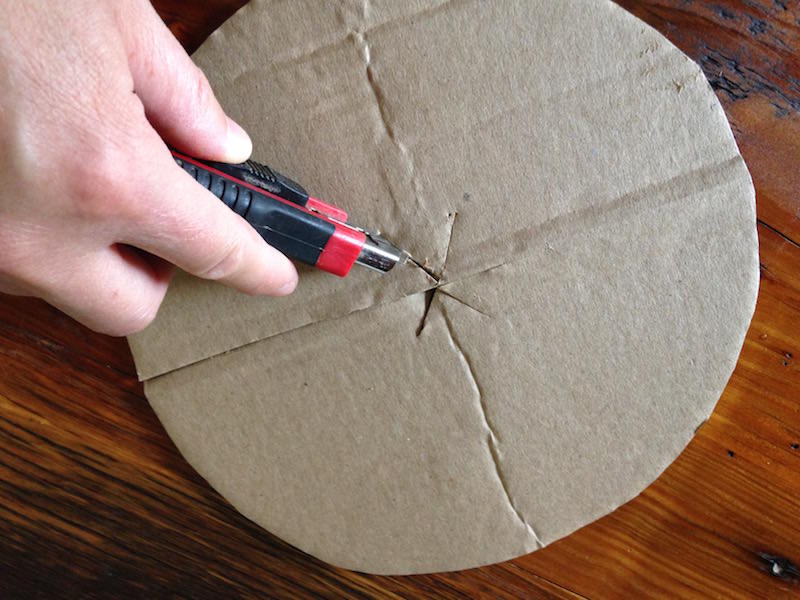
Starting at the center point, use the box cutter to cut four 1- to 2-inch lines that radiate out from the center point. Try to space them equally.

Step 4

scoring cardboard to make cabbage collars

The final step in making cabbage collars is to bend the small flaps created in Step 3 upwards.

Step 5

center hole opened

Install the collar around the plant by slipping the cut line around the plant’s stem. Once in place, overlap the cut line slightly until the small flaps are positioned loosely around the plant stem. There should be enough space for the stem to expand, but not enough for the flies to gain access to the soil around the base of the plant.

Step 6

finished cabbage collar surrounding young cabbage plant

Once in place, staple the overlapped cut line of the circle closed in two or three places.

Tips For Using Cabbage Collars

  • At the end of the growing season, the collars can be tossed onto the compost pile after pulling them out of the garden and discarding the staples.
  • Unwaxed cardboard may warp slightly during the growing season. You can use waxed cardboard for a longer-lasting cabbage collar if you find this to be problematic.
  • In gardens that have suffered from major cabbage root maggot damage in the past, you may find it helpful to treat the soil around the plants with beneficial nematodes (Steinernema feltiae) before putting the collars in position. These beneficial organisms patrol the soil all season long and seek out certain ground-dwelling pests, including cabbage root maggots.

This article about cabbage collars was written for Hobby Farms magazine. Click here to subscribe.