Categories
Homesteading

Bright and Open Kitchen Shelving

Stephanie Staton put open shelving in her new farmhouse to complement the high ceilings and display her everyday wares. Photo by Stephanie Staton (HobbyFarms.com)
Photo by Stephanie Staton

It’s not news to hear that kitchen cabinets can really put a dent in any budget, and a big trend right now is open shelving in the kitchen. I knew right away that with 10-foot ceilings, I wanted an open and airy feeling in the upper sections of the kitchen. To avoid paying top dollar for beautiful but expensive glass-front cabinets, we decided to jump on the open-shelving train.

Not to toot my horn, but I think it turned out great. I love the horizontal lines of contrasting white that the shelves afford, as well as the ability to display my most-oft used items. Our daily-use dishes will go on the first shelf within easy reach, while some of the lesser-used but attractive items will be placed up higher. We’ll see how I fair with dust in the coming months—I realize this is one downfall to this method and might need to rethink the items currently housed there. For now, though, I enjoy the touch of sparkle my glassware adds to the overall kitchen scene.

If you’re considering open shelves and, like me, you’re particular about the supports that hold them—a few keywords might come in handy during your search: brackets and corbels—the latter of which is most often used to describe the wooden supports similar to the ones pictured. You’ll find that many retailers and mills use a variety of terms to describe these supports, though, so be ready to explain what it is your seeking for your shelves. (Visual examples of shelving you like are even better.)

Once you get your point across for the look of the shelves, stick to your budget. Prices range from $8 each to $50 per support, which can easily derail your budget if not kept in check. I searched high and low before stalking—I mean researching—corbels found in an inspiration image on the Internet, only to discover a local big-box store carried similar ones for $10 each. It took some digging, and unfortunately, the store sales associates had no idea what a corbel was. I was able to ascertain a general location in the store from the company’s website and browse their offerings (as well as those of other nearby locations and competitors) to find just the one I was looking for.

Most wooden corbels, including ours, come unfinished, so we sanded and painted them along with the 1x12s in the same paint used on our doors and mouldings throughout the house. The semi-gloss finish will make it easier to wipe down shelves while giving them a polished look. We mounted them directly into the studs, never exceeding a span of 36 inches, for proper weight support.

When seeking just the right look and finish for your kitchen shelving, keep in mind that a picture really is worth a thousand words—at least when referring to corbels. Arm yourself with the proper terms to get the materials you need without losing your mind in the shopping process.

« More Restore Farmhouse Order»

Categories
Homesteading

Turn a Dresser into a Potting Bench

Turn a Dresser Into a Potting Bench - Illustration by Tom Kimball (HobbyFarms.com

If you drool over the beautiful garden benches found in garden- and farm-supply catalogs, but can’t manage to fork over the cash a top-dollar work station, you’re in luck. Armed with do-it-yourself skills and a few tools, you can make a potting bench all your own out of salvaged materials.

The foundation of the project below is an old dresser, which you might have around your house or can readily find at a local thrift shop. The majority of the other materials, with the possible exception of the drawer slides, can also be found around your home or at a secondhand store.

Before you start building your potting bench, browse your favorite garden catalogs to find the features you most want to incorporate. Our project included:

  • a workspace tall enough that we can pot our plants without bending over
  • a potting-mix container within reach
  • storage for record-keeping and reference materials
  • space to hang tools and hats

Think through your own needs before starting your project, and adjust your materials accordingly.

Tools and Materials

  • jigsaw
  • drill or electric screwdriver
  • hammer
  • flat-head screwdriver
  • sander (optional)
  • tape measure
  • dresser
  • 2 2x4s sized to dresser width
  • 2 2x4s sized to dresser length
  • screws
  • coarse sandpaper
  • outdoor paint or stain
  • 2 sets undermount drawer slides
  • toilet-paper dispenser
  • hooks or rigid metal-rake head
  • organizers of your choice
Turn a Dresser into a Potting Bench - Illustration by Tom Kimball (HobbyFarms.com)Step 1: Find your dresser.
We started our search for the perfect potting bench by looking at old desks but found they weren’t tall or wide enough for our needs. Dressers, though, come in a variety of heights, and many are long and wide enough to provide ample workspace. Determine an ergonomic height for your potting bench by standing up straight and bending your elbows; the tip of your elbow should reach the top of the dresser. The bench can be a few inches shorter, but not so short that you have to bend over to work. Any taller, and you’ll wear out your shoulders while working.

Find a dresser with good construction. Pressboard from flimsily made furniture will not hold up to the wear and tear—not to mention the weather—your potting bench will endure. We found our dresser at a flea market. You might look for yours at a secondhand store or yard sale, on Craigslist or Freecycle, or in your own basement. Our dresser is 42 inches tall, 30 inches deep and 36 inches long with four drawers.

Turn a Dresser into a Potting Bench - Illustration by Tom Kimball (HobbyFarms.com)
 

Step 2: Deconstruct your dresser.
Pull all of the drawers out of the dresser, and set them aside. Keep the bottom two drawers intact for storing garden supplies. The top two drawer spaces will become a shelf: Half will be stationary, and half will pull out to hold a potting-soil container. Using a jigsaw, cut out the frame between the top two
drawers. You’re left with an open space approximately 20 inches tall.

If your dresser has side-drawer slides, remove these from the now-open space. Remove the bottom piece from one of the extra drawers. You can use the jigsaw to cut it off, if needed; however, you can probably work it apart using a hammer and flat-head screwdriver.

Remove the drawer slides, and cut the wood piece in half width-wise. You’ll use one of these pieces for the pull-out shelf and the other to reinforce the stationary shelf. If your drawer bottom is flimsy, use 1/4-inch plywood instead. This shelf will hold your potting mix, so it needs to have some heft. Remove the drawer pulls from the two drawers you’re keeping as well as the deconstructed drawer.

Turn a Dresser into a Potting Bench - Illustration by Tom Kimball (HobbyFarms.com)
 

Step 3: Size your dresser.
If the dresser you’re working with is a little taller than necessary, use a jigsaw to cut off the legs flush with the bottom of the dresser.

Add a base for stability: Secure one 2×4, wide-side down, along each side of the dresser base. Insert our screws along each board (one in each end and two in the middle). Pay attention to the dresser’s construction. The very bottom of the dresser might be too thin to hold the screws. In this case, screw the base to the outside edge of the dresser.

Step 4: Paint your pieces.
Dressers are constructed for indoor use, so you’ll want to repaint yours to hold up to outdoor conditions. This is important even if you plan to keep your potting bench in a garden shed or barn, out of direct contact with precipitation; fluctuating temperatures and humidity will still take their toll on wood like this.

Strip the finish from the wood and stain it, or give it a good sanding and paint over the existing finish with outdoor paint. Give your potting bench personality. If you have a classic, rustic style, go with an antique-looking color or give it a distressed treatment. If you’re more bold and carefree, consider using a bright, glossy paint.

Invite kids to join in on this part of the project, as well, if they’ll be participating in gardening activities. Paint the dresser, the pull-out shelf, the stationary shelf and the two bottom drawers, inside and out.
Your hooks, drawer pulls and toilet-paper dispenser also become new again with a coat of paint that complements your potting-bench colors.

Continue the project when the paint has dried per manufacturer’s instructions.

Turn a Dresser into a Potting Bench - Illustration by Tom Kimball (HobbyFarms.com)

Step 5: Attach pull-out shelf slides.
If your dresser has undermount drawer slides, you can use these for your pull-out shelf slides; otherwise, purchase undermount slides at a salvage shop or hardware store. If you buy new slides, these will likely come with installation instructions—follow the manufacturer’s instructions, if available.

Mount inner slide bars along the edges of the bottom of the pull-out shelf. Measure to space them evenly. Precision is important—if these are not parallel to each other, the shelf will not slide properly.

Slide the mounted bars into the base slides and set the shelf, slide-side down, on the left side of the dresser shelf base. Mark the base slides’ positions on the dresser shelf. Remove the sliding shelf and set aside, disengaging the bars from the base slides. Attach the bottom slides to the dresser shelf base as marked. Reassemble the slides, test your pull-out shelf, and adjust base slide placement as needed.

Turn a Dresser into a Potting Bench - Illustration by Tom Kimball (HobbyFarms.com)Step 6: Reinforce stationary shelf.
With a screw in each corner, mount the other half of the drawer base inside the dresser, next to the pull-out shelf, to reinforce the stationary shelf.
Turn a Dresser into a Potting Bench - Illustration by Tom Kimball (HobbyFarms.com)Step 7: Reassemble drawers.
Reattach the drawer pulls to the two bottom drawers, and replace the drawers in the dresser.
Turn a Dresser into a Potting Bench - Illustration by Tom Kimball (HobbyFarms.com)

Step 8: Create more storage space.
The sides of this potting bench are as useful as the interior. On the left side, secure the remaining two drawer pulls. Keep your gardening gloves and anything with a hook or loop here. Also attach a toilet-paper dispenser to keep your trellising twine.

On the right side, secure a series of hooks or the head of an old metal rake to hang your gardening hat and hand tools with hanging loops. (If the loops have broken off of your tools, now’s the time to replace them with trellising twine.)

Turn a Dresser into a Potting Bench - Illustration by Tom Kimball (HobbyFarms.com)

Step 9: Organize your bench.
No one can tell you how to organize your potting bench—you have to do what makes sense to you. For our potting bench, we used items we found at the flea market to provide a place for everything. In the top drawer of our potting bench, silverware-drawer organizers do wonders for keeping garden markers organized and handy. A waterproof, plastic photo box has a second life as a seed-packet organizer. Our garden journal, a box of colored pencils and pens, a favorite garden-reference book, and a three-ring binder with garden articles kept in plastic sleeves for reference have a home here, too. If your potting bench has the potential to get rained on, keep your printed materials in a waterproof, plastic container.

The bottom drawer holds bags of soil amendments, less-often-used tools, and a dust pan and hand broom to keep the bench tidy.

On our potting bench’s pull-out shelf, we keep a plastic tub for potting mix, and extra pots
and spray bottles sit on the stationary shelf. An organized potting bench gives you a central place to use as a garden workbench, making your garden chores that much more enjoyable.


Categories
Homesteading

Four-letter Words that Make You Question Homesteading

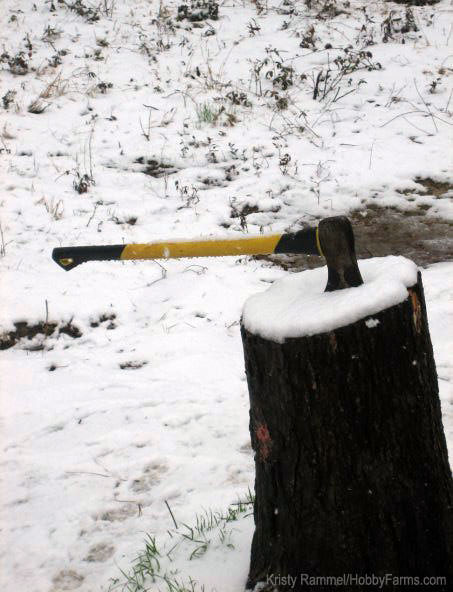
Do the four-letter words of winter (snow, cold, wind, chill) make you question your decision to be a homesteader? Photo by Kristy Rammel (HobbyFarms.com)
Photo by Kristy Rammel

Snow, cold, wind, chill—all four-letter words. The news today is flooded with stories of record-breaking lows, high winds and severe storms as millions of people woke this morning to face piles of ice and snow. Surely they grunted and grumbled as they donned layers of clothing and headed out into the frozen winter tundra. Yes, Mother Nature is a little pissed off right now!

No one knows Mother Nature’s drastic mood swings quite like the homesteader. In addition to the standard preparations of her impending tantrum, we have a commitment to our furry and feathered companions. Unfortunately, we can’t just bring in Dixie the donkey for the night and let her sleep in the garage. No, homesteader winter preps are a wee bit different than any other—no worse, mind you, just different. Trust me, I’ll take my winter mucking boots over your high heels any day of the week.

These times of conflict with nature test our resolve. When we are outside at 10 p.m. during howling winds and stinging rains because a barn door wasn’t closed properly, we might be tempted to reexamine our way of life. When we are mucking around outside shoveling frozen poo, snot glued across our cheeks, we might want to say “Wow! This kinda sucks!” I know that’s a bit graphic, but that’s the reality of it. There are times that the choice to be a homesteader sucks.

Our determination is further tried as we winterize our crops, equipment and outbuildings. Oh, it would be so much easier to just buy all our vegetables from the grocery store, we think as we slush, slip or slide to the shed to ensure our equipment isn’t frozen. (Wow! Say that three times fast!) Nothing seems quite so arduous and unyielding as spending countless hours wrapping pipes, chopping wood, fixing, patching, layering, shucking, mucking, hauling, towing, pushing, pulling, dragging, blah-blah-blah, for what? Fresh eggs and some garden greens?

But that’s what makes us different. We don’t see this as just some fresh eggs and garden greens. We see the crisp spring nights when we fall asleep to the vocal ensemble of the resident crickets, and the long summer days spent in the garden munching on greens straight from the dirt. We appreciate the difference between the dark rich gold of a farm-fresh egg yolk and the pale, flaxen color of a store-bought egg. We see today’s frozen poo as tomorrow’s fresh compost. And although we might need to be reminded of our commitment as we check water barrels for ice in single-digit temps, we will remain steadfast.

Now, get off your tuchas and get the eggs before they freeze! There’s work to be done. It’s not pretty, it’s probably going to suck, and it’s almost guaranteed to cause your teeth to chatter and your bones to shake, but it’s life. Beautiful, messy, unpredictable, life! One day in the not so distant future, the sun will bathe you in her warmth, the earth will bless you with her bounty, and the life you feed and protect today will return the favor for your family. And then it will be hurricane/tornado/mudslide season—but we’ll worry about that wrath later. Stay warm, dry, safe and dedicated!

Kristy Rammel at Kids on the Homestead—Uncensored
About Kristy Rammel
A self-admitted former city girl, Kristy Rammel was “promoted” from AVP of Operations in a Fortune 200 company to VP of Homestead Operations and team leader of her family’s Animal and Child Disaster Response Unit. While many people work desperately to avoid the monotony of daily life, she prays for it. Come back each week to follow her wild, crazy, but never boring homesteading adventures with four boys.

« More Kids on the Homestead—Uncensored »


Categories
Animals Large Animals

Llamas, Move Your Poop Piles Elsewhere

How do you stop llamas from pooping in same spot? They keep pooping on my gravel driveway. Is there anything I can put on the poop spots that would make them move to another place to do their business, hopefully in the pasture? —Mike

Mike, that’s a good question. Uzzi and I asked our llama, Bandit, why he makes big piles of poop in the paddock he shares with Maire, the very old Standardbred and my adversary, Kerla, the obnoxious buck. “Beans,” he said. “Those are llama beans. I pile them up because that’s the way of the llama.”

Uzzi and I looked at each other: What does that mean?

“See,” Bandit said, “every alpaca and llama mama takes her newborn baby to the poop pile and tells him, ‘That’s where you go.’ Mama llama shows her baby how, and from then on, that’s what we do. We pee on our poop piles, too.” He nodded at the paddock. “I have four piles. That one by the shelter is more than 2 feet tall. It’s my best effort so far.” Then he sniffed. “I’m not like you dirty goats who poop whenever and wherever you want to.”

Well!

So we asked Mom what she would do if Bandit made his poop pile in the driveway. She scratched her head while she thought. “I’d move it,” she said. “I’d pick up every bean and take them wherever I wanted Bandit to poop. Then I’d use bleach to obliterate the smell of the old pile. Once I had, I’d show Bandit the new pile and hope he got the message. But tell you what, guys. I know a lady with Southeast Llama Rescue who knows more about llama and alpaca behavior than anybody else I know. Her name is Deb Logan. Let’s email Mike’s question to her and see what she says.”

Uzzi and I could hardly wait to hear back! Here’s what Deb said.

“When you find a remedy, let me know! Llamas and alpacas seem to gravitate toward gravel. Ours have pooped all over the gravel in front of our equipment shed and also the gravel path that leads up to the barn.

“I’m not sure how to get them to relocate other than putting poop where you want them to go. However, I think the smell of the urine attracts them the most, and even when I lime an old spot the urine smell is still there.

“Mike could try putting down a stall mat over where they are going now, putting poop on it or even leading them over there. Once they start using the mat he could slowly move it to where he wants it. But they may migrate back, eventually. That’s how it usually works for me.”

Mom says she thinks it’s great that llamas and alpacas pile their poop. That makes it easy to scoop up and add it to the garden as a soil amendment. Llama beans don’t burn plants, so they can be tilled into soil straight from the poop pile. Llama poop is one of very few animal manures that doesn’t have to be aged or composted, though it’s OK to compost it if you want to.

Last year, Dad gave several empty feed bags filled with beans from one of Bandit’s poop piles to a friend who has a plot at a community garden. She piled the poop at her garden spot intending to spread and work it in another time. The next day another gardener met her at the gate with a huge smile on his face. “Where did you get the giant rabbit pellets?” he asked her. She laughed and gave him half of her stash.

Categories
News

2014 Marks the Year of Family Farms

The United Nations declared 2014 the Year of Family Farming. Photo courtesy MarcoGovel/iStock/Thinkstock (HobbyFarms.com)
MarcoGovel/iStock/Thinkstock

The United Nations General Assembly has declared 2014 the International Year of Family Farming, aiming to raise the profile of family and small-scale farming by focusing world attention on its significant role in eradicating hunger and poverty, providing food security and nutrition, improving livelihoods, managing natural resources, protecting the environment, and achieving sustainable development, particularly in rural areas. The campaign has the support of 360 organizations on five continents.

The World Rural Forum, a member of the International Land Coalition, is coordinating the IYFF-2014 Civil Society program, highlighting the need for agreement on public policies that promote the development of family farming and recognize the right of nations to produce the majority of their food. The UN’s Food and Agriculture Organization was invited by the UN General Assembly to implementation.

Family farming includes all family-based agricultural activities, and it is linked to several areas of rural development. It’s a means of organizing agricultural, forestry, fisheries, pastoral and aquaculture production, which is managed and operated by a family and predominantly reliant on family labor, including both women’s and men’s.

In both developing and developed countries, family farming is the predominant form of agriculture in the food production sector.

“ILC members universally agree that a sustainable future can only be achieved if there is secure and equitable access to and control over land that protects the interests of the world’s family farmers, which already produce 80 percent of the food consumed in the developing world, despite the incredible number of challenges they face,” says Annalisa Mauro, ILC Secretariat’s network coordinator. “Some of these challenges are directly related to land tenure and land governance.”

At the national level, there are a number of factors essential to the successful development of family farming, including agro-ecological conditions and territorial characteristics; policy environment; access to markets; access to land and natural resources; access to technology and extension services; access to finance; demographic, economic and sociocultural conditions; and availability of specialized education.

Family farming has an important socioeconomic, environmental and cultural role:

  • Family and small-scale farms are inextricably linked to world food security.
  • Family farms preserve traditional food products, while contributing to a balanced diet and safeguarding the world’s agro-biodiversity and the sustainable use of natural resources.
  • Family farming represents an opportunity to boost local economies, especially when combined with specific policies aimed at social protection and well-being of communities.

Small-scale food producers and family farmers are at the forefront of the fight to eradicate hunger. Under the right conditions, their contributions can be increased in scale and transform agricultural systems throughout the world, according to the ILC. Addressing landlessness and securing the land rights of people on the verge of becoming landlessness is a fundamental initial step.

As we approach 2014, the ILC will work with its members to celebrate the role of family farmers and the critical importance of securing their land rights for achieving a food-secure future.


Categories
Homesteading

Evergreens of Hope

Good nature could winter foresee when she made the evergreen tree. —Pepper Blair (HobbyFarms.com)

It’s become sort of a tradition of mine to start off the new year with a winter hike. I like to take this opportunity to clear my head and center myself as I prepare for the year’s activities that lie ahead. Not everyone enjoys a wintertime hike, but as I mentioned in a previous post, for me, it’s one of the more interesting times to observe nature. The juxtaposition of living and deceased indicates how complex the world around us can be, and with trees clear of leaves, you can more clearly see the earth structures they hide when in full bloom.

On my winter hikes, I love to search out cold-loving plants, like wintergreen and holly bushes, as well as the smattering of fungi and moss found growing on the limestone rocks and fallen trees of eastern Kentucky. Even the boulders themselves present interesting shapes and colors as I meander along a forest path. The quietness of the world around me on these winter hikes allows me to take time to contemplate, meditate, and find appreciation for the things and people in my life.
 
Evergreens, in particular, provide something to be appreciative of during these winter hikes. Although we recently celebrated the evergreen during our Christmas celebrations, these hardy trees provide lush padding against the somewhat bare landscape all winter long. Evergreens are a steady reminder that we can find joy in all walks of life, even—or maybe especially—during seasons of rest and recuperation.

Just as these green firs grow alongside dormant maples and oaks and tower above sleeping wildflowers, reminding us that life still exists among the blustery winds of winter, we can find much activity to participate in on the farm that can motivate us for the year to come. Although the month of January is a welcome chance to put your feet up and perhaps take a relaxing vacation from farm responsibilities, you are no doubt eager to start ordering seeds from catalogs for this year’s crop or to construct a new outbuilding to support your new beef-production enterprise

Even if prefer not to get out for a winter hike, I hope you find a spot on your farm, perhaps an old evergreen friend, that can offer you hope and goodness for this winter and the year to come.

« More Farm Inspiration »


Categories
Crops & Gardening

Spinosad: Beat Pests in 2014

Help keep pests out of your garden with spinosad, an organic pesticide. Photo by Jessica Walliser (HobbyFarms.com)

As you plan your 2014 garden, consider adopting a more organic approach if you haven’t already. Although certified organic farms have dozens of pages of rules to follow in order to maintain their certification, home gardeners don’t have to go through quite the same effort. However, adopting natural methods of soil care and pest management are simpler than you might think.

Come spring, it’s quite likely that you will begin to encounter some pest insects in and around your garden. Mexican bean beetles, Colorado potato beetles, cabbage worms, hornworms, sawflies, cucumber beetles and lots of other “bad guys” will be making their debut in a few short months. You might want to start thinking about how you’re going to nip them in the bud before they cause any significant damage. 

All gardeners should look at preventative measures first and foremost when it comes to keeping away pests. This means doing things like choosing resistant crop varieties, covering susceptible crops with floating row covers before the pests show up (great for cabbage worms and Colorado potato beetles in particular), or surrounding young squash plants with a collar of aluminum foil to deter vine borers from laying eggs. Other preventative methods include placing paperboard collars around tomato seedlings to foil cutworms or hanging pheromone and/or red sticky traps in the orchard to trap coddling moths and apple maggot flies. 

Sometimes, though, despite our best efforts at prevention, the pests come anyway. So, what to do? I’d like to introduce you to an organic pesticide that’s fairly new to the market and can be a great tool for cutting down on pest problems without resorting to toxic chemicals: spinosad.

Even though spinosad is an organic product, I still recommend using it only when absolutely necessary—in my book, that advice goes for any pesticide, organic or not. 

Spinosad-based products have become a great tool in the arsenal of many organic gardeners and farmers, and with good reason. These products (brand names include Captain Jack’s Deadbug Brew, Entrust, Green Light and Monterey Garden Insect Spray) are made from a unique fermented soil-dwelling bacterium called Saccharopolyspora spinosa, which was discovered by a scientist in the Caribbean in the early 1980s. Spinosad-base products work most effectively when ingested by the pest, so critters with piercing-sucking mouth parts aren’t very susceptible, but a wide range of other insect pests are.

Insects that ingest spinosad die within a few days of consuming it, and they stop feeding immediately. Spinosad-based products have a low toxicity to beneficial insects like ladybugs and minute pirate bugs, but you’ll want to apply it only when no beneficials are present—obviously good advice when applying any product to the garden. However, spinosad is known to be toxic to foraging bees, so it’s absolutely essential that you apply the spray when no bees are active—early morning or evening is best. And it should go without saying, but please follow all label instructions.

Spinosad works to manage pests like Colorado potato beetles, Japanese beetles, Mexican bean beetles, cabbage worms, budworms, hornworms, spider mites, flea beetles, sawfly larvae, asparagus beetles, cucumber beetles, various caterpillars, bagworms and many others. It is a great alternative to synthetic chemicals and is extremely effective.

« More Dirt on Gardening »


Categories
Urban Farming

Winter Slaw

/images/blogs/winter-slaw2_490.jpg

Photo by Judith Hausman

Top some tacos with this winter slaw.

We had black bean and corn tacos for dinner last night: perfect warming food for a frigid snowy night. The local corn in them (I had frozen wisely) reminded us that summer would eventually return. Still, even wintery dinners need the refreshment and balance of a salad of sorts to off set the hearty, spicy beans.

What local fare could my “root cellar” (aka the bottom drawer of the fridge) offer? Well, it looked like slaw to me: a few beautiful carrots, softening radishes, a thick daikon and a small red cabbage.

A quick cleaning and a pass though the julienne blade of my food processor easily transformed the vegetables into snow white, red-flecked and orange strands that all soon turned pink with the red cabbage added. I tossed them together with lime juice, salt and, because of the Mexican main, some medium-hot chili powder. You can add a little onion or a couple of scallions too if you like. My winter slaw was ready to pile on top of the tacos or eat alongside them.

Note: Before I added the red cabbage, I scooped out some of the slaw and seasoned it with sesame oil and a little seasoned rice wine vinegar. That mix will compliment my Korean scallion pancakes tomorrow — multi-ethnic multi-tasking!

Servings: 4

INGREDIENTS

  • 1 10 to 12-inch daikon, peeled
  • 3 medium red radishes
  • 2 medium carrots, peeled
  • a wedge of red cabbage, roughly 3-by-6 inches
  • 2 scallions or 1/2 small onion (optional)
  • juice of one lime
  • salt, to taste
  • 1/2 teaspoon red pepper flakes or chili powder

PREPARATION

Put daikon, radishes, carrots, cabbage and scallions through the food processor, mandolin or grater. 

Toss with the lime juice, salt and red pepper flakes or chili powder. 

Let rest briefly to meld flavors; then serve. 

Read more of Locavore Recipes »

Categories
Crops & Gardening

Winter Treats for the Birds

Hang citrus fruit peels filled with peanut butter and seeds as winter treats for birds. Photo by Dawn Combs (HobbyFarms.com)
Photo by Dawn Combs

Our farm is named after the beautiful mockingbird, which tends to be quite territorial about the property where it nests. Spring and summer, therefore, is not the time for us to see a wide range of bird visitors. Winter is more promising, as the mockingbird either migrates a bit south or uses her energy more wisely by keeping warm instead of chasing off intruders.

We do many things in our herb gardens to encourage the birds while the weather is warm, but what do we do when the weather has turned cold and we’re no longer working the soil?

Decorate the Tree
One of our holiday traditions is to decorate a tree outside. I like the feeling that while we make merry indoors, our bird friends are able to have some presents, as well. On New Year’s Eve we make sure to get our tree taken down indoors owing to family tradition. The tree that is outside for the birds, however, continues on.

Treats for Birds
Over the years we’ve used strings of popcorn, orange halves and peanut-butter pinecones to decorate our outdoor tree. The main consideration is that the birds need rich food, high in fat and protein, during winter. They also need a good salt supply and open water. When making strings of popcorn garland, it is important to pop the popcorn in a good fat supply and to salt it. Alternatively, you can toss it in peanut butter before stringing.

A couple weeks ago, as we were preparing for Christmas, the kids and I sat one day and made ornaments for the outside tree. The birds really appreciate it if you choose an evergreen that is near a clearing so they can see any predators approaching. In our case, we have farm cats. We are careful about the trees we select for this type of decorating. This year, we settled on peanut-butter coated pinecones and orange cups. My kids are 2 and 4, so we keep our decorations simple. After coating the pinecones, we dipped them in sunflower seeds. We added a string for hanging, and voila!

Planting For Winter
For us, deciding what plants to feed the birds is more a question of what not to pull. Weeds are so important to us on our farm. They are full of more vitamins and minerals than are typically available in the cultivated vegetables. Once these weeds have gone to seed, they also provide winter feed for the birds without any intervention from us. Goldenrod (Solidago spp.), aster (Asteraceae), Joe Pye weed (Eupatorium maculatum), coneflower (Echinacea spp.), black-eyed Susan (Rudebeckia spp.), and Queen Anne’s lace (Daucus carrota) are some of our favorite seed heads to leave waving in the winter breezes. All of these plants also happen to be very useful medicine for our human and animal family.

We have an area that is specifically set up for our bird-viewing pleasure just off the patio doors, but the places most frequented on our property are the weedy areas that we do not clear. Our farm echoes with bird calls even on the coldest days, and that’s worth the time and energy it takes to decorate an outdoor tree!

« More of the Prescription Gardener»

Categories
Recipes

Farmstead Potato Leek Dumplings

Recipe: Farmstead Potato Leek Dumplings - Photo by John D. Ivanko/farmsteadchef.com (HobbyFarms.com)
Photo by John D. Ivanko/farmsteadchef.com

We’re always looking for ways to get back to our food traditions, often influenced by ethnic or cultural heritage. From Poland to Tibet, from India to Hong Kong, dumplings are one of those foods that seem to cross national borders. For your dumplings’ filling, you have the opportunity to showcase what’s local and seasonal—if not from your own gardens, from your neighborhood, village or shire.

Our renewed interest in dumplings was inspired by a visit to the “Dumpling House,” a roadside attraction on the two-week-long Reedsburg Fermentation Fest that takes place every year in Wisconsin around the first couple weeks of October. Billed as a “live culture convergence” that celebrates all things fermented, the Reedsburg Fermentation Fest also embraces the culture of agriculture and the intersection of the arts and community, the latter of which is captured by the event’s 50-mile-long Farm/Art DTour, on which the Dumpling House was a featured stop.

The Dumpling House resulted from a collaboration between artists Emily Stover and Molly Balcom Raleigh, both from St. Paul, Minn. During the 10 days of Fermentation Fest, the Dumpling House included a sample kitchen in which participants made and then sampled steamed dumplings using locally sourced ingredients.

Making dumplings can be a fantastic way to get helping hands working together, especially if you have a family member who’s a kitchen novice or kids in need of a project. The tactile experience of making dough with the rhythmic rolling of the dumpling skins and hand-forming them around your filling can be great fun.

In their original proposal, Stover and Raleigh wrote: “The simple act of preparing food with friends is a powerful way to share history, build knowledge and foster strong relationships in a community of people. Working with food as a social medium, we often find ourselves sharing a table and sharing ideas for places where people connect through cooking.”

Here’s our version of farmstead dumplings, little pockets of dough filled with leeks, potatoes and some shredded cheese. We steam them, but they can also be fried or boiled. Using bread flour, which contains more gluten, makes working with the dough skins easier because it’s more flexible.

Recipe: Farmstead Potato Leek Dumplings

Yield: 24 dumplings

Ingredients

Dough

  • 2 cups bread flour
  • 1/4 tsp. salt
  • 3/4 cup boiling water

Filling

  • 1/4 cup chopped leek
  • 2 T. butter
  • 1/4 tsp. salt
  • 3 cloves garlic, minced
  • 1 pound potatoes, peeled and cut into 1/2-inch pieces
  • 1/2 cup brick, cheddar or havarti cheese, grated
  • 1/4 tsp. pepper

Preparation

Dough
Sift together flour and salt. Add boiling water to dry ingredients in small amounts at knead together until soft dough forms.

Set dough aside inside sealed plastic zipper-top bag at room temperature for 15 minutes, or up to 2 hours, before using.

Filling
In heavy, medium-sized skillet over medium-low heat, cook leek in butter and salt, covered and stirring occasionally, for 5 minutes. Uncover, add garlic, and continue to cook, stirring frequently, for about 15 minutes, until leeks are quite soft.

Peel and boil potatoes in medium-sized pot until tender, about 10 minutes. Drain and mash. Stir in leeks, cheese and pepper.

Divide dough into 24 small, round balls. On a floured counter surface, roll out each dough ball to about 1/16 inch thick. Put rounded tablespoon of filling in center of each dumpling skin. Lightly brush wrapper with water, then fold in half (diagonally if square) and press to seal.

Place dumplings in steamer basket over boiling water and cook for about 10 minutes. Removing when outside skins are firm.

Serve immediately, with some soy sauce, ranch dressing or sour cream for dipping.

Savoring the good life,

John and Lisa's Signatures

<< More Farmstead Chef >>