Categories
Animals Breeds Farm & Garden

Livestock Guardian Dogs: Best Breeds, General Rules

Livestock guardian dogs, also known as livestock protection dogs, are generally large—with males weighing more than 100 pounds—and often unfriendly toward other dogs, keeping stray dogs away from the flock. These breeds are bred as working animals, not pets. Their focus is to detect and deter predators.

Most predators stay away from dog-protected flocks to avoid being confronted by the guardian dog. 

Great Pyrenees

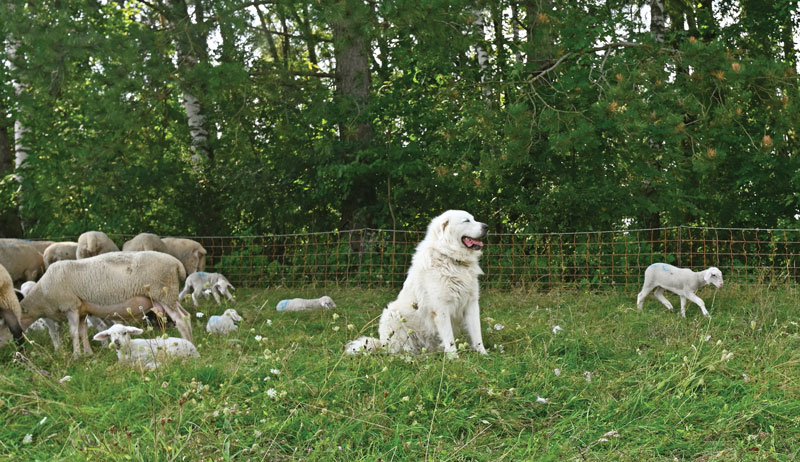
There are many guardian dog breeds, but the Great Pyrenees is the most widely used in North America. Originally bred by Basque shepherds in the mountains between Spain and France, this breed is probably the least aggressive toward people. Its thick coat and heavy build, however, often make it a poor choice for hot regions.

The breed’s “bear-shaped” head is an identifying breed trait, as is its tendency to bark and “posture” to threaten away would be 4-legged intruders.

Akbash Dog

If you have livestock in large pastures and a lot of predators, you might need a more aggressive breed. The white Akbash Dog from Turkey is considered one of the most predator-aggressive and livestock-protective dogs around.

It isn’t as heavy boned as the Great Pyrenees and is proportionally longer legged and athletic with a more wolflike head.  Males are 30 to 33 inches; females about 2 inches shorter.

Like the Great Pyrenees, on small properties it is known to “posture”—growl, bark, snarl—as a part of its defense.


Read more: Livestock guardian dogs bring live-and-let-live sheep protection to the pasture.


Kangal Dog

Another native Turkish breed, the Kangal Dog is more mastiff in appearance and is always black-masked dun or fawn. Like the Akbash Dog, it’s bite-inhibited (reluctant to bite or even nip) people or its livestock. However, strangers are met with an  intimidating stare and an aloof attitude.

The breed rarely postures (threatens). It watches and then acts—silently charging a predator. Most recently Kangal Dogs have been successfully introduced to western U.S. sheep producers where grizzly bears and wolves threaten livestock. 

Anatolian Shepherd

The Anatolian Shepherd also traces its heritage to Turkey. While European countries no longer register this breed, it’s registered in the U.S.

Developed from Turkish dogs brought to the U.S. and other Western countries, this large, imposing breed is sometimes slow to mature but devoted to its herd. It can be unfriendly toward humans.

Varying in coat length and color, these dogs can withstand hot weather because they are similar to the Akbash Dog in body proportions. Dogs with more mass and more weight are more suited to mountain climates. 


Also read: Using GPS Collars On Your Livestock Guardian Dogs


Komondor

The Komondor from Hungary has a long, heavy, nonshedding coat that can develop feltlike cords similar to dreadlocks to protect against weather and wolf bites. This thick coat requires care, and some people just shear it when they shear their sheep.

These dogs weigh 80 to 100 pounds and are as tall as 27 inches. They are very protective and territorial toward two- as well as four-legged intruders.

General Guardian Dog Guidelines

Individual dogs vary, regardless of breed, and some work better than others. If you start with a puppy, put it with the flock as soon as it’s able to be safe around potentially aggressive sheep or goats. A young pup can be housed next to livestock. By 10 to 12 weeks, it should be familiar with the sight, sound and smells of its livestock. 

A feral livestock guardian is a liability, not an asset. It’s important to socialize the puppy to humans. Calling its name and handling it at feeding time helps to build respect and trust in humans.

However, these dogs must live with livestock, not with you. They guard and protect the animals they are bonded to as pups. It usually takes 12 to 24 months for pups to become effective guardians with some breeds and individuals. Dogs can take longer to mature and outgrow the instinct to chase or play with livestock.

Livestock guardian dogs intimidate predators by barking and behaving aggressively Most will attack a predator if it doesn’t leave. Some stay with the livestock all the time. Others prefer to roam the perimeter of the herd.

Wandering off property is a common issue and is dangerous for the guardian dog. Owners need to teach young dogs to respect their boundaries, and nothing is better for that than a dog and livestock-proof fence! 

Guardian dogs require minimal care, except more feed (and feed of higher fat/energy content) during cold weather and routine health care. Neutering ensures ease of management. Some people provide self-feeders for the dogs.

These dogs often choose to stay outdoors in all weather conditions. Or they might use the same shelter as the sheep they protect.

This article originally appeared in the November/December 2022 issue of Hobby Farms magazine.

Categories
Animals Beekeeping Breeds Farm & Garden

Honeybees Often Need Winter Help To Sustain Hive Health

Winter is often a real nail-biter for beekeepers. We may think our honeybees have plenty of stores to get through the cold winter months, but then we sustain colony losses anyway. Fortunately, from sugar syrup and fondant to candy boards and beyond, you can offer some important extras to help your most vulnerable colonies make it through. 

Based in South Carolina, Charlotte Anderson is a master beekeeper and the owner of Carolina Honeybees. For Anderson, simply leaving honeybees to fend for themselves is a nonstarter.

“Some people feel that you shouldn’t feed bees at all—period,” she says. “You know, ‘Let them survive on their own or not.’”

But, she maintains that’s simply poor animal husbandry. “I have miniature donkeys,” Anderson says. “If we have drought and there’s not much grass in the pasture, I’m going to buy hay. I’m not going to just let my donkeys die because of weather conditions. And, when we keep honeybees—honestly, no matter how we try to keep them as naturally as possible—it’s not a natural environment.”

Not only do we install bee packages in man-made hives, but we often cluster multiple hives close to one another—something you’d be hard-pressed to find in nature. With such increased competition for limited forage, it falls to beekeepers to ensure that their bees have enough to eat.

Of course, that’s not to say you should have to feed each of your hives every year in perpetuity. “The beekeeper should only have to step in when, for some reason, the bees are short of resources,” Anderson says.

Categories
Equipment Farm & Garden

A Pole Saw & Pruner Makes Tree Trimming Simpler

When it comes to pruning trees and cutting down dead or low-hanging branches, I’ve always been fond of hand tools. Not that a chainsaw isn’t convenient for making quick work of large projects. But a hand saw and pruning loppers are my go-to tools for much of my tree-trimming work.

Now I’ve added another tool to my arsenal: a combination pole saw and pruner. I’m excited to give it a try and can think of many instances where I’ll put it to good use.


Read more: What kind of pruning loppers are right for you?


A Simple Tree Tool

A pole saw and pruner is exactly what its name implies. It’s a combination of a handsaw and pruning loppers mounted on the end of a pole for reaching high branches without need for a ladder. My pole saw and pruner measures about 5 feet long at its shortest. But it can be lengthened to 10 feet by loosening a locking mechanism and extending a telescoping inner pole from within the outer pole.

The saw portion of the tool is simple. It’s a curved blade that can be mounted in several positions at the end of the pole. Raising the pole up and down pulls the saw blade back and forth to cut through high branches.

The pruner portion is more elaborate and quite pleasing with its clever design. A rope with a wooden handle runs up to a series of pulleys and levers at the top, which work together to operate a bypass pruning blade.

The pulleys and levers increase the strength of my pull on the rope. This makes it easier to cut through branches, and the stationary jaw of the loppers is designed to hook over the tops of branches. That way, when I pull on the rope, the loppers won’t slip off the branch.


Read more: Pruning fruit trees is a great task to resolve for this year.


Changing the Pruning Game

The pruner is going to come in handy when I prune my young fruit trees this winter. Some of them (particularly an Early Gold pear tree) have grown vigorously to impressive heights. I was going to need a ladder to prune the highest branches, but my pole saw and pruner changes the equation entirely.

By eliminating the need to haul around and constantly shift the position of a ladder, pruning my trees will be much faster, simpler and easier.

The saw is going to be similarly useful. There are many coniferous trees around my farm that grow long, sagging lower branches. The branches hang down low enough to interfere with walking and lawn mowing. But often these sagging branches attach to the trunk at a considerably higher point, out of reach from regular tools.

Cutting off the hanging ends of these branches looks messy. But it can be difficult to safely position a ladder to cut them off at the tree trunk. My pole saw should make quick work of these low-hanging branches, tidying up the appearance of the trees.

The list of possibilities goes on and on. A flowering crabapple tree near my house often tries to grow upper branches too close to the wall. No longer will I need a ladder to keep it under control. I want to gather scion wood from high in a few of my old apple trees.

The pruner will be perfect for this task.

Truthfully, I can’t believe it’s taken me this long to add a pole saw and pruner to my selection of tools!

Categories
Equipment Farm & Garden Farm Management

Some Basic Pointers For Installing A Well On Your Farm

In Groundwater Facts, The National Ground Water Association, headquartered in Westerville, Ohio, states that more than 15.9 million water wells serve all purposes in the United States. A portion of these wells, according to the U.S. Geological Society, provides about 15 percent of the country’s population with drinking water. 

Indeed, many home and farm owners up and down Tennessee’s Sequatchie Valley rely on water wells to supply water for our homes, livestock and more. On my farm, I also make use of wells to supply fresh drinking water to my livestock.

For the past 20 years, electrician Jarvis Wooten of Jasper, Tennessee, has helped my family and other area families with repairing their wells. A friend who serviced wells provided Wooten with his start when he asked for his help in pulling and troubleshooting well pumps. Wooten progressed from there.

From this vantage point, he offers advice on installing, maintaining and troubleshooting a farm well.

Installing a Well

“The first thing people need to think about is what the well will be used for,” Wooten says. “Will it be used for people, animals, irrigation or some combination of these?” 

Once you have determined your needs, the next step is deciding on where the well will be located. For example, some farmers with livestock will use a gravity-fed system with a large reservoir located at the highest elevation on their farm. 

Wooten advises talking to your neighbors to see what they are doing as a good place to start. This can help you to determine where to locate your well in addition to providing you with a rough estimate as to the depth of the well you can expect to dig.

Based on their experiences in your area, professional well-drilling companies can also help.

If you have several to choose from in your area—which isn’t always the case—shop around and get estimates to compare costs and availability before deciding which company to hire.

Water dowsing, also known as water witching or water divining, remains a popular local method that Wooten still sees being frequently used. Water witchers first consider the terrain of the property to determine where an underground water source might lie. Next, they make use of dowsing rods or may cut a branch from a tree such that two forks from it can be held in each hand to point to the water source.

Wooten also advises being mindful of how far the water will need to be pumped. For example, how far will the well be from your home, barn, chicken coop, etc.? The power source you’ll use for your well factors in here, too, as you’ll need to locate your well near one.

Consider how your well, and potentially a heat lamp for it in the winter, will be powered. Will this come from solar energy or be powered by a generator or from electricity from your home or barn?

Finally, water quality is another area in which your neighbors with wells can help advise you. “Usually, the shallow wells are good water,” Wooten says. “With deeper wells, you may run into a coal seam. That’s where you get sulfur water [which you’ll know] because it smells like rotten eggs.” 

An expensive filtering system would have to be employed to make use of sulfur water. But you can also have iron water.

“Using iron water can cause a rusty-looking appearance to your laundry,” he says.

Taking water samples and asking your neighbors about the depth of their wells and the quality of the water from those wells can be extremely helpful information to have on the front end.

farm well

Air Pressure Tank Size

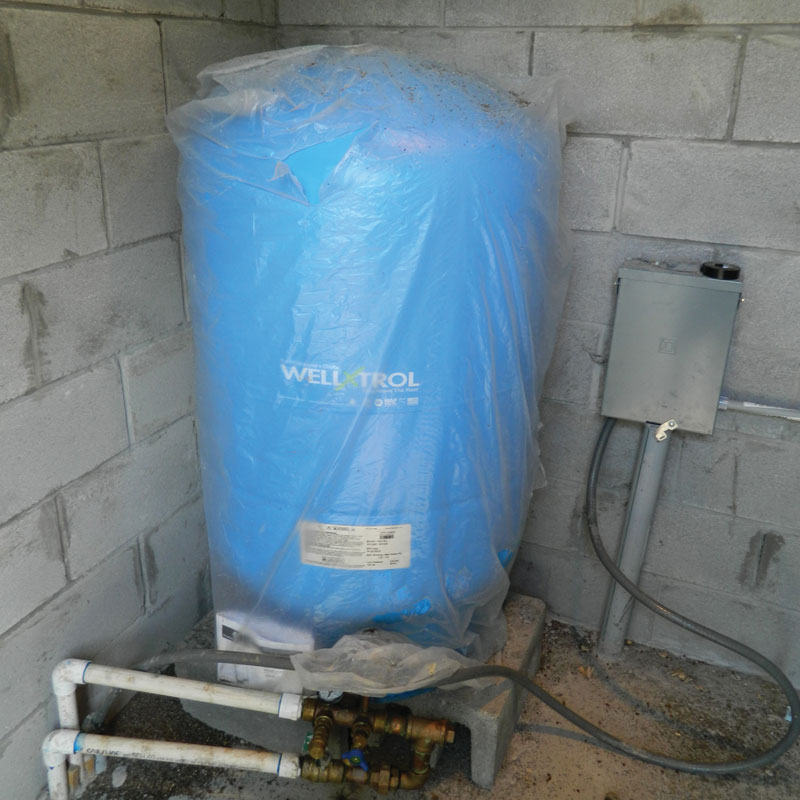
The size of the constant air pressure tank that you ultimately choose is another important factor that plays heavily into well location, as does the well’s intended use. 

“For a house with two people, you are going to use a 30-gallon tank,” Wooten says. “If you have six people, then you will use a 40- or 50-gallon tank.” A professional well installer can also help you to determine the appropriate size tank for your needs and farming operation. 

farm well

Pump Horsepower

Well location also affects the size of the well pump you’ll need to use. “The depth of the well is the biggest factor here,” Wooten says. 

Pumps range in size from half horsepower to a horse and a half. The deeper the well is, the larger the well pump will need to be.

Digging a Well

After considerable thought into your initial needs, it’s now time to dig your well. While it’s of course possible to dig a well by hand, most will make use of a well-drilling company. 

“There are two types of well digging,” Wooten says. “You can drill, and then there’s a churn. The churn drills don’t spin, and people like it because it opens up streams and you have a better water flow.”

However, the churn type has now become almost obsolete in favor of the drill. 


Read more: Here are some basics on water cistern location and maintenance.


Well House Design

If a well house is to be used, its construction is your next consideration. Traditionally, well houses were small and constructed over the well pump. The design allowed for the use of a heat lamp to prevent freezing during the winter season.

While this type of well house is still in use today, it’s becoming increasingly common to have the well dug 20 to 30 feet from the house and locate the tank somewhere in the house. This type of design makes it easier to make repairs on the well should a problem arise.

Though they add to the overall expense of well-house construction, the installation of a concrete floor, light fixtures and electrical outlets contribute to the ease of use of your well house. They make it easier to heat in the winter season as well as for maintenance and any repairs needs that may occur.

Finally, as their requirements differ, the type of well pump used will also play a role in your well house design. “There are two types of pumps,” Wooten says. “There’s a jet pump, and there’s a submergible pump.” 

Jet pumps are on top of the ground connecting to the pipes down below, and are more commonly used for a shallow well. Wooten prefers the submergible pump because they don’t have to be primed.

“Most people are moving away from the jet pump,” he says.

Well Maintenance

Once you have your well installed and your well house built, start thinking about how you’ll maintain your well going forward. Freeze prevention is a large part of maintaining your well. Wooten advises wrapping your pipes and, depending upon the location of your well pump, making use of a heat lamp inside the well house. 

Temperature control wraps can be used, and twice a year you should check the air pressure in your constant air tank and check for leaks. Wooten typically doesn’t flush the lines unless the water becomes muddy. 

Installing and maintaining a farm well may seem like a daunting task. But with careful planning and research, it can prove to be a valuable long-term asset to your farm. City water, while convenient, can be an expensive venture, and while you may be fortunate enough to be located near a creek or stream, there is an increasing push to keep livestock out of these waterways to reduce erosion, contamination and more. 

If you have an interest in installing a well on your farm, advice and sometimes also financial assistance is available through your local U.S. Department of Agriculture office to help with well installation, the purchasing of livestock and irrigation watering systems and more. 

This article originally appeared in the November/December 2022 issue of Hobby Farms magazine.

Categories
Animals Farm & Garden Large Animals

Breed Profile: Get To Know The Beefalo!

The Beefalo has been around for quite some time. Back in the late 1880s, several early pioneers saw the hardiness of the bison as a very positive trait but also wanted the docile nature of the domestic cow.

They had hoped to have an animal that could handle the harsh cold winters and extremely hot summers, while also being more manageable. 

Introducing the Beefalo

In the 1970s, someone decided to start marketing Beefalo. By the 1980s, the USDA recognized the animals as its own breed for a number of significant reasons. Of primary interest were the breed’s:

  • longer reproductive lifespans
  • smaller birth size for ease in calving (yet a rapid rate of gain with forage/roughage feeding without grains or hormones
  • extreme climate adaptability (cold or hot)
  • maternal instincts
  • great milking
  • high conception rates
  • disease resistance
  • superior carcass structure, quality and healthy meat 

The nutritional values have shown that the breed’s meat has a superior vitamin level, higher protein, nearly 13 less cholesterol, 79 percent less fat and 66 percent less calories than conventional beef.

So, Beefalo show to be profitable in the pasture and healthy in the food market. 


Read more: Consider raising these 5 unusual livestock breeds!


What Is a Beefalo?

A common misconception about the Beefalo is that it’s half cow and half bison. Those animals, however, are bison hybrids, also called Cattalo.

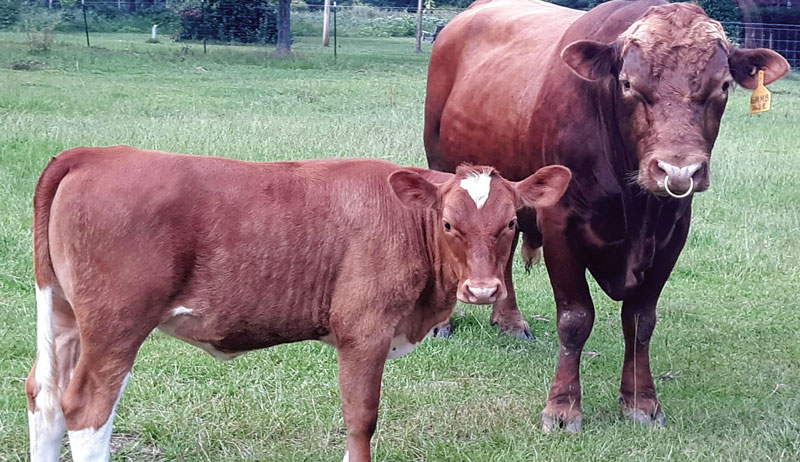
The USDA recognizes a fullblood Beefalo as containing 37.5 percent bison or 3⁄8 bison. Various domesticated cattle breeds are selected for desirable qualities to produce the remaining 5⁄8 heritage. Through all the crossing that was done to produce the breed, it was determined that this was the sweet spot, allowing all the best qualities of both animals to be present. 

When you cross bison with domestic cattle, females from that cross prove to be fertile most of the time. Males, however, do not. The bison percentage had to be brought down to get a fertile male. The American Beefalo Association recognizes any animal containing 17 to 37.5 percent bison as a Beefalo.

A purebred Beefalo contains 34 to 37.49 percent bison, and if used on domestic cattle, will produce a halfblood Beefalo containing 17 percent or more bison.

Note: Any animal containing 17 percent or more bison will give you the hybrid vigor and nutritional value that you are looking for. A lot of beginning breeders started out with just a purebred or fullblood bull and breed it to their domestic herd. They kept those heifers slowly increasing their bison content of their herd.

So, you don’t need to start with a bison to get Beefalo.

To maintain the breed, the ABA requires that all fullblood animals be DNA-proven back to both the sire and dam. There are some breeders that focus on crossing bison with domestic cattle to provide new bloodlines. The fullblood Beefalo produced from these crosses also must be DNA-proven back to the original bison to maintain the accuracy of the breed.

This article originally appeared in the November/December 2022 issue of Hobby Farms magazine.

Categories
Crops & Gardening Farm & Garden Homesteading News

Success Is Sweet For This Teenage Maple Syrup Maker

Will Wanish, an 18-year-old recent high-school graduate, knows exactly what he wants to do for his future: manage his own business and build his passion for maple syrup. While some 2022 graduates are planning for college or working for someone else, Will is an entrepreneur at heart and has been shaping his future for at least five years—driven and dedicated to securing “liquid gold” from maple trees.

He began tapping maple trees with his uncle, Jon, in the Cadott, Wisconsin, area. Then, the next season, he decided to have about 50 tree taps in his yard.

Each year since that time, he has added trees and modified his operation. In 2019, he decided that he wanted to focus on this as a business. So he had a conversation with his mom and dad, Todd and Heather Wanish.

During that discussion, both parents told him that a business was completely different than a hobby. They said he needed to have a plan for funding, sales and future opportunities.

“We made a list of the equipment he would need, potential sales he could make and how he would be able to make this actually work,” Todd says.

Wanish Sugar Bush maple syrup

Starting from Scratch

After reiterating this was a long-term plan, Will decided to move forward. He was able to secure a $30,000 loan from a local regional business fund. This allowed him to purchase an evaporator and a reverse osmosis machine.

“Without the help of Chippewa County Economic Development Corporation and the Regional Business Fund, I wouldn’t have been able to get my business off the ground,” Will says.

During the 2020 spring season, he cooked down approximately 22,000 gallons of sap into maple syrup. Then, the COVID-19 pandemic changed everything, and Will had to look beyond farmers markets and events for sales. He was able to get licensed and inspected, allowing him to sell his syrup via wholesale methods to stores.

“Currently, my maple syrup is in approximately 150 stores throughout Wisconsin and Minnesota,” he says. During 2020 and 2021, sales remained extremely strong and business kept expanding. Will, Todd and Heather took things on the road to build sales and secure new accounts.


Read more: Start sugaring your own maple syrup!


Sweet Success

Then during the spring 2021 sap season, Will received a call from Boyd Huppert, a KARE-11 NBC reporter from Minneapolis. He featured Will and his business on The Land of 10,000 Stories, an award-winning segment on the station. Within minutes of airing, hundreds of orders came through the Wanish Sugar Bush website.

Individual sales catapulted. 

“The exposure we received from the KARE-11 story has been amazing. We are so appreciative that [Huppert] wanted to share Will’s story,” Heather says. For spring 2022, Will made approximately 3,200 gallons of maple syrup and is already planning for next year.

He traveled to Vermont and toured several maple equipment production facilities. He has now ordered an evaporator twice as big as his first one, as well as a new reverse osmosis system, and is planning an expansion to his syrup shed. Furthermore, he has hopes to add more taps, build his tubing system, enhance efficiencies and potentially expand into other products beyond the maple syrup and maple sugar he currently offers. 

Will’s parents are proud of his accomplishments. They know he’ll be successful in whatever he chooses to do.

“He is always on the go, enjoys working and is not a teenager that has ever just sat around,” Todd says.

“I couldn’t be more excited for what he has done so far,” Heather says. “There aren’t many kids his age who can say that they have a successful business already.”

Will is confident that he can make Wanish Sugar Bush a success story well into the future. “This is what I want to do,” he says. “And it’s not an option to not be successful. I know that I can continue to grow and build this business.”

This article originally appeared in the November/December 2022 issue of Hobby Farms magazine.

Categories
Beginning Farmers Crops & Gardening Farm & Garden Permaculture

Soil Health & Equipment: The Power Of Soil Aggregates

The soil aggregate is a house for soil life, with macropores and micropores (openings) holding air and water within a mineral (bricks) and SOM (mortar) matrix. Compaction reduces porosity. Macropores (> .08mm) hold water when it rains and let it drain freely afterward. This allows air to return to help oxygenate soil for aerobic processes like decomposition.

Micropores (< .08mm) store water longer-term for crops. There are even ultra-micropores in soils that contain activated carbons!  

All About Aggregates

Overall, soil aggregates have huge (but microscopic) surface areas when the edges and planes of various mineral and organic materials are taken into account. These surfaces provide points for adhesion of water molecules and nutrient ions to soil surfaces and cohesion of molecules to each other within porous soil spaces.

Well-aggregated soils have a high cation exchange capacity (CEC). This means they hold and release more nutrients and water than soils with low CEC.

Soil life also thrives within these soils and helps regenerate them by connecting the soil’s water, nutrient and communication pathways as it shreds organic matter for decomposition, excretes micro manure, and fixes nitrogen right out of the atmosphere.

By building below-the-surface habitat, we regenerate nitrogen-fixing bacteria, mycorrhizal fungi and other beneficial organisms. 


Read more: Organic no-till is good for you and the land.


How to Improve Soil Using Equipment 

It is important to understand not only how to reduce harm to soil and soil aggregates from equipment (which is what S4-tillage is all about) but also how to use equipment to improve soil. Equipment can help improve your soil if it allows more soil-beneficial processes to occur each year.  

  • Spreader: Applying compost is a great way to build and boost soil health. Soil organisms eat and live in soil organic matter (SOM). SOM helps to cycle and store water and nutrient. 
soil aggregates
courtesy of Zach Loeks
  • Flail Mower: Efficient cover crop, green manure and crop debris management adds SOM and nutrients and mulch to the soil. 
  • Rear-Tine Tiller is used to blend compost, crop and cover crop bits into soil. Shallow introduction of oxygen and debris-rich material allows the soil life to consume and transform it in the A horizon. 
  • Power Harrow doesn’t invert the soil and can be used to work deeper into the soil profile without mixing the A and B horizons. This keeps soil healthier for more self-regulation. Even the prairies had disturbance from bison, and prairies made great soil!
  • Power Ridger reforms Permabeds with in situ compost in paths. By focusing aggressive actions in paths, we maintain the ecosystem mimicry of a natural soil on the bed top.
  • Roller/Crimper is used to maximize the leaf litter effect of forests and grasslands with in situ mulch that protects soil from heat/cold temperature extremes, heavy rainfall, snow melt erosion and compaction from equipment. Plus, the debris blocks weeds!

Grow On,

Zach

For more on growing with two-wheel tractors, check out Zach’s new book: The Two-Wheel Tractor Handbook, available for pre-order from New Society Publishers.

Categories
Animals Chicken Coops & Housing Farm & Garden Poultry

This Cool Chicken Coop Keeps It Cool In South Carolina

We bought our homestead in 2021 and named it the “Lil S Farm.” Our first major project after building the house was building a chicken coop. We spent hours looking at hundreds of different types of coops and even bought plans for several of them.

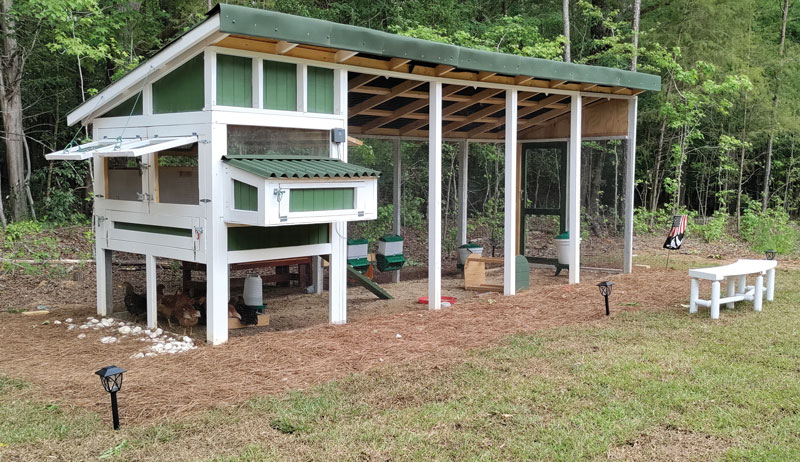
In the end, no single plan fit our needs. So, I made my own—a 6-by-4-foot coop with a 20-foot run. 


Read more: Here’s how to get your kit chicken coop ready for winter,


Keep It Dry

One issue with coops is keeping the run dry. Usually, this is rectified by intensely grading the area, but this can be costly.

To save money, I designed our coop with a lean-to roof rather than a gable. This allows the water to shed to one side, which makes grading much easier and cut down our costs. 

With the roof, we used corrugated asphalt panels rather than steel, tin or traditional shingles. The asphalt panels were much easier to cut, handle and fasten than the other materials.

Our roof has already withstood a very bad storm where we had winds up to 70 miles per hour. Choosing asphalt panels was one of my best decisions on coop construction.

chicken coop

Ventilation 

The coop itself has two very large windows with two smaller windows built in the two coop doors. This allows plenty of ventilation. Our girls love to sit on their roost and look out the windows. 

The third window above the egg hutch is a Plexi­glas window that doesn’t open. For design purposes, this was easier to build because of the lack of clearance above the hutch’s roof paneling. But it also gave the chickens a wonderful view when it rains. Right before we close the coop up for the night, the pecking order gets quite competitive on who gets to roost by that window.

chicken coop

Security First

For security, we have PVC-coated 14-inch hardware cloth throughout the run, on every window, and skirted around the whole coop. We also have locking latches on all openings.

A team of raccoons has tried multiple times to get to our girls without success. Our coop has proven to be predator-proof.  

Around the coop, we have benches so we can sit in the mornings and afternoons to talk to our girls. It has become a full family affair to congregate in the evenings around the henhouse. Our girls seem to love their home, and our family loves having them on our “Lil S Farm.”   Brad, Katie & Meekin Stokes, Chapin, South Carolina

This article originally appeared in the November/December 2022 issue of Chickens magazine as a “Cool Coop” feature. Have a cool coop you’d like to share? Email us a short write-up (~250 to 500 words) about your chicken coop along with a few images to chickens@chickensmagazine.com with the subject line One Cool Coop, and include your name and mailing address. Check out Chickens magazine for current prizes and contest rules.

Categories
Crops & Gardening Farm & Garden Foraging

Harvest Creeping Charlie For Its Respiratory Benefits

When a plant has this many nicknames, you know it has been special to humans for a long time. Glechoma hederaceae, known more commonly in my neck of the woods as creeping Charlie, alehoof, gill over the ground or ground ivy, has a heavenly aroma when prepared as a tea or extract.

It has been employed for centuries as a respiratory support, helping to clear sinuses, lungs and ear complaints.

Get to Know Creeping Charlie

Ingestion of this plant does not come with cautions. But, before harvesting for the first time, please have a knowledgeable person there with you to corroborate its identification. Once you have smelled and tasted creeping Charlie, you will have the sensory input you need to gain confidence next time.

Creeping Charlie is widespread here (in the eastern states) as a common “pest” in the mulched garden or landscape. It provides fresh aerial parts to harvest nearly year round.

If you really can’t find it in the garden or the wild, some nurseries sell ornamental varieties. You will, however, want to smell those to be sure that aromatic qualities are present. That’s the good stuff you want flavoring your teas and getting into your sinuses as you inhale its steam.

Creeping Charlie loves to run along disturbed moist areas and seems to have almost no roots. It’s interesting that its aerial parts are most dominant, while the plant itself has an affinity for the parts of our body used to breathe.


Read more: Check out these 5 tips for drying homegrown herbs.


Harvesting Creeping Charlie

Harvesting creeping Charlie is easy! Regeneration is not a concern with this plant, as it grows in quantity. We can just grab it by the handful and its tiny roots give way, leaving behind broken strands that will quickly recolonize. But do consider the folk herbalists’ tradition of giving thanks to this abundant plant that can be gathered almost as easily as air, and whose benefits will increase with your gratitude.

You can usually find a friend who does not use weed killers or other harmful sprays and is happy to have help removing ground ivy from their pathways and beds. Their frustration may even ease a bit when they taste the fresh salad you share or clear a cough with the extract you trade.

When you have correctly identified creeping Charlie, pinch it between your fingers to smell its aromatic offerings and begin to create a sensory memory in your brain. Then put a leaf in your mouth and chew very slowly. Or let it dissolve as if it were a lozenge.

If that leaves you with a good taste in your mouth, you’ve got a new addition to fresh salads or a secret soup ingredient with which to stump your guests.

Tea Time!

Above all—and ideally before you decide to go to the effort of harvesting a lot of alehoof—celebrate meeting this plant with a cup of tea! I hope you love it as much as I do, but, of course, no plant is for everyone.

Taste and see for yourself with a few handfuls into a quart jar of just-boiled water. Steep covered for about 10 minutes. This will introduce you to the plant and teach you at what strength you most like it.

Preserving Creeping Charlie

The strongest aromas (and herbal potency) will be found in the flowering plant harvested midmorning, after dew has evaporated but before the sun draws insects to the flowers.

However, the best time to harvest any herb is when you know you‘ll have time to finish the processing part of preserving it. Don’t let it sit on the counter for days. Put it in the dehydrator immediately (at 80 degrees or less for herbs). Or hang it up in paper bags, filling bags only about a third full, out of the sun and with good air circulation.

You‘ll know it’s ready to put up into airtight containers when the crispy leaves break when bent. They’re too dry if they crumble to dust.

This plant loses its potency, flavor and color at the same rate. So while the shelf life is shorter than many dried herbs (about three months), you‘ll be able to observe the loss of color and flavor and decide for yourself when it’s time to renew your supply. The flowers are especially telling as they transform with time from brilliant blue to pale grey.

For in-depth herbal uses and more help with identification, check out this article from one of the most accessible experienced teachers in the eastern U.S., jim mcdonald.

Note: This information is for educational purposes and not intended to diagnose, treat or cure disease. The FDA does not evaluate herbal actions.

Categories
Crops & Gardening Equipment

5 New Year’s Farming Resolutions For 2023

Happy New Year! While there are still a few more days left in 2022, I’m always glad to welcome a new year. I am excited to see what 2023 has in store. Do you have any farming resolutions? Think how much can be accomplished in 365 days!

I’m already making plans for farming projects I intend to tackle in 2023. I suppose you could call them New Year’s resolutions, but I think of them more as inspiration, both for myself and (hopefully) for readers.

I’ve shared my farming resolutions every year since 2016. The goal of this annual exercise isn’t to compile a list of resolutions that must be followed at all costs. Rather, I hope to encourage proactive thinking about fun projects to accomplish during the coming year.

With this goal in mind, here are five of my 2023 New Year’s farming resolutions.

1. Run Garden Hoses to My Orchard

The young orchard I started planting in 2018 is thriving. Every year I expand it a little bit, focusing the last couple of years on adding a garden section with raised beds for growing corn and pumpkins. But my orchard is about 600 feet away from the nearest water source. And the 35-gallon leg tank I’ve traditionally used to supplement rainfall is no longer a time-efficient way to keep everything watered.

I’ve thought about getting a second (or larger) tank. But after reevaluating my options I’ve decided to run a long line of garden hoses to my orchard instead.

I experimented with hoses a couple months ago and found water pressure was still suitable even across the 600-foot distance. So in 2023 I intend to run hoses directly to my garden beds and simplify the process of watering everything thoroughly.


Read more: A 35-gallon leg tank can really help with your orchard irrigation efforts.


2. Continue Post-Storm Tree Cleanup

The impact of the powerful December 2021 thunderstorm that blew down a couple dozen trees across my farm can still be felt. While I made great progress addressing the biggest messes in 2022 (calling in professionals was a big help), there’s still more to be done in 2023.

As soon as the ground dries out sufficiently in spring to allow a tractor and cart to drive around without risk of getting stuck, I’ll resume cleanup with an eye on completely conquering the storm debris

3. Prune My Fruit Trees

Many of the young fruit trees in my orchard grew with incredible vigor in 2022. It was by far their best year so far from a growing standpoint, suggesting the trees are settling in nicely and hopefully preparing to produce impressive fruit crops in the coming years.

But left unsupervised, fruit trees don’t necessarily grow in the best manner for fruit production. Some of the branches on my trees are lower than I would prefer for mowing. Others are a bit too upright, or too long and gangly.

My fruit trees need corrective pruning to shape them favorably for healthy and productive lives. You can bet I’ll be busy with my pruning tools in late winter.

4. Invest in Anvil Pruning Loppers

This is actually unrelated to Resolution 3, because anvil pruning loppers aren’t really suitable for cleanly cutting delicate live growth. But the crushing strength of anvil pruning loppers (as opposed to the slicing action of bypass pruning loppers) makes them perfect for removing limbs from dead trees and cutting up fallen branches.

A pair of anvil pruning loppers will serve me well as I execute Resolution 2.


Read more: Do you need bypass or pruning loppers? Let’s take a look.


5. Build a Bridge in My Orchard

For a couple of years now I’ve wanted to build a wooden bridge over a low spot in my orchard where water gathers in the spring and after heavy rainfalls. I’ve already removed sod from along the path of this natural “stream” and backfilled it with rounded stones, giving the impression of a streambed. I’ve also planted water-loving irises along the banks.

Building the bridge is high on my list of “just for fun” projects in 2023. It will serve as the focal point of a highly picturesque orchard area.

What are your New Year’s farming resolutions for 2023?