Categories
Animals Poultry Urban Farming

What Are Bantams?

If you’re new to chicken keeping, you might not be familiar with bantams yet, but they’re not too complicated to understand. As Karen Unrath, the American Bantam Association secretary, explains, they’re basically miniature chickens.

“Many bantams were bred from their large-fowl counterparts,” she says. “Examples include the Plymouth Rock, Rhode Island Red and even the Brahma Bantams. However, many bantams, often referred to as true bantams, have no large counterpart. These are beautiful ornamental birds bred hundreds of years ago, many in Europe and the Far East. These include the Rosecomb Bantam, Japanese Bantam, Belgian d’Anver Bantam, Sebrights and many more.”

The bantam standard recognizes 63 breeds and 415 varieties. The variety of a breed is the recognized color or color pattern of that breed. For example: Sebright bantams are recognized in two varieties, Golden and Silver. Bantam breeds are divided into seven classes:

  • Modern Game
  • Game (American and Old English)
  • Single Comb Clean Legged
  • Rose Comb Clean Legged
  • Feather Legged
  • Any Other Comb Clean Legged
  • Bantam Ducks

Why Keep Smaller Chickens?

Bantams certainly have some advantages over their full-sized counterparts. They consume less feed, so are cheaper to keep and create less waste, and they take up less space, making them great for small backyards and urban environments. They can also be easier to handle due to their small stature, which is especially good for young people and the elderly, and they have big, fun personalities.

Their eggs are smaller: It usually takes two bantam eggs to equal one regular egg in a standard recipe. And while most breeds aren’t typically raised for meat, they still have a function beyond laying eggs, according to Unrath: “They are all dual-purpose—eggs and pleasure!”

ABA OK

The ABA has been around since a small group of bantam breeders split off from The American Poultry Association in 1914 to form the Chicago Bantam Club, later renamed and reorganized as the American Bantam Association. The organization celebrated its 100th Anniversary Centennial show in Columbus, Ohio, in November 2014.

“It was a great show with more than 10,000 birds exhibited,” Unrath says. “It was three full days of events, judging and lots of great people to chat with.”

Most ABA sanctioned shows also have a youth show with separate recognition prizes; sometimes the youth compete with the adults. Some youth shows have such a large junior turnout that they sanction the junior shows separately.

“The junior movement in the poultry show world is growing each and every year,” Unrath says. “We are very excited about this and hope this trend continues.”

Unrath believes the trend is rising due to the relatively inexpensive nature of showing chickens (as opposed to larger livestock), the smaller size and easier-to-handle nature of bantams and the number of suburbanites opting to keeping small flocks in their backyard these days.

“The world of show poultry is very inviting,” she says. “It welcomes new and interested kids easily, and it’s a natural fit to many 4-H programs. You don’t have to be the fastest runner, strongest jumper, best speller or have off-the-charts SAT scores to excel in the showroom. You do have to have patience, a good eye and understanding of your breed, a game plan for keeping your birds in condition and a little luck.”

A separate organization, called Youth Exhibition Poultry Association, is headquartered in Philadelphia, Tenn.

In addition to sanctioned shows and the annual, the ABA has been offering seamless leg bands since the early 1970s. These plastic leg bands are individually numbered, permanent and put on young birds. Each year, the bands are inscribed with the current year. “They are extremely helpful to the serious breeder and even the backyarder who wants to be able to know the age of his birds forever,” Unrath says. “The ABA has all the numbers registered. If a person purchases a bird with an ABA leg band, we are able to let the person know who originally purchased the band, which is very helpful when working on the breeding program.” Currently, the ABA dispenses more than 25,000 leg bands annually.

Anyone can join the ABA and showing your birds is easy, once you get started. Membership dues are $25 per year or $70 for three years. All members receive three newsletters per year plus the annual ABA yearbook, which is a huge resource. Also, at the poultry shows, you will meet many ABA members, and “once an ABA member,” Unrath says, “you will likely stay as long as your bird interest remains.”

Small But Popular

If you’re thinking of adding bantam breeds to your flock for the first time, go with a trusted breed. Here are the top-10 most popular bantam chicken breeds registered with the ABA:

  1. Old English Game Bantam
  2. Modern Game Bantam
  3. Silkie
  4. Wyandotte Bantam
  5. Cochin Bantam
  6. Plymouth Rock Bantam
  7. Serama
  8. Rhode Island Red Bantam
  9. Sebright
  10. Cornish Bantam

Hovering just outside the top 10 of the ABA registration list are Brahma Bantam, Belgian d’Anvers, Leghorn Bantam, Belgian d’Uccles, Japanese, Polish and Dutch Bantam.

If eggs are what you’re after, Japanese Bantams, Leghorn Bantams, Plymouth Rock Bantams, Rhode Island Red Bantams and Wyandotte Bantams are all good picks.

Categories
Beekeeping Beginning Farmers

How Our First Honey Harvest Made Me A Beekeeper For Life

Just prior to learning about our new fate as farmers, I spoke these words out loud, quite plainly, to a friend:

“I don’t see myself ever keeping bees. They’re just so … mysterious.”

Now, let me explain this sentiment. It’s not that I don’t love honey and revere the work that bees do. In fact, it’s that reverence that led me to believe I didn’t deserve to be a beekeeper. Bees are amazing little creatures, each individual working diligently through their entire lifespan as part of a greater whole to create the most perfect product that could ever come out of your farm. I can’t even wrap my head around it. I, in contrast, am not as disciplined. I’m a creative soul, a dreamer, who likes to jump into projects on whims, not necessarily seeing them through to fruition. While I admire any being who can methodically work their way through a process, I’m not at all like that. I didn’t think the bees needed me up in their business, mucking things up.

Well, hindsight is pretty hilarious, isn’t it? Just a few weeks after declaring myself a non-beekeeper, Mr. B and I learned about our new 50 acres—a piece of land with which we would inherit, you guessed it, a hive of bees.

Don’t get me wrong—we were pumped. But with honey production already underway, we had a lot to catch up on. Of course, I deferred beekeeping responsibilities to Mr. B, an engineer who could nerd out on the feats of our newly acquired colony—these insects are like his “people,” and I was content to merely be a helping hand.

So, I called my beekeeper friend and beeswax supplier to help us get to know our bees a little better.

honey
Rachael Brugger

We suited up, opened the hive and, not to be biased or anything, discovered that we have the best bees on the planet! Gentle, healthy and abundant, they’d already been hard at work making us a welcome home present: lots and lots of honey.

Despite having a million other things on our plate regarding the move and getting the farm in working order, honey harvesting jumped to to the top of our to-do list. With some loaned equipment and the guidance of our bee mentor, we pulled 15 full frames of honey from the hive: nine left by the previous owners containing fall-made honey and six with newer spring honey.

Rather crudely, we uncapped the comb using a dull kitchen knife, but the honey oozed out with amazing beauty. The sticky syrup drenched our fingers, and we couldn’t resist helping ourselves to more than our fair share of taste tests.

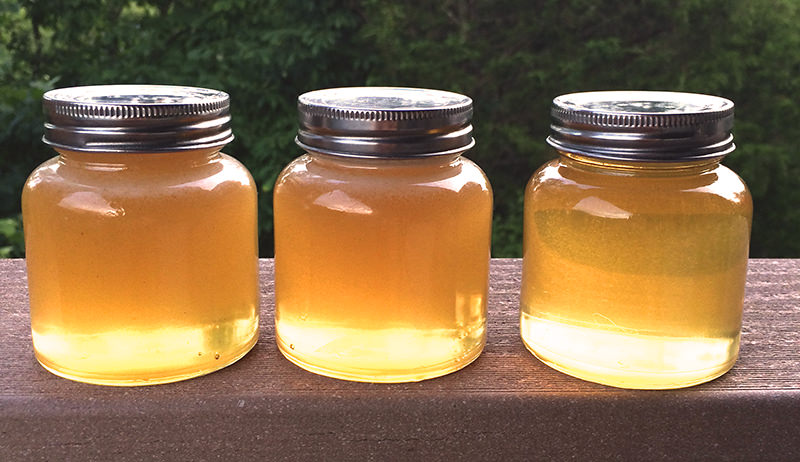
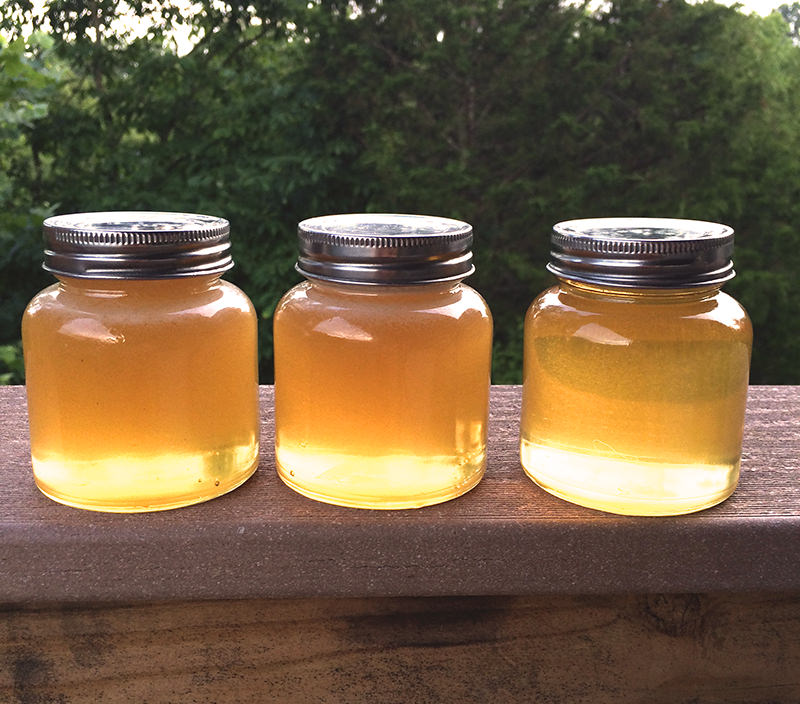
And y’all, I’m so sorry you can’t taste it, but honey doesn’t get any better than this. (Again, it’s not like I’m biased or anything.) In the lighter spring honey, you can pick up the floral notes of the flowers growing in our meadows: the butterfly milkweed and the red buds and vetch all coming through. It’s my favorite. The fall honey, a little darker and cloudier, has a deep richness to it—Mr. B says it would make a great pancake topping.

The biggest treat out of all of this, though, was something I learned about myself: I love keeping bees!

I love opening the hive and hearing the buzz of the bees fanning their honey. I love the thrill of the tiny insects flying around me as I pull out the frames. I love the care the bees take to build their comb, forage for their food, fill the cells and, with the skill of a chef, cap the cells when the honey reaches just the right moisture content so that it can be perfectly preserved. I love the viscosity of the honey as it pours out of the comb once it’s been uncapped, and the variety of flavors it takes on depending on the season and surroundings.

I still don’t quite understand how bees do what they do, and I’m not sure that I ever will. But there’s so much beauty in the mysterious—to know that we humans, no matter how hard we try, can never replicate something so perfect.

Categories
Farm Management

Make Your Property a Farmcation Destination

Up early to feed horses, move cows and check fences, Melissa Libby loves every minute of her day. Ranch work out West isn’t her profession, though—she’s a New Jersey-native consumer-safety officer for the Food and Drug Administration. For two years, ranching at McGinnis Meadows Cattle & Guest Ranch in Libby, Mont., was her vacation—her farmcation. Like an increasing number of non-farmers with agricultural and culinary interests, Libby opted to use her days off from her full-time work to escape to the country and become connected to a lifelong passion—in her case, horses.

Libby is a dressage rider, not typically known to go roping cattle, but she learned horsemanship techniques at McGinnis Ranch that she was able to take home and use with her own horses.

“My Dutch Warmblood back home was 3 years old the first year I went, and the groundwork the ranch taught me really helped me teach him. I still use it to this day,” Libby says.

Being able to connect people to rural living in this way is a reason many farm-stay operators want to host guests on their farms. The McGinnis Ranch is a large, full-time ranching operation that hosts many visitors at a time, but farm stays can be as small as a single cabin on your property that works with your schedule and provides a little extra income for your farm.

When John and Marni Rapf purchased the 100-acre Butter Creek Ranch in Hyampom, Calif., the property already had a small cabin—just a one-bedroom cottage perfect for couples. They started renting it when they had a small, personal orchard and garden. Their operation now includes a 2-acre vineyard and a winery, and they quickly found that guests were interested in helping out with work they were doing.

“Generally speaking, they might pick grapes for an hour, but they don’t usually do hands-on work for all that long,” Marni Rapf says. Afterward, guests like to tour the winery and watch the wine-making process.

For Jean Eagleston and her husband, Terry Sapp, the farm came before the farm stay. Their Hoehn Bend Farm in Sedro-Woolley, Wash., also had a house on the property, but the couple used it as a rental home. They were becoming disillusioned with the renting process when a friend sent them a New York Times Sunday Review article about farm stays. All it took was a few calls to local bed-and-breakfasts for advice and a rough business plan for guidance, and Farm Stay Skagit at Hoehn Bend Farm was launched.

Know These Things Before You Start

Farm-stay operators attest to positive experiences hosting farmcationers, but also admit it’s not for everyone. Here are seven things to keep in mind before launching a farm stay:

1. You Must Follow the Law

Check county and city laws regarding farm-stay and bed-and-breakfast arrangements. Learn the definition of these entities to see how the operation you’re considering fits in legal standards. You might not be able to offer food to guests, depending on laws in your area regarding commercial kitchens and the exchange of money for grub.

At The Farm in Danville, Ky., Roy and Angie Martin provide a full country breakfast to guests, and a local, family-owned restaurant has a special seating area for The Farm’s guests for lunch and dinner-—the farm stay is only structured as a bed-and-breakfast, and the Martins allow guests to enjoy local dining options for the other meals of the day.

At High Breeze House and Farm in Highland Lakes, N.J., guests have a cabin to themselves, including a fully equipped unstocked kitchen.

“Many of [the guests] buy ingredients grown here on the farm (produce, meat, eggs and maple syrup), but they prepare all of their food on their own,” explains Jess Clark, who operates the farm stay with Bill Becker. Many counties and states require a commercial kitchen to serve food to guests. Developing a commercial kitchen on-farm has a lot of benefits, but it’s also costly if it doesn’t fit into the farm’s business plan.

“Talking to your extension, local business development [Small Business Development Center] and planning department are best done before you invest in a farm stay,” says Scottie Jones, owner of Leaping Lamb Farm in Alsea, Ore., and founder of the U.S. Farm Stay Association, a nonprofit established in 2010 offering support for farm-stay operators. “You also might find you need to educate your local regulatory agencies about farm stays. Start with the term ‘bed and breakfast,’ and work from there. (This is also true for insurance!)”

2. Research Is Crucial

Some farm-stay operators in have had experience with rental properties or the hospitality industry before offering accommodations on their own farms. If you’re not so lucky, there’s help.

Jones’ farm-stay directory website, FarmStayUS.com, has a host of information about starting and running a farm stay, and the USFSA offers networking opportunities. Do an Internet search for agritourism resources, and you’ll likely find cooperative extension and other farm- and tourism-related business resources in your area.

Additionally, Jones used her friends as guinea pigs for Leaping Lamb Farm’s first farm-stay season, asking them for feedback about items that would make their stay more comfortable and anything she could do better as a host. In return, she got ideas ranging from a guest book that includes farm rules to a luggage rack so guests don’t ruin the bedspreads by putting luggage on them. Also draw on your own time spent vacationing: What did you like or dislike about various accommodations?

3. Guests Are Not Free Labor

Be prepared for people of all ages and abilities to want to help around the farm, especially if adorable baby animals are involved.

“Guests are invited to join us for morning chores at 9 a.m., where we are happy to have them gather eggs, feed the pigs and try milking if they’d like. We move at a leisurely pace and talk a lot,” Clark says. “Usually, after doing morning chores, they are happy to be on their way to another activity, though they are welcome to spend as much time on the farm as they’d like. They will often hike on the farm or picnic on the farm, but we have not found that people take vacations to squat in the blistering sun and weed thistles out of the garden. They’re here for the romance of it, which means that they are not in our way or keep us from getting the work done.”

Have your regular chores structured in a routine that makes it easy for guests to join. Keep in mind additional work that can be done by the extra-willing. Eagleston has had kids want to clean the barn and chicken coop, scrub water troughs, and help pick up litter in the driveway.

“During lambing season, I actually get help with all the veterinary responsibilities, as well,” Jones says. “This might include filling syringes with vaccines, writing notes, holding lambs, bottle-feeding bummers, even collecting lambs out in the fields and helping me to bring them in with their mothers to the barn.”

When guests help Jones harvest berries or vegetables, they keep half and Jones keeps half, providing a nice reward for a little easy work. The activities you engage your guests in should depend on your level of comfort having people work around your farm.

Larger farm stays, such as The Farm, might host a guided barn tour and classes each day so guests get the full experience.

“Guests usually all like the butter-making class and the milking of the goats,” Angie Martin says. “During the summer, a favorite is milking the goats; then we turn it into homemade goat’s-milk freezer ice cream. After all the hard work, the ice cream tastes so much better.” There is a charge for the tour and classes, but she builds those into a farm-stay price package for guests.

Common sense dictates that guests shouldn’t partake in certain activities, including those involving machinery—which is the first thing many guests will ask about!

While it’s not the norm, don’t take it personally if a guest doesn’t want to participate. “There are some people who come to just get away from life,” Eagleston says. “We’ve had a couple of folks who’ve been writers, and the house has become their writing retreat.”

4. You Will Have Less Privacy

Having quarters that are well separated is helpful for privacy’s sake, but it’s not always feasible if you’re working with an existing structure or if you’re hosting farmcationers in your home, as is the case of a bed-and-breakfast. Even with separate living spaces, you’ll have guests accompanying you for farm work, usually with many questions and photo requests. You might end up on many people’s Facebook pages, which could be good (for word-of-mouth business referral) or bad (if you’re having a bad hair day). You need to be comfortable with this idea from the get-go.

5. Set Rules & Stick to Them

If you’re an “anything goes” kind of person, you’ll need to rethink this approach. There are numerous ways in which an inexperienced person can get hurt on a farm. You might think you’re coming across as a stickler by introducing rules, but they’re necessary for making everyone’s experience—yours, your guests’ and your animals’—as safe and fun as possible.

“Before guests book the house, they are warned that this is a real working farm with large animals, electric fences, equipment, watering holes and many other potential dangers. We ask them to be mindful and cautious and let it be known that children must be supervised at all times. We have these rules posted again in the house to remind them,” Clark says.

Rules at Leaping Lamb Farm—Jones calls them “facts”—involve gates, animals, eggs and the hayloft: “I have a Farm Facts book that is set noticeably on the coffee table in the cottage. It says, ‘Read this first!’ I also have terms and conditions and a liability waiver I include in all reservations, on my website and in the Farm Facts book. These deal with things like cancellations, noise, -illegal activities and acknowledgment that farms are dangerous places,” Jones says. “I had my lawyer review both the terms and conditions and liability waiver.”

Convincing parents that children must be supervised at all times can be a challenge. This requirement is included in Farm Stay Skagit’s rental agreement, which guests receive before arriving and is emphasized during the guests’ introductory tour upon arrival.

If your farm has animals, consider carefully whether it’s OK for guests to interact with them when you’re not around for the safety of both animals and guests.

6. This Is a Major Time Commitment

There’s time involved in listing your accommodations for rent, keeping the space tidy and in good repair, preparing the space for guests, keeping up with hazards and clean-up around the farm, meeting your guests, and interacting with guests. Thanks to plentiful websites, listing your farm stay is less time-consuming now than in pre-Internet days. Still, you need to write your description, take quality photos, and keep up with scheduling and potential farmcationers’ inquiries.

Clark estimates she spends six hours preparing High Breeze House between guests. Eagleston and Sapp do all the work surrounding Farm Stay Skagit themselves, except when a neighbor helps out with cleaning, such as when farm work is in full swing.

With the time commitment in mind, Martin blocks out time to close The Farm to guests when her family visits, and Jones takes off late fall from the farm stay to have a break herself.

“If someone is thinking about doing this, they may want to be sure that it will fit into their lives, because it becomes your life,” Martin says. “The time concerns that it takes up are no different than if you are raising a field full of corn or tobacco. It’s up in the early morning and up late at night, ‘tending your crop.’ The beauty of this ‘crop,’ however, is that you can give it a hug and welcome it to come back and see you again and again.”

7. The Rewards Are Plentiful

Especially if you’re in an area with high tourist traffic, you can get visitors from another county, state or country. “The majority of the people want to talk and want to learn,” Eagleston says. This is your opportunity to teach people about where their food comes from and about life on a small farm. More than one child has left Farm Stay Skagit wanting to be a farmer or a veterinarian when he grows up.

“I am like grandma and mom as I take families out, and we learn all sorts of interesting things, do chores that are unusual in the city, pull fresh veggies from the earth, throw rocks in the creek and make hay forts in the hay loft,” Jones says. “I have had families go home and add chickens to their backyard. I am rewarded when people want to come back for another visit.”

Like any business, running a farm stay requires commitment and a learning curve. It can provide a nice income—at least enough to cover your mortgage and taxes, in many cases—with the right time investment. And every visitor is one more person in this world who better understands rural living and farm life.

This article orignally appeared in the July/August 2014 issue of Hobby Farms.

Categories
Crops & Gardening

How To Control Iris Borers

I’ve grown bearded iris in my garden for years; in fact, these perennials are one of my favorite spring bloomers. But in recent years, my bearded iris have been plagued by a troublesome pest: the iris borer.

In early spring, my iris flowers bloom beautifully, but by mid-July the foliage begins to turn yellow and slimy. Brown splotches appear all over the sword-like leaves, and when the plants are disturbed, sometimes there’s an unpleasant odor. These are all pretty clear signs of an iris borer infestation.

Spotting The Iris Borer

Iris borers (Macronoctua onusta) are the caterpillars of a species of moth. These caterpillars spend their entire larval stage inside of an iris plant, munching on the foliage and rhizomes. The brown, slimy leaves are caused by their feeding. Eventually, all the damaged leaves will turn completely brown and shrivel up, possibly impacting next year’s flower production.

Adult iris borer moths fly around the garden at night. They’re fairly non-descript, and the females lay eggs on iris leaves in August or September. These tiny eggs sit on the leaves all winter long, and the larvae hatch the following spring. The young caterpillars burrow into the newly emerged leaves and spend weeks feeding. They move down toward the base of the plant as the season progresses, and by the time July arrives, the borers are feeding on the rhizomes.

When they reach the rhizomes, the borers tunnel through these fleshy roots and often cause the rhizomes to rot. That’s what makes infested iris plants smell so badly. I think they smell like rotten potatoes or onions.

In early August, the mature caterpillars begin to pupate in the soil around the iris plants. Pupation takes only a few weeks before a new generation of adult moths emerge and begin to lay more eggs.

Protecting Your Irises

iris
Jessica Walliser

Trim Back Foliage

The reason these pests have begun to plague me the past few years is because I’ve neglected to cut my iris plants back in the late fall. Because the eggs overwinter on the foliage, it’s very important to spend some time every autumn removing all the leaves from the plants, all the way back to the rhizomes, and tossing them into the garbage or burying them. This is best done after we get a few hard frosts and the adult moths have stopped laying eggs. I haven’t gotten to this chore the past few seasons, and as a result, my iris plants are paying the price.

Discard Infested Rhizomes

If you have iris plants that are already infested with borers, you can dig up the plants and crack open the rhizomes to reveal any borers housed inside. Throw away any soft, rotted rhizomes and replant the healthy ones. If you happen to come across any chubby, pink, hairless caterpillars in the process, be sure to squish them or feed them to your ducks or chickens.

Apply Beneficial Nematodes

Another option for those gardeners who, like me, have neglected to trim back the foliage in the fall, is to apply beneficial nematodes to your plants in the spring. The correct species of this beneficial, microscopic roundworm are Heterorhabditis or Steinernema. These little critters are mixed with water and spread over the iris plants where they seek out and kill any iris borer larvae. They’re best applied when the iris leaves are fully grown but the plants have yet to flower.

The Silver Lining

Although I’d like to rid my bearded iris plants of borers to keep the plants looking and performing their best, it’s important to note that an iris borer infestation seldom kills an established iris plant. Even if a handful of the rhizomes are damaged, the rest will go on to produce healthy flowers the following year. Except in extreme cases, iris borers don’t mean the end of the road for your bearded iris plants. Gardeners like myself just need to put in a little effort to keep them in check.

Categories
Animals Poultry

How To Hang A Chicken Waterer Off The Ground

Suspending your chickens’ waterer off the ground is critical. If you don’t, your hens will spend their day scratching and foraging, meaning a saucer of water will be filled with debris in record time. When I built our first waterer, I had plenty of scrap wood that I used to make a contraption held a 5-gallon bucket of water off the ground , and I inserted water nipples in the bottom of the bucket for hens to drink from. However, there are easier ways to suspend a waterer off the ground.

Commercial bucket holders are sturdy and easy to install, look good and will last forever. They’re basically a metal ring that holds the bucket and a couple of flanges that attach to a wall to hold the ring so it lays flat when the bucket isn’t in use. The design works well and may be just the thing for your site. However, you can also try to create something similar.

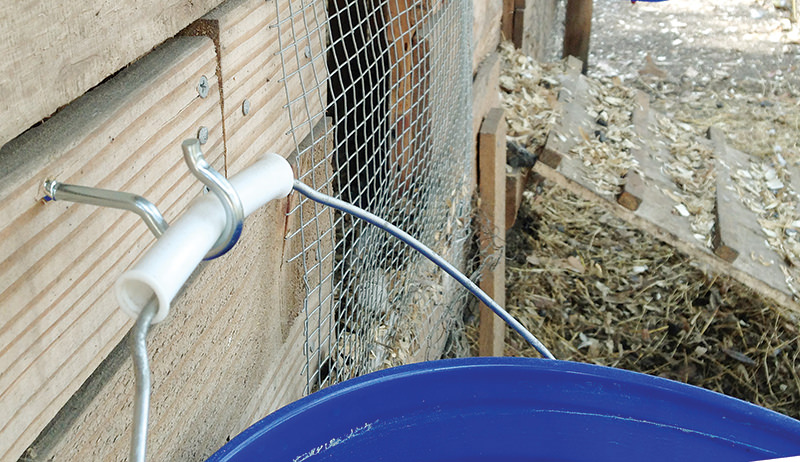
I use the kind of hook a gardener might use to suspend a hanging basket on his or her porch. Look for a zinc-coated, screw-in hook that’s at about 4 or 5 inches long. They’ll cost $1 to $2 each. You want to screw the hook into a wall or post so it will hold the bucket handle. The bottom of the bucket will need to be about 12 to 14 inches above the ground so the chickens can reach the water nipples.

Once you mark the spot where the hook needs to go, choose a drill bit that is the same diameter as the shaft. It should be narrower than the diameter of the threads of the hook. By drilling a hole that size, the shaft has room to enter the wood without splitting it, yet the threads themselves will slice into the wood.

If it’s too difficult to screw in the hook by hand, there are a couple things you can do. Rake the threads lightly across a bar of soap; some carpenters keep a bar in their tool box just for these situations. The little bits of soap act like a lubricant, making it easier for the screw to go in. As an alternative, or in addition, use a set of pliers to hold the hook end and twist it into place. If you don’t have any soap or pliers handy, put the shaft of a big screwdriver perpendicular to the hook to give you more leverage for turning the hook.

A 5-gallon bucket that is full of water is going to weigh 40 pounds (each gallon weighs 8 pounds); that’s a lot of pressure on three points of the bucket handle. Over time, the plastic tube may break, which will only make the bucket less comfortable to carry. Also, the two points where the metal handle attaches to the bucket may break, especially in cold conditions. For those reasons, this DIY option may be cheaper and faster than a commercial bucket holder, but it might not last as long because the bucket itself may fail.

Categories
Animals Poultry

This Common Nursery Material Makes The Perfect Chicken Feeder

Katie Ford had been feeding her dozens of chickens with only three small gravity feeders that needed topping up every day or two. When I showed up with a stack of 25-gallon black nursery pots, she said, “I need one of those!” She sized it up right away as a ready-made gravity feeder and quickly put one in the run. She then handily dumped the first of several 25-pound bags of pellets in the pot and realized it would hold enough feed for a week or two. That’s a big time-saver for a first-grade teacher trying to expand her backyard homestead.

Ford discovered one of my favorite chicken-keeping hacks. Nursery pots make great gravity feeders for several reasons:

  • They’re free. Just ask your local landscaper or nursery for a few. Or scoop them up when you see a landscape crew doing a planting job. They’ll be happy for you to take them off their hands.
  • They’re built to last. Most plastic objects left in the sun will break down into pieces that blow away and get into everything. Nursery pots, however, have UV inhibitors that keep them from breaking down. They can stand being out in full sun for many years.
  • They’re ready-made. Chicken feed will continuously spill out from day one, thanks to several drainage holes distributed along the bottom edge.
  • They come in whatever size you need. And some are bigger than any gravity feeder on the market. There are also small ones that could serve as gravity feeders for chicks in their brooder. The sizes that nursery pots come in can match your project needs: 1, 3, 5, 10 and 15 gallons—take your pick.
  • They’re easy to handle. The bigger pots have handles on two or four sides, making them easy to move even when filled.
  • They’re easy on the eyes. Because nursery pots are black, they’re less eye-catching. Aesthetics may not be your most important consideration, but a good rule when conditions allow is that any object in the garden that isn’t gorgeous should be a dark color, so that your eye is more naturally drawn to the brighter, more attractive elements in your yard: plants, garden accents and, of course, chickens.

Ford positioned the pot inside the chicken run on her feeding station: a pallet set on bricks, where the small feeders had been parked. The bricks keep the pallet from rotting, and by raising the feeders off the ground, the birds can’t scratch debris into them. A piece of metal roofing overhead keeps the rain off the feeders and pallet.

Being handy, Ford immediately went to work customizing her new gravity feeder. She thought the drainage holes needed to be bigger to allow more pellets to flow, so she took a knife and quickly widened each hole to about twice its size. The plastic is sturdy, but easily yields to almost any knife or even pruners. Next, she cut down an old baby pool to function as a saucer to hold the pellets. And then she went to place an order for more feed.

Categories
Crops & Gardening Uncategorized

5 Beetles You Don’t Want Around Your Vegetables

There are more than 350,000 identified species of beetles in the order Coleoptera. These insects constitute one-half of all the known animals on the planet. That’s a lot of beetles! There are also predatory beetles that consume other insects as part of their diet. But the beetle species that have become most infamous in the garden are herbivores, consuming plant foliage, roots or woody tissue as a food source. While species that munch on plant roots as larvae (including white grubs, iris borers, wireworms and the like) are certainly problematic, those species that feed on foliage are more frequently encountered in the vegetable patch.

The beetle family is host to an enormous range of life cycles and feeding habits. Some beetle species are decomposers, feeding on animal and plant wastes, while others feed on fungus, pollen or nectar. All members of the beetle order have two pairs of wings. The outer wings constitute a pair of hardened elytra that create a shell-like covering over the membranous wings used for flight. All ­beetle species go through complete metamorphosis, passing through life first as an egg, then a larva, a pupa and finally an adult. Here’s the lowdown on some of the most common pest garden beetles and what you can do to keep their population in check.

1. Colorado Potato Beetles (Leptinotarsa decemlineata)

Colorado potato beetle
Brad Smith/Flickr

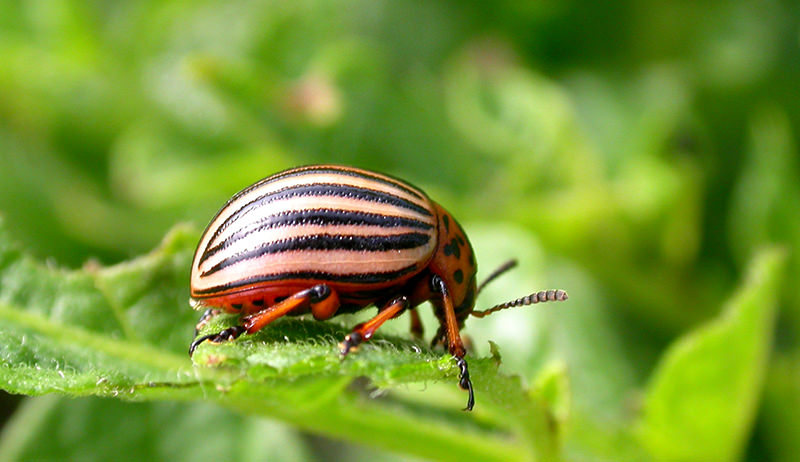
Adult Colorado potato beetles are 1/3 inch long with hard, rounded wing covers that are black-and-tan striped. The fat, reddish-pink larvae are 1/2 inch long, have rows of black dots on their sides and a small black head. Colorado potato beetles are very common across the U.S., except in the Pacific Northwest and the Deep South. They feed on all members of the tomato family, though potatoes are by far their favorite.

Adult Colorado potato beetles overwinter in the soil, emerging in spring to feed and breed, producing up to three generations each year. Both adult and larval Colorado potato beetles skeletonize the leaves of host plants very quickly. To manage them, cover newly planted seed potatoes with floating row cover and leave it in place until the potatoes are ready for harvest—pollination doesn’t need to occur for potatoes to be produced. Handpicking both adults and larvae is also very effective. Because Colorado potato beetles have developed resistance to many synthetic pesticides, use biological pesticides based on Bacillus thuringiensis var. San Diego or var. tenebrionis (commonly called Bt—just be sure to select the right variety). Other effective biopesticides include those based on spinosad.

2. Mexican Bean Beetles (Epilachna varivestis)

Mexican bean beetle
Stephen Ausmus/Wikimedia Commons

Adult Mexican bean beetles look a lot like ladybugs on steroids, though the absence of white markings between the head and body easily distinguish them from their friendly cousins. Their wing covers are copper-colored with 16 black spots. Mexican bean beetle larvae measure about 1/3 inch long, are light yellow and are covered in bristly spines. They’re found in almost every state east of the Rocky Mountains.

Mexican bean beetles spend the winter as adults nestled under garden debris. Eggs are laid in late spring on the undersides of leaves of host plants, including nearly every species of bean, with each female laying hundreds of eggs. The spikey larvae and adults feed on leaf backs, leaving only the leaf veins intact. They’ll also feed on the beans themselves. Damage is most severe in July and August.

To prevent an onslaught of these beetles, choose early bean varieties that mature before the pest becomes problematic. Handpick adults and squash larvae—their spines are very soft. Cover susceptible plants with floating row cover immediately after planting, but remove the covers when the plants begin to flower to allow pollination. Mexican bean beetles fall prey to numerous species of beneficial insects, including parasitic wasps, pirate bugs, assassin bugs, ladybugs and many others. Plant a lot of flowers in the veggie patch to provide nectar for these predators. Effective product controls include Bt var. San Diego or var tenebrionsis, and anything with the active ingredients of spinosad, neem and citrus oil—all three can be effective.

3. Cucumber Beetles (striped: Acalymma vittata; spotted: Diabrotica undecimpunctata howardi)

Cucumber beetle
John Flanner/Flickr

Both common species of cucumber beetle, striped and spotted, measure about 1/4 inch long. The adult striped beetles are bright yellow and bear three broad, black stripes running the length of their wing covers. Spotted beetles are greenish-yellow with 11 (Eastern species) or 12 (Western species) black spots on the wing covers. Both species overwinter as adults in weedy areas. Beetles emerge in spring to mate and lay eggs in the soil or on plants. Larvae burrow into the ground and feed on roots for several weeks.

Adults chew ragged holes in plant leaves and can consume entire blossoms of favorite plants, including all members of the Cucurbitaceae family. Newly planted seedlings can be consumed quickly. Most importantly, cucumber beetles can transmit deadly bacterial wilt and cucumber mosaic virus, so controlling the beetles is key to preventing the spread of these pathogens. You should only plant varieties with a known resistance to these pathogens.

To control cucumber beetles, trap adults on yellow sticky cards placed just above plant tops. To attract more beetles, attach cotton balls soaked in allspice, clove or bay oil to the cards. These oils contain eugenol, a pheromone that attracts female cucumber beetles. For added protection, delay planting cucumbers by a few weeks to help break the beetle’s feeding cycle and prevent major damage from the initial early spring feeding period.

A species of beneficial nematode (Heterorhabditis bacteriophora) is particularly effective at attacking the soil-bound larvae and killing them before they reach adulthood. These nematodes can be mixed with water and sprayed throughout the planting area any time during the growing season, as long as the soil temperature is above 65 degrees F. Spinosad-based products are also effective against adults.

4. Japanese Beetles (Popillia japonica)

Japanese beetle
Sara Eguren/Flickr

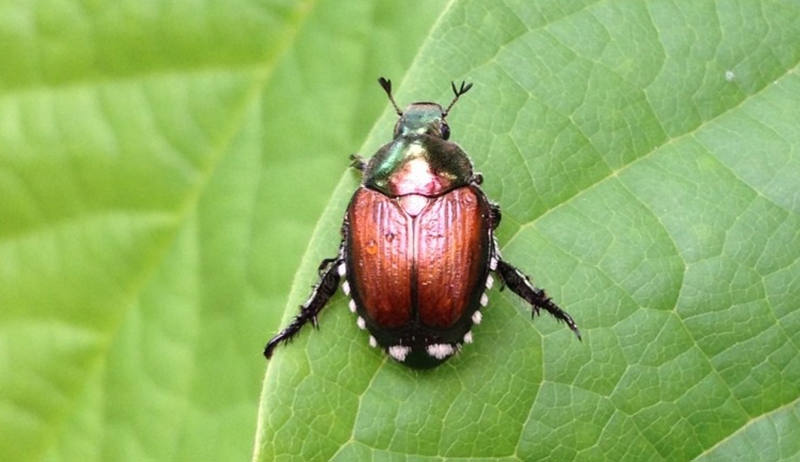
Introduced to North America from Asia in the early 1990s, Japanese beetles have become a notorious pest. Adults are metallic green with copper-colored wing covers. They measure about 1/2 inch in length and are half as wide. Their ground-dwelling larvae are C-shaped, grayish-white grubs with light-brown heads. The larvae grow up to 1 inch long and spend the winter several inches beneath the soil.

As adults, Japanese beetles consume more than 300 different ornamentals, beginning in midsummer. They release aggregation pheromones as they feed, resulting in large numbers of adults coming together to “feed and breed” on the same host plant. As larvae, Japanese beetle grubs attack the roots of turf grass and many ornamentals. When serious infestations are present—10 or more grubs per square foot of soil—the turf might peel back in a carpet-like fashion. Grub damage is most evident in spring and fall when the grubs are actively feeding in the upper layer of soil.

Hand-pick the adults as early as possible. Product controls for adults include spinosad- and neem-based products. Their larvae tend to cause the biggest problems in lawns that are fed excessive amounts of chemical fertilzer and are frequently, but shallowly, irrigated. Stop watering and allow your lawn to go naturally dormant in summer’s heat. Effective, chemical-free grub control comes from Heterorhabditis bacteriophora, a species of beneficial nematode, applied to the soil each spring. The nematodes are mixed with water and sprayed over the lawn.

5. Blister Beetles (Meloidae family)

Blister beetle
Richard Orr/Flickr

North America hosts some 300 species of blister beetles, but only a handful are harmful to gardens. Common food sources include legumes, Japanese anemones, potatoes, phlox, members of the Asteraceae family, amaranth, zinnias, and many other garden vegetables and ornamentals. Adults of pest species consume plant tissue while their larvae are seldom seen. All blister beetle larvae are predators, often using only one species of wild bees or grasshoppers as hosts. As small, newly hatched larvae, some blister beetle species piggyback on adult bees, who carry them back to the nest where the beetle larvae consume the larval bees.

Blister beetles acquired their common name because of their ability to produce a defensive compound that can cause the skin to blister when exposed (largely through accidental crushing). Adults are black, gray, orange or bronze, with various patterns of stripes and solids, and can measure 3/4 to 1 inch long. Their elytra are leathery, rather than rigid. Blister beetles can poison cattle and horses if they ingest infested alfalfa or hay.

Blister beetle adults can be controlled with careful hand-picking (do not squash them!), or with spinosad-based organic pesticides.

Pest beetles can become problematic in even the most well-maintained organic garden. Regular trips between crop rows to scout for them enables effective management and keeps their numbers at a tolerable level. Arm yourself with a little beetle know-how and have your best garden ever.

Categories
News

There’s More Food Waste Than You Think, Farmers Say

The stats on food waste are bleak. You’ve probably heard from the Food and Agriculture Organization of the U.N. that 40 percent of U.S. food is thrown away. While much of this waste has occurred on the consumer end—in our homes, restaurants and grocery stores—leading retailers to start selling “ugly” produce, farmers have chimed in to say that even more food waste could be happening. And they’re owning up to the problem.

Due to an food industry that promotes the bold and the beautiful, farmers are admitting they let much of their crop stay in the fields to be tilled under or fed to livestock because they won’t be able to profit off of the imperfect produce.

“I would say at times there is 25 percent of the crop that is just thrown away or fed to cattle,” California farmer Wayde Kirschenman told The Guardian. “Sometimes it can be worse.”

If you’re a market farmer, you understand the dilemma. The pretty stuff has to come out first because it’s going to sell first. Even if you pull out a squash that grew in an abnormal shape or a tomato with some discoloration—both of which are perfectly OK to eat, just not what your customer had in mind when they set out for the farmers’ market—you know it will likely sit on your table for awhile if it even sells at all. The thought of it going to waste is probably more upsetting to you than to anyone who loses sleep over our food waste epidemic, but it’s the unfortunate reality.

We still don’t have a completely accurate picture of how much food waste is occurring in the U.S., but with retail and farm losses combined, researchers are saying that more than half the food in the country doesn’t make it to a plate, according to The Guardian. And that’s a tough place for farmers to be in.

What are you doing on your farm to overcome the food waste problem? Share your thoughts and ideas in the comments below.

Categories
Crops & Gardening

A Quick Way To Boost Iron In Your Soil

I heard a piece of folk wisdom from an Irish gardener. Her sapling apple tree was struggling, and a local woman told her to bury a piece of scrap iron at the base. By the next year, the tree was thriving.

Stories and superstitions like these from gardeners and farmers abound. They’re obviously not based on hard science, but they often come from observations that have been passed through generations.

In this case, what an old piece of scrap iron can add to the soil at the base of a seedling apple tree is rust or iron oxide, which is an under-appreciated plant micronutrient. Iron deficiency, also called iron chlorosis, causes a yellowing of the leaves, and overall lack of vigor. It is often especially prevalent in acidic soils or soils with an excess of copper, manganese or phosphorus.

Iron is a necessary component for the formation of chlorophyll, so it impacts a plant’s ability to harness the energy of the sun. Iron also plays a role in the respiratory function of plants, where they convert carbon dioxide to oxygen. Soils can have a lot of iron, but plants growing in them can still be iron-deficient. Red soils, for example, are typically iron-rich, but often it is in the insoluble form of the mineral.

Iron is one of the most common micronutrients that plants can be deficient in, which is probably why the older Irish lady suggested burying a piece of scrap iron beside the apple tree. Even without a comprehensive soil test, a diagnosis of iron deficiency is often right on the money.

Adding iron to the soil can be as simple as using scrap pieces of iron, but sharp, rusted pieces of metal in the garden carry their own risks. A popular choice as a soil amendment is powdered or granular chelated iron. Correcting other soil imbalances, like pH and the other aforementioned nutrients, can also go a long way toward preventing iron chlorosis.

Categories
Animals Poultry Urban Farming

How Much Coop Space Do Your Chickens Really Need?

By nature, chickens are meant to roam, graze and hunt. Their jungle fowl ancestors passed down the instinct, but human domestication of chickens over time has removed some (not all) of their own protective abilities out in the wild. Some breeds are better rangers than others, and some smaller, meeker breeds actually prefer to be buttoned up in confinement. Confinement, on the other hand, can conjure images of inhumane 1-square-foot cages, or hundreds of broilers bring raised wing-to-wing in a “cage-free” barn.

In the backyard or on the hobby farm, there’s a lot of room for a happy medium. For the health of the flock and for the health of the meat and eggs you harvest from the flock, the amount of space you offer them to roam is one of chicken keeping’s biggest, most important decisions.

Space Exploration

Inside a coop where hens lay eggs, rest and snuggle on the roost at night, large chickens (versus small bantams) need at least 4 square feet per bird. Many coop-building tutorials will advise this amount of space in both the coop and run with little mention of ranging or confinement living. Unfortunately, the modest 4 square feet per chicken is a minimum estimate, and it should be considered for short-term confinement use and daily overnight protection only. This minimum coop space should be considered only for a flock that spends most of its daylight hours free ranging in the yard or with some other protection at pasture.

My 8-by-4-foot A-frame mobile coop has enough square footage in the run (minus the coop space above it) to pass the minimum 4 square feet per bird recommendation, but it’s not enough room for my eight chickens for any longer than a short weekend away—their behavior in confinement tells me so. We’ve built an additional 8-by-4-foot run extension, which we attach it to the existing run to double their space for short weekends when we can’t allow them to free-range unsupervised.

Personal Bubbles

In confinement, a flock should have enough space available to satisfy natural behaviors, get exercise and even spend time alone. Think of extra space as being necessary for personal care. When adding extra space for a long and healthy life of confinement, count on this extra space being room for play.

Inside a coop, hens will often share a favorite nest box or two, so extra space inside the coop will often go unused, especially in the summer. In the winter, extra space holds more cold air that chickens have to fill with body heat, so don’t waste space; just 4 square feet per bird is a fine estimate for indoor coop space. However, outside run space should extend to a full 10 square feet per bird, another minimum recommendation. Even better would be doubling the run area to 20 square feet per bird, construct the run height to 6 feet tall, and install roosts the chickens can fly to. The goal in confinement should be to mimic real outdoor living.

For comparison, full-time confinement in my A-frame mobile coop would require a flock no larger than three full-sized chickens, but because my coop has no vertical space, it’s inappropriate for healthy, full-time confinement.

Leave Room For Chicken Math 101

Inevitably, most of us become obsessed with our chickens, so three chickens turns into five chickens turns into 12 chickens, and so on. This is called chicken math—the unintentional multiplying of a flock size. Don’t risk overcrowding in your coop. Build more space now and your future chickens will thank you with happy lives and healthy eggs.