Categories
Crops & Gardening Homesteading

Garden DIY: Wire-And-Newspaper Potato Bin

When garden space is at a premium, you have to get creative. Potatoes take up quite a bit of real estate, so if you don’t have room to grow them—or if you just want to grow a lot of spuds in a very small space—build a potato bin out of an old piece of fencing and some newspapers. You’ll be pleasantly surprised at how many pounds of potatoes you’ll harvest!

Step 1: Cut The Wire

cut the wire
Jessica Walliser

Use a pair of heavy wire cutters to cut a piece of 3-foot-tall boxwire or chicken wire fencing. Although you can make the bin any size you’d like, I find that a 6- to 8-foot-long piece of fencing makes a nice-sized bin.

Step 2: Fold The Wire Into A Cylinder

secure the bin
Jessica Walliser

Bend the fencing into a cylindrical shape and wrap the loose ends around each other to fasten it closed. Place your bin in an area that receives a minimum of six to eight hours of full sun per day.

Step 3: Line The Wire With Newspaper

line with newspaper
Jessica Walliser

Spread a layer of newspaper, five to six layers thick, around the inside of the wire bin. This will hold the soil inside the bin and form your first layer. At the end of the season, the newspaper will degrade.

Step 4: Fill The Bin

Fill the bin up to the top of the newspapers with a 50/50 blend of compost and potting soil. Alternatively, if you want to save some money, skip the potting soil and use a blend of compost and shredded leaves.

Step 5: Plant The Potatoes
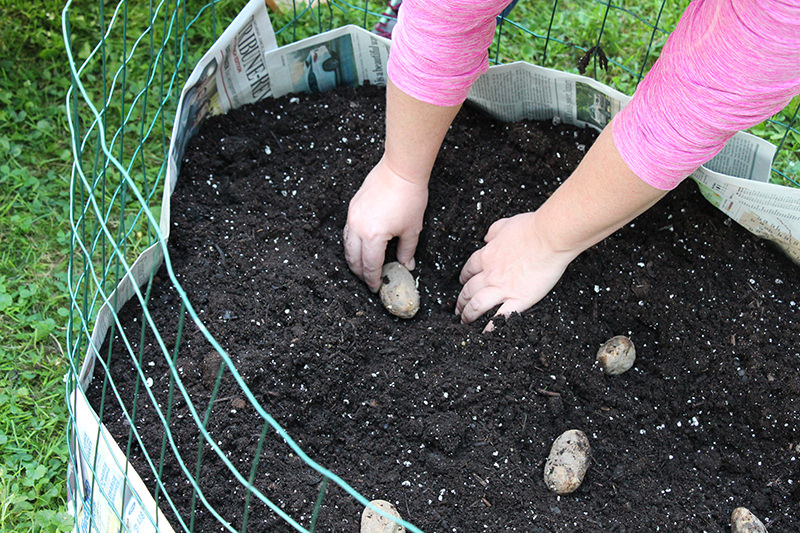
plant potatoes
Jessica Walliser

Space the seed potatoes 4 to 6 inches apart, and plant them about 3 inches deep into the compost/potting soil blend. Once they’re planted, water them in well.

Step 6: Mulch With Straw

mulch with straw
Jessica Walliser

Cover this first layer with 2 inches of straw. Make sure the bin stays watered during hot, dry weather. The potatoes should begin to sprout a week or so later.

Step 7: Add More Layers

When your potato sprouts reach about 4 or 5 inches tall, add another layer of newspaper around the inside of the bin. Fill this layer with the 50/50 compost/potting soil blend and another layer of straw, covering the plants and leaving only the top-most leaves exposed. As the plants continue to grow, add a third layer, filling the bin until the potato plants are spilling out the top. Continue to water the bin regularly throughout the growing season.

Step 8: Harvest
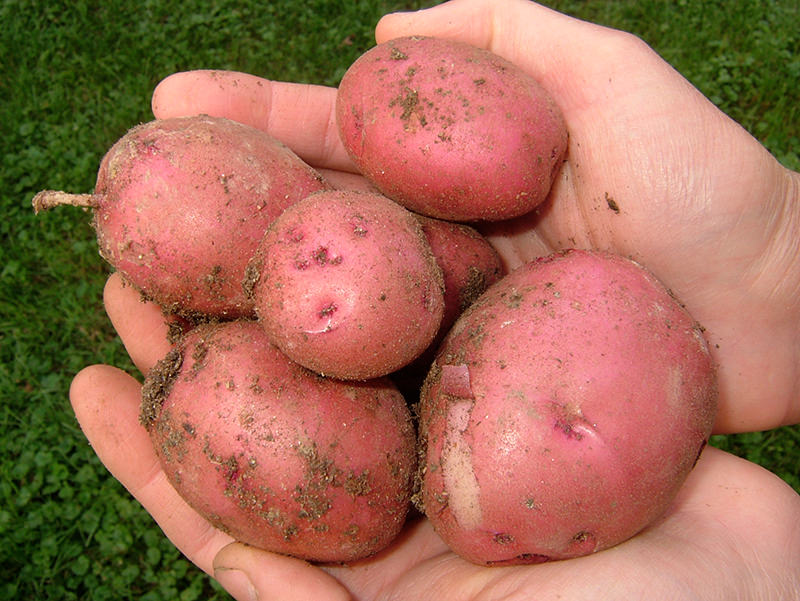
harvest potatoes
Jessica Walliser

When the plants reach maturity, they’ll start to turn yellow and die back. Your potatoes are ready to harvest two weeks after the plants are completely dead. This extra time in the ground allows the skin to cure before the spuds are harvested, increasing their shelf-life. To harvest, simply unfold the wire edges until the bin pops open. Dig through the soil and pull out the potatoes. The same wire bin can be used for many years.

Categories
Beginning Farmers

Chicken Chat: Our Son’s Flock

“Chicken Chat” is a series for chicken keepers by chicken keepers. To submit your own story, email us 750 to 1,200 words about you and your flock, along with a handful of photos, and put “Chicken Chat” in the subject line.

Our story begins about six years ago when I got a teaching job in Califon, a rural area in Hunterdon County, N.J. One day, I went into the teacher’s room and overheard one of the women, Marcy, talking about her goats. I asked her more about them and was pleasantly surprised and intrigued to find out that she lived on a nearby farm. She even invited me and my family to visit: Aryeh, our only son, must have been about 12 at the time; Ilana, our oldest daughter, was probably around 10½; and Neora, our youngest girl, was about 4 years old. During our visit, Marcy showed us around her farm, which included goats, horses, llamas, dogs, cats, koi and, of course, chickens.

My husband, Nachum, and Aryeh were fascinated by the chicken coop and the chickens. Nachum is a very curious individual; he peppered Marcy with a variety of chicken-keeping questions. After our visit, he started researching backyard chicken-keeping. Every so often, as the years went by, he would bring back up the chicken idea. As Aryeh got older, he became more interested in chickens, too.

A Compromise

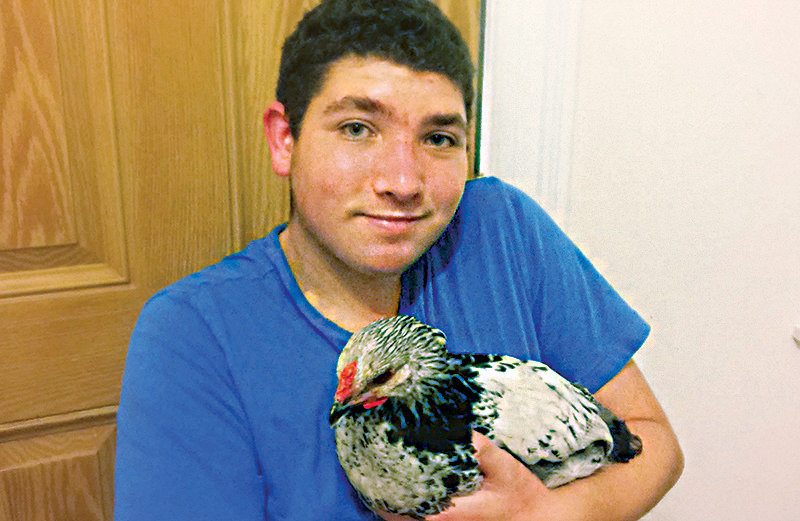
Aryeh and Marcy the chicken
Allison Weisel

Nachum and his family are real animal lovers. On our third date, he took me to the Philadelphia Zoo, and on another date, he took me to a park to feed the animals, so you can understand that Aryeh has grown up in an environment with a father, grandmother and uncle who are true animal lovers.

To foster his love of animals, our home has been like an aquarium and zoo over the years. You name it, we had it as a pet: birds, fish, lobsters, crayfish, frogs, lizards, hamsters, guinea pigs and even stray cats that followed us home.

Last July, Aryeh started talking about getting chickens. He had finished his sophomore year in high school but was really unhappy there, and the hours were very long. In the winter and spring, we found a school that he could transfer to. I was so happy when he was accepted. However, he was nervous to switch and was leaning to stay where he was. I asked him: “How will you care for chickens with your current schedule?” He pondered the question and decided he would transfer to the new school, so he could get the chickens he so desired.

Nachum and Aryeh then started researching coops. They chose one and spent two Sundays assembling it, and it turned out just gorgeous.

They had a difficult time finding local pullets in New Jersey in July, so they decided to buy chicks through the mail from a hatchery and were able to secure five light Brahma females.

Chick Days

urban chicken
Allison Weisel

We counted the days until the chicks arrived. Then, one glorious Wednesday morning on July 5, the mailman delivered chicks to our front door, packaged in a crate with a heating pad. Aryeh got to work with our indoor brooder, which was housed in the living room. They were the cutest little balls of fluff you could ever imagine.

We gave them old-fashioned girl names—Sophia, Rita and Grace—and one special name for one very cute black ball of fluff: Marcy. Aryeh took great care of them, and they matured into adorable little chickens. Eventually, they graduated to the coop, especially after I came home one afternoon and found all five of them on the living room rug!

Summer passed, the chicks grew and Aryeh started school. All was good. Our backyard flock attracted many neighborhood folks we never met as well as curious onlookers. Little kids loved our corner property. We were very proud of the care Aryeh took of our little pets.

In the fall, Nachum began to think Marcy was actually a rooster. I reminded him how we paid extra to sex the chickens to get all females, but Nachum pointed out the four girls traveled together, and Marcy went his own way. Over time, Nachum’s observations came to be true. Marcy is indeed a rooster, maybe the most beautiful and vocal rooster you will ever meet in our small town! Little did we know that roosters not only crow at 5 a.m. and 6 a.m., but also 4 p.m. and 5 p.m. Aryeh, very worried people would complain, walked over to our neighbors to talk to them, and much to our surprise, Marcy’s crowing doesn’t seem to bother anyone. Even the neighbors down the block like hearing him because it makes them feel like they live on a farm.

So that is our story. Our family is enjoying having backyard chickens and their tasty eggs. Aryeh, their sole caretaker, is doing a fine job. Our hope is that one day he will be an animal scientist or researcher. We are providing him with a great opportunity.

This article appeared in the July/August 2016 issue of Chickens.

Categories
News

The Secret Way To Keep Deer From Eating Your Landscaping

We’ve all been there, and it’s so frustrating. You plant a tree or a shrub outside of the farmhouse, only to have it nibbled on, hurting or even killing it before it has a chance to thrive. One of the realities of living in a rural area—and these days, even in a suburban area—is that the deer are hungry and munching. And they don’t care if that hurts your feelings.

This Old House shares a number of ways you can attempt to grow trees and shrubs with deer around:

  • First, you can try planting deer-resistant plants. This is great in theory, but doesn’t always work out the way you hoped.
  • Scatter human hair. The scent given off by your hair should deter the deer from getting too close. However, in areas where deer are accustomed to humans, this might not be effective.
  • Create a barrier. You can drop netting over the shrubbery or encase young trees with fencing to deter deer from feeding. This is somewhat effective, but not foolproof.
  • Sprinkler head on a motion detector. These contraptions send out a spray as the deer walk by, startling them and scaring them off. However, who’s to say it won’t get you, too?
  • Chemical deer repellents. Not always effective, and not our first choice for the sake of birds and beneficial insects 

Our Favorite Must-Try Deer Repellent

You’ve been waiting for it: Irish Spring soap. According to TOH, simply hang Irish Spring soap or your favorite fragrant soap on tree or shrub branches and the deer will steer clear. This may take a lot of soap in my case, because I have several young fruit trees I’m trying to establish, but if it’s effective, could be completely worth it.

Have you found a foolproof deer repellent you’d recommend to others? Would you try the Irish Spring soap method?

Categories
Crops & Gardening

Keep Your Tomatillos Beetle-Free

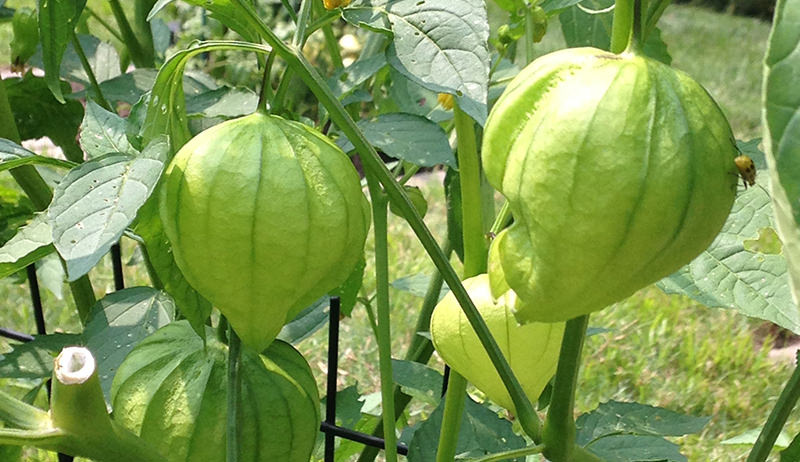
Tomatillos, a husked fruit in the tomato family, are full of nutrients and fiber, and they’re so easy to grow. With a rich flavor and dense texture that’s excellent for making salsa verde, tomatillos have become a must-grow in my garden every season.

The plants are highly-branched and sprawling, and each plant bears dozens of husked fruits, each about 1 to 2 inches across. You know the fruits are ripe when the husk splits and folds back, exposing the fruit inside. Ripe fruits often fall to the ground, where they can be collected and taken to the kitchen. Although staking or caging the plants isn’t necessary, I find using a wire tomato cage around each plant, keeps the plants more upright and makes harvesting a bit easier.

Tomatillos Of A Different Color

There are many different tomatillo varieties, though some are more difficult to find than others. We’re big fans of the purple varieties, as the flavor tends to be much sweeter. Purple tomatillos can be eaten fresh off the vine, though we much prefer to grill them or make purple salsa.

Good green varieties include Toma Verde, Gulliver and Miltomate. These selections have a tart flavor that’s perfect for making fresh salsa verde. We grow several varieties of jalapeno peppers for the same purpose.

There are also a handful of yellow tomatillos, though we’ve only ever grown a variety called Mexican Strain. It comes in a bit earlier than the green or purple types, producing fruits about 10 days before the other varieties we grow. The fruits of Mexican Strain are almost twice as large as green and purple types, and I find they’re more flavorful after they fall from the plant. I’ve added these to my homemade spaghetti sauce and tomato soup and have had excellent results. They’re very meaty.

The Big Enemy

three-lined potato beetle
psychmike/Flickr

The biggest challenge we’ve faced when growing tomatillos is in the form of a tiny insect called the three-lined potato beetle. These little buggers can completely defoliate a tomatillo plant in short order. The adults look a lot like cucumber beetles, but they only have three black stripes. They lay eggs on tomatillo plants, and the newly hatched larvae feed in groups. These little guys look like slimy, brown, miniature slugs with black heads. And, what’s really gross, is that they cover themselves with their own excrement to mask themselves from predators. Ick!

To control three-lined potato beetle grubs, we squish them or apply a spinosad-based organic pesticide to plants where the beetle grubs are present. If caught early enough, you can prevent them from causing significant damage to the plants. I check my plants for new grubs every few days throughout the season.

Categories
Beginning Farmers

What I Do When Gardening Isn’t An Option

One of the hardest things about moving, especially for a gardener, is that you have to start all over again from scratch to get things growing your way.

At our “town home” (that’s what I’m calling the old house until it sells—we so fancy), I was finally was on top of things after three years of getting the garden established. Due to a relatively mild spring, I was able to get the garden growing ahead of schedule this year. Potatoes were in the ground in March (like I said, a mild spring), and I actually made time to plant other root crops. In fact, a week before we learned about our farm-to-be, I got beans in the ground—a first! With my perennial medicinals in the mix—lavender, echinacea, valerian, nettles (yes, I grow them on purpose—don’t judge) and California poppies—my urban garden looked the best it’s ever been. I was pretty proud of myself.

urban garden
Rachael Brugger

Wouldn’t you be?

But now that we’re at the new farm, I have a gardening itch I just can’t quite scratch. Periods of transition are like that, I guess. There’s so much you dream of doing—that you know you’re completely capable of doing—but with the amount of time a move co-opts, you just never get around to it.

Let me start off by saying, despite having some garden withdrawal, we’ve been completely blessed by our new space. Beside the farmhouse, we have a terraced garden that the former owner planted with heirloom tomatoes, butternut squash, culinary herbs, and lots and lots of mint, so we’re not without farm-grown food. I’ve also been able to harvest from the town home, even if I haven’t been able to tend it as much as I would have liked.

To fill the remaining gardening void, I’ve managed to fit in a number of other outdoor food- and garden-related activities. Here’s a peek at what I do to scratch my gardening itch.

Pick Berries

picking blackberries
Rachael Brugger

If I never plant a crop ever again, I’ll be completely satisfied because our property is covered—I mean covered—with wild blackberries and black raspberries. I may have come home from work the other day, stopping my car every 2 yards up our quarter-mile drive to harvest newly ripened berries. Call me lazy, call me greedy, call me whatever you want—my fingers were stained and I was as happy as I could be.

Weed Like Crazy

weeding the garden
Rachael Brugger

The reality of a farm in transition, particularly at the end of spring/beginning of summer, is that not as much farm maintenance happens as it should. That’s life, and unfortunately, Mr. B and I are the ones left to deal with it. I’ve been taking a few hours out of my week to work away at the terraced garden beside the house, because I’m pretty sure we were growing more grass than mint there—and that’s saying something!

A friend and I also did some emergency weeding in the large production garden at the foot of our hill to prevent weed seeds from further spreading—though considering the number of non-cultivated plants that are growing there, it may have been a waste of time. As soon as I can get in to lift up the drip tape that’s matted underneath the weed jungle, it’s till time. With all the vetch and dock and other rogue plants, our soil should be pretty darn nutritious afterwards.

Mow, Mow & Mow Some Mo’

mowing
Rachael Brugger

Mr. B can take most of the credit on this one. As I’ve been unpacking boxes, he’s been cutting trails through our fields and forestland, and cleaning up the lawns around the house, so that we can get out and actually enjoy our property this summer without becoming too overrun with ticks and chiggers. (It’s a bad year for biting bugs here in Kentucky. Real bad.) But as you can see, I got my mowing fix this weekend, as we christened our new-to-us lawn tractor.

Native Plant Seek & Find

St. John's wort wildflowers
Rachael Brugger

This has been my favorite part of our move to date. One thing we absolutely fell in love with at our property is the diversity of ecological life on it—and as a student of herbalism, I’m smitten with the native plants I’ve discovered: milkweed, daisies, yarrow, wild bergamot, St. John’s wort. Many of them I hope to sustainably harvest one day for salves and tinctures to keep us healthy, but for now I’m content watching their growth habits and leaving them for the bees and butterflies to enjoy.

Dream Of The Gardening To Come

There are plenty of spaces around our house that are in need of some landscape rehab. Gardens overrun with grasses need to be replanted with deer-resistant plants—I hear such things exist, but we’ll see how well the theory does in practice. I also want to expand our little kitchen garden to include our favorite teas, culinary herbs and vegetables. It might not happen this year, but I take solace in the fact that we have nothing but time in front of us. And it gives me the opportunity to change my mind a couple dozen times.

I know many of you are also moving to the farm—how’s your green thumb holding up in the process? And for those of you who have already settled onto the farm, how did you keep your patience during the transition? We’re eager to use our land to its full potential, but there always seems to be another box to unpack first.

Categories
News

Chicken Defends Her Eggs Against A Prowling Snake

Chickens have it tough. Being among the smallest animals on the farm, they’re constantly being predated by wild animals large and small. In this video shared on Facebook by Queensland, Australia, resident Sandy Rewald, her beloved chicken, Chook Chook, is being threatened by a snake, which Mashable reports to be a water python.

The hen is working hard to save her eggs from the attack of the coop intruder, but when the snake takes things too far, she attacks. Take a look in the video above.

Chickens, especially the leaders of the flock, can be valiant protectors of their kin. I’ve even heard of roosters in Alaska protecting their flock from grizzly bears. These farm poultry may come in small packages, but they’re tough.

Have you ever seen a chicken take on a predator? Share your story.

Categories
Crops & Gardening

Grow & Use Your Own Stevia

Stevia has become quite a buzzword in recent years—a sweetener that seems to fulfill the constant human quest to have our cake with no consequences.

To be clear, I believe in sugar—real, raw sugar, that is. The body uses sugars for energy, and once upon a time, it asked for what it needed when it needed it. Sugar and sorghum cane, maple and other tree sap, and honey provided any sweetening that humans needed beyond what’s naturally in fruit. Then we started figuring out how to super-refine these sugars, and sell them cheaply—if you don’t count the human cost, that is, from slavery to Type II Diabetes—and what was once a natural and reasonable craving for a little sweetness became what amounts to an addiction that now crosses many cultures.

I believe in sugar. I don’t believe in excess.

End of rant.

So I ignored stevia when it first appeared on my radar, but as I learned more about it, I became intrigued. Supposedly, it had been in use by Asian cultures for millennia and was 100 times sweeter than sugar. I read a little—and learned that in fact, it was never used in Asia, but in South America, specifically Brazil and Paraguay, and for more like 1,500 years. Also, according to the Global Healing Center, it’s only 40 times sweeter than sugar in raw leaf form, though the powdered sweetener you find in stores is up to 300 times sweeter.

Giving Stevia A Try

stevia
my_amii/Flickr

If it was really a plant, and not something humans had made in a lab, then I decided I might be interested. I looked for it at my local natural health food store and gasped in shock at the price—that tiny bottle was somewhere in the vicinity of $16 (though, for 644 servings)! I bought some, and I liked it. Because I still don’t believe in excess, and because I also believe in sugar, those 644 servings lasted me more than two years.

Being me, I soon began to wonder if I could grow it. Last summer, while buying starts for other herbs, I discovered I could buy a pot of four stevia plants at a local gardening center. I sneaked a bit of leaf to chew. It was, indeed, super sweet, but it had just a hint of herby bitterness. That was OK with me, but also made me wonder if, as usual, the whole plant had a lot more in it than the refined white powder in the bottle at the store.

I got the pot and planted them in my kitchen herb garden, which grows right outside my front door. Stevia was effortless to grow, and in fact grew taller than I expected, so next year I’ll plant it farther back from the edge of the bed. I cut the plants on half the garden but not the other, so they’d flower and I could save their seeds; this year I’ll plant more. You can take them indoors over winter—I’m going to try that with one or two.

Using Stevia

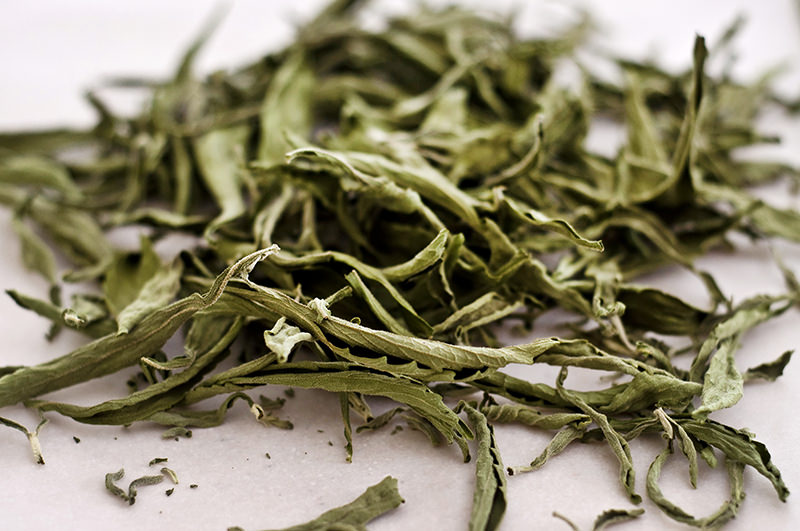
dried stevia
Karen P/Flickr

I use stevia mostly for things like sweetening tea (herbal, in my case, which should really be called a tisane). One fresh sprig can be steeped with tea leaves and will sweeten to my taste. Experiment to see how much you need.

Stevia also dries well and keeps its flavor. You can, of course, dry in a dehydrator, but if you don’t have one, simply find a warm, dry spot. If you have an old gas stove with an oven pilot light, use that. You can also dry on top of a refrigerator, freezer or microwave, or hang in bunches in a dark, dry spot.

When you steep leaves in tea, you are only getting their essences and oils. Another way to use dried herb is to grind it up and use the whole thing. In early fall, after I had collected all the flower seeds I could, I cut the whole plants and dried them in the dehydrator so they would be well-dried. Then I put these into my VitaMix (that thing is worth its weight in gold!) and came up with about 3/4 cup of powder from those four plants. (This does not count what I had used over the course of the season.) I use the powder to sweeten cocoa, which I make myself from real, 100-percent cocoa powder. However, there is one disadvantage: This powder floats on top of the drink and gives just a hint of grittiness. I find I don’t mind it; I stir the cup now and then. This way, I’m getting all the health benefits of the herb.

I have not yet grown enough stevia to try it in baking or homemade candy, but I will. Bottom line: I like it!

Categories
Animals Poultry Urban Farming

How Much Chicken Feed Does A Flock Need?

Farmers are concerned with the feed conversion ratio, which is how efficient an animal is at converting feed into a certain number of eggs or amount of meat. For the business of farming, the feed conversion ratio helps determine the bottom line. Backyard flocks are a bit different. As their keepers, we’re often the only consumers of their products. But, raising chickens is still an investment, however small the flock might be.

Backyard chicken keepers still want to minimize waste, because wasted feed is wasted money. So, how much should chickens eat? Or, how much should we feed our chickens in order to reduce waste?

According to the University of Kentucky College of Agriculture’s report “How Much Will Chickens Eat,” a laying hen will eat 1/4 pound of feed per day, and roosters a bit more, but other variables affect how much a chicken will eat.

Energy Output

Commercial broilers and layers are, overwhelmingly, raised in confinement—they are feed-conversion-ratio machines, and their egg and meat products make up their greatest energy output. However, the energy output of backyard chickens with access to more space includes running, flying, foraging, playing, preening and dust bathing. Backyard chickens need more food energy to continue those activities and to continue laying eggs consistently. For backyard chickens, the 1/4 pound of feed per hen estimate is low, even for summer free-rangers, and far too low for any backyard flock in the winter months.

Forage & Food Scraps

Access to supplemental foods, like insects, yard greens, garden waste and the contents of compost bins, increases access to food energy without increasing feed consumption. An active free-range hen could very well eat her estimated quarter-pound of feed throughout the day while still feeding on the yard, picking and choosing her own diet. During the foraging seasons of the year, offering feed once in the morning and once before dusk is a good way to control feed consumption and waste, while also encouraging foraging for food energy and activity.

Human food scraps are a great addition to a flock’s diet, but for optimal health, nutrition and egg production, scraps should never replace feed.

Temperature

In the summer, chickens usually won’t eat during the hottest hours of the day, because digesting food creates more heat. This is a good time to practice morning and evening feeding, while providing cool places to rest, forage and drink throughout the day. Summer’s heat often reduces feed costs.

During the winter months, access to forage and other natural foods is greatly reduced. The desire to eat more feed increases with the need to produce more body heat. Winter nights beg the fast-burning energy of scratch grains as a supplement to grain feed, but scratch should never replace a complete feed as a food source. Winter is notorious for increasing feed costs, often by double.

Access To Water

When chickens run out of drinking water, they stop eating. UK’s report advises that 2 pounds (or 1 quart) of water is required for every 1 pound of feed, but like foraging and pecking through mash feed for favorites, backyard chickens not only prefer to self-regulate, they’re very good at determining their individual needs. Always supply fresh water.

Weigh Their Needs, Not The Feed

Pay careful attention to how much your chickens eat at different times of the year. If you offer two feedings per day in the summer and continual access through winter, know that if chickens run out of feed, they probably haven’t had enough to eat.

Categories
Crops & Gardening

Red Clover In Your Garden & Pantry

Red clover (Trifolium pratense) is one of the first plants I tried to grow on our farm. I had encountered its benefits while visiting Zack Woods Herb Farm in Vermont. My notes from that day suggest that I plant red clover and oats together, using oats as a nurse crop for the understory of red clover. For a few years, I struggled with getting this valuable crop started until I realized it was happily starting itself in some of the recovering areas of the farm. Now I practice a system of “no mow” in a few areas of the yard—our orchard is chief among these—to harvest the purple blossoms throughout the late spring and early summer.

A Soil Booster

Red clover is one of the best known plants for fixing atmospheric nitrogen—140 pounds per acre to be exact—into a usable form for plants in the soil. This happens at the roots because of a symbiotic relationship with mycorrhizae in the soil. In red clover’s presence, the soil is filled with these networks of fungal threads that move both macro and micro nutrients to where plant roots need them. Letting red clover grow will bring about the same result as buying inoculant, ultimately improving the nitrogen content in the surrounding soil for the benefit of neighboring plants. Of course, as I found out here at Mockingbird Meadows, if you turn over a new plot in an area of grass that has been fertilized with chemicals, it is important to add the inoculant for the red clover itself.

A Blood Booster

Red clover is a classic alterative, favorably improving the condition of our blood just as it improves the condition of our soils. The flowers and the top pair of leaves are picked for their high vitamin and mineral content, namely calcium, chromium, magnesium, phosphorus, potassium, tin, and vitamins B and C. The plant is also an important blood thinner and cleanser.

Red clover is found in tonic teas that support the health of the respiratory tract, especially among those who suffer from allergies and asthma. It is even reported to be a topical remedy used by the Native Americans for the reduction of tumors. It was this reputation that landed the plant in the famed Hoxsey formula, an herbal medical treatment touted as a cure for cancer.

A Life Booster

For years before I recognized red clover for all it brings my garden and cupboard, I saw it as a nuisance. Now I look forward to the vivid purple blooms and my time with them each morning while the dew soaks my pants cuffs and I fill my gathering baskets with their heady smell. While not a classic cut flower, they now make up the center attraction at many of my dinner parties. Beyond their color and scent, red clover tends to support us with calm and clear thinking in times that can lead to mass hysteria and societal upheaval, according to those who specialize in flower essence therapy.

Whether you gather their flowers for tea, flower essence, bouquet or merely let them grow to improve your soil, red clover is definitely worth a second look as a member of your garden.

Categories
News

You’ve Heard Of A Sub Sandwich—Try A Submarine Salad

For U.S. Navy crews that serve on submarine ships, fresh food is hard to come by, as you might imagine—you know, with all the soil that’s to be found hundreds of feet under the sea. As soon as the on-board supplies are used up, Navy chefs are left to make meals from dehydrated potatoes, canned tomatoes and the like. The food’s not all that bad, as Chief Culinary Specialist Brian Pearson of the USS Missouri told the Associated Press, but sometimes crews crave something a little … fresher.

To improve morale aboard submarines, the Navy wants to provide more meals serving fresh produce. So they’re investing in $100,000 worth of research to learn how to grow hydroponic fruits and vegetables on board, the AP reports. Don Holman, former farmer and engineering technician with the Army’s Natick Soldier Research, Development and Engineering Center, is heading up the research, testing more than 80 fruits and vegetables. Here’s a look at some of the crops he’s grown and how they’ve fared in the constrained growing conditions of a submarine:

  • lettuce: this and other leafy greens were some of the best performers
  • zucchini: the large leaves blocked the grow lights
  • strawberries: didn’t produce enough to be substaintial
  • cucumbers: the vines became tangled
  • green onions: another good performer
  • root vegetables: fresh beets and potatoes may be a thing of the Navy’s future
  • rhubarb: it grew, but probably won’t make the cut

In his second phase of testing, Holman will be re-growing the crops that did well track how much they produce.

Read more about the story here.