Categories
Urban Farming

Know Your Beneficials: The “Preying” Mantis

Know Your Beneficials: The

One trendy insect that makes everyone’s top-10 lists for garden beneficials is the praying mantis. These familiar insects are known for their unique appearance with distinctive (and deadly) fore-limbs folded in a “religious” pose, waiting to prey on unsuspecting insects. The name “praying mantis” is a generalized term for a closely related group of insects that are classified in the order Mantodea and are known collectively as mantids. About 20 mantid species are found in the contiguous United States. Of these, three species are most commonly seen: the European mantid (Mantis religiosa), the Chinese mantis (Tenodera aridifolia sinensis) and the Carolina mantid (Stagmomantis carolina).

The Carolina mantid is the only native mantid of the big three; the Chinese and European mantids, as their common names suggest, were introduced from other parts of the globe in an effort to help farmers deal with insect pests in the late 19th century. Telling the difference between mantis species can be quite technical and involves a study of wing coloration, body size, markings and head shape, among other factors. For help identifying mantids in your area, contact your local extension agent or the entomology department at a regional university.

Terminator of the Garden

The “preying” mantis is a killing machine, well-camouflaged in either brown or green shades that can blend into vegetation, where it waits for unfortunate insects that happen to cross its path. Mantids are indiscriminate predators that prey on a range of insects and spiders, including both pest and beneficial species. Growing up, I vividly remember visiting the butterfly bushes (Buddleia) near our farmhouse and finding a pile of discarded Monarch and Swallowtail wings beneath. A close inspection of the bush revealed a well-concealed praying mantis capitalizing on the butterflies’ attraction to this tempting plant.

Show Support Native Mantids

Well-intentioned gardeners are often interested in promoting beneficials in the garden by purchasing mantid eggs online or at garden centers, but I don’t recommend buying mantid eggs. First, introduced mantids won’t do much for your small garden. The vast majority of the new mantis hatchlings (nymphs) will be food for other predators or end up cannibalizing their siblings. Mantids thrive at a certain population density, and the surviving insects will space themselves out rather quickly, moving into areas away from your garden. Finally, many of the purchased mantid eggs come from non-native mantid species (often regardless of the label) that may be out-competing the native North American species, like the Carolina mantid, gradually putting these native species at risk.

Read more of Garden In Front »


Categories
Crops & Gardening

Build a Grow-Light Frame for Starting Seeds

In some parts of the country, garden beds and farm plots are still locked away in sheets of snow and ice. A peak outdoors might discourage the eager gardener, who is no doubt counting the days until the projected last frost, when they can finally get their hands into the soil. In truth, some gardeners are already launching their gardens indoors, working with starter soil and grow lights in anticipation of a fruitful spring harvest.

Believe it or not, it’s already time to start seeds indoors. Starting seeds is a gardener’s way of cracking open the door to the spring season and getting a jumpstart on a dynamic garden. Seed-starting is a weeks-long process that involves plotting out a garden timeline, collecting seeds, nurturing those seeds with the right amount of heat and light, watching them germinate, and gradually introducing them to the outdoors. There’s no greater reward for a gardener than to witness a tiny speck of a seed transform into a sturdy plant, which returns the favor of your labor by bearing delicious vegetables in a shorter amount of time.

There are many crops that don’t require a head start, but those that could benefit include onions, peppers, tomatoes and eggplants, as well as members of the brassicas family, including broccoli, Brussels sprouts and cabbage. Some herbs and flowers could also benefit from germination indoors.

Naturally, starting seeds indoors requires extra work before the growing season begins. One crucial element is providing favorable light. While natural light is best, it’s not always possible for many gardeners (myself included) who are starting in a garage or basement. In these cases, the best solution is an overhead hood with T5 florescent lights. The closer to the plant you can get the light without scorching or burning, the better. Hanging and controlling the light’s position as the seedlings grow can be quite a balancing act without drilling into the ceiling or purchasing expensive equipment. This easy-to-build grow light hanging frame will allow you to hang and adjust your overhead light as your seeds transform into seedlings.

Materials You’ll Need:

  • standard-size 2×4 (untreated) cut into the following pieces:
    • – overhead cross beam piece: one cut at 4’ 3”
    • – legs: two cuts at 2’ 6”
    • – base pieces: two cuts at 1’ 4”
  • support pieces: two 8” lath boards, cut at 45-degree angles at the ends
  • grow light
  • rope-and-pulley system with two clips (offered by light manufacturer)
  • nails or screws
  • eyebolts

Step 1

Use a nail or screw to attach the legs of the frame to the base pieces, inserting nails (or screws) at an angle into the base piece. Attach the cross beam to the top of the legs by inserting a nail at the top of the cross beam where it meets each leg. Reinforce the structure with additional supports between the leg and cross beam at a 45-degree angle.

Step 2

Attach your lath board support pieces where they fit into the 90-degree angles on each side of your support system. Insert angled nails where each lath board piece fits alongside the leg and the cross beam at a 45-degree angle.

Step 3

Where you insert eyebolts will depend on the size of your grow light. Your grow-light system should be equipped with metal clips and ties to hang the light from. Measure the length of your grow light to determine how far apart each eyebolt should be, then mark the distance on the cross beam piece. Drill holes and insert eyebolts, using a wrench to tighten the nuts. Attach the upper clips to the eyebolts and the bottom clips to the light, adjusting the length of the rope as desired, allowing the light to hang a few inches off the ground.

Now you can place your trays of seeds under the light and adjust the position of the light with the length of the ropes as they continue to grow.

Categories
Beginning Farmers

Now, That’s My Kind of Tractor

Every farm needs a tractor … are you picturing one of those cute vintage ones, sitting in the middle of a newly-plowed field? Well, not even those little ol’ McCormick-Deerings will fit in a raised bed. Although it would look adorable in my front yard.

I digress. Apologies for my tractor lust. So what’s a gal to do if she has a large number of raised beds to turn and she’s not at all a fan of digging?

There’s a different kind of tractor that is just right for the job: A chicken tractor.

Now, That's My Kind of Tractor - Photo by Cyn Cady (HobbyFarms.com) #chickentractor #chickens #chickenkeeping

They’re easy and cheap to build, lightweight, and for raised-bed gardeners, the perfect solution to churning compost into the soil in a small area. The chicken-powered tractor may lack the appeal of a shiny vintage toy, but it makes up for it in chicken cuteness … they get so excited about a new digging project, I can hear their contented chortling from my kitchen window.

I made my chicken tractor from some scrap 1x2s and some chicken wire left over from another project. I used half hardware cloth when building their coop for protection against predators (raccoons can bust right through poultry wire), but I figured for the tractor, the poultry wire would be fine to use. The Girls would only be “tractoring” for short periods of time, mostly under supervision, and I wanted the tractor to be super lightweight so I could fling it around at will. I have a small waterer I used when they were chicks that fits nicely inside, and The Girls take turns, 2 or 3 at a time, digging up spent garden beds to their little hearts’ content. On very hot days, I soak an old white towel in water and drape it over the top to give them some shade, but usually I try to use the tractor early in the morning or later in the day, when the sun’s not blasting directly down.

Other people (you know, those overly ambitious types who like to show off their superior carpentry skills and giant muscles) have built much more elaborate versions, with wheels, built in hutches, tin roofs and paint, but I can lift mine with one hand. Can you do that with one of those over-engineered versions? No! Therefore mine is automatically super awesome and not at all “flimsy” or “ramshackle,” as my aggressively skilled friends might say. It also makes a great playpen for chicks when they are big enough to start exploring the great outdoors.

Now, That's My Kind of Tractor - Photo by Cyn Cady (HobbyFarms.com) #chickentractor #chickens #chickenkeeping

Cabbage, of course, gets the first turn in the tractor, along with whoever else is close at hand. As Queen of The Girls, Cabbage is the one who comes when she’s called, so she always gets the good stuff. She also keeps trying to break into the house. I know that soon the day will come when she discovers the dog door.

I digress again … so, here I am, puttering around planting stuff or sitting in the shade sipping a cold beverage while drawing plans for a cider press or doing one of the other 60 bizillion things that I prefer to digging, while The Girls churn away in their little tractor, grinding the soil into beautiful tiny pieces. Life is good, even if there is not an adorable vintage tractor carefully posed in my front yard.

Get more chicken-keeping help from HobbyFarms.com:

« More Greenhorn Acres »


Categories
Beginning Farmers Farm Management

Burning Question: Is Biodynamic the New Organic?

Is Biodynamic the New Organic - Photo by iStock/Thinkstock (HobbyFarms.com) #burningquestions #farming #agriculture #biodynamics

Editor’s Note: “Burning Questions” is a new HobbyFarms.com blog that takes an in-depth look at the hot-button issues facing today’s farmers. As beginning farmers start to work the land again—often being the first in generations to do so—new ideas about agriculture and sustainable farming are emerging. This blog is meant to give a voice to those new and diverse concepts. The ideas expressed here are not the opinions of Hobby Farms, but of individual farmers and food advocates rooted in the local-food movement. You may agree with what is spoken here, or you may not—that’s OK. We want this blog to be the birthplace of discussion. If you have thoughts or opinions about what is expressed here, please contribute them in the comments below. We want to hear from you, too! Remember, no matter your beliefs and ideas about tending to the land, we’re all in this together to grow food.

I think it’s safe to say the USDA Certified Organic label doesn’t quite hold the same cachet it once did. It used to represent quality and health, but now it’s hard to say what it represents. Although there are decidedly well-meaning farmers who are Certified Organic, there are also a lot of big companies trying to get in on the attractive price tag the label brings. These big players have stretched the practice to its absolute limits through overprocessing and a dizzying array of “bio-pesticides.” So unfortunately, organic has started to represent that instead.

But unlike the label, the customer who wants organic food has not really changed beyond perhaps becoming slightly more label-wary. They still want healthy food that’s free of pesticides and chemical fertilizers, and they still want to support small-scale farmers. So is there a label out there for that customer? One they can rely on? What about biodynamic?

The answer is … well, complicated.

For the uninitiated, biodynamic agriculture is a style of organic farming that not only takes into account what the plants need to grow, but the effects of the moon and stars on plant growth. In the early 1920snotably, a couple decades before the modern organic movementRudolf Steiner gave a series of lectures that originally outlined biodynamic agriculture. In Steiner’s design, the farm was to be viewed as a living organism and treated as such, suggesting different types of minerals and fermented composts to encourage health and productivity. (This works similarly, perhaps, to the way we might use yogurt or kimchi to improve our bodies’ gut flora.)

Some people take this practice to Steiner’s near-spiritual level, while others see the positive effects of biodynamic agriculture in their vineyards or farms and employ it for that reason. Either way, to be certified, the farmer must follow all of these principles, ensuring that the consumer can trust that the biodynamic label means the product they are buying is indeed organic and then some. (In fact, because biodynamic certification through Demeter USA follows the National Organic Program guidelines for organic certification, practitioners can register under a sister label called Stellar Certification for no extra cost and legally call themselves “organic.”)

So does that make the biodynamic label trustworthy enough that consumers can look to it with confidence?

In my opinion, sure. For the most part, consumers can trust the biodynamic label: It is, by its very nature, an organic practice, and it promotes healthy soil and sustainability. But keep in mind that, like the organic label, there are still massive farms, vineyards and ranches who carry the biodynamic certification. ”Biodynamic” doesn’t mean it it didn’t cross the country or an ocean; it doesn’t mean it’s not still processed in some fashion; and it doesn’t mean that a small-scale farmer had anything to do with it.

Labels are definitely useful when we’re somewhere we normally don’t shop, and in that case, few are more trustworthy and up-and-coming than “Certified Biodynamic.” But labels will always just be labels: inherently vague. Biodynamic, organic, or otherwise, the reality remains that the best way to know if you can trust a product is by talking directly to the farmer who produced it. Farmers will always be the best food labels. And if that farmer is biodynamic, all the better.

Your Thoughts
We asked you on social media if you thought biodynamic was the new organic. This is what you said:

Kerry Kafafian: It is organic plus. It’s more than the absence of chemicals it’s also looking for ways to increased he life forces in food. I think it tastes better and has more nutrients.

Michelle Follett: Sounds to me like organic as it’s meant to be. New name to very old methods? 

Emily Shifflken: Warning: It gets pretty hokey at times. The actual farming part is really fascinating, and I love how it stresses using microbes, as well as organic practices, but you will not find me burying a horn of herbs and manure in a field on the solstice like their protocols call for.

Join the conversation below!

About the Author: Jesse Frost is a Kentucky farmer, blogger and author. He and his wife run a small, off-the-grid farm in southern Kentucky called Rough Draft Farmstead, where they raise vegetables and livestock naturally.

« More Burning Questions »


Categories
Crops & Gardening

7 Carrots I’m Growing This Year

7 Carrots I'm Growing This Year - Photo by Jessica Walliser (HobbyFarms.com) #carrots #garden

Depending on who you ask, it’s the Year of the Sheep, or the Year of the Goat, or the Year of Soils. But I’m declaring 2015 “The Year of the Carrot.” We eat a lot of carrots in my household, and while I’ve always grown them in my garden, this year I’m going to grow way more than usual. I’m aiming to increase the number of varieties I grow, as well as do a better job of staggering the plantings to ensure I have roots to harvest from mid-May all the way through next March. In other words, I want to harvest 10 months of fresh, colorful carrots.

I’m going to sow my first row of carrot seed in a cold frame in late March, then follow with new row every week, all summer long. The first few weeks will fill the cold frame, as will any plantings that take place after late July. The rest will be seeded directly into the garden. Because we eat so many carrots, I don’t feel bad dedicating so much space to a single crop. I’ve discovered that sometimes it’s important to be willing to sacrifice the square footage of less-adored crops, such as turnips, rutabagas and eggplants, and dedicate it instead to the crops we eat more of.

I’m also promising myself that I’ll religiously thin my carrot seedlings this year. I’m not always good at this important step, but it’s critical for developing long, straight roots.

Here are some of the carrots I’m excited to grow this year:

1. Scarlet Nantes

This is my stand-by carrot variety. I grow it in my garden every year because it produces consistently-sized carrots that are sweet and do not get pithy when over-mature. It’s my son’s favorite carrot for fresh eating straight out of the garden.

2. Sugarsnax 54

This is the longest carrot I plan to grow, topping out at a whopping 11 inches! I’ll prepare the seed bed extra deep for this variety. It’s worth it, though, as Sugarsnax 54 is super sweet and tender. No need to peel this beauty.

3. Yaya

My friend Niki Jabbour, a gardener in Halifax, Nova Scotia, and the author of The Year-Round Vegetable Gardener, loves this sweet, crisp carrot. The roots are 6 inches long and are particularly good for autumn and winter harvests. She says their flavor greatly improves after the roots have been touched by a few frosts. I plan to sow a few rows of Yaya in July for winter harvests.

4. Merida

Probably the hands-down favorite for fall planting and overwintering, Merida has been bred to be planted in September and October and then harvested the following spring. This is the carrot that will bring my harvest to a full 10 months. It resists bolting and the roots are crunchy and delicious. If you don’t have a cold frame, a thick layer of straw mulch is all that’s needed to see this carrot through the winter in all but the extreme North.

5. Purple Sun

I’ve grown a lot of purple carrot varieties over the years, but Purple Sun sits at the top of the list. They make great baby carrots and their purple color extends all the way through the carrot, unlike some other purple varieties. The roots are high in anthocyanins, the antioxidants that lend them their rich coloration, and are a boon to human health. I love this one!

6. Lobbericher

A beautiful yellow heirloom, Lobbericher will be a first-timer in my garden this year. I’m looking forward to harvesting this variety while the roots are still young, steaming or sautéing the roots as a side dish. I’ve grown Touchstone Yellow before and I’ve been wanting to try a different yellow selection for comparison.

7. Red Samurai

I saw this true red carrot for the first time last year at the farmers’ market, and I was so stunned that I had to ask the farmer about the name of this amazing root crop. The flavor is bold, but it’s also quite sweet, and the red stays red, even when cooked. I’m so excited to grow this variety!

Get more help growing your favorite crops on HobbyFarms.com:

  • How to Grow Bean
  • How to Grow Okra
  • How to Grow Tomatoes
  • How to Grow Pumpkins
  • How to Grow Radishes 

« More Dirt on Gardening »


Categories
Crops & Gardening

4 Tips for Growing Market-Worthy Radishes

4 Tips for Growing Market-Worthy Radishes - Photo by Chiot's Run/Flickr (HobbyFarms.com) #garden #crops #radishes

Radishes will either break your heart or send your gardening self-esteem to the moon. If you follow a few simple guidelines, baskets full of crisp, peppery radishes will find their way to the dinner table or market in a mere 30 days. But if you go astray, you might end up with pencil-thin, wiry radishes or roots that are too woody and spicy to eat. If perfect homegrown radishes have eluded you in the past, try again. These crunchy and delicious vegetables deserve a place in your garden—and on your plate.

1. Plant Early

Radishes are a cool-season crop, and trying to grow them in warm weather is a big no-no.

“The biggest problems we’ve had when growing radishes are weather-related,” says Sara Bozelli, owner of Five Elements Farm in Worthington, Pa. “When spring temperatures rise well outside of the norm and we don’t get rain, the radishes don’t grow well.”

Optimal soil temperature for radish germination is between 50 and 65 degrees F for both winter and spring radishes, and sowing seeds first thing in the spring is a must in most parts of the country; fall and winter radishes, however, perform better than spring-sown ones in the Deep South. Sow your first batch of radish seeds six weeks before spring’s average last-frost date. For Bozelli, that means she’s in the garden planting spring-grown radishes every few weeks, beginning in mid-March and continuing until late April, though she says they get excellent results from fall radish sowings, as well.

A fall crop can be sown eight to 10 weeks before the first expected fall frost. “Fall is another perfect time to plant radishes,” says William Adams, co-author of The Southern Kitchen Garden (Taylor Trade Publishing, 2007). “The pressure from bugs is lessened greatly, and the temperatures are very conducive to producing nice radishes. They come to maturity so quickly!” Adams suggests that southern gardeners also plant radishes in the fall and continue to sow seeds weekly throughout the winter months.

When the appropriate planting time arrives, begin by preparing the soil. “Soil is the most important element in your garden,” Adams says. “Lousy soil, lousy garden—it’s that simple.”

Amend radish growing areas with several inches of organic matter, such as compost or well-aged manure, a few days to a few weeks before planting. “Almost regardless of the ‘soil hand’ you’re dealt, you can amend it to be a productive soil,” Adams adds. “Secure organic matter however you can. A yearly, even seasonal, addition of organic matter is not an option; it’s a necessity.”

Because the edible portion of this vegetable extends below the soil surface, a properly prepared seed bed helps to ensure well-developed, unforked roots. Loosen the soil to a depth of 12 to 18 inches before sowing seeds 1/4 to 1/2 inch deep.

“Root crops, such as carrots, turnips and radishes, are almost always directly seeded into the garden rather than planted from transplants,” Adams says. “That’s because transplanting these plants will usually result in damage to the tap root, causing a misshapen or forked root.”

To plant, broadcast the seeds over the soil surface and lightly rake them in to create a bed of radishes, which will need to be thinned in the seedling stage. Furrow planting is also an option: Use a hoe or other tool to open up a shallow trench, sprinkle the seeds into the furrow, and lightly cover them with soil. To avoid the thinning process, space the seeds 1 to 2 inches apart.

2. Test Your Soil

Radishes require a balance of nutrients as they grow; however, as with all root crops, they rely heavily on phosphorus for proper root formation. Testing your soil’s pH and nutrient content every few years is an absolute necessity. Root crops thrive in a pH range between 6 and 7, and they use good amounts of phosphorus and moderate amounts of nitrogen. Over-application of nitrogen fertilizers encourages top growth and sacrifices large, well-formed roots.

Because phosphorus doesn’t readily travel in the soil, the zone from which your plants can absorb it is relatively small and quite close to the root itself, meaning if your soil test indicates a need for phosphorus, it should be applied as a side-dressing. Favorite sources of organic phosphorus include rock phosphate and bone meal.

At Five Elements Farm, Bozelli fertilizes her radish crop with compost and a dose of organic, liquid fish emulsion about 15 days after sowing the seeds. Fish- and kelp-based liquid fertilizers provide a quick shot of nutrients to plants—something especially important for fast-maturing crops like radishes—along with necessary trace nutrients and plant-growth hormones.

3. Harvest On Time

Consult your seed packet’s “days to maturity” number when harvesting radishes; leaving them in the garden too long means they’ll turn bitter and quickly go to flower or the bulbs might crack open.

“Radishes mature quickly,” says D.J. Herda, author of From Container to Kitchen (New Society Publishing, 2010). “When they’re ready to harvest, you’ll see the shoulders of the bulbs popping out of the soil line. Harvest and use them as soon as they are large enough.”

To harvest radishes, simply pull them from the soil with your hands or pry them out with a small spade. Many of the nutrients contained in radishes are found in the colorful skin. Pass this information along to your customers and recommend they not peel radishes before eating, but rather simply cut off the greens and any small, stringy roots, scrub them well, and enjoy their crisp texture and snappy taste. The greens can also be sautéed or braised.

4. Keep Pests Away

Radishes can be targets for several different pests. Public enemy No. 1 is the flea beetle. While healthy radish plants can put up with a significant amount of damage from this small, black, fast-hopping insect, seedlings can be killed by heavy infestations.

“Flea beetles can do a lot of damage to the leaves, weakening the plants,” Bozelli says. “We prevent them by growing our radishes under floating row covers. This seems to be especially important for us in the spring.”

Flea beetles can also be deterred with regular applications of kaolin clay, a natural product sprayed on the leaves, covering the plant in a powdery, white film. Flea beetles and other insect pests don’t like to land on the powder to feed.

Wireworms and root maggots can also be problematic for radish growers as they tunnel through the roots. Wireworms are the larvae of several species of click beetles, while root maggots are larval flies. Both can be prevented by using floating row covers to prevent access to egg-laying adults.

Fall tillage helps limit numbers of these insect pests. It exposes developing larvae and pupa to both freezing temperatures and predators, such as spiders, ground beetles and numerous species of birds.

Get more growing advice from HobbyFarms.com:

  • 15 Tips for Growing Perfect Eggplants
  • How to Grow Beans
  • 9 Soil Tips for Growing Better Asparagus
  • 4 Compact Squash That Save Garden Space
  • 4 Orchard Fruits You Never Thought to Grow

About the Author: Horticulturist Jessica Walliser is the author of the brand-new book Attracting Beneficial Bugs to Your Garden: A Natural Approach to Pest Control (Timber Press, 2014). She grows six radish varieties and especially enjoys them thinly sliced between two pieces of buttered bread. (Radish sandwiches are seriously delicious!) You can connect with Jessica at www.jessicawalliser.com.


Categories
Crops & Gardening

Lobelia for Hiccups—And Much More!

Lobelia for Hiccups—And Much More! - Photo by Peter Gorman/Flickr (HobbyFarms.com) #lobelia #herbs

The first time I encountered lobelia (Lobelia inflata) was while I was studying with herbalist Rosemary Gladstar. It was one of the herbs I was learning about, both through book knowledge and through taste. My mother was taking the course with me, so she and my father were tasting it, as well. They drank a bit too much of their lobelia tea with predictable results: They vomited.

One Plant, Many Uses

While lobelia can make you sick in too large of doses, there are seemingly unlimited uses for this delicate plant if taken in just the right amount. It’s very easy to pigeonhole healing plants to one or two uses, forgetting to look at them for any additional benefit or value, and I did this with lobelia. In my house, it became an important emetic for my first-aid kit, but lobelia also happens to be an important and powerful antispasmodic. One or two drops of lobelia tincture will stop hiccups—immediately! This was a great discovery for me, which may sound silly, but if you’ve ever suffered from hiccups that seem to go on and on without relief, it’s amazing to know a more reliable remedy than drinking a cup of water upside down, holding a teaspoon of sugar under your tongue or any of the other crazy home remedies people have tried with dubious results.

Because of its antispasmodic qualities, lobelia is a must-have during cold and flu season. I like to add just a bit to my tea or syrup recipes to relieve coughing or sneezing. It’s also an absolute necessity for those who suffer from serious asthma. Two to three drops of tincture given in about two ounces of water can act as an emergency bronchodilator.

Careful Wildcrafting

There are a number of lobelia species throughout the country, so you’re likely to have come upon one of them. United Plant Savers lists Lobelia inflata as a “To Watch” species because it has the potential for decline. It grows in waste areas, showing up after the ground has been damaged. It’s a self-seeding annual in the wild, and those who wildcraft it take the aboveground portion before the seed sets, when the leaves are green. You can, of course, see the problem if we all take patches of an annual before it has a chance to set seed. It’s still possible to wildcraft this plant, we just need to be sure to leave some of the plants in a stand so they can reseed the patch for next year.

Grow Your Own

Lobelia inflata is a short, delicate, white-flowered plant. It likes full sun, but can tolerate some shade. It isn’t showy, so in the native flower garden, you’ll want to mix it in with some other plants that have more shape and bulk. Seeds and plants can be readily obtained from responsible native-plant nurseries. We recently discovered a nursery in Minnesota that is growing with great integrity called Prairie Moon. They were gracious enough to allow me to use their photograph of Lobelia inflata for my next book, Heal Localcoming out in June.

Think about giving a space in your garden for this beautiful native plant. It has an important and rich place in our country’s medical history and most likely has more to offer for our future than we know.

Learn more about healing plants on HobbyFarms.com:

« More of the Prescription Gardener »

Categories
Animals Large Animals Poultry Urban Farming

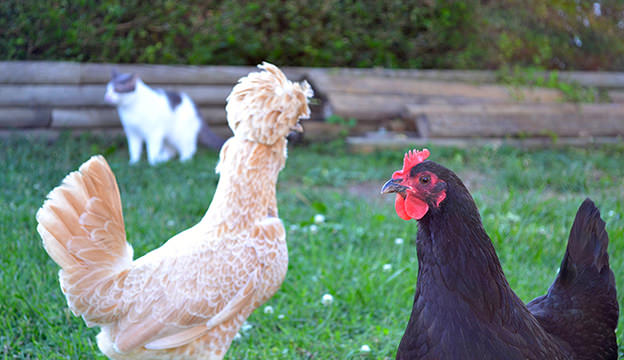
Are Cats a Danger to My Flock?

Because cats are carnivorous predators, it’s common to wonder if a neighborhood cat or stray will leap over your fence and attack your laying hens. But are cats really that dangerous?

Stray Cat Strut

While my first flock was still quite young—feathered out but not laying—a neighborhood cat would come by to stalk my birds. He would prowl around the coop and lie down next to it. This was before I started free-ranging the flock. When the cat first started visiting, the birds would cluck a bit, but they were still too young to be keenly aware of danger.

Had I free-ranged at the time, the birds would certainly have been in some danger, because the hens were quite small then. As they grew, the cat was less of a threat and hung out with my flock. He became a feature of the yard some days, enjoying the ambiance that chickens bring to the yard, perhaps.

Desperate House Cats

One of our house cats, Lily, became an outside cat when she was about 8 years old. (She had a problem urinating everywhere in the house.) When we determined with our veterinarian that she had a behavior problem, putting her outside ultimately relieved us all. By that time, our chickens were fully grown laying hens, and they were larger than Lily.

The hens needed a bit of time to get used to our cat being in the yard with them while they free-ranged. Like a guard dog, Lily kept some pests away, including wild birds that got into our chicken feed. In the backyard, Lily, the chickens and even the neighborhood cat, co-existed with ease. It was Lily and the neighborhood cat that often fought over territory, but the chickens were always left out of the catty drama.

Consider a Cat’s Motives

If you’re a cat owner, you understand the cat personality. They’re lazy, easily bored and only bother themselves with things that are simple, like chasing laser lights, killing weak animals and napping. A cat won’t prey on an adult chicken for the same reason she won’t prey on the family dog—chickens are too large and not worth the cat’s time. Cats normally kill mice, small birds, and maybe a bunny or a chipmunk on rare occasions. Cats prey on very small creatures they can pick up and take with them, especially if a kill is an offering for its owner. To travel with prey, the dead have to be small enough to keep the cat’s agility intact.

Consider chicks to be in danger of a cat attack until the reach the size of a house cat. This is usually around the time they’re ready to start laying eggs; however, small adult chickens, like bantams and Silkies, will probably always be in danger. If you choose to free-range any of these small chickens, do so only with strict human supervision. Small birds are vulnerable to all predators because they can’t protect themselves, and the youngest won’t even detect danger. Pullets and chicks are far less aware of the world around them than adult chickens, and predators always prey on the small and weak.

The Old Cat is Old Hat

Large, full-grown hens can co-exist with cats because they are as large or larger than domestic cats. Lily became old news to our flock. When she would bring home mice, the hens would steal the kill and chase one another around the yard for it. Poor Lily would pad her way to the back door, defeated.

If a neighborhood cat visits your yard and is a stranger to your flock, the chickens will let you know with frantic calls of danger to one another. And, they’ll stand still in the yard like statues until you shoo a cat away or until the cat gets bored and leaves on his own.

Categories
Equipment

How to Replace Old Fence Posts by Hand

Maybe you backed your truck into your fence. Or maybe your cows decided it was entertaining to chew fence posts during a long winter. Or maybe wet weather and fungi conspired to rot your fence over time. There are multiple reasons your farm’s fence posts can break down, but one thing is clear: You’ll eventually need to replace them. Fortunately, replacing fence posts is a relatively simple DIY project that requires little more than some strong hands, a few tools and a couple of hours. Here are step-by-step instructions to help you make your fence repairs.

Materials and Tools You Need

  • claw hammer
  • electric drill/screwdriver
  • nails and/or screws
  • new fencepost
  • bucket(s) of dirt
  • shovel
  • post-hole digger
  • digging bar with a tamper head
  • safety goggles
  • level

Step 1: Remove Fencing From Post

Whether your fence is electric, wire, plank or something else entirely, you will need to remove the actual fencing from your fence posts before you can replace a post. The way the fencing is attached varies, but in the majority of cases, it’s nailed or screwed into each post. To remove the fencing, use the forked end of a claw hammer to pry the nails away or an electric drill or screwdriver to remove the screws. If the fencing itself is undamaged, you can save the nails or screws to reattach the fencing to your new post.

Step 2: Remove the Old Post

To remove the old post from the ground, use a digging bar to loosen the ground around the post, methodically working from all sides while wiggling the post back and forth to free it from the dirt. A shovel can also be useful if the ground is particularly hard to remove dirt from around the post as you work.

Depending on how long the post has been in the ground and how well it was set in to begin with, removing the old post can take anywhere from a few minutes to an hour—even longer, if concrete was used to secure it. If concrete was used to fix your post, you can use your digging bar to break it up into smaller pieces, but be sure to wear safety goggles in case any pieces should chip off.

Step 3: Modify the Hole

After you have removed the old post from the ground, you will have a hole that is roughly post-shaped and can be reused for your new post. Before placing your new post in the ground, use your post-hole digger to deepen and define the hole, which has likely lost some of its shape during the removal process.

Step 4: Place the New Post

Once the hole has been prepared, carefully lower your new post into place, using a level to ensure it’s not tilting. If the post stands too high above the ground, use the post-hole digger to make the hole deeper.

Once you’re satisfied with the height of the post, fill the sides of the hole with dirt to secure it in the ground. Use your digging bar to push the dirt deeper into the hole, and use the tamper head (the flat end) of the bar to pack the soil firmly into place.

Step 5: Reattach the Fencing

Now that your post is in the ground, all you have to do is reattach the fencing. Using your salvaged nails or screws, or fresh ones if the old hardware was damaged or rusty, secure the fencing back into place using a hammer or drill.

Tips for First-Timers

  1. Don’t work in wet weather: Replacing fence posts in damp conditions can be extremely challenging, even if it’s bright, sunny and seemingly dry when you begin your work. If you experienced heavy rain in the days leading up to your project, the soil just underneath the surface can be extremely moist and muddy, making it difficult to secure your fence post firmly in the ground. Wet conditions can also make it more challenging to remove old fence posts, in addition to getting your tools (and quite possibly your clothes) rather muddy. For these reasons, it is best to wait until you have had several days of dry weather.
  2. Don’t struggle with rotten posts: If you’re replacing an old post due to rot, it’s possible that the underground portion of the post may have rotted to the point that removing it isn’t feasible. If this is the case, or if time is an issue, simply saw or break off the old post at ground level, flatten the remaining stub so it doesn’t stick out of the ground, and dig a new hole beside the old one to hold your new post.
  3. Make a checklist of supplies: Replacing fence posts is a job that requires many tools, and it can be frustrating to trek out to the farthest pasture only to realize you’ve forgotten your drill, your digging bar, or worst of all—your new post! To avoid unnecessary trips back and forth with extra supplies, create a checklist with all of the equipment you’ll need and confirm you’ve gathered everything before setting off on your latest post-replacing excursion.
Get more farm fence help from HobbyFarms.com:


Categories
News

Phone a Friend: How to Talk to Your Legislator About Farming

The very first session I went to at the Southern Sustainable Agriculture Working Group conference this year was titled “Inside Food & Farm Politics in D.C.” I wanted to pop my eyeballs out with a spoon. It was 9 a.m., and I was missing out on sessions about heritage pork, vegetable-crop diversification, Biodynamic compost and farm-to-school programs. Hearing about politics is the last thing I wanted, but because I am a loyal “News Hog” blogger and know that the information that comes from sessions like this is vital to our understanding of the food system at large, I went.

While the presenters, Sarah Hackney from the National Sustainable Agriculture Coalition and James Robinson from the Rural Advancement Foundation International, were delivering an engaging session (like always—I love going to their conference sessions), I realized how far removed we are from the policy work that takes place in Washington. Every day, someone who knows nothing about what takes place on your farm is making decisions that directly affect your farm. With this fact in mind, you have two options:

  1. Get riled up about some article I write and leave nasty comments, then complain to your friends about how much you hate Hobby Farms.
  2. Contact someone who can make a difference about the actions being taken.

I always encourage you to take the second option and try to leave you with instructions about how to do so. Hackney and Robinson are helping me out this week: After their SSAWG Conference session, they did a short video skit of what it’s like to make a phone call to your legislator. The video is completely unrehearsed—we did it all in the first shot—and it’s only three minutes long. If you’ve never picked up the phone to discuss an issue with your senator or congressperson because you didn’t know how, you no longer have that excuse.

Why a Phone Call?

How to Talk to Your Legislator About Farming - Photo by iStock/Thinkstock (HobbyFarms.com) #newshog #farmpolicy

“The No. 1 most important, best possible thing you can do in 2015 is to call your legislator at least once,” Hackney said during that session. Then she paused and said the top thing would actually be to donate millions of dollars toward the political cause you believe in. Short of that, though, pick up the phone!

A phone call carries so much more weight than something as simple as an online petition. Your legislator knows how easy it is to “sign” your name to a petition online. He also knows how much more time and thought it takes to place a phone call.

If you don’t make this phone call and someone with an opposing viewpoint does, your legislator isn’t going to know about the range of viewpoints held by people in his district. Points are tallied here, and the side who doesn’t make the phone calls loses.

Your Game Plan

I don’t like talking on the phone. I’m an emailer, for sure. So I before I make a call like this, I scribble some notes. They might look like:

Introduction—I’m a constituent
I want the GMO Right-to-Know Act to get passed:

    • Consumers should be informed about what’s in their food
    • Opens up trade opportunities
    • Industry transparency

Say thanks
Leave contact info

Notes like this help keep you focused, and they prevent you from going down an emotional path, which is so easy to do when we’re dealing with topics that are so close to our homes, health and hearts.

If you have statistics—particularly anything related to the economy and job creation because legislators love that stuff—include them in your message. If you’d like to hear back from your legislator—or more likely a staff member—leave your contact information.

In the video above, a staff member from Senator Jane Smith’s office (we made this up, by the way) answers the phone and has a nice conversation with the farmer who’s calling. You’ll often call a legislator and get his voicemail, which is less intimidating than actually talking to a person, I think. Even when you do end up talking to a person, I can all but guarantee they’ll be polite and patient as long as you are the same. This is what they’re paid for! You are their boss’ constituent, so technically, you are their boss’ boss.

Another thing happening in this video that you might not experience is that Senator Smith’s staffer asks if someone can visit the caller’s farm. Sure, this might happen when you call, but it’s not extremely likely. Rather, if you have an event happening on your farm or with a farming group that you’re involved with, you should extend the invitation to show off how you’re benefiting from (or not benefiting from) government policies or programs. You never know what a good working relationship with your representatives can lead to.

Walking the Walk

Something I appreciate about writing these blog entries and asking you to take action is that I feel I also have to take action. It’s not fair for me to say you should do it and then not do it myself, right? I have left voicemails for my representatives, submitted comments to the Food and Drug Administration and the Environmental Protection Agency, and talked with friends about how they can do the same. This is not a do-as-I-say kind of blog I’m writing here—I’m doing this with you.

Now, please watch the video! And consider making a few phone calls about subjects that are on the table right now. (GMO labeling, GM mosquitoes and fracking are just a few hot topics.) Your first phone call is your hardest. I swear.