Categories
Beginning Farmers

5 Questions to Ask When Buying an Old Farmhouse

5 Questions to Ask When Buying an Old Farmhouse - Photo by Mindy Georges/Flickr (HobbyFarms.com) #farm #farmhouse 

You’ll have a million and one questions when buying a house, but an old farmhouse presents its own set of potential challenges. With long-time farm use, farmhouses have seen their fair share of wear-and-tear, and if this is your first time in a rural location, you’ll be faced with concerns you never had to think about in the city or suburbs. Make sure the house and land you purchase is what you dreamed of by asking your Realtor these questions before you make the purchase.

1. How is the property zoned?

This is an important question whenever you’re buying a home, but it can be of particular importance when buying a farmhouse. The specifics of zoning can limit or prohibit the activities you wish to pursue on your property, including livestock keeping and agritourism endeavors. If you’re buying property intending to keep a couple of horses, you don’t want to discover that your property isn’t zoned for livestock after the fact.

2. How old is the septic system?

You might be accustomed to being connected to city sewer lines, but most old farmhouses have out-of-date septic systems. Find out what kind of system is in place, when it was installed, whether it’s up to current code and whether it will need to be replaced. A new septic system is a significant expense, and if it’s required, could be a negotiation point with the seller. (I speak from experience on the expense. Yikes!)

3. Is cell service/high-speed Internet available?

Welcome to the land of rural living, where cell phone service is spotty and “high-speed” Internet is slow. Depending on the location of the farmhouse and its proximity to cell towers and Internet lines, you may have difficulty getting reliable service. If these services are important to you—and for most Americans, they are—ask your Realtor about local availability and alternative services.

4. Does the house have any problems with its [fill in the blank]?

Old houses are filled with charm, character and a sense of history, but they can also have structural issues, outdated plumbing and electricity, and other problems that might not be visible at first glance. Ask your Realtor for as much information as he or she can provide. When was the roof replaced? Is the foundation solid? When were the electrical systems updated? How old is the furnace? Is there any lead paint or asbestos in the home? Has the well been tested recently? Does the house have any seasonal flooding issues? While you’ll have the home inspected prior to purchase, it’s good to discover any potential red flags sooner rather than later. Cover all your bases to make sure you understand exactly what you’re getting into. It’s easy to become enchanted with the idea of purchasing an old farmhouse—it’s a farmhouse, after all!—but you don’t want to overlook potentially hazardous or costly problems.

5. Where are the property lines?

The land you’re looking at might sound so delightfully spacious, but has the property been surveyed recently? Do you know exactly where those property lines fall? Is your neighbor’s fence actually on your side of the property line? These issues are important to address prior to purchase so you can eliminate issues down the road. You’ll also want to ask your Realtor if the property has any easements or encumbrances.

Get more tips for managing your property on HobbyFarms.com:

  • Eminent Domain and Your Farm Property
  • Cut Your Property Taxes
  • Top 3 Things to Look For When Buying a Farm
  • How to Site Your First Barn
  • Flip the Switch on Electricity Consumption 

About the Author: Samantha Johnson is the author of several books, including How to Build Chicken Coops (Voyageur Press, 2015). She raises Welsh Mountain Ponies in northern Wisconsin and enjoys gardening, especially heirloom vegetables. Visit her online portfolio.


Categories
Homesteading

Ditch the Chore Chart

Ditch the Chore Chart - Photo by Tessa Zundel (HobbyFarms.com)

Sometimes I get overwhelmed by the homesteading activities, like gardening and chicken keeping, and lose track of all the other work that needs to be done around the house. I used to think I could organize the troops and get it all done if I just had the right chore chart. Well, I’m here to tell you that I’ve outgrown out that notion and so have my kids.

A few years ago, after my fourth baby was born, I realized something important about myself. I’m not a chore-chart type of person. Chore charts fill me with a sense of dread. They’re a visual reminder that my life is chaotic and nothing ever goes as planned. So I went into my school room and tore every chore chart from the wall.

Having no plan or organization was no better, of course. Because I homestead and homeschool, plus care for five children, I need some form of organization. There’s indoor work, outdoor work and school work that has to be done every day.

A New Solution

Ditch the Chore Chart - Photo by Tessa Zundel (HobbyFarms.com)

Enter the Kid-of-the-Day rotation. I learned this concept from a friend who runs the Family Builder Program, a home-based learning coaching course. As she taught about how to inspire children to own their responsibilities without being harsh or, worse, disorganized in our demands, she presented Kid of the Day as a tool for engaging multiple children in multiple chores. (If you have one child, simply insert yourself into this rotation so you can participate with your kid.)

Each child is assigned a day of the week and given both privileges and responsibilities for that day. To decide on those privileges and responsibilities, I sat down and talked with my children about what they’d like to be responsible for when it was their turn to be Kid of the Day. You’ll want to create a list of your own, here’s what we came up with as an example.

Kid of the Day will:

  1. Be first to pick their chores from the daily chore list. Then move through the kid rotation from there.
  2. Be first to choose where they sit at the table and in the car.
  3. Help with dinner preparation and setting the table.
  4. Get two votes when we vote for family movie or activity on family night.
  5. Be special helper to the youngest child for the day.
  6. Get to pick which book we read first during family reading time.
  7. Help things go right in the house and be a friend to all who need it.

This simple concept has saved our family from countless fights on where to sit in the car and who gets to go first with anything. We just ask, “Who’s Kid of the Day?”

It readily became apparent that this system would solve my chore dilemma. I can’t keep track of a chore chart; I can’t remember to give cute stickers when something is completed; and I can’t for the life of me keep up with the ever evolving personalities of my children. I wouldn’t want to wash the dishes every day for an entire year just because my mother decided that was my chore, so how can I expect my children to be happy with that arrangement either?

Chore Chart to Chore List

Ditch the Chore Chart - Photo by Tessa Zundel (HobbyFarms.com)

Now, instead of a chore chart, we have a daily chore list that is always new and spontaneous. I write it on a scrap paper with whatever writing implement I can find on my counter in the rush of morning breakfast preparations. This often means our chore list is penned with a broken crayon on the back of a used paper plate. Whatever. I stopped being picky three kids ago.

On the list go the things that need to be done that day. Because the chores are different each morning, there’s always variety. We use our Kid-of-the-Day order so that no one person is getting stuck with the less desirable chores every day. I sometimes have to jump in and help my 6-year-old with some things, but all the children are accountable to me to do their best work.

A Day In the Life

Here’s how our days usually go during the week:

  • Monday: Big cleanup and laundry day; each child has has about five chores.
  • Tuesday to Friday: Each child has two to three chores, depending on if we have to do some extra pick-up for a school activity hosted at our house.
  • Saturday: Daddy is home, so we work on our biggest homestead chores; housework is limited to two tasks each.
  • Sunday: We take the day off to observe our Sabbath.

I have five children but only four of them are old enough to be included on the daily chore list. (My toddler helps put away the silverware and feed the cat, but we don’t keep track of that on a chore list, nor do we hold her accountable yet.) My other children get extra chores if their daily expectations are not met. Here’s an example chore list:

  • put away clean dishes
  • wash dishes
  • tidy and vacuum the family room for book club
  • tidy and vacuum the basement for school group
  • sweep kitchen and dining room
  • take out chicken scraps
  • take out compost
  • clean toilet and tub in kid bathroom

If I feel we need a morale boost, I’ll also add things like:

  • make monkey noises
  • tell a knock-knock joke
  • do a funky dance
  • use the word “spork” in a sentence

Remember, each household is different and you’re going to have your own priorities. As you’re making your list, be sure that you put down only what needs to be done. Your time with your children during daylight hours is precious and occupied, especially if they’re in public school. Spending time reading on the couch together is way more important than a sparkling house.

Just to clarify: Because I’m also my children’s school teacher, I assign daily schoolwork, as well as family learning and group activities with other homeschoolers. My children are involved with some sort of learning activity about eight hours every day, onto which we pile house and homestead chores, community service, family time, and of course, sleeping and eating. Eight hours of work, eight hours of recreation, and eight hours of rest: a healthy formula that’s negotiable for each person.

Do What You Do Best

I don’t pretend to have it all figured out. As I see it, the first 50 years of parenting are the hardest and I’m only 12 years in. However, I’m happy to use other people’s wisdom and good ideas to manage the enormous tasks of keeping our homestead functioning. Plus, anything that introduces variety into the several mundane tasks we have to do every day is truly an asset.

If you love your chore chart and it works for you, keep it and rock on. If you find the chore chart confining, ditch it. Try a Kid-of-the-Day rotation and a simple list of daily tasks, and let the children choose what kind of work they’ll do. We can’t choose to abstain from the work, so we may as well make it fun!

Get more help with homestead organization and chores:

« More Farm Sprouts »


Categories
Urban Farming

Know Your Beneficials: Golden Silk Spider

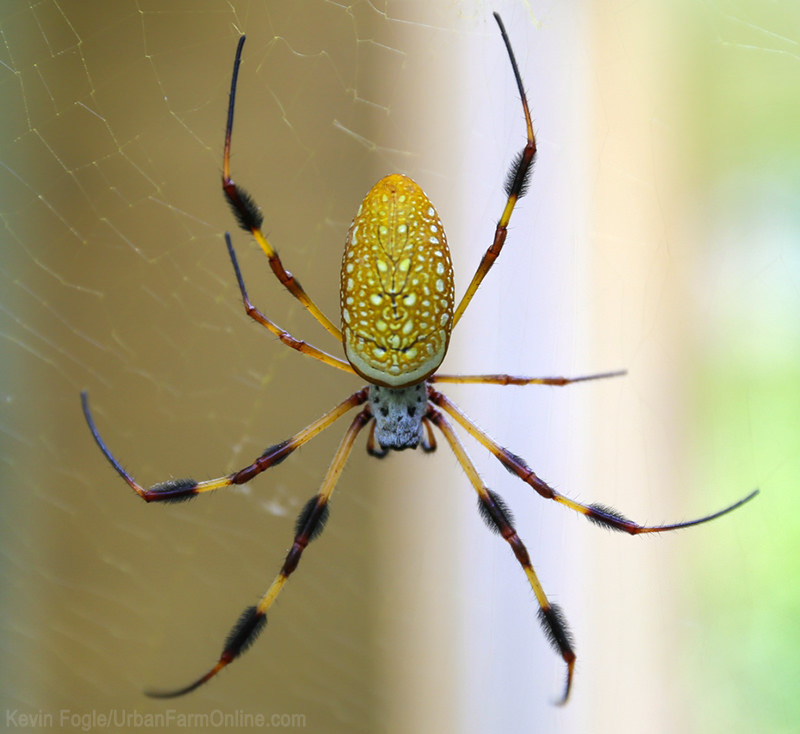
Know Your Beneficials: Golden Silk Spider - Photo by Kevin Fogle (UrbanFarmOnline.com) #spider #beneficialinsect #garden

Last week, I introduced you to the black-and-yellow argiope (Argiope aurantia), perhaps better known as the black-and-yellow garden spider. As we continue to look at beneficial spiders in the yard and garden, I want to introduce you to another very large spider, the golden silk spider (Nephila clavipes), which looks similar.

Like many spiders and insects, the golden silk spider confusingly goes by many common names, which often refer to multiple species. Other names for the golden silk spider include the banana spider and gold silk orb-weaver. The reference to the color gold does not speak to the coloration of the spider itself, rather to the color of the spider’s web, which can appear yellowish in certain lighting conditions.

Check Your I.D.

Golden silk spiders are a common sight in the southeastern United States, from Florida west to Texas, and are regularly found as far north as North Carolina. Adult female golden silk spiders are very large, reaching up to several inches in diameter when leg span is included. Their cylindrical abdomens are brown to muted orange and feature a rather sporadic white or yellow pattern. Their legs have red and yellow bands with several dark fur-like tufts on them.

Adult males reach only one-quarter the size of the adult females. They have a non-descript, dull-brown body and can be found occasionally visiting the female’s web. The size and color difference between the two genders leads many casual observers to mistakenly believe that the males are either immature golden silk spiders or spiders of an entirely different species.

Master Weavers

The golden silk is an active garden and yard predator. It builds large strong webs in peripheral locations intended to capture flying insects of all sorts. You’ll most often see the adult females in late summer and fall. Last year, my family was fascinated by two golden silk spiders that built their webs between the house and our front hedge next to the garden. Every day we would go over and see what the spiders were up to, what they had caught in the webs and how big they had gotten. It was amazing to see the range of critters they ensnared, from grasshoppers to the annoying leaf-footed bugs that were attacking my cherry tomatoes.

Feel free to share your spider stories. I would love to hear what spiders you see around the garden!

Read more of Garden In Front »


Categories
Animals

6 Ways to Predator-Proof Your Farm

6 Ways to Protect Your Livestock From Predators - Photo by Roger S. Hart/Flickr (HobbyFarms.com) #farm #farming #livestock

Animals that prey on livestock and poultry are more creative and intelligent than farmers would like them to be. The species that want to prey on your livestock probably lived on your farmland before you moved in, so telling them they can’t be there isn’t exactly easy.

You have a number of options for livestock and poultry predator control, exclusion and removal on your small-scale farm. The most effective means of preventing predation is to keep the predator from getting to your animals in the first place. Once the predator knows there’s a meal to be had, it can easily establish a pattern of attack, and that’s difficult to break.

Assuming you’re reading this because you have a predator problem, your first task is to determine what predators are causing problems on your farm. Armed with that knowledge, develop a plan to eliminate the issue using these six strategies.

1. Exclusion

The best way to remove a predator threat is to simply keep the predator out. Fencing is a farmer’s best friend in this case, and there are many types to choose from.

  • Tall, woven-wire fencing buried partly in the ground will prevent predators from jumping over and burrowing under. An electric strand at the top will keep raccoons and opossums, which love to climb, from getting over.
  • An electrified-net, portable fence can be effective against many critters—raccoons, opossums and foxes for sure—but persistent dogs and coyotes can jump 5 feet or higher, right over the fence.
  • High-tensile, electric-wire fencing with strands spaced 6 inches at the bottom graduating to 12 inches at the top so predators cannot squeeze through is another option.
  • Fladry—a wire fence with long, red flags hanging at 18-inch intervals—can be effective against wolves, particularly if it’s moved regularly.

While fencing out critters works pretty well for land-based predators, those coming from overhead—the hawks and owls that are after your chickens—are more difficult to keep away. If you keep your poultry in a small, fenced lot, you could potentially put a mesh fence overhead, but if your birds are out on pasture, it’s hard to install overhead fencing on an acre! There are more predator-control options that would likely work better for you below.

2. Guardian Animals

Properly socialized guardian dogs, donkeys and llamas can be effective predator protection. Dogs are useful for land-based and aerial predators, though they could become chummy with other dogs preying on your animals. Donkeys and llamas are especially effective against dogs and coyotes; however, if you live in an area with a large presence of wild dogs or coyote packs, your llama could become prey to them, as well. Each farming situation needs to be considered individually.

3. Distraction and Scare Tactics

In this category, think “fun house.” Around every turn, something is making a noise, flashing or blowing in your face. You don’t want your animals to feel like they’re at the carnival, but well-placed elements of surprise can deter predators.

  • Noise devices and flashing lights set to go off at intervals at night are effective against all predators but can also disturb your livestock until they become accustomed to them.
  • A radio can keep away predators for a short period.
  • Continually lighting a pen at night will allow you to keep an eye on your animals and deter nocturnal predators, but a light might attract a dog searching for prey.
  • Predator eyes—those large eyes painted on balloons or signs—can make an aerial predator think it’s being watched by a predator of its own.
  • Hang random shiny things. Just like you tie CDs and strips of Mylar around the garden to keep out birds, you can tie them around the perimeter of the pasture to keep out visitors.
  • Firing cracker shells when a predator is in sight—not at the predator but in the vicinity of a predator—can send them running.

Don’t employ all of these tactics at once. As predators become used to these sights and sounds, you’ll need to switch up your course of action by moving or alternating their use.

4. Removing Attractants

Predatory animals are attracted to your farm for more than just your livestock and poultry. Keep your property clean so they have one less reason to visit.

  • Don’t put meat, eggs and dairy in your compost pile.
  • Don’t leave cat and dog food outside.
  • If your sheep, cows or horses give birth outside, clean up the area as soon as possible.
  • Keep poultry and young animals in a predator-proof area at night.
  • If an animal dies on your property, remove or bury the carcass.

5. Relocating

Trapping animals requires some research. Certain animals can be trapped in certain states, and what you’re allowed to do with them from that point also varies. Find out rules governing trapping wildlife in your area through your state department of fish and wildlife.

A lot of issues surround trapping, even when doing so humanely with a box trap: Catching the target animal rather than another animal, holding an animal in a trap for a period of time, safety (for you and the animal), moving the trap, and relocating the animal after trapping. These are all issues you need to work out to be in line with your farming philosophy and your wildlife-management agency.

6. Lethal Force

Before taking lethal action against a predator on your farm, consider the legal and ecological implications. Many predators—hawks, owls and wolves included—are protected species and cannot be harmed or killed. Other predators, such as bears, might require a permit for hunting. Even the less endangered animals causing problems on your farm still have a role in the ecosystem. Removing them from an area can invite other predators to move in or promote the growth of another pest species that they also prey on, such as rats and mice.

If lethal force is your choice for predator removal, first be sure you can legally hunt the animal, and get the proper licenses, if required. Know the animal’s movement patterns, find a hunting spot that is safe for you and the people and animals around you, and have a plan for disposal of the predator’s carcass.

Work with your state’s Animal and Plant Health Identification Service wildlife services manager if your predator problem is more than you can handle. He might be able to work with you on a management plan.

Also, read “Predator Control for Sustainable and Organic Livestock Production” from the Appropriate Technology Transfer for Rural Areas for more information.

Get more predator help from HobbyFarms.com:

  • Infographic: Pick Your Predator Patrol
  • Protect Your Flock With Guard Donkeys
  • 5 Predators After Your Livestock
  • Will Your Dog Attack Livestock?
  • Keep Coyotes Away From Pets and Livestock

About the Author: Freelance writer Lisa Munniksma blogs weekly about ag news and opinion for HobbyFarms.com’s “The News Hog” and about farming and traveling around the world at www.freelancefarmerchick.com.

Categories
Animals Poultry

How to Incubate and Hatch Chicken Eggs

Buying chicks from a hatchery is easy, but it’s not the only option, and “easy” isn’t the only attribute to consider. There’s sustainability. There’s economy. There’s flexibility, enjoyment and a sense of accomplishment. All of these take center stage when you decide to incubate eggs from your own flock.

Set Up the Incubator

Choosing an incubator is an article in its own right, so let’s just assume you’ve got one. Step 1? “Disinfect incubator with 10-percent bleach solution, then wash with warm soapy water and rinse thoroughly,” recommends the University of Illinois Extension.

Then choose a location that’s both constant in temperature and draft-free. Garages and barns are not ideal, especially in chilly weather, because the eggs must remain between 99 and 102 degrees F, with target range of 100 to 101 degrees. Wrapping the incubator in a thick blanket and placing it inside a large box insulates for better heat economy and stability.

Set up your incubator two or three days in advance to make sure it is operating correctly and that you understand how to maintain the target temperature and humidity. If those eggs were under a mother hen, they’d be receiving the perfect amount of moisture from contact with her skin. Substitute a pan of water—some incubators come with built-in water reservoirs—in order to hold humidity at 50 to 55 percent, and increase to 65 percent humidity for the last three days. Make sure to test your thermometer for accuracy.

Gather Eggs

incubate hatch chicken eggs

While readying your incubator, stockpile eggs. They must be fertilized, of course, so if your flock lacks a rooster, obtain eggs from someone who has one. Alternatively, fertile eggs can be purchased online, though this isn’t as economical as gathering from your own coop.

Eggs you plan to incubate should be less than 10 days old. The University of Minnesota Extension says, “Hatchability declines rapidly when incubation is postponed for more than 10 days. Until they are incubated, hatching eggs should be stored in cartons or cases—large end up—at 40 to 70 degrees F (50 to 60 degrees F is best) with a relative humidity of about 75 percent.” If storing for more than two to three days, change their positions daily to reduce the tendency for the yolks to stick to the shells. Avoid oval/football-shaped eggs, possibly double-yolked eggs and any with shell abnormalities, as these may interfere with successful incubation. Washing eggs pre-incubation is not recommended, but if excessively dirty, Virginia Tech recommends using a damp cloth warmer than the egg so that dirt and bacteria are not absorbed through the pores of the shell.

Wait for Hatching

incubate hatch chicken eggs chicks

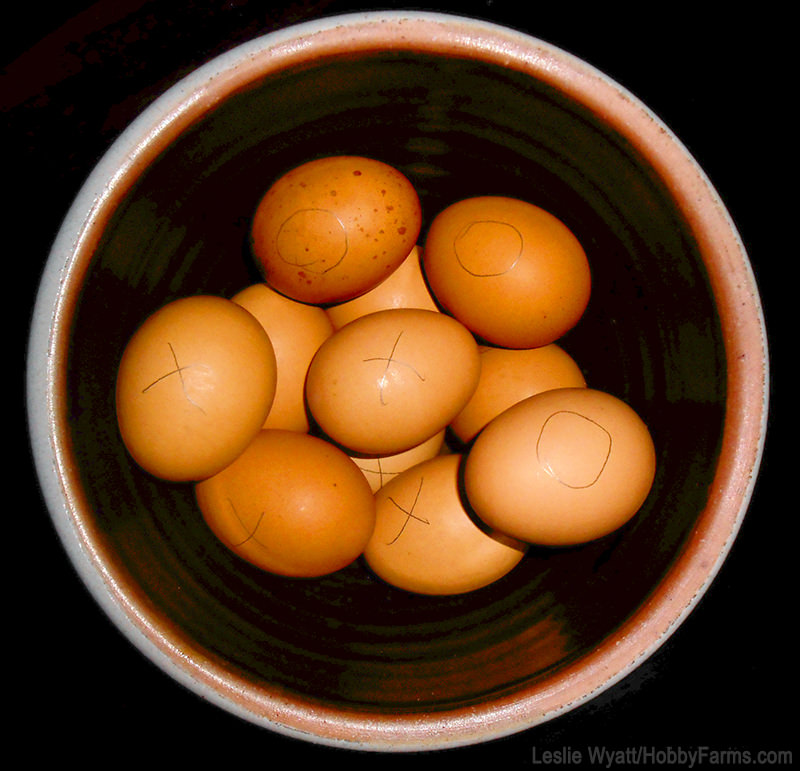
Incredibly, it only takes three weeks for eggs to turn into chicks. Once you’ve set the incubator’s temperature and humidity at the ideal range and you have your quota of eggs, use a graphite pencil to mark each one with an X on one side and an O on the other. These are your references, as eggs must be turned a half turn three times a day to keep the yolk from adhering to the side and causing embryo death. Some incubators come with a rotating base that turns the eggs automatically, but it is a good idea to mark them anyway so that when you check temperature and humidity, you can see at a glance whether they’re being turned correctly. Don’t open the lid frequently: It takes a while for the temperature to regulate again, and embryo growth slows in cooler temperatures.

If all goes well, candling will reveal growing embryos. On Day 18, cease turning the eggs and increase the humidity to 65 percent to avoid having chicks stick to their shells when hatching. By this time, you may hear the babies peeping inside their shells. For incubators with wire bottoms, add a layer of paper towel on day 18 so that tiny chick feet won’t be damaged. At this point, prepare the brooder so it’s warm and ready to receive the newly hatched babies.

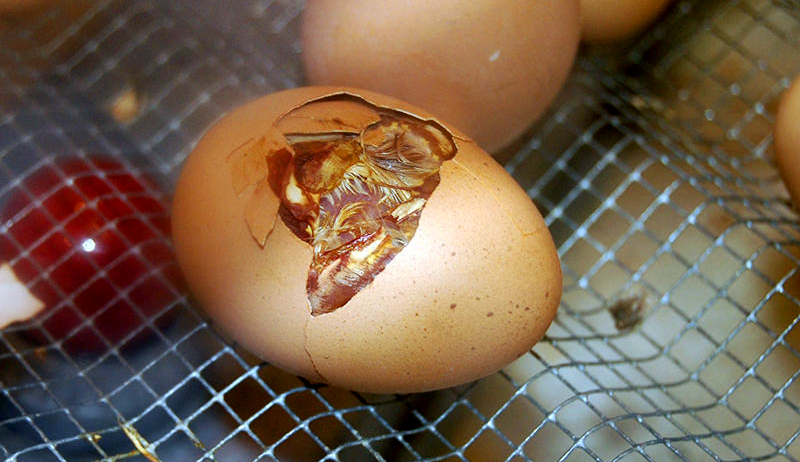
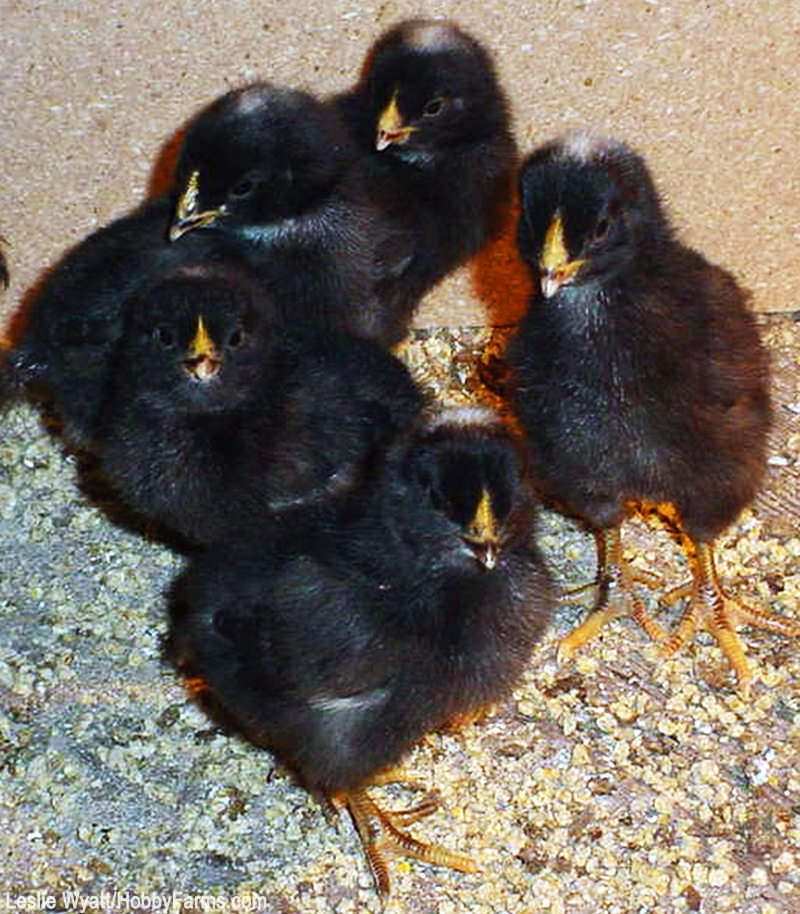
On Day 21, watch for the chicks to “pip” their shells—they peck a little hole so they can breathe. It can take hours for a chick to hatch after pipping. Be patient and don’t “help” them: Those you assist will usually die. You can assume that any eggs that haven’t hatched by day 24 are not viable (hatches seldom yield 100 percent). If all goes well, you’ll soon have an incubator full of damp, wobbly chicks. Enjoy the babies at a distance while they dry off and fluff up, then transfer them to your brooder, clean the incubator, and store it until next time.

Categories
Beginning Farmers

My 5 Favorite Weeds: If You Can’t Beat ’Em…

My 5 Favorite Weeds - Photo by Cyn Cady (HobbyFarms.com) #weeds #edibleweeds #foraging

… Eat ’em!

At least, that’s the conclusion I’ve come to about the weeds in my yard. I’ve stopped looking at weeds as annoying competition for my landscaping and veggies, and started looking at them as, well … delicious. A brief excursion into the side yard this morning resulted in a foodie-heaven breakfast: wild greens and leftover Spanish rice, topped with poached eggs. And weeds … I mean, “wild greens,” are free! Cost-free and labor-free (except for the work of picking and prepping). Let’s face it, Mamacita Nature is a much, much better gardener than I am. Her stuff grows like mad without fertilizers, extra watering or cultivation.

So far, these are my top five favorite edible weeds: They’re easy to ID, easy to pick and pretty darn tasty. It’s also tough to overharvest these, as they are as tenacious as a honey badger and as hard to get rid of as head lice.

Chickweed

My 5 Favorite Weeds - Photo by Cyn Cady (HobbyFarms.com) #weeds #edibleweeds #foraging

Vying for the title of “Cutest Weed,” with its delicate leaves and adorable tiny white flowers, it’s also prolific and yummy. Now that I know how to identify it, I’m seeing it everywhere. It’s made a broad carpet in an area below my deck, and because it’s not interfering with any of my other plantings, I can leave it there until I’m ready to toss it into a stir-fry or salad.

2. Yellow Dock

My 5 Favorite Weeds - Photo by Rachael Brugger (HobbyFarms.com) #weeds #edibleweeds #foraging

This stuff is everywhere! I’ve been using the young, tender spring leaves in salads or lightly sautéed with other wild greens, but the seeds can be used to make flour. (It’s a relative of buckwheat.) This involves a lot of grinding or milling or whatever, so I won’t be whipping up loaves of dock bread anytime soon, but I might toss a few seeds onto my oatmeal later in the season.

3. Dandelion Greens

My 5 Favorite Weeds - Photo by Sarah/Flickr (HobbyFarms.com) #weeds #edibleweeds #foraging

Dandelions are SO annoying. The little puffballs scatter at the slightest breeze and bammo, they’re everywhere. I’m not really a lawn person, but if I were, dandelions would really tick me off. Luckily, the young greens are tasty, which motivates me to get at them before they go to seed and take over the universe.

4. Milk Thistle

My 5 Favorite Weeds - Photo by Cyn Cady (HobbyFarms.com) #weeds #edibleweeds #foraging

Until very recently, my interaction with the thistles in my yard was limited to hacking wildly at them with a hoe and muttering angry inappropriate things under my breath (or at the top of my lungs, depending on who was in earshot). Once I learned that the leaves and stems of milk thistle are delicious used as a veggie or salad green, I started picking and trimming leaves, but quickly realized that the thistles would grow and propagate waaaay faster than I could eat them. The trimming process was time-consuming, and borrrrrring. The solution? Thistle juice! I can cram loads of untrimmed leaves (and the roots!) into my juicer and extract super-potent green juice. Add a squeeze of lemon and maybe an apple for sweetness, and even the kids will drink it. I don’t even have to threaten to ground them.

5. Miner’s Lettuce

My 5 Favorite Weeds - Photo by Cyn Cady (HobbyFarms.com) #weeds #edibleweeds #foraging

I have to admit, I’ve never really thought of miner’s lettuce as a weed. I snacked on this a lot as a kid; it grows pretty much everywhere. The raw leaves are tasty but very delicate; they don’t hold up to cooking very well, but work great in salad or juices. When I nibble on it as I roam around the property, inspecting the fence line or looking for trees that need trimming, I’m 10 again.

Is adopting my new role as a human Weed Eater actually considered farming? Maybe not directly. But it is related to that larger task, or what Aldo Leopold describes as the “…oldest task in human history, to live on a piece of land without spoiling it.” So instead of grubbing out weeds … I mean, “wild greens”… by the roots and eradicating them completely from my personal landscape, I’ll turn them into dinner, and leave a little space for them to keep growing in the corners of the yard.

Get more help with weeds on HobbyFarms.com:

« More Greenhorn Acres »


Categories
Poultry Urban Farming

Feeling Cooped Up

Feeling Cooped Up - Photo by Rachel Hurd Anger (UrbanFarmOnline.com)

Chickens are spooked easily by sudden changes. Where I live, we haven’t had much of a traditional winter, but last week, the sky fell. In fact, an entire foot of sky piled up around my chicken coop. My dearly departed Red Star Mabel would have trudged through the snow like an Arctic explorer, but since she’s been gone, the other old girls have gone soft. Who can blame them, really? Even the humans hid inside last week like the chickens hid inside their coops.

A friend mentioned to me yesterday that one of her chickens avoided the snow and ice on the ground by flying up into a tree. Despite the below-zero wind chills overnight, the hen spent two days up in the tree refusing to come down.

My own adventures out to the coop through the snow to check on the flock left a nice compressed trail where the chickens could walk to the back steps for treats and kitchen scraps. The kids and the dog helped leave trails through the rest of the yard, too. I tried to coax the flock out a couple times early in the week, but they wouldn’t budge.

The hens and the pullets spent nearly two full days inside the coop, even with the door of the run open to freedom. I finally scattered some leftover vegetables in their direction, and three pullets jumped at the temptation, flying unsteadily. Each of them landed in deep snow; not one landed on the compressed paths we’d stomped out for them. I swear I heard thunks when they landed, but I might have imagined it. For a moment, they looked like ducks floating on water, not chickens stuck in snowflakes.

Feeling Cooped Up - Photo by Rachel Hurd Anger (UrbanFarmOnline.com)

I let the hens sit where they landed for a few minutes to see if they’d move on their own or make a ruckus. They didn’t. The girls just sat there. Perhaps it felt comfortable to them, but the snow was so deep where they’d landed—their shanks and toes not long enough to touch the patio beneath them—they’d never have made it out on their own. So I pulled on my boots and rescued them, one by one, each one flapping and squawking at me as I returned her to the coop.

The next day, our Easter Egger seemed fed up with staying indoors. She was the only chicken to leave the coop that day, but she avoided the snow. She flew up onto the coop, then onto the north-facing privacy fence. I guess a chicken’s got to roost when a chicken’s got to roost.

On Sunday, a full week into what seemed like an entire winter’s worth of weather, the hens found snow- and ice-free areas in the sun to hang out. The whole flock stood on the back steps for most of the day. Every time I peeked outside, they would tantrum with clucks and squawks, as if they’re the only ones whose normal activities were derailed by the winter weather.

Did winter storms affect you this year? What kind of wacky behavior did you notice in your flock?

Read more of Chicken Quarters »


Categories
Animals Large Animals

Are Pigs Right For My Farm?

With enough work, you can adapt just about any animal to any farming situation, but few animals exemplify this idea quite like pigs. They can live in large pastureland, roaming free and eating legumes, or they can just as easily spend their days in the dense woods, chomping on roots and nuts. Maybe all you have is a barn and some corn—they can do that, too. Pigs can thrive on almost any farm, so long as a few small things—and a few big ones—are taken into consideration.

1. Different Breeds Have Different Needs

Determining what kind of pig you want to raise is a good first step to deciding if pigs are right for your farm. Heritage-breed pigs, such as Red Wattles or Tamworths, will not thrive in a contained situation as well as crossbreeds, such as Spots or Durocs. Heritage hogs like to browse, and though they’ll eat corn and other grains, they prefer legumes, grass, roots and nuts. Non-heritage crossbreeds, on the other hand, are bred for eating high-density starch and protein. Also, the heritage breeds take longer to mature, so a farmer cannot generally expect to get the same amount of meat in the same amount of time from both types. In other words, if raising them up and selling them off quickly is your intention, the heritage breed may require more patience.

2. Diverse Food Equals Tastier Meat

Most pigs, regardless of breed, are fond of alfalfa, clover and other legumes. They’ll eat a little grass, but because they aren’t ruminants, will not make the most efficient use of pastureland alone. If keeping them on pasture, provide access to a woodlot so they can forage high-protein nuts and offer a small supplement of grain in colder months. It’s not required to give pigs grass, nuts and legumes, but they’ll be healthier and happier (and their meat will be tastier) if you can.

If you plan to park your hogs in one spot, consider making that location under the branches of some white oak trees so acorns might fall into their paddock every autumn as a bonus treat. You can also place their paddock at the end of your garden so you can easily feed them garden scraps. Any extras you can offer—even hay and kitchen slop—will help pay off in flavor and health.

3. Avoid Confinement If Possible

If you want to keep pigs in a small, permanent area, you should probably think twice. Pigs are prone to parasites and rotating them through woods or pasture is a great way to reduce their exposure, even though it takes more work. In rotational grazing, you’re constantly moving them away from the parasites every few days or so. Plus, as mentioned above, variety in their diet will not only make them healthier and happier, but tastier come processing time.

However, if you have no choice but confine the herd, frequently give them new hay to bed on, pick through and cover their manure with while mixing diatomaceous earth—a natural dewormer—into their feed. As an environmental bonus, the hay will also help lessen the mud issues that can occur in penned situations.

4. Feed Is Pricey

Before getting hogs, it’s always a good idea to ask around and see what kind of corn or feed is available from neighbors and local co-ops. One hog can eat up to 800 pounds of corn before it’s finished, and you’ll need to factor in the time and the cost of gas required to get it.

While, many of the heritage breed hogs can technically fatten themselves almost entirely on pasture and woodlot foraging alone, they’ll take considerably longer to finish—a year and a half or more, depending on the forage and breed—compared to non-heritage breeds at six to eight months. As for protein, many people opt for soybeans, but you can also look into fish meal as an alternative. Again, see what’s available nearby.

5. Pigs Don’t Sweat

Pigs are not heavy water drinkers, but they do need constant access to it, especially in the summer. Pigs don’t sweat, so water helps keep them cool and hydrated. You’ll need to be able to supply them with unlimited fresh water every day in the hotter months. If you’re able to mist them in the summer, even better.

6. Fencing Must Be Secure

Look at your fencing—or how much you’re willing to invest in fencing—before getting pigs. Standard pig fences are 34-inch-by-16-foot hog panels secured with T-posts, but if you’ll be keeping them penned for a long time, consider adding extra protection. Although pigs are strong and can plow up or through a weak fence, they’re also relatively thin-skinned, so electric wire tends to be a good deterrent.

For pigs in confined situations, a strand of wire at shin height in front of the hog paneling will help keep pigs from escaping. For rotational grazing, 8-by-16-inch electrified polywire works well, as the wires are highly adaptable and don’t easily get hung up on sticks and saplings like nets do. Premier1Supplies offers electric nets specific for pigs; they’re raised a few inches off the ground, which works well for rotating on pasture and doesn’t get buried as easily by pigs’ rooting.

7. Shelter Needs Are Minimal

If you plan to breed hogs, you’ll need a small, enclosed structure that can be filled with hay for farrowing. Preferably, this structure would be equipped with a heat lamp and electricity. If you’re just wanting to raise feeder pigs—that is, young pigs you buy from another farmer—they don’t need a lot in terms of shelter: only shade in the summer and protection from cold in the winter.

How much shade and winter housing you provide will depend on the breed and the climate. In a colder climate, certain heritage breeds can handle the cold better than others, while many of the other breeds are bred for indoor living and may need heat lamps. That doesn’t mean these hogs can’t thrive outdoors; it just means they can’t handle extreme temperatures.

Learn more about pigs on HobbyFarms.com:

Categories
Crops & Gardening

To Feed or Not to Feed?

To Feed or Not to Feed? - Photo by Jessica Walliser (HobbyFarms.com)

It’s been a long, cold winter here in the East—and not just for the humans but for all the living creatures. Wild birds have been emptying our feeders and suet cages on a daily basis, and our chickens have been enjoying a breakfast of hot oatmeal every morning. Even the squirrels are begging for a few extra peanuts!

The other creatures that are surely struggling are the deer. It’s been a bit of a challenge keeping them out of the garden this winter. They’ve been hungry and sampling trees and shrubs normally left untouched. I’m struggling because I know there are far more deer than our forests can sustain. Naturally culling the herd, as a winter like this will do, is part of the natural cycle of things, but I don’t like knowing that something is starving to death.

Like many gardeners, I’ve covered my evergreen shrubs with plastic netting to keep the deer from browsing the branches, but I was too late in getting to some of the deciduous trees and shrubs before the deer managed to nibble off all the buds. I probably won’t get many blueberries this year and my fringe tree won’t bloom because the stem tips and buds are all gone. The deer also nibbled away all of the apple trees’ fruiting spurs that were within reach. They haven’t resorted to sampling the boxwoods yet (it seems to be one of their least favorites around here), but I suspect it won’t be long until they do, especially if the boxwoods continue to be the only unfenced plants sticking out of the snow.

I was at the feed store yesterday and actually considered buying some dried corn for the deer. I told myself that if I put it outside the back gate, it would discourage them from jumping the fence and dining on more of my trees and shrubs. But I didn’t buy the corn because it’s a risk I don’t want to take. 

I don’t want to encourage the deer to come to my yard any more than they already do. Plus, I know that, in the summer, when they hop the fence and chow down on my vegetable garden, I won’t feel so bad for them. When that doe comes back and eats all my container plantings to the nub, I will be cursing instead of pitying her. When the six-point buck that regularly stalks my yard rubs the bark off my new magnolia tree again next fall, I will remember standing in the feed store in the dead of winter, considering feeding them on purpose, and I’ll laugh at myself for even having such a silly thought.

But for now, I can’t help but think about the fawn growing inside the ragged-looking doe that’s sniffing at my boxwoods and wonder what nature has in store for the little guy. It’s been a tough winter out there. For everyone.

Get more wildlife-management help from HobbyFarms.com:

« More Dirt on Gardening »


Categories
Beginning Farmers

The Book To Get Kids Excited About Growing Food

The Book For Getting Kids Excited About Growing Food (HobbyFarms.com) #bookreview

At A Glance

Title: Square Foot Gardening With Kids
Author: Mel Bartholomew
Publisher: Cool Springs Press
Release Date: January 2014
Cover Price: $24.99
Target Audience: Parents who want to get their kids involved in the garden; kids of all ages with a desire to get their hands dirty

In 1981, in his first book, Mel Bartholomew coined the term “square foot gardening” to describe an easy-to-learn, adaptable small-scale gardening method designed to help new growers experiment with plants and design their own intensively planted starter gardens. The idea’s innate simplicity and ease of implementation caught on, launching Bartholomew’s career as a garden writer, television host and founder of the Square Foot Gardening Foundation.

Now, he’s taking those very same square foot gardening principles and gearing them toward budding growers with his newest book, Square Foot Gardening With Kids, designed to help parents teach their children gardening basics and get them excited about food production while also helping them build science, math and health skills.

In a nutshell, square foot gardening consists of building a 3-by-3-foot box, filling it with soil—Bartholomew recommends a mixture of equal parts peat moss, vermiculite and compost that he calls Mel’s Mix— and dividing it into nine 1-by-1-foot sections. From here, kids (or adults—don’t knock it till you’ve tried it) can decide what fruits and vegetables to plant in each of the squares. The fresh potting soil minimizes weed growth and eliminates most of the more arduous garden tasks (think tilling and fertilizing); the multi-square grid encourages garden experimentation through its minimal space for each plant; and a square foot is actually a great amount of space for small plantings of lots of herbs and vegetables—just maybe not pumpkins or fruit trees.

Honestly, it’s a little surprising that this book is only coming out now, almost 35 years after the original volume. The principles behind square foot gardening seem tailor-made for kids, and Bartholomew does a excellent job pointing out the lessons children can learn from the various steps of the process, from constructing the box to harvesting that first ripe tomato. The book is written for parents of any-aged children, but he does pull out tips, experiments and strategies for specific age groups where possible.

Take the section on growing transplants, for instance: Bartholomew outlines how to start seeds in small containers of vermiculite that can be transplanted into the square foot garden when they sprout. He encourages the use of a cottage cheese or yogurt container to teach the value of recycling. He also builds in a lesson on capillary action by urging parents to poke several holes in the bottom of the container and set it down on a saucer of water so kids can see the water absorbed by the plant as it begins to poke through the vermiculite.

I’d wager that these are the most valuable takeaways from Square Foot Gardening: not the kids’ guide to herbs and vegetables or the solid gardening advice throughout, though both definitely have their merits. The book is chock-full of ways to get your children excited about growing food while also providing frequent strategies for additional education and involvement. Looking at square foot gardening through the eyes of a child merely hammers home what an excellent technique for beginning gardeners is really is.

The Final Word: Square Foot Gardening With Kids is a good way to instill a lifelong love of farming and growing in your kids, and provides an excellent summer activity for the whole family to enjoy.

Find more advice on getting children involved with farm life:

« More Plowing Through »