Categories
Animals Poultry

Why I’m Totally Into Chicks

Why I’m Totally Into Chicks - Photo by Cyn Cady (HobbyFarms.com) #chickens #backyardchickens

In a big way, getting into home hobby farming meant, of course, raising chickens. I had a vague idea that I would obtain some hens from Craigslist or one of my chicken-raising neighbors, chuck them into a chicken pen, and toss them food and water from a distance while they produced bushels of eggs for my enjoyment.

I had never really liked chickens. They seemed to have a maniacal gleam in their little round eyes, and their feet were always yellowish and dirty, like an old hippie’s. But they were a necessary part of my Global Mini-Farm Plan, so I psyched myself up to tolerate them.

But there were kids involved, so the plan of getting adult birds went right out the window. We had to get chicks. Why? “Because they’re soooo cuuuuuute.” So even though having chicks meant dealing with brooders and heat lamps and mortality rates, I went ahead and picked up a batch of gold sex-link chicks from the local feed store.

The adorableness of the peeping from their box all the way home was almost enough to turn me into a chick-worshipper. Watching the little chicklets tottering around their brooder turned things up another notch. But when we followed the advice about raising friendly birds by holding chicks until they fell asleep and then placing them gently back in their brooder, well, I was a goner.

Why I’m Totally Into Chicks - Photo by Cyn Cady (HobbyFarms.com) #chickens #backyardchickens

We would gather on the couch, each of us holding two chicks until they nodded off. I wasn’t prepared for the way they slept. I thought they would sleep in a kind of perchy way, but they slept like puppies or kittens; completely sacked out and limp. We handled them a lot; when my friend Wendy came over, we each tucked a couple of chicks into our bras, so our hands could be free to drink wine and eat cheese.

I was in love. We named them: Cabbage, Ham, Soupy, Peanut and The Andrews Sisters (for the three we couldn’t tell apart). Cabbage soon established herself as Queen of the Coop and bonded to me so strongly that one day when I was cleaning one of the upstairs rooms, she tried to fly up into an open window to hang out. (It was something of an epic fail; as you know, chickens are not very good at flying; she just bounced off the side of the house and back down into the yard.)

All the Girls are friendly, but Cabbage’s fondness for humans borders on the obsessive. If I call her name, she leaves the flock at a dead run, wings out, half hopping, half flying toward me until she skids to a halt at my feet. If I sit outside reading, she hops in my lap or on the deck rail near my shoulder. She tries desperately to get into the house at every opportunity. I am pretty sure she would sleep with us if we let her. I am considering the possibility of a chicken diaper, but I feel like we need to set some kind of a boundary.

Why I’m Totally Into Chicks - Photo by Cyn Cady (HobbyFarms.com) #chickens #backyardchickens

The Girls are prodigies; they started laying at 4 months instead of 6. I can’t possibly convey the excitement of that first egg (Cabbage’s), tiny though it was. Over the next months, we encountered ghost eggs (eggs laid without a shell, only a thin membrane), eggs with ridges, and one egg so enormous that I swear a turkey had crept in and laid it as a joke. We adjusted feed, making sure The Girls got ample protein. We let them free-range, using a chicken tractor to contain them to garden areas we wanted turned, and the dogs eventually stopped trying to chase them. The cats ignore them, as they do everyone. We were a family.

People ask me all the time if I am going to eat them. Eat them? Everyone knows you don’t name your food. Raising a flock destined for the table is a possibility for the future, but The Girls are safe; as the charter flock, they enjoy lifetime protected status.

« More Greenhorn Acres »


Categories
Animals Poultry Urban Farming

4 Places to Buy Backyard Chickens

Whether you aim to fill a chicken coop for the first time or you want to add to an existing flock, sourcing your chickens can be tricky because there are so many options. Here are some of my preferred ways to grow my flock family.

1. Hatcheries

You can easily order chickens online from a hatchery website. With so many hatcheries open, it’s probably best to order from one closest to you, rather than from one clear across the country. The less time the babies are traveling, the better.

The best reason to order from a hatchery is the selection of so many rare and endangered breeds, many of them rare and/or endangered. If you’re into keeping chickens for pets or eggs, ordering from a hatchery is well worth the high cost of shipping.

Early in the year you might be shocked to see mandatory minimum orders of 15 chicks or more. Until spring, it’s too cold for the chicks to retain enough heat inside the shipping container unless there are enough of them to warm each other to survive 24 to 72 hours in transit. In the winter months, only larger orders will do. For those of us in smaller urban environments, setting up shipment for spring and early summer works best. Many hatcheries will ship as few as three chicks to your post office during the warmer months.

Consider that sometimes a baby chick doesn’t make it, even when the circumstances are exactly right. Adding an extra chick or two to your order helps ensure you’ll get as many chickens as you need, as losses can’t be predicted. Between accidents with the package to unforeseen health or developmental problems, your order is at the mercy of many random variables. However, know that the U.S. Postal Service has been shipping baby chicks through the mail for more than 100 years. While accidents can happen, USPS does its best to handle live animals with great care.

2. Local Farm Supply Stores

A great time to pick up chickens at your local farm and garden supply centers is early spring. Not only can you pick these babes up for “cheep,” the store has been caring for them, so they aren’t likely to be day-olds when you bring them home. That means they’ve survived those first critical days of life, and those that would die probably already have. While you’re there, any chicken supplies you might still need to collect can be purchased when you buy your chicks! It’s a one-stop-shop.

buy backyard chickens chicks
Rachel Hurd Anger

Breed and sex choices might be limited, unless the store sourced them from a hatchery and they know exactly what they’re selling. It’s possible they’ve ordered a variety, and even a straight run (males and females) to reduce costs. Ordering only females comes with a surcharge.

If the chicks were sourced locally, the chicks might not be true breeds, but mixes of many breeds. Raising mixed-breed chickens can be fun, and full of colorful surprises when the birds feather out and begin laying eggs. Plus, mixed-breeds are more genetically diverse than true breeds, which can help protect them from disease.

Later in spring, some of these stores even sell pullets. Pullets are young hens under a year old. These birds will be considerably more expensive than baby chicks, because the store has raised them for you. But, this saves you from investing in a brooder and other supplies you’d need to raise chicks yourself.

3. Adoption

Sometimes people bring home chicks from farm supply stores right around Easter because they think the birds will make fun pets from the Easter Bunny. It doesn’t take long for them to realize the Bunny’s generous gifts poop without abandon, grow at an alarming rate, and require more care and shelter than the humans can provide.

After Easter is a great time to check out online classified websites such as Craigslist, your local newspaper’s classifieds (either in print or online), and even social-media groups related to backyard farming. Sometimes people move and can’t take their established flocks with them, they’re transitioning out of the hobby, or they’re breeding chicks at home.

4. Farmers

If you’ve gotten to know any farmers at the farmers’ market, ask if they or anyone they know breed chickens for sale. Some farmers near you probably hatch their own chicks to keep costs down and also to supply backyard chickens to keepers in the community. If you don’t know any farmers, look for websites and social media pages for some in your area.

Categories
Beginning Farmers

The Book For Getting Bugs Back in the Garden

Title: Attracting Beneficial Bugs to Your Garden
Author: Jessica Walliser
Publisher: Timber Press, Inc.
Release Date: January 2014
Cover Price: $24.95
Target Audience: Gardeners wanting to eliminate pesticides and increase pollination; bug enthusiasts of any skill or interest level

Jessica Walliser, organic gardener extraordinaire and blogger behind HobbyFarms.com’s Dirt on Gardening, did not start out as a bug lover. In fact, as she writes in the introduction of her latest book, Attracting Beneficial Bugs to Your Garden, that when she worked as a professional gardener and oversaw 40 gardens for various clients, she considered bugs nefarious creatures. “Since my crew and I only visited each garden once per week, anytime I saw a bug, I saw the potential for a less-than-perfect garden and a disappointed client,” she writes. “I carried an arsenal in the car and brought out the pump sprayer whenever I deemed it necessary.”

Thankfully, she eventually hired someone who set her straight, teaching her about how dangerous chemical pesticides were and how not all insects are destructive. Now, Walliser finds herself a bigger fan of the insects on her plants than the plants themselves and has focused these energies into a helpful and comprehensive book on promoting the presence of beneficial insects.

Consider this book a companion to her previous one, Good Bug Bad Bug (St. Lynn’s Press, 2008), a guide to identifying the bugs in your garden and on your farm that classifies them as pest or beneficial. Her new book book goes a step further, equipping you with the tools and info necessary to create a garden landscape that protects and promotes the habitat of both bug types. You don’t need the prior book to enjoy and appreciate this one, though—this volume has considerable information on common beneficial bugs, including their feeding and egg-laying habits.

There’s also a lengthy section that explores the best plants for beneficial bugs, detailing growth preferences, appropriate companion-planting strategies and which bugs will thrive on each included plant. There is also a brief section on plants good for bugs but not necessarily good for gardens, such as poison hemlock, which is extremely toxic to both humans and livestock but holds habitat for soldier bugs, rove beetles, ladybugs and syrphid flies, just to name a few.

She also includes garden planning diagrams that outline a variety of different ways to incorporate insect-friendly plants either into existing gardens or as the focus of a brand-new garden bed.

Arguably, though, the best part of the book is the full-color photography—each insect and plant variety gets a profile shot, taken either by the author or a handful of contributors. The insect photos are of particular note: They’re so impressive that some of them look almost like studio shots. You can see Walliser’s passion for these critters in her careful photography, and when she discusses the inner workings of the insect world and how they can affect our gardens, her photos provide a peek into that elusive, unseen society.

She may not be an entomologist proper, but Walliser’s zeal for insects is catching, and it found a happy partner in her longstanding love of gardening. Attracting Beneficial Bugs to Your Garden is the fruit of that union, and it should be found on every gardener and bug lover’s bookshelf.

The Final Word

For a better appreciation of the insects that keep our world spinning while maximizing your garden’s output, pick up Attracting Beneficial Bugs to Your Garden—you may just find yourself planting some buckwheat strips alongside your potatoes or studying the undersides of leaves in much greater detail, looking for those elusive tachinid flies.

For more information on beneficial bugs, check out:

Categories
Crops & Gardening

5 Plants for Your Pollinator Garden

There’s a new—and very exciting!—trend emerging among home gardeners. It’s called pollinator gardening, and its mission is to create habitat that’s adept at supporting all sorts of pollinators, including native bees, butterflies, beetles, flies and other pollen-moving insects. As the author of a book titled Attracting Beneficial Bugs to Your Garden: A Natural Approach to Pest Control (Timber Press, 2014), you might have already guessed that I’m really excited about this particular trend. I love hearing about the huge numbers of homeowners, Master Gardener groups, farms, schools and communities now integrating pollinator-friendly habitats into their landscapes. Heck, even the Illinois Tollway Authority and the National Resources Defense Council are working together to create a network of pollinator/monarch gardens throughout the Illinois toll-road network. It’s exciting stuff!

Although you might think it’s difficult to create a pollinator-friendly garden, it isn’t. There are several great books written about the topic, including two personal favorites Attracting Native Pollinators: Protecting North America’s Bees and Butterflies (Storey Publishing, 2011) by the Xerces Society and Pollinators of Native Plants: Attract, Observe and Identify Pollinators and Beneficial Insects with Native Plants (Pollination Press, 2014) by Heather Holm. Both books offer important information on identifying native pollinators, as well as how best to invite them to your garden by providing them with plenty of suitable nectar sources and a pesticide-free habitat.

To get you started on creating a pollinator garden of your own, I’d like to tell you about a few plants that are particularly good at attracting and supporting a broad range of pollinators. As you plan your spring garden, be sure to include these terrific plants on your must-have list. They, in addition to a trip to the library or bookstore to pick up one of the above mentioned books, will set you on the path toward a bright future for the thousands of pollinating insects that call North America home.

1. Asters (Symphyotrichum spp.)

5 Plants for Your Pollinator Garden (HobbyFarms.com) #pollinator #garden #bees #butterflies #asters

Our many species of native asters, including the New York aster, the New England aster and the heath aster, provide pollen and nectar to foraging native bees late in the season, a critical time for insects that are soon to enter winter dormancy. Asters also serve as a host plant for several species of butterfly larvae and are extremely tolerant of less-than-ideal soil and sun conditions.

2. Hyssop (Agastache spp.)

5 Plants for Your Pollinator Garden (HobbyFarms.com) #pollinator #garden #bees #butterflies #hyssop

This is a pollinator magnet in my own garden I grow anise hyssop (A. foeniculum). On any given day, I can find upwards of two dozen different species of pollinators foraging in the blooms. The plant thrives in dry to average soil across most of the U.S., except for the extreme Southeast. The purple, white, yellow, blue or orange flowers occur all summer long.

3. Mountain Mint (Pycnanthemum spp.)

5 Plants for Your Pollinator Garden (HobbyFarms.com) #pollinator #garden #bees #butterflies #mountainmint

If ever there was a plant that is abuzz with pollinator activity, this one is it. I grow two different species of mountain mint (Virginia and big-leaved), and both are absolutely smothered with scads of tiny native bees, flies and beetles from July through the first autumn frost. These easy-to-grow plants are beautiful, and unlike true mints in the Mentha genus, they are not overly aggressive. I will never garden without them.

4. Sunflowers (Helianthus spp.)

5 Plants for Your Pollinator Garden (HobbyFarms.com) #pollinator #garden #bees #butterflies #sunflowers

Sunflowers are not only lovely plants, they’re also super good at supporting tons of pollinators. Perennial varieties, such as H. divaricatus, H. petiolaris, and H. salicifolius, are reliable, hardy bloomers, and annual types (H. annuus) come in nearly every color, shape and form. Avoid the double-petaled types and pollenless varieties, as the former have nectaries that are hidden or absent and the latter lack the protein-rich pollen many insects need to reproduce.

5. Purple Coneflower (

Echinacea spp.)

5 Plants for Your Pollinator Garden (HobbyFarms.com) #pollinator #garden #bees #butterflies #coneflowers #echinacea

This large-flowered group of perennials is already quite common in many gardens across North America, and deservedly so. It’s a tough-as-nails genus of plants that includes such beauties as the purple coneflower and the narrow-leaved coneflower. Every year, my coneflowers are alive with bumblebees, sweat bees and lots of butterflies. The checkered fritillaries seem to enjoy it more than any other plant I grow in my garden. I caution you against planting the new varieties of double-petaled coneflowers in an attempt to lure in pollinators. They are beautiful to look at, but they lack the exposed nectaries of “plain” coneflowers and therefore cannot support pollinators nearly as well.

Categories
Recipes

6 Simple Kitchen Tools Home Cooks Must Have

There’s something about being invited into someone’s kitchen that nurtures a deeper connection between us that person. Perhaps it’s the culinary equivalent of those celebrity newsstand publications, where you get a glimpse into their private world—a peep into all things personal. But rather just gawking at their shiny appliances and pantry organization, we look for inspiration that we can apply to our own farmstead kitchen.

With that idea in mind, we asked homesteaders we admire for their self-sufficiency and culinary creativity about their favorite kitchen items. Most of the items they always have on hand embrace simplicity, are inexpensive and serve multiple purposes. Perhaps you’ll be inspired to incorporate these items into your own kitchen.

1. Canning Jars

“I haven’t found anything more versatile than classic canning jars. Aside from the obvious use for home-canned food, I use them for everything from general storage for dried goods purchased in bulk to using the jars and the rings as cookie cutters for making biscuits. I even transform canning jars into travel mugs by poking a hole in the lid and inserting a straw. To save money when I buy yogurt, instead of buying the pricier little individual containers that use all that plastic, I buy the largest yogurt container and divide it into small half-pint canning jars for individual portions.” —Wendy Brown, Co-author of Browsing Nature’s Aisles: A Year of Foraging for Wild Food in the Suburbs

2. Spatulas

“I hoard spatulas. It’s such a diverse type of tool with many shapes and purposes, but specifically my little metal spatula for flipping eggs and pancakes and my high-heat scraper spatula are my most used kitchen tools.” —Kate Payne, Author of The Hip Girl’s Guide to Homemaking and The Hip Girl’s Guide to the Kitchen

3. Bread Machine

“Our family’s large investment that we’ve recouped over the years is a bread machine, which I end up using primarily now as a mixer for bread and pizza dough. While it’s a larger unit space-wise, it does multiple things, like making jellies and jams. I just throw one part fruit and one part sugar in and press the button and have a homemade jam a couple of hours later.” —Roger Doiron, Executive Director and Founder of Kitchen Gardeners International

4. Bamboo Toaster Tongs

“They are inexpensive and so versatile for things beyond getting toast out of the toaster and work much better than any other tongs I own. They are great at picking things up, like taking something out of hot water or pulling brats out of beer.” —Brenda Carus, Homesteader

5. Stainless-Steel Nesting Bowls

“A set of stainless-steel nesting bowls that fit into each other and come with lids [are] lightweight, easy to store, [serve] multiple functions, [are] inexpensive and [are] just about indestructible.” —Tom Ponik and Kristi Waits, Urban Farmers

6. Cotton Dish Towels

“My most versatile item is a big—as in as large as I can find it—100-percent-cotton dish towel in any color other than white for easy washing. I use it for multiple things beyond drying dishes, from a cover for rising bread to tying it around my waist as an apron to a makeshift salad spinner by throwing the washed greens in and patting them dry. It even makes an impromptu cape for a ‘super chef’ costumes for my kids.” —Brett Olson, Creative Director at Renewing the Countryside

What are your kitchen essentials?

Categories
Crops & Gardening

The Bone-Healing Properties of Boneset

The Bone-Healing Properties of Boneset - Photo by Dan Mullen/Flickr (HobbyFarms.com)

If you’ve ever had a broken or fractured bone, you probably remember the weeks and weeks of waiting on the sidelines of your life. Fortunately, the only time I’ve had this experience was when I got stress fractures in several bones in both my feet after running my second triathlon in old running shoes. (There is a reason that you are advised to update your equipment in endurance sports.) One foot was worse than the other, so I got to live, work, drive and socialize in a boot cast.

I don’t remember that time with any fondness, so I empathize greatly with readers and customers who ask me for suggestions on how to help heal broken and fractured bones. This past week, I received a call from someone who wanted advice for a stress fracture in the heel of a student athlete. I was happy to help them with information that I didn’t have when I suffered my own running injury.

The wonderful news is that you can do things to encourage bones to knit. This is a perfect time to see how allopathic medicine and alternative medicine can complement each other so well. When a bone is broken or fractured, you will, of course, head to the nearest medical facility for an X-ray. If needed, your doctor will set the bone, cast it or suggest the necessary brace and give you advice on how and how long to restrict your activities. If you then incorporate herbs, like boneset, that can help heal bones, you’re ahead of the rest of the population that goes home and simply waits for inactivity to do the trick.

Boneset (Eupatorium perfoliatum) is such an easy plant to grow that it would be silly not to have some available if you have physically active (or clumsy) family members. Boneset is in the same family as Joe-Pye weed, and it’s native to much of the United States. Here in Ohio you’ll find it growing in heavy clay, which is moist some of the year and hard as concrete the rest.

The most remarkable part of the plant is that the stem is arranged as if it is perforating the slightly leathery opposing leaves. The leaves run north and south at one node and the west and east at the next, alternating this way all up and down the stem. Its small white bloom turns to white fluff in the fall, when the wind carries away its seeds. It is generally considered a prairie weed, but can be grown in a perennial garden, as well, with showy results.

Boneset has a long history of being used for fever relief and for its antibiotic/antiviral qualities. The folklore behind its name is often called into question. Many in the academic circles of herbalism have struggled to isolate the common compounds we would expect to see in a plant that assists with bone health. Still, anecdotal evidence brings us story after story of people who have successfully used its leaves for broken bones. Matthew Wood, a well known herbalist and author, reconciles this by finding evidence that it appears to increase blood flow to the periosteum, which is the fibrous membrane covering the surface of our bones.

Someone wishing to support their healing bones might sip a boneset tea while continuing to follow their doctor’s orders for rest. It’s worth mentioning that boneset isn’t a pleasant-tasting plant—it’s very bitter, but many have found it worth enduring. If you’re not in a hard cast, it can also be helpful to soak the appendage in question in a comfrey (Symphytum spp.) tea. Comfrey is very high in calcium and has also been used for mending bones.

Learn more about medicinal herbs on HobbyFarms.com:

« More of the Prescription Gardener »

Categories
Urban Farming

Roasted Parsnip and Carrot Soup with Crabmeat

Roasted Parsnip and Carrot Soup with Crabmeat

I never tire of soup this time of year, but adding a new one to the mix keeps things exciting. Winter is crabmeat season—at least at my house!—and I still had a handful of carrots and parsnips leftover from the fall harvest, so I merged them together in this glorious soup recipe. This soup stimulates the senses while not adding too many extra calories to the meal: It’s creamy without cream and sweet without sugar, and the Asian-inspired ingredients incorporate the flavors of the Far East without being overpowering. The final product is a beautiful pale orange, and the dollop of crabmeat salad on top adds a luxurious touch to the humble root-vegetable combination.

The preparation of the soup couldn’t be simpler—it’s the ingredients that do the heavy lifting. Ginger is a natural partner to any carrot and parsnip dish. For that touch of sweetness in your soup, roast the parsnips first. Add lemongrass and lime juice for acidity, creating balance and complexity in the flavor.

Yield: 4 servings

Ingredients

Soup

  • 6 small parsnips, peeled
  • 6 medium carrots, peeled
  • 1 small onion
  • 2 cups chicken or vegetable broth
  • 1 stalk lemongrass
  • 1-inch knob ginger, peeled
  • 1 bay leaf
  • juice of half a lime
  • salt and pepper, to taste

Crabmeat Garnish

  • 1/4 pound cooked crabmeat
  • 2 scallions, chopped
  • 1 small hot pepper, chopped
  • 1 small tomato, chopped (or in a pinch, 2 T. tomato salsa)
  • 2 T. cilantro, chopped
  • 1 T. olive oil
  • lime juice, to taste

Preparation

Preheat oven to 350 degrees F.

Cut onion, carrots and parsnips into even chunks, toss with olive oil, and roast for 15 minutes or until fork-soft and slightly browned.

In large pot, combine roasted vegetables with broth, lemongrass, ginger and bay leaf. Simmer for about 20 minutes. Remove bay and lemongrass. Purée, and add salt and pepper to taste.

While soup is cooking, use a fork to carefully mix crabmeat-garnish ingredients.

Before serving, add lime juice to purée. Carefully spoon a tablespoon of crabmeat garnish on top of each bowl of soup. Float a few croutons and some chunks avocado on the soup, too, if you like.

Read more of The Hungry Locavore »


Categories
Beginning Farmers Equipment

How to Build a Sawhorse

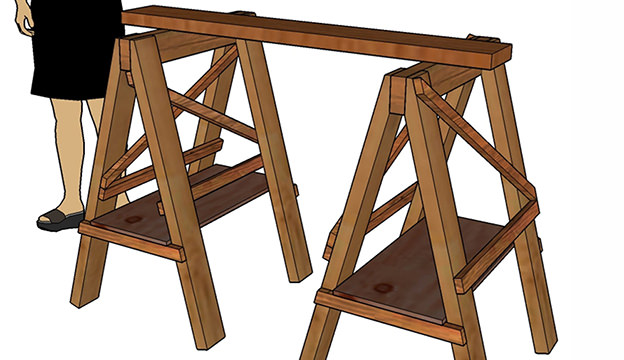
Every farm needs a good pair of sawhorses. These multi-purpose platforms are for more than construction projects. With a sheet of plywood across the top, they become the support for a table when extra company arrives. In the shop, they might be a work bench. You can drape a blanket over them, and youngsters have an instant tent or cave, and they can even be used to support boards you’re cutting. I recently saw some for sale at a major lumber retailer at a very reasonable price—only six times as much as you would pay for the materials to build a better one from scratch.

When selecting the wood for your sawhorse, think about how you will use it. If it will be outdoors in the elements, you may wish to use treated lumber or a durable wood, such as cedar, if it’s available. Also, the wood should have straight grain and be free of defects. Hopefully, you have enough scrap lumber to build your sawhorses, but if not, this design makes good use of common lumber sizes.

Use this how-to as a baseline for building a sawhorse that best suits your needs. If you are taller or shorter, for example, by all means, adjust the height of the legs. You can also put hinges on the legs on one side and a chain or pivot on the end cross pieces to allow the sawhorses to fold up to save room. If you have plywood scraps laying around, use them to make the braces.

The main frame is made of 2×4 lumber, and the cross bracing is a 1×4 ripped in half lengthwise.

Materials:

  • 2 8-foot 2x4s
  • 2 8-foot 1x4s (You can substitute 1/2-inch or thicker plywood strips for bracing, if you prefer.)
  • 4 3/8-by-3-inch carriage bolts with washers & nuts
  • 20 2½-inch deck screws

Tools:

  • tape measure
  • speed square
  • skill saw (or hand saw)
  • table saw (if possible)
  • power drill
  • 3/8-inch drill bit
  • 3/4-inch spade drill bit
  • Phillips driver bit

Step 1

How to Build a Sawhorse

Cut your 2×4 into the following pieces: a 24-inch length for the top rail and four 36-inch lengths for the legs. Put a 15-degree bevel on one end of each leg. You can either measure 15degrees or use the measurements in the drawing.

Step 2

How to Build a Sawhorse

Attach the legs to the top rail, squaring them at the ends. For the strongest joint, use 3/8-inch carriage bolts. You could substitute long deck screws, but don’t use nails, as they will work loose.

Step 3

Rip the 1×4 boards lengthwise to make two 1?-inch strips. Precise width is not critical.

Step 4

How to Build a Sawhorse

Screw a 15-inch strip of wood 12 inches up on each end of the sawhorse. Use two deck screws at each attachment point.

Step 5

How to Build a Sawhorse

Screw a 24-inch strip of wood 16 inches up on each side of the sawhorse. Use two deck screws at each attachment point.

Step 6

How to Build a Sawhorse

The diagonal strips will be about 30 inches long. It will be easiest to cut them square, then trim them flush with the legs. Use two deck screws at each attachment point.

Step 7 (optional)

How to Build a Sawhorse

Lay a sheet of plywood across the bottom end supports to make a shelf to hold tools and materials.

How to Build a Sawhorse

Your sawhorses are now ready to use, whether for a construction project or table support at a local farmer’s market. When you aren’t using them, stack them neatly to take up less space.

Find more DIY projects on HobbyFarms.com:

About the Author: Dave Boyt has a degree in forest management from the University of Missouri. He is managing editor for Sawmill & Woodlot Management magazine and manages a family tree farm in southwestern Missouri.


Categories
News

8 Sustainable-Farming Groups That Need Your Help

8 Sustainable Farming Groups That Need Your Help - Photo by Chiot's Run/Flickr (HobbyFarms.com)

Writing about sustainable agriculture and food can be a depressing job. I regularly have to research legal hurdles farmers face, multi-million-dollar GMO labeling fights, new diseases wiping out livestock herds and other difficult subjects. But there’s a silver lining: For just about every one of these topics, there’s an organization working toward a positive outcome for the sustainably minded among us. Additionally, agricultural groups publish educational materials and host events so we can continue to improve our farms. For all of these organizations, I’m supremely thankful.

Having just attended the Southern Sustainable Agriculture Working Group conference and met leaders from several of these groups, I’d like to introduce you to eight you might like to get to know better.

1. Farm and Ranch Freedom Alliance

When there’s a farm versus public/government controversy, FARFA is probably involved. This organization works nationally to support independent farmers and a productive food system, focusing on policy development for local, diversified agricultural systems. Some of the issues FARFA gets involved with include raw milk legislation, the Farm Bill, animal identification systems and right-to-farm laws.

2. Food and Water Watch

Good food, clean water and the protection of natural resources for everyone are FAWW’s concerns. These large topics encompass sustainable energy production, industrial farming practices, food safety, water-system privatization and more. Only around since 2005, FAWW directs grassroots advocacy, produces films for consumers, and compiles guides and fact sheets for each of the issues it works with.

3. National Center for Appropriate Technology

When I first looked for a sustainable-farming apprenticeship, I turned to the NCAT apprenticeship listings. The options outlined were overwhelming—and it isn’t even their main focus. NCAT hosts the National Sustainable Agriculture Information Service—called ATTRA, confusingly enough—which offers educational guides for pretty much any sustainable-farming subject you can imagine. There are fact sheets, webinars, farmer profiles, disaster-assistance links, marketing tutorials, organic seed and feed supplier lists, and way more. Some of the publications are available for a fee (most are free), but if you don’t have the means to purchase these guides, the organization will try to work with you to make them available.

4. National Sustainable Agriculture Coalition

If you read one of my blog entries and it has something to do with federal farm policy (like the Farm Bill or the Food Safety Modernization Act), it probably also has something to do with the National Sustainable Agriculture Coalition. This organization works with grassroots groups, develops public-education campaigns and makes itself known in government offices in Washington to create a better outlook for sustainable agriculture in this country. While sustainable farmers don’t have the lobbying power that the industrial-farming complex has, we do have organizations like NSAC getting to know our legislators and guiding individuals like you to become involved in the system. I did a fun video with NSAC and the Rural Advancement Foundation International (explained below) about contacting your legislators—look for it in an upcoming News Hog blog entry!

5. National Young Farmers Coalition

Don’t let this name fool you—the National Young Farmers Coalition is for farmers of all ages who are just starting out. (I’m a member!) It’s also for anyone who wants to help support these farmers in this crazy-difficult endeavor. Land access, a student-loan-forgiveness campaign, training and farm-credit resources, and other great things are all happening here.

6. Rural Advancement Foundation International

I go to a lot of conferences, and I hear a lot of speakers, but the speakers from RAFI are always among my favorite. Because I’m an ag-issues blogger (see complaints at top of post), I have to go to conference sessions that I’d rather not go to. I want to hear about organic goat dairies, not Farm Bill funding allocation. Alas, to the Farm Bill sessions I go, and I’m relieved when RAFI speakers are there.

This group works on creating policies and programs to benefit the small-scale, sustainable farmer and sustainable food systems—particularly for North Carolina and the Southeast, but also nationally and internationally. RAFI works directly with farmers as well as with policy makers and is called upon to help shape legislation and agricultural-program reform.

7. Southern Sustainable Agriculture Research and Education

As the name implies, Southern Sustainable Agriculture Research and Education is an organization dedicated to sustainable-ag research and education. They offer grants for on-farm research projects; educational programs based on the results of these grants; and books, bulletins and fact sheets that get down deep into the roots of sustainable farming. No worries if you’re not in the South! Every region has a Sustainable Agriculture Research and Education group.

8. Southern Sustainable Agriculture Working Group 

SSAWG—the host of the most recent conference I attended—works with farmers, consumers and communities for an ecologically sound, economically viable, socially just and humane food and farming system. The annual conference is one event that does just that, plus the organization works in cooperation with other groups to offer training programs, virtual farm tours and ag-policy alerts for everyone’s benefit. There’s also a Northeast Sustainable Agriculture Working Group and a Western Sustainable Agriculture Working Group.

One organization not mentioned here is the cooperative extension. There were several state extensions represented at the SSAWG conference, but I’m guessing you already know all about yours.

I hope you’ll get involved as a member or supporter of some of these groups! The food- and farm-policy work they do is stuff we can’t accomplish as individual farmers, and the education and training they offer can change your farming life.

« More The News Hog »

Categories
Beginning Farmers

Should I Be a Farm Apprentice?

Should I Be a Farm Apprentice? - Photo by Suzie's Farm/Flickr (HobbyFarms.com)

While apprenticing on a farm is the post-graduate’s new answer to joining the Peace Corps, there’s often tension between the dream of living off the land and the harsh realities of farm life. Long working hours, manual labor and little (or no) pay all come as part of the apprenticeship package, and not everyone is cut out for it.Before you jump into a farm apprenticeship for a growing season or longer, educate yourself on what to expect from farm life to help you to determine if apprenticing is the path for you. It may not be for everyone, but it can be a good fit for anyone who knows what they’re getting themselves into.

Why Farmers Take Apprentices

In order to understand an apprentice’s role on the farm, you need to understand why a farmer might take an apprentice in the first place. Apprentices are typically inexperienced in agriculture, so a lot of time is spent teaching the apprentices how to do a certain task. The farm owner must also endure the cost of room and board, gas, and any tools or equipment that might be mishandled and inadvertently destroyed. Honestly, a good intern year for most farmers is if they break even. So why do they start an apprenticeship program?

Most farmers will tell you that they like having the extra help, they enjoy teaching young people, and like the enthusiasm apprentices bring to the farm. It can be a challenge—especially when an apprentice crashes the farm truck or forgets to close a gate,releasing the animals—but it can also create long-lasting relationships. If you’re considering an apprenticeship, sometimes referred to as an internship, go into it knowing the farmer isn’t using you or making money on you. More than anything, they’re sharing what they know.

How a Farmer Might Expect You to Work

Farming is extremely rewarding, but it’s also extremely hard work. You’ll likely be asked to work just as hard as anyone else on the farm, even if you’re not being paid. As an apprentice, you should embrace this––for many farms, the education, experience and exercise you get is your payment. You’ll find that most farmers are sensitive to your needs and abilities, but they’ll also challenge you to work beyond what you might feel capable. Without that challenge, people new to farming may never realize how hard they can work.

What a Farmer Might Expect You to Know

The good news is if you’re considering an apprenticeship, most farms don’t require any previous farming experience: A good attitude and a willingness to work is plenty. Ask the farmer you plan to work for, however, if there are any books they might recommend reading before you arrive. Don’t feel like you have to be a soil expert to be an apprentice, but doing a little extra homework ahead of time can help you to slip into the job more smoothly. Two of my favorite books to recommend to budding farmers are Greenhorns (Storey Publishing, 2012) and Joel Salatin’s Fields of Farmers (Polyface, 2013), as they offer good perspective on what to expect in your apprenticeship and your first years of farming.

How You Can Prepare Yourself Physically

The first thing many farms will do when you arrive is condition you. Whether that’s moving hay bales or splitting firewood, you can expect the farmer’s going to try and get you in shape for the season. Be preemptive here and do some pushups every day before you arrive. Spend some time outdoors, even if it’s cold. Your body will have to learn how to adjust itself to the heat and cold of the farm—you might as well start practicing.

How You Can Prepare Yourself Financially

Nothing is more disappointing than having to quit a season early to go make money. Try to build up some savings before going to the farm, whether or not the farmer agrees to provide a stipend. The savings will prevent you from having to get a part-time job in town, spending time away from the farm and your education. Don’t stress too much, as you won’t likely be spending much during your internship—enough savings to pay your bills and a little extra for treats at market should be sufficient.

How to Live in the Middle of Nowhere

Although some farms are within a few miles of town, or within city limits, most are 30 minutes or more from a decent bar, coffee shop or bookstore. This can often be a harder transition than people may realize, especially if you are the only apprentice. It is not always economical or feasible to drive into town every day, so consider weaning yourself off of your basic vices and “creature habits” before you get to the farm. Take it as an opportunity to teach yourself to cook a few more dishes, as you’ll likely wind up doing more cooking on the farm than you did before.

Why to Keep an Open Mind

Not everything the farmer does is going to be perfect. You may disagree with an idea here and there, but you should always know that the farmer is doing the best they can with what they have. Their years of experience may have taught them something you may not realize yet, so if you find yourself wondering why they may do a certain thing—such as using Bacillus thuringiensis sp. (Bt) on brassicas or giving a certain animal an antibiotic—don’t judge them, ask them why. If you go to the farm without strong opinions of what constitutes good farming, you’ll come back with a much richer education.

Read more about beginning farming on HobbyFarms.com: